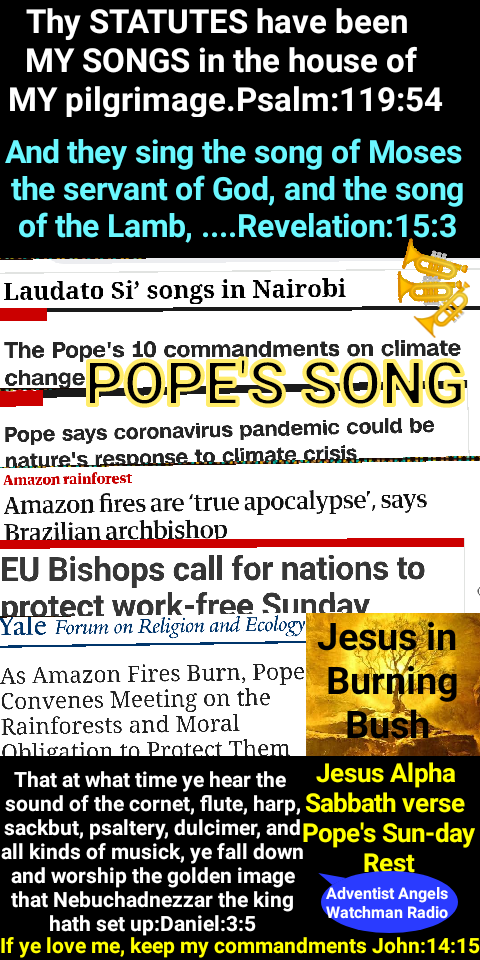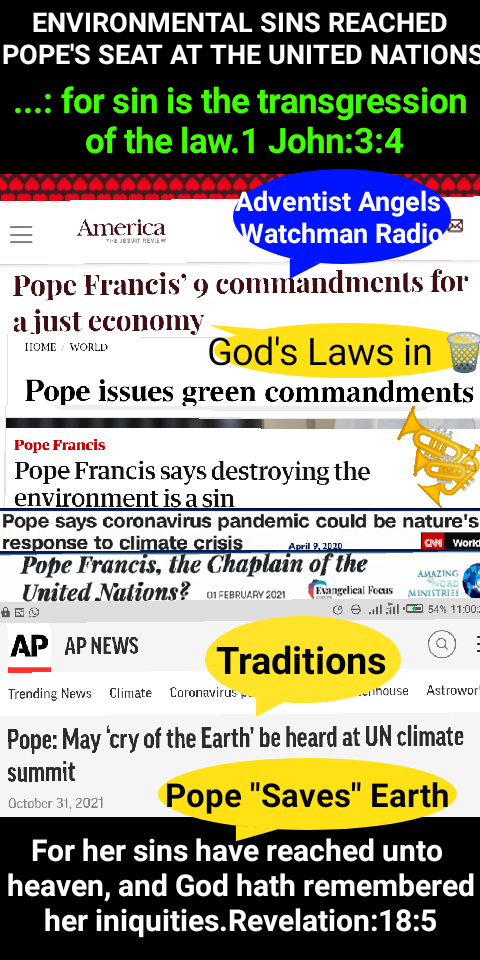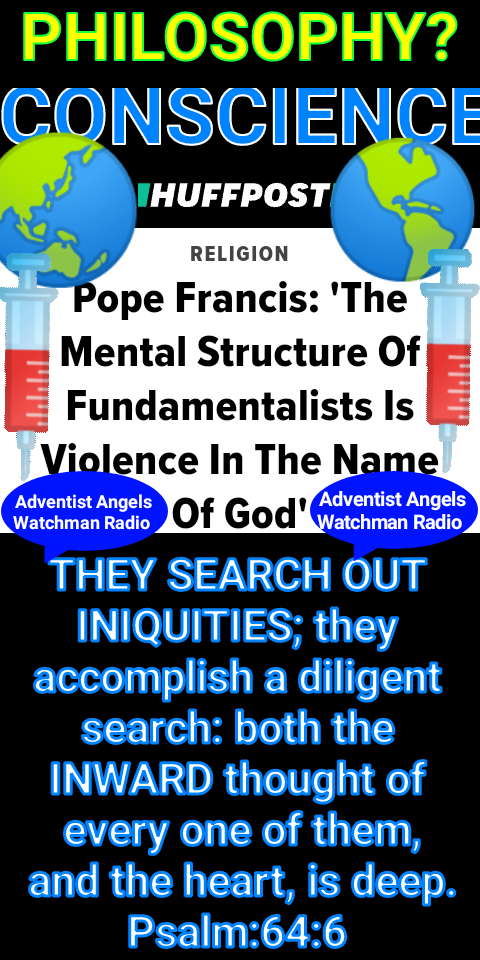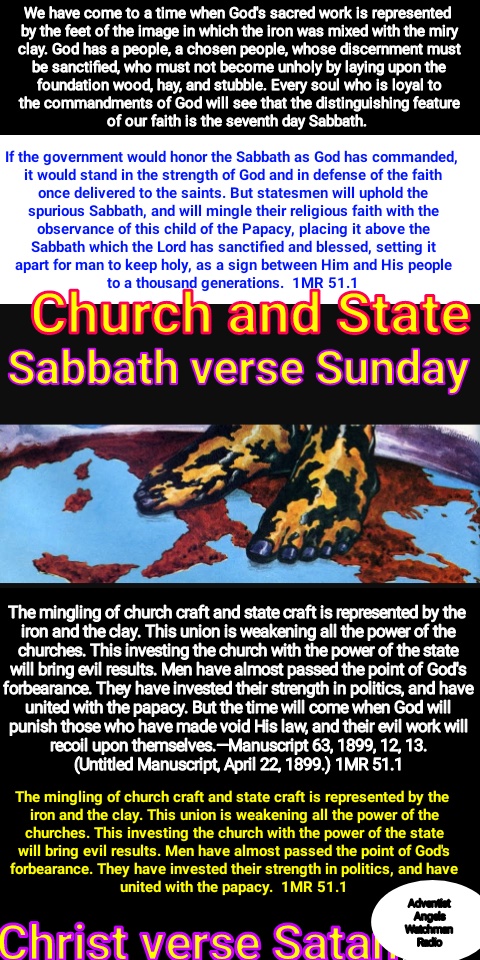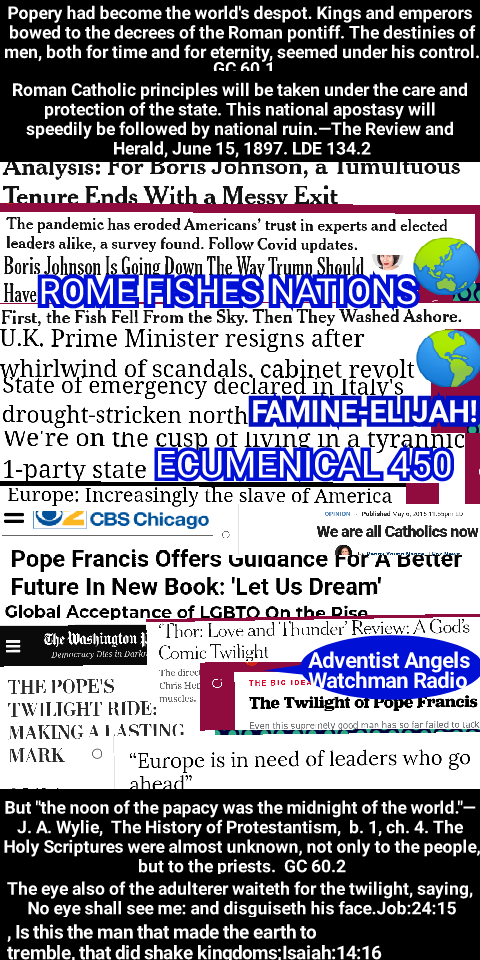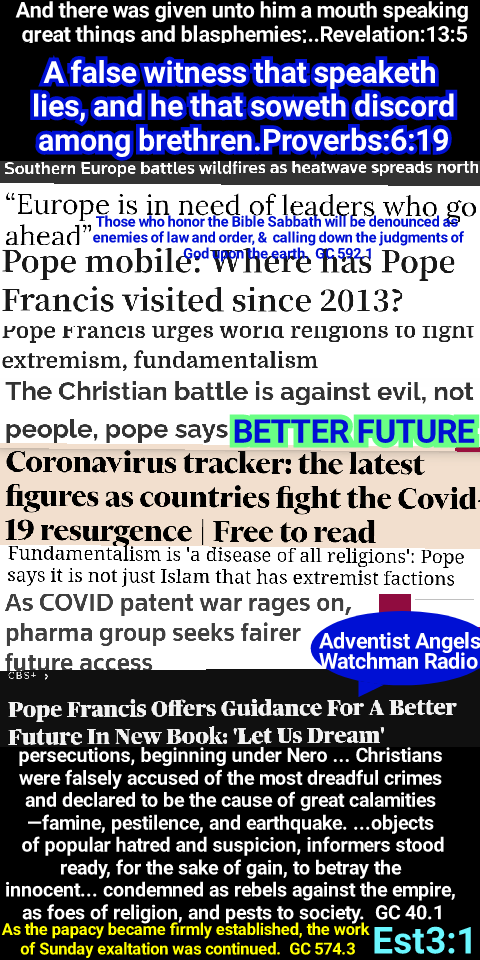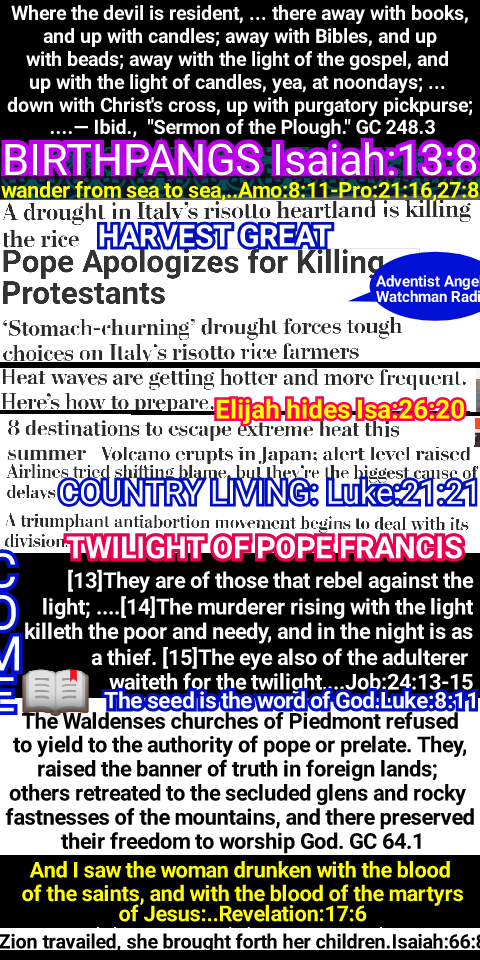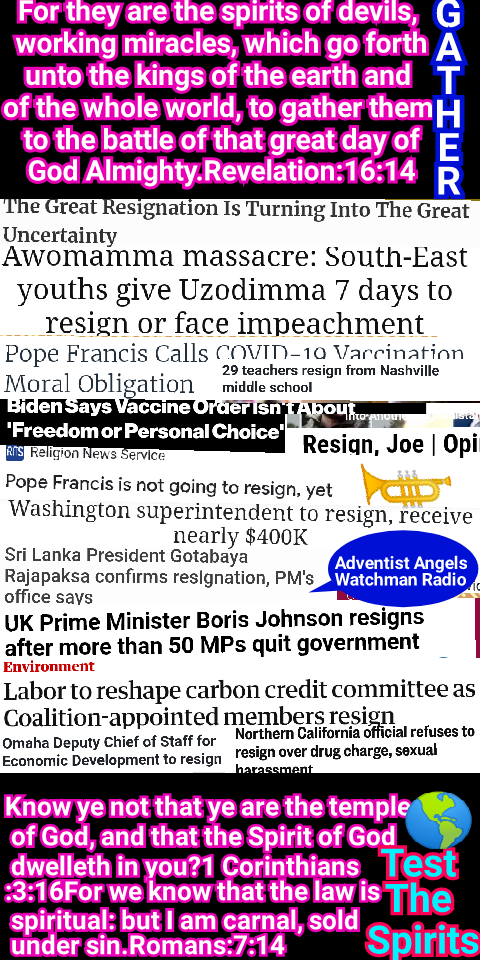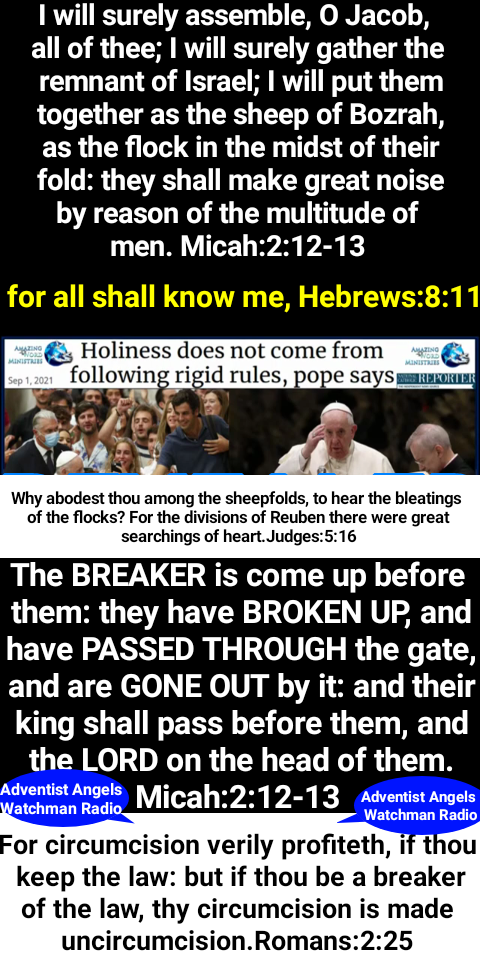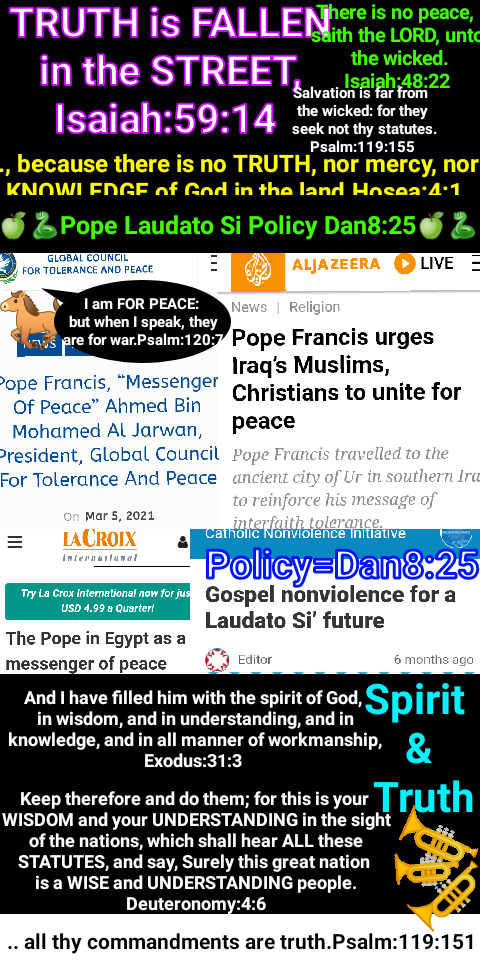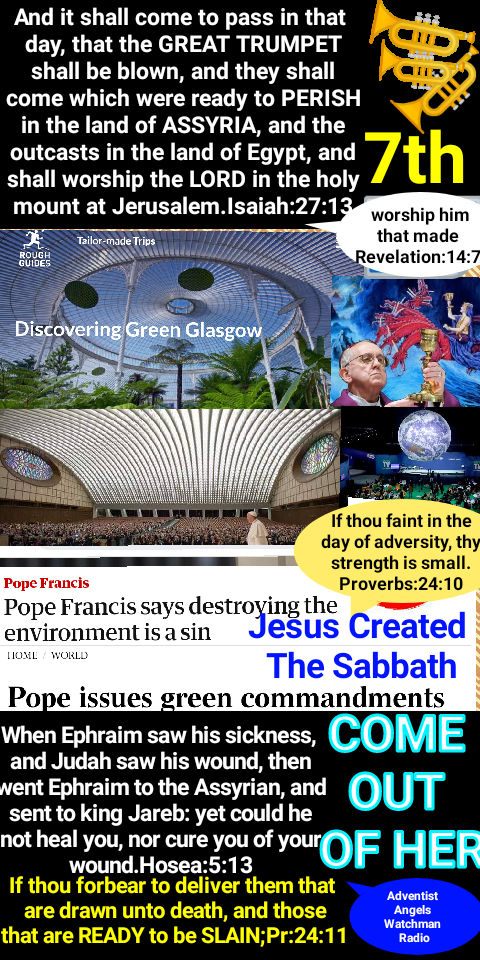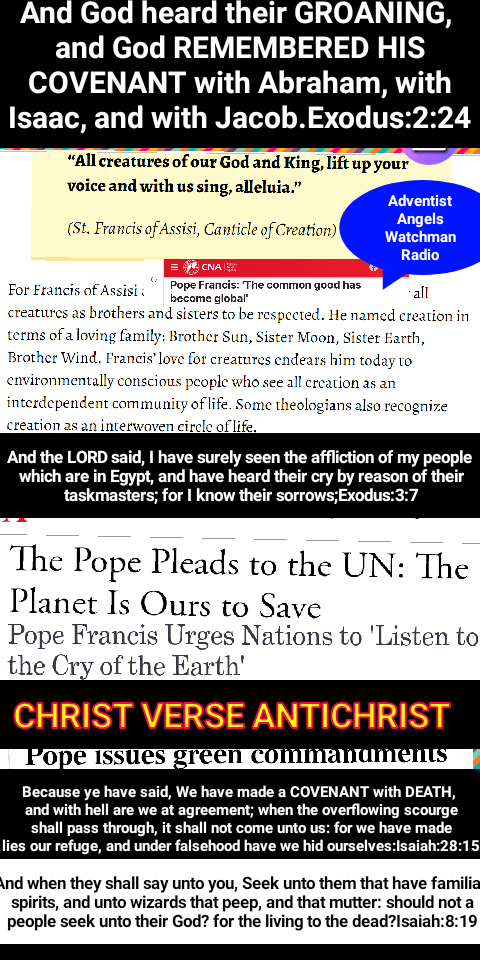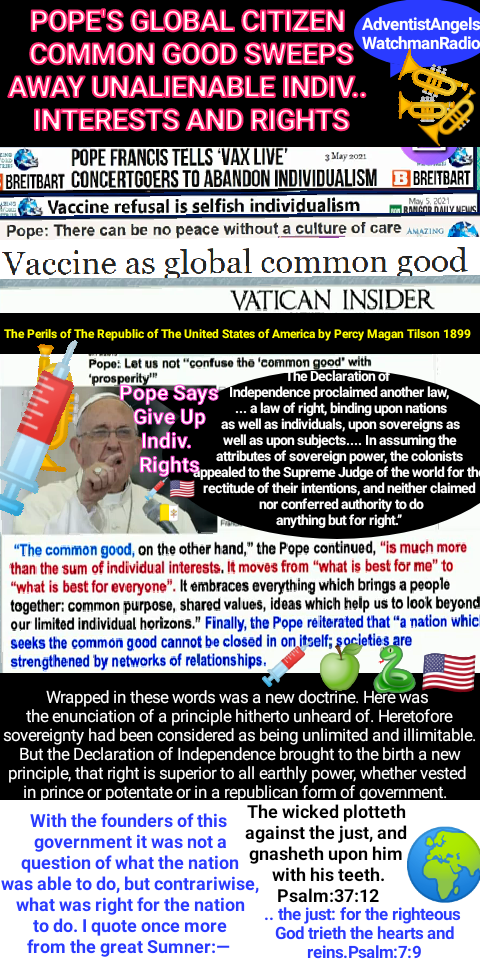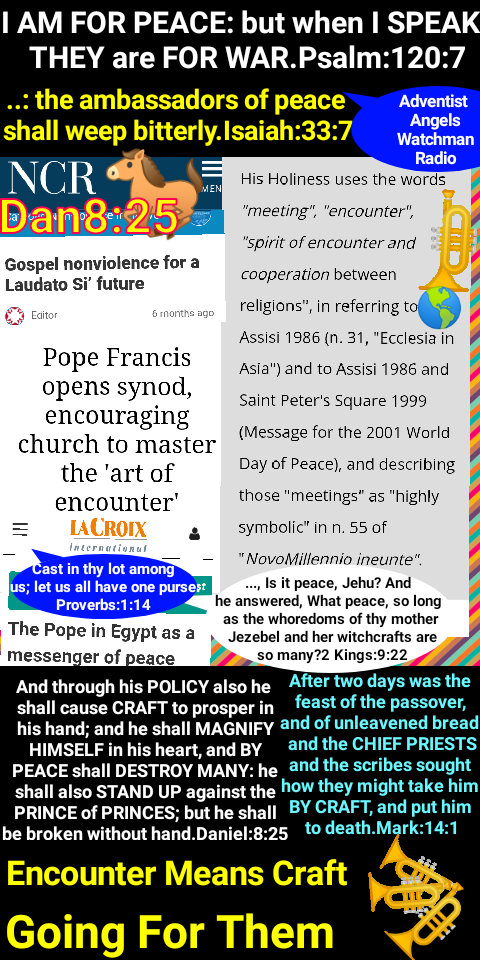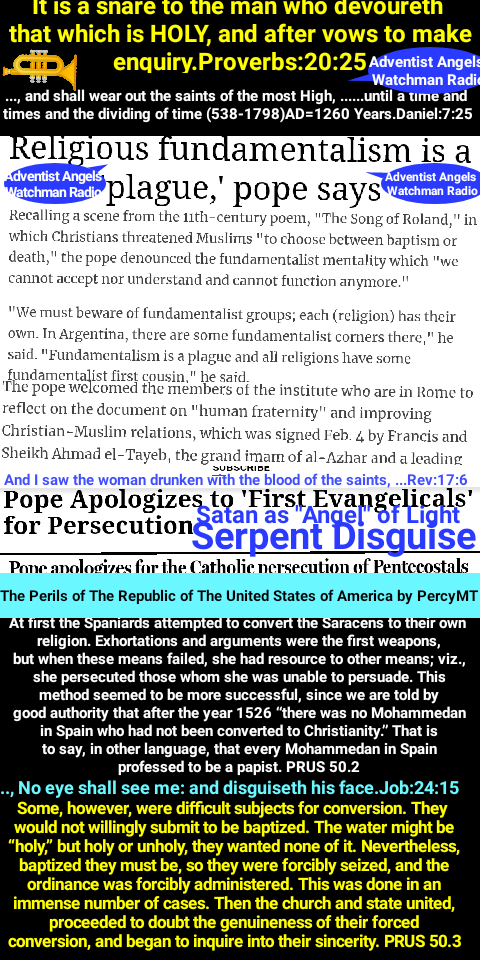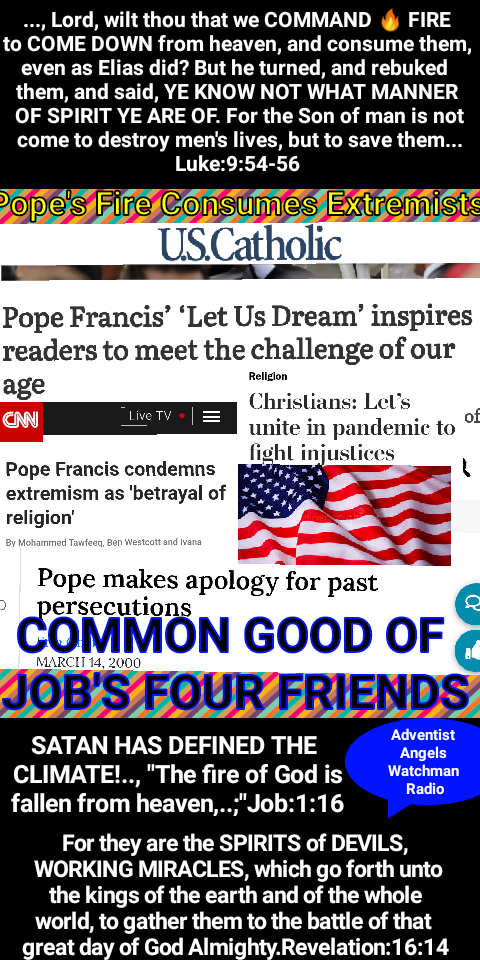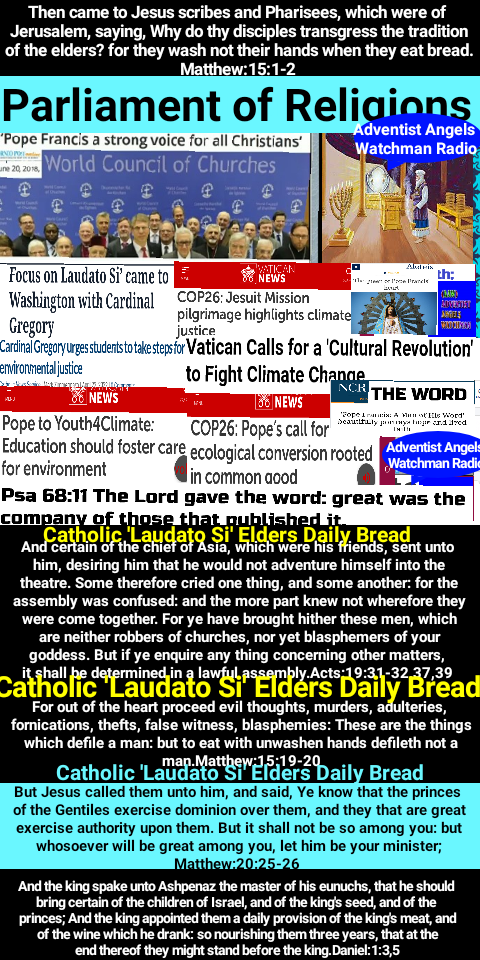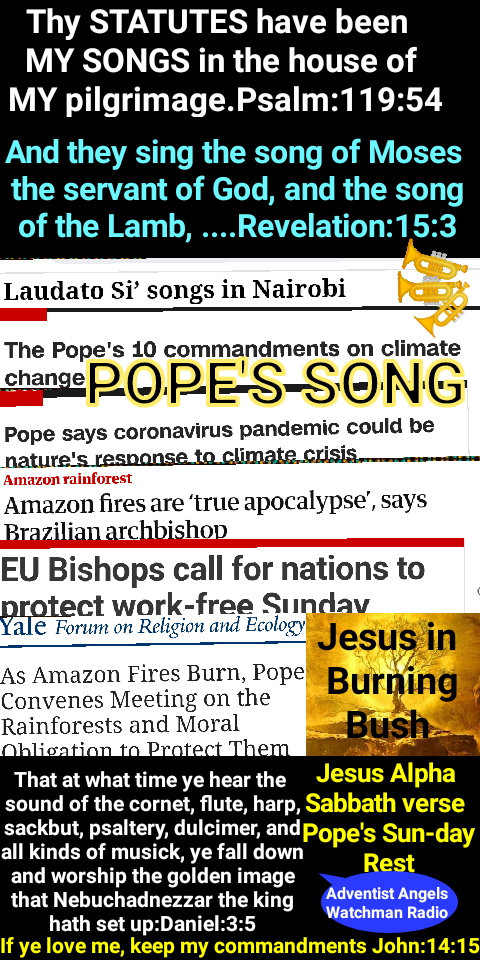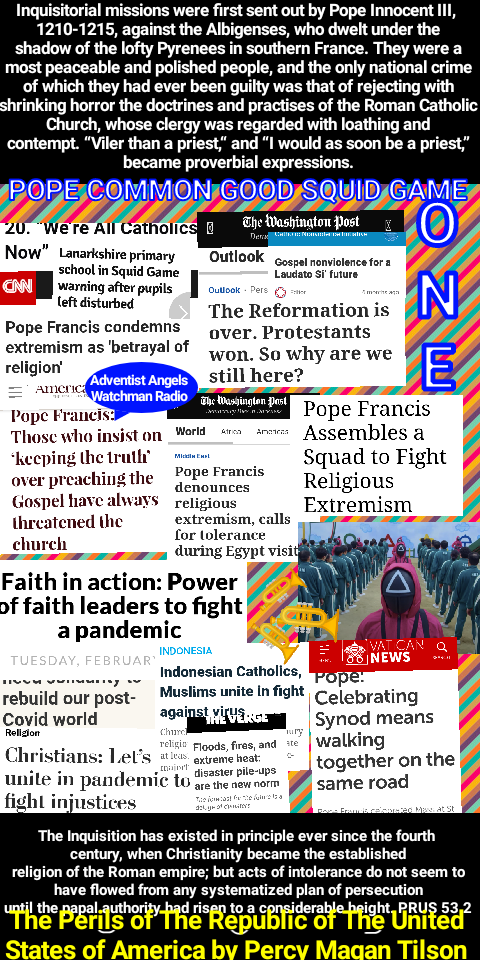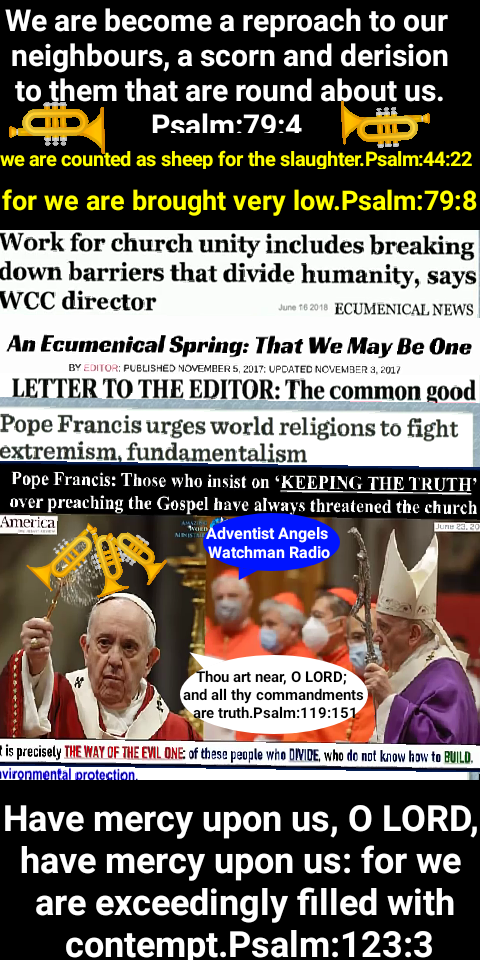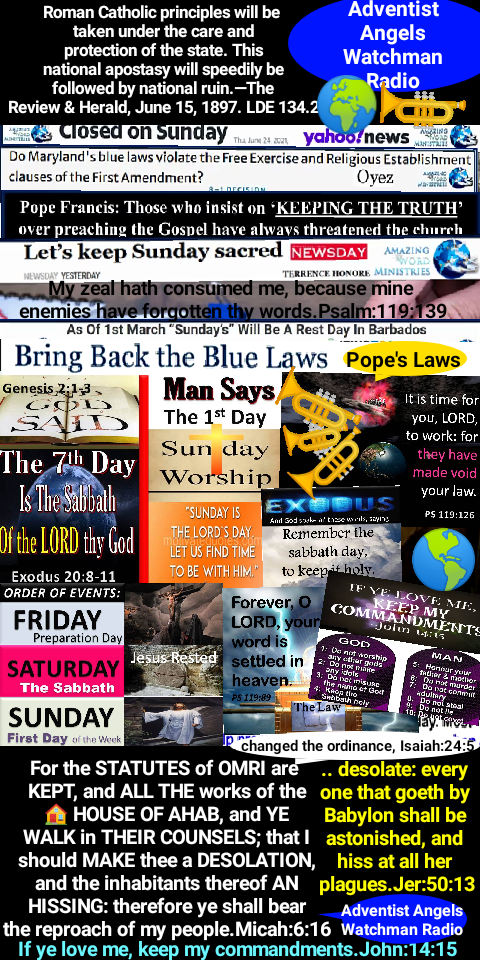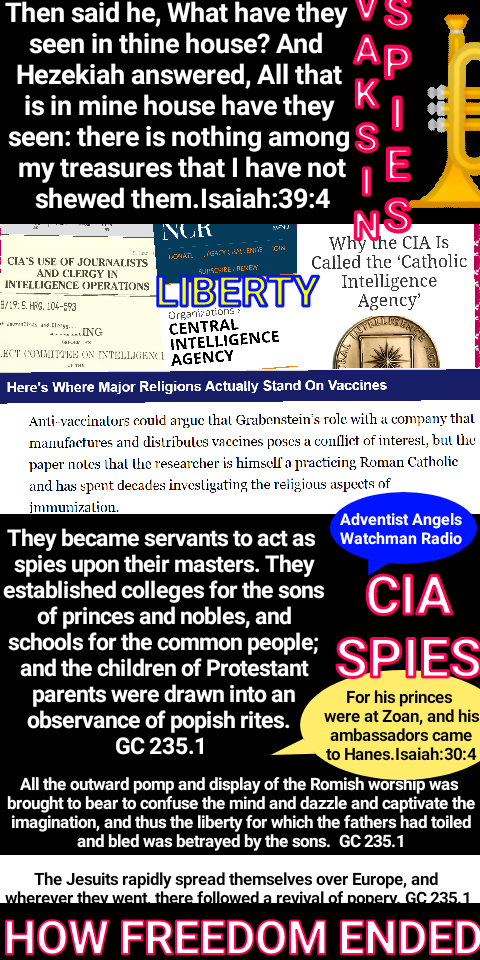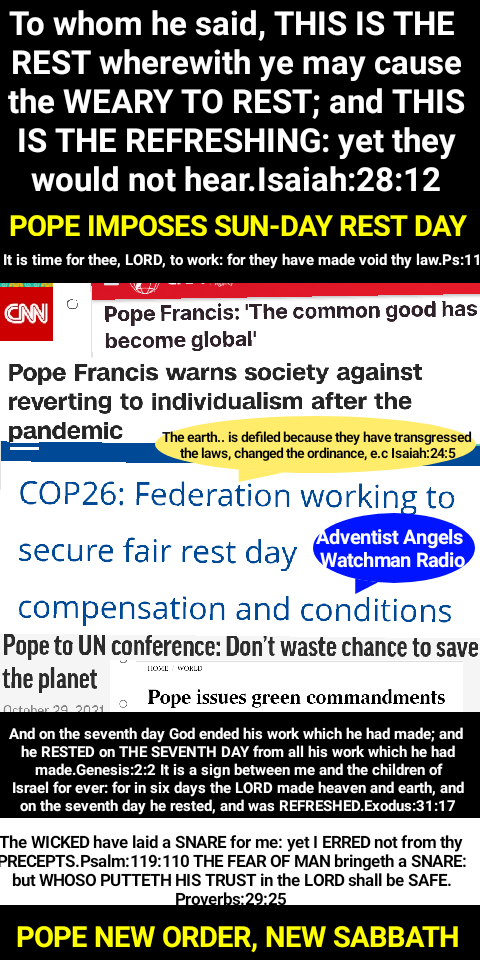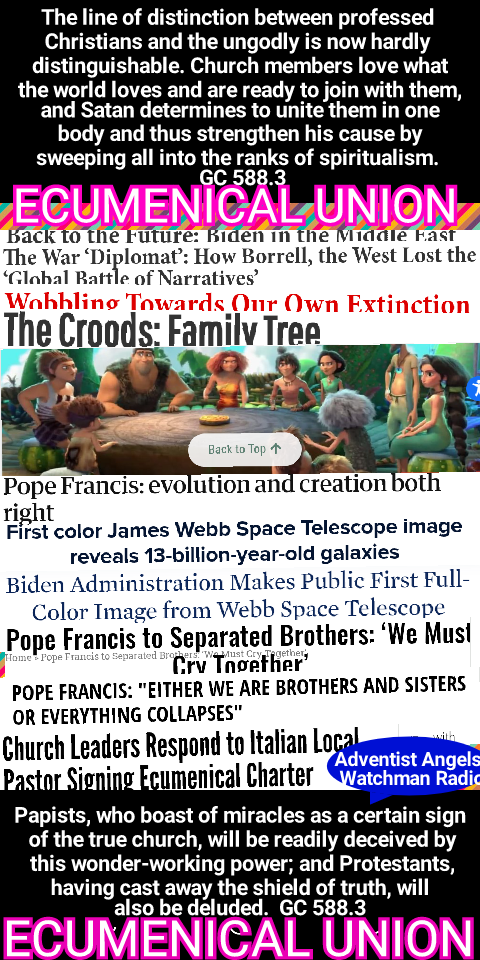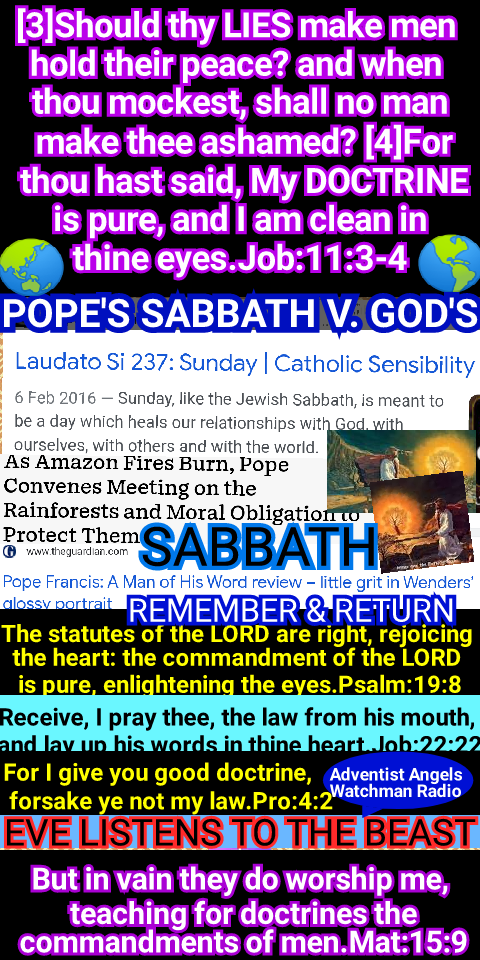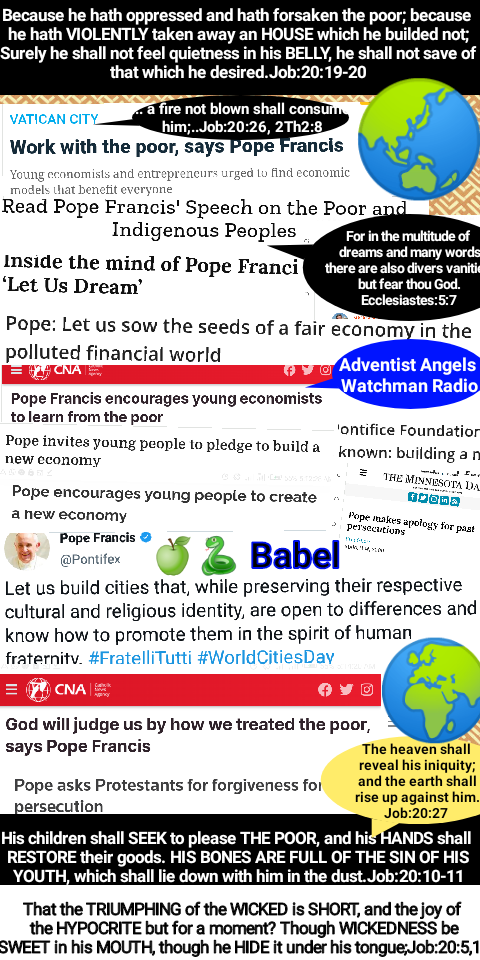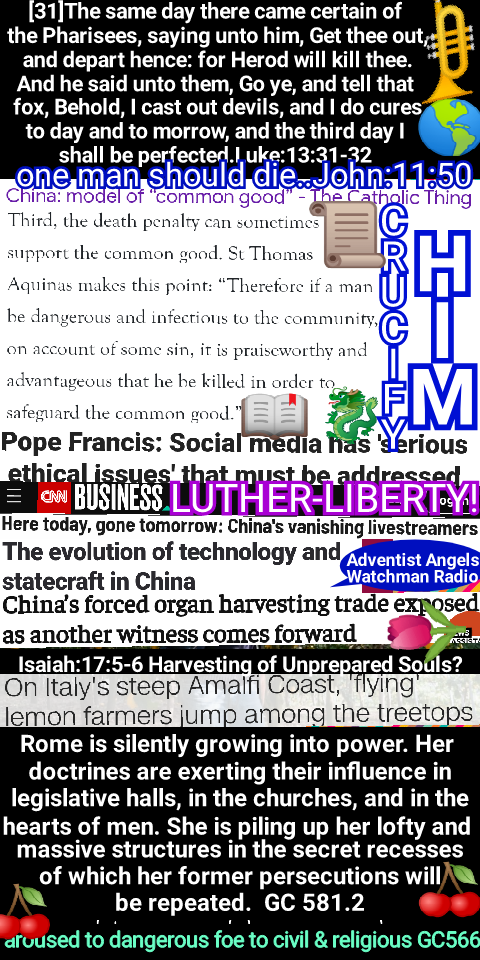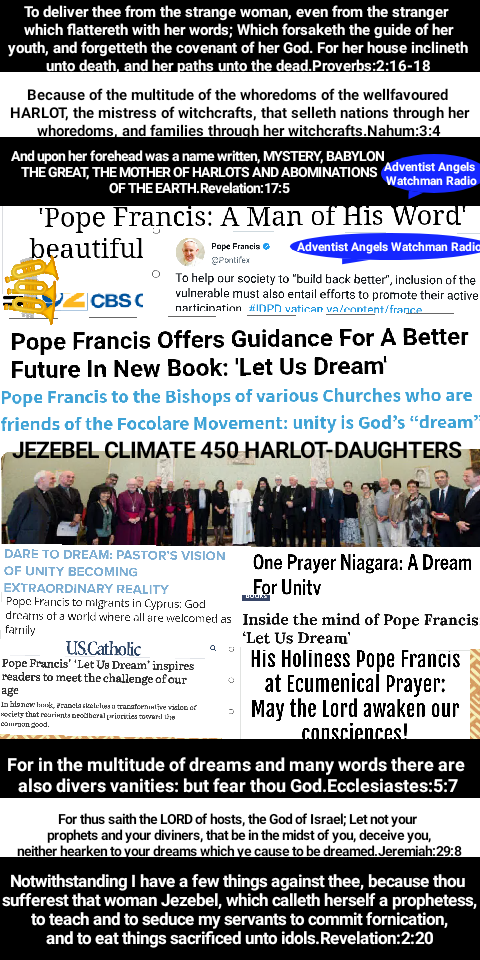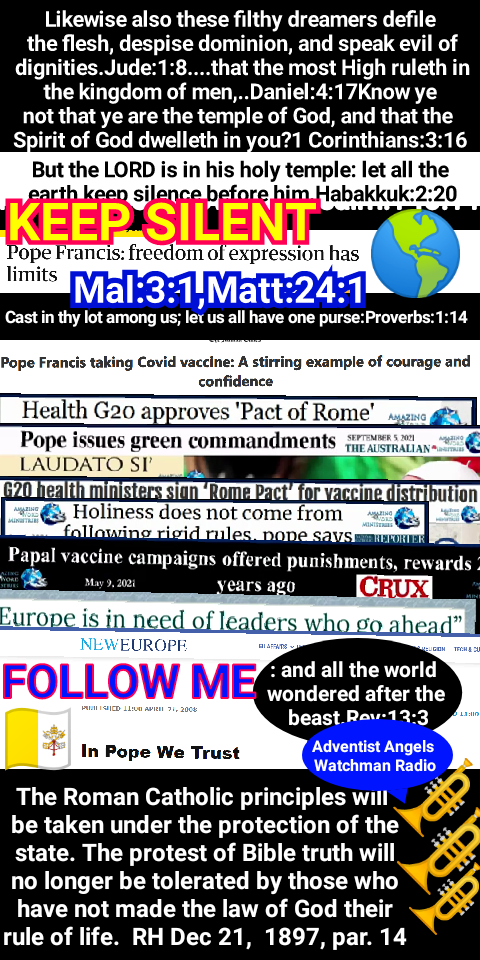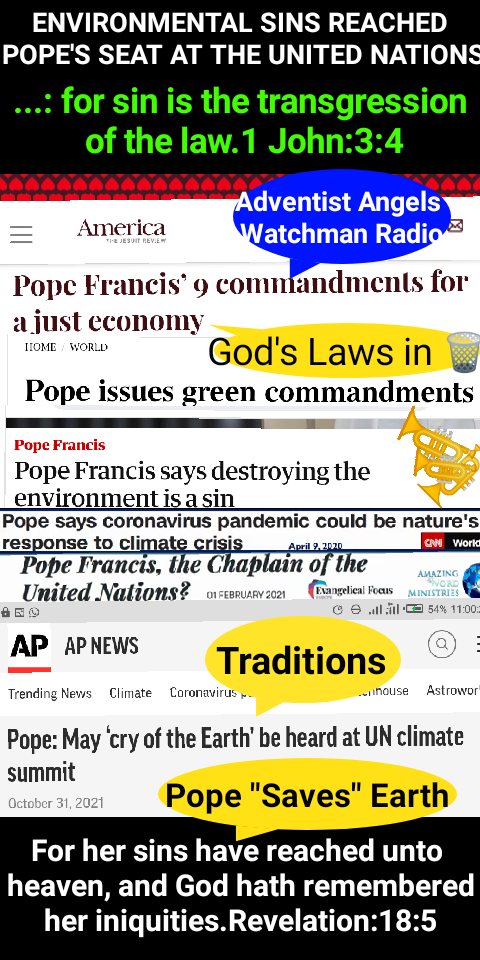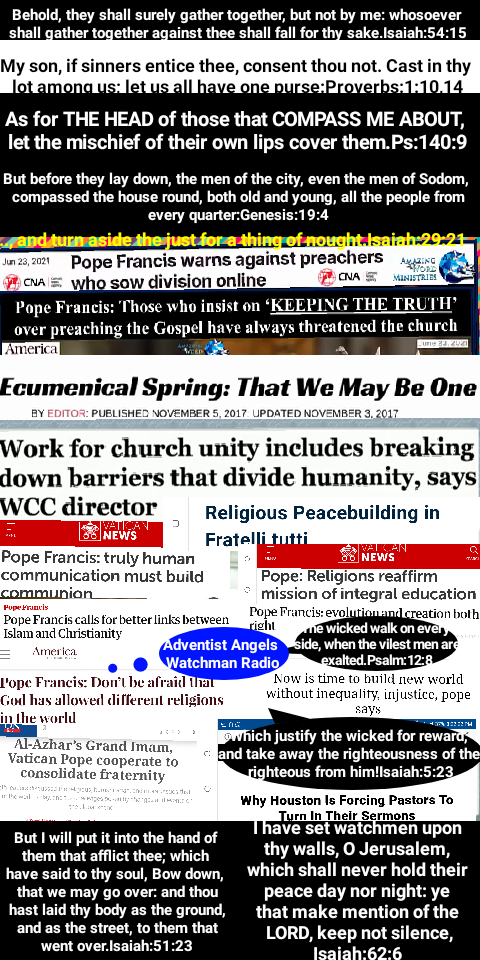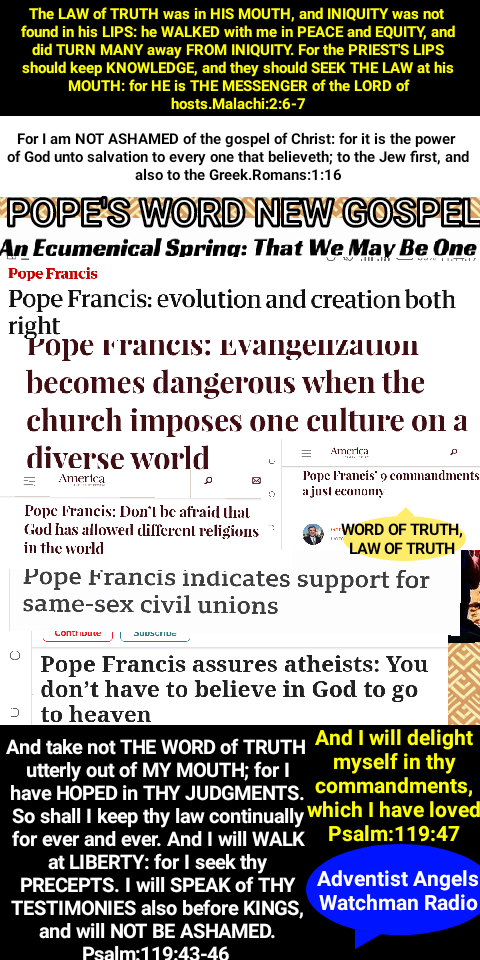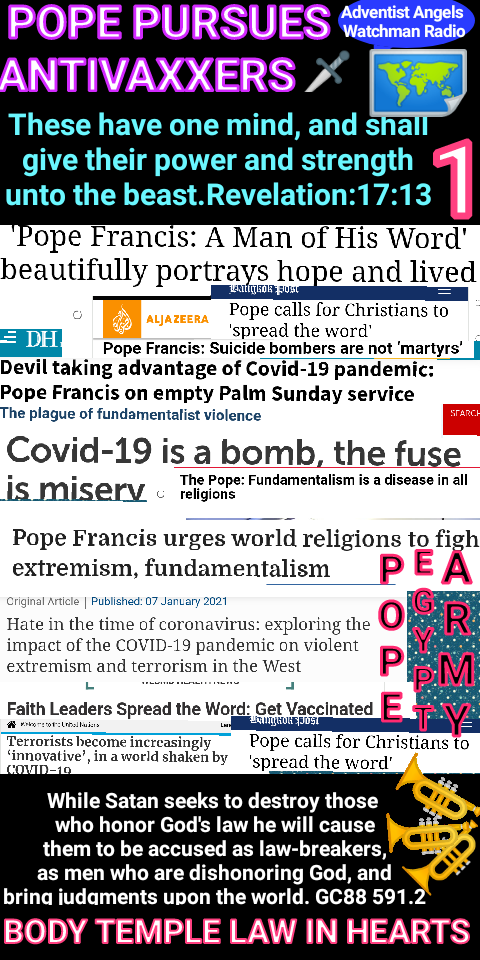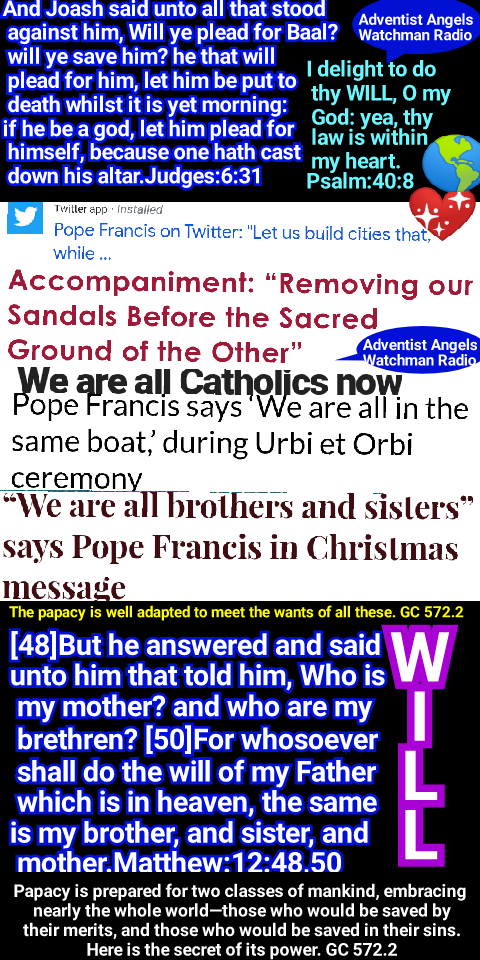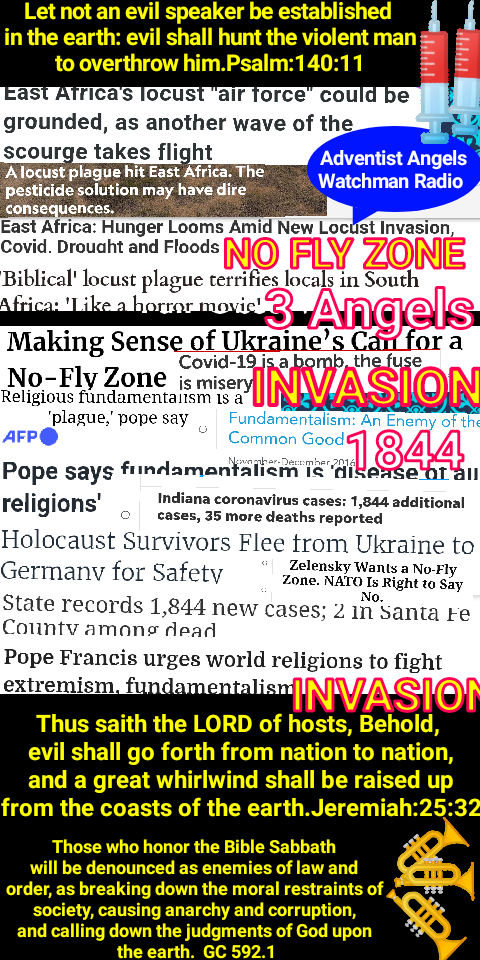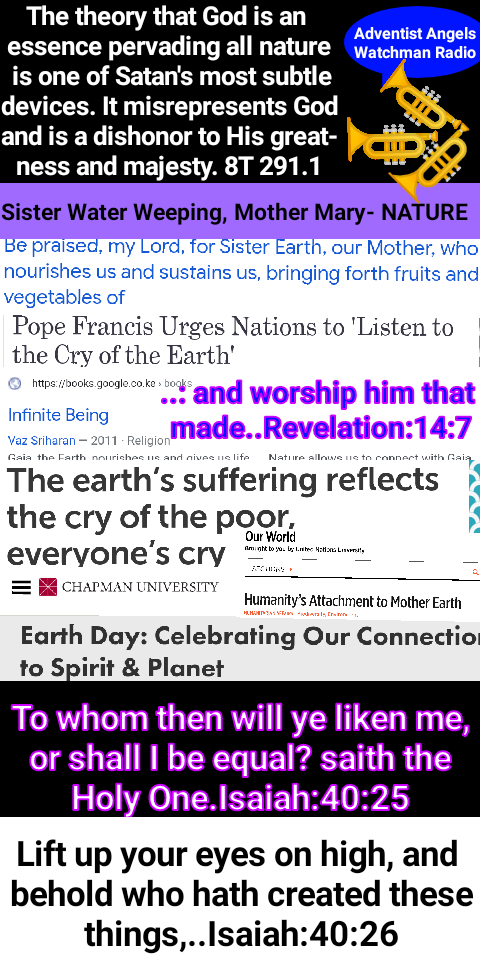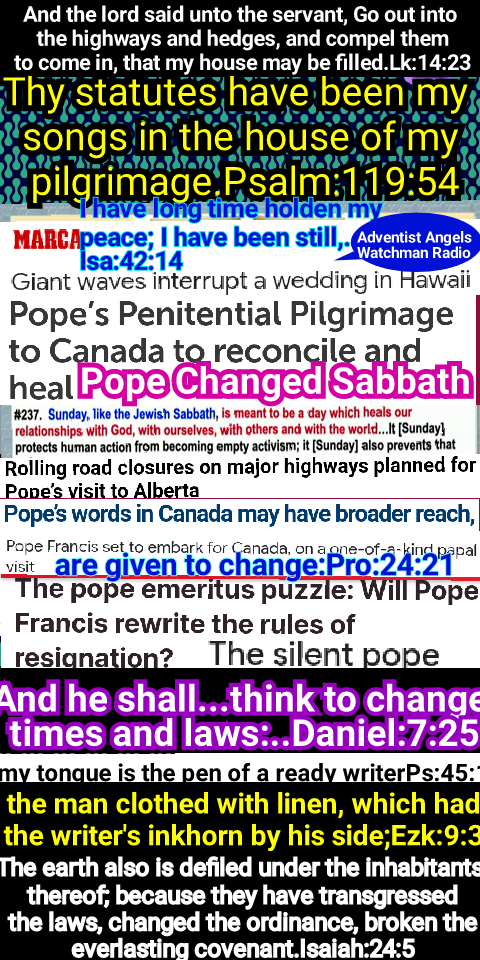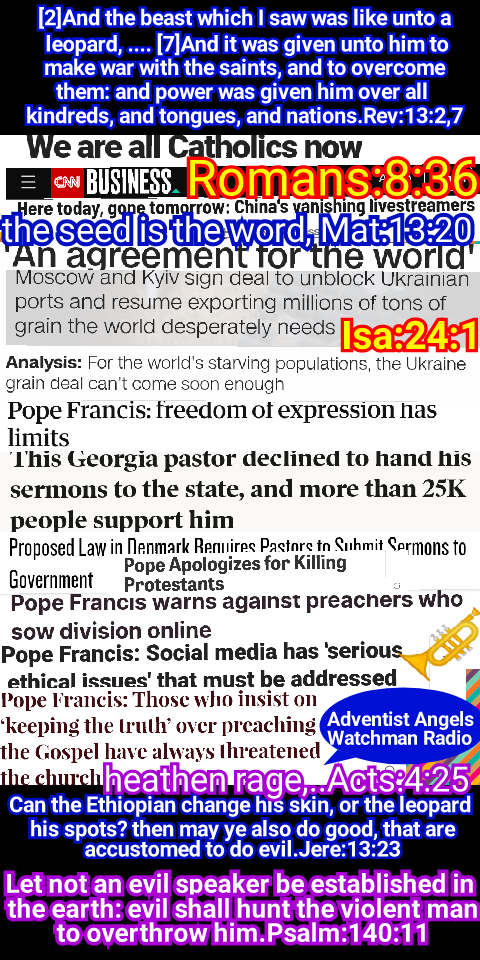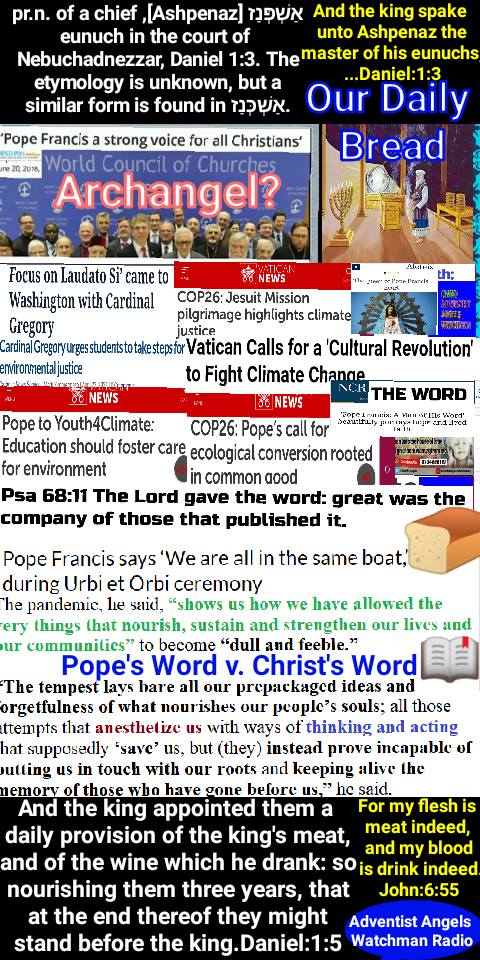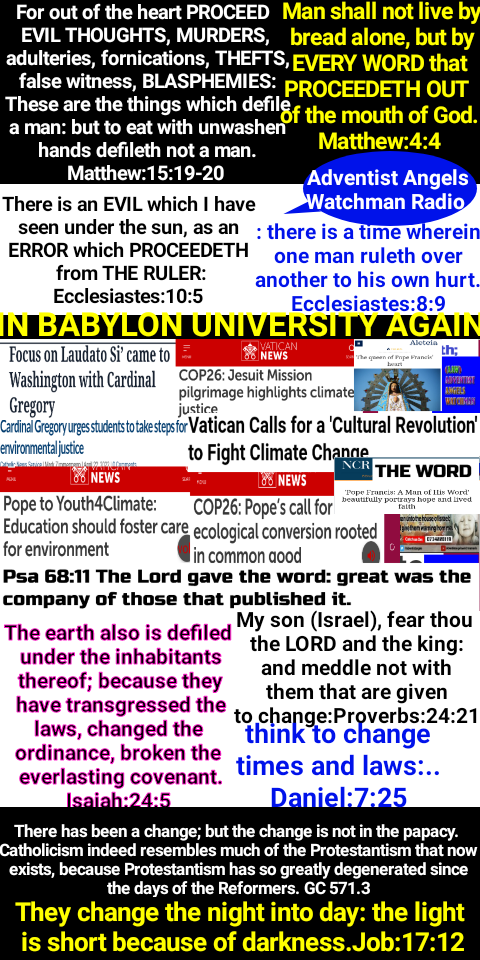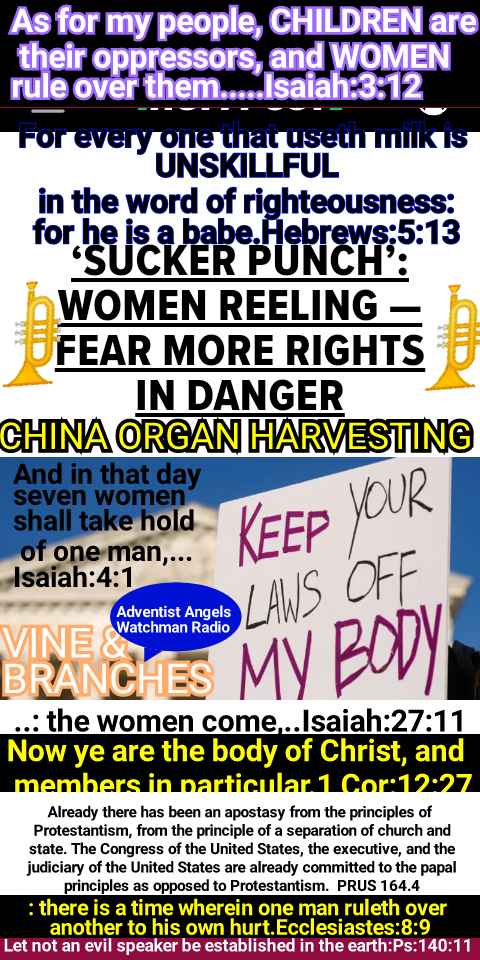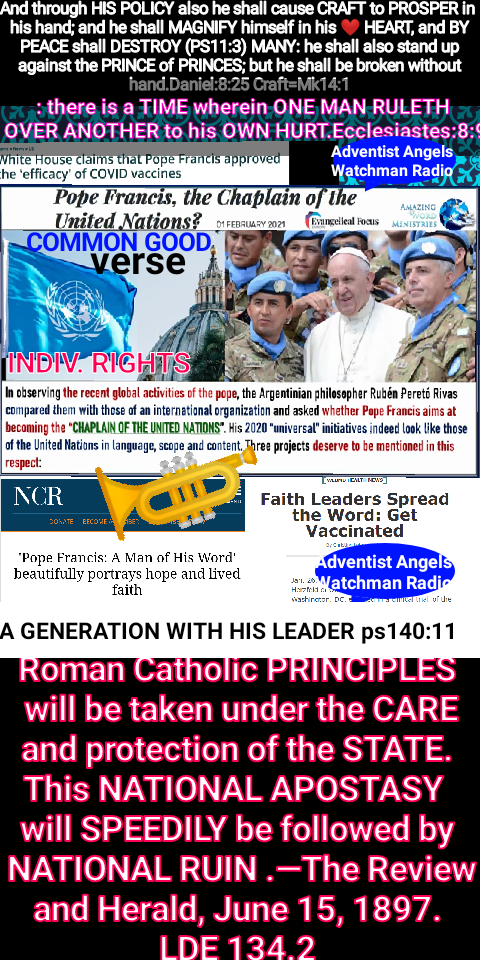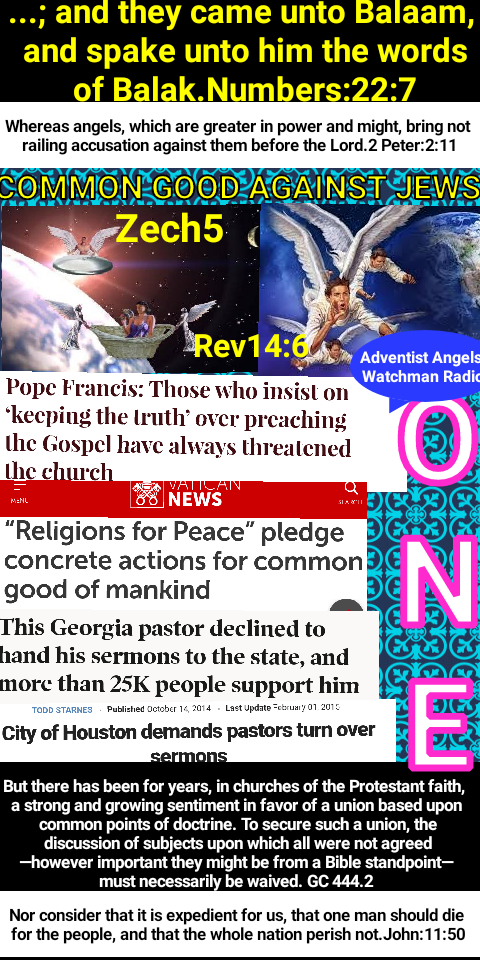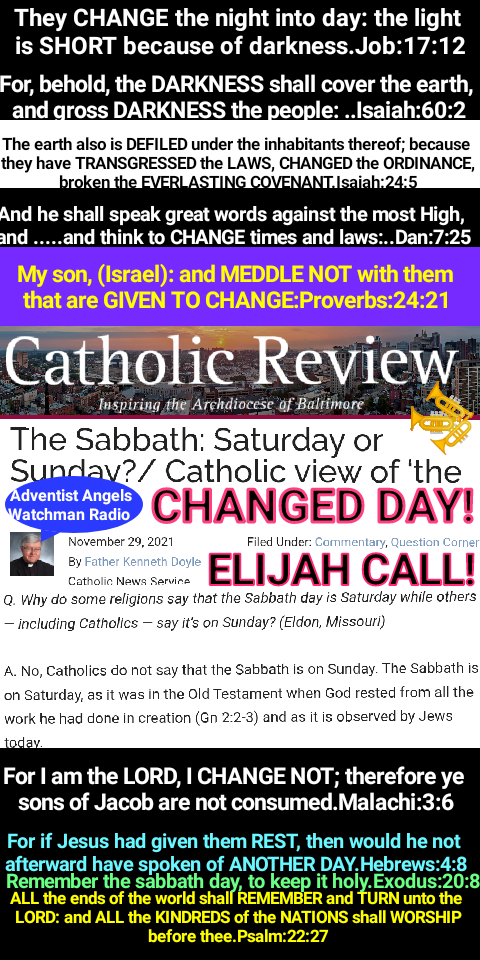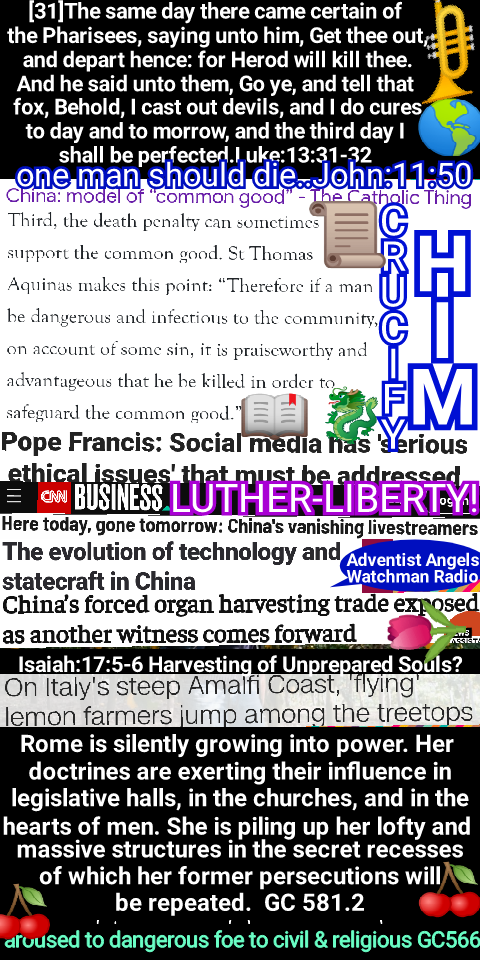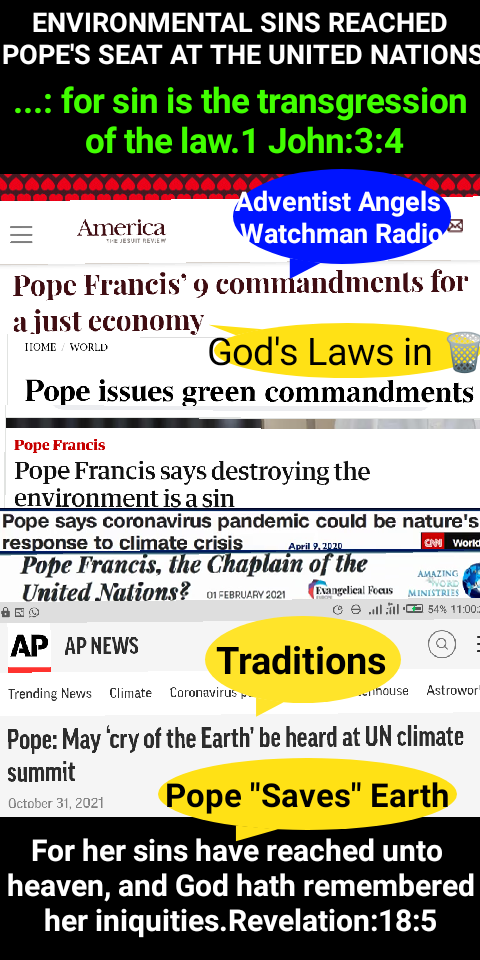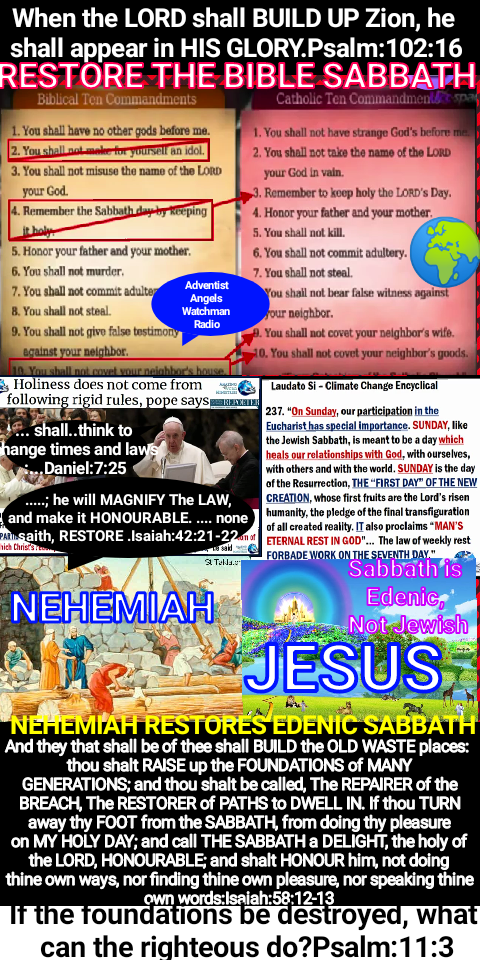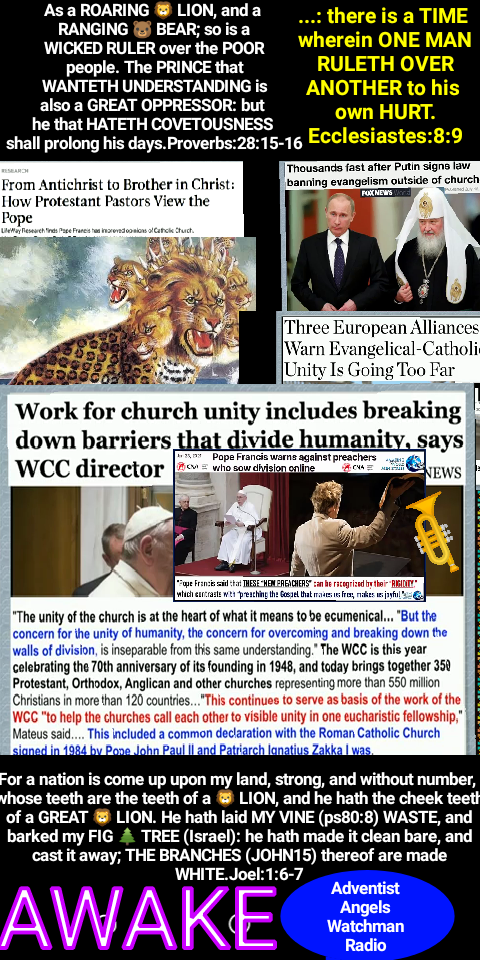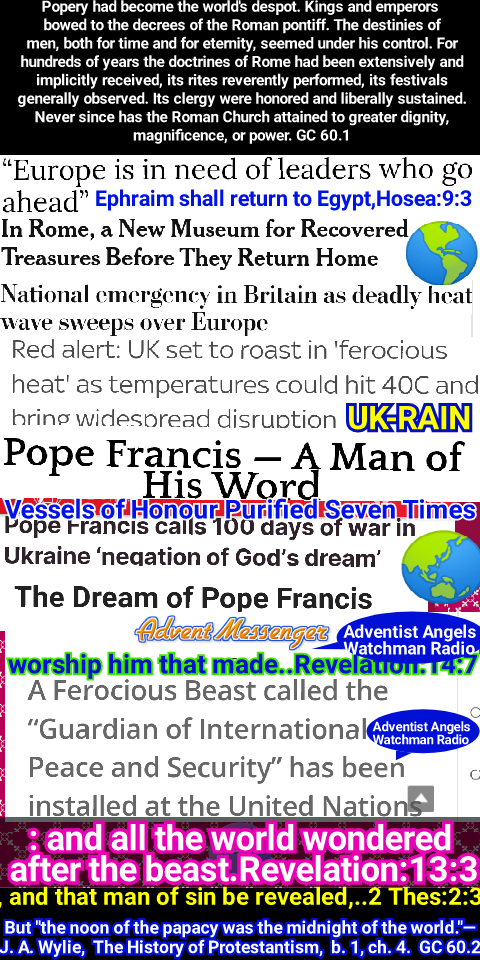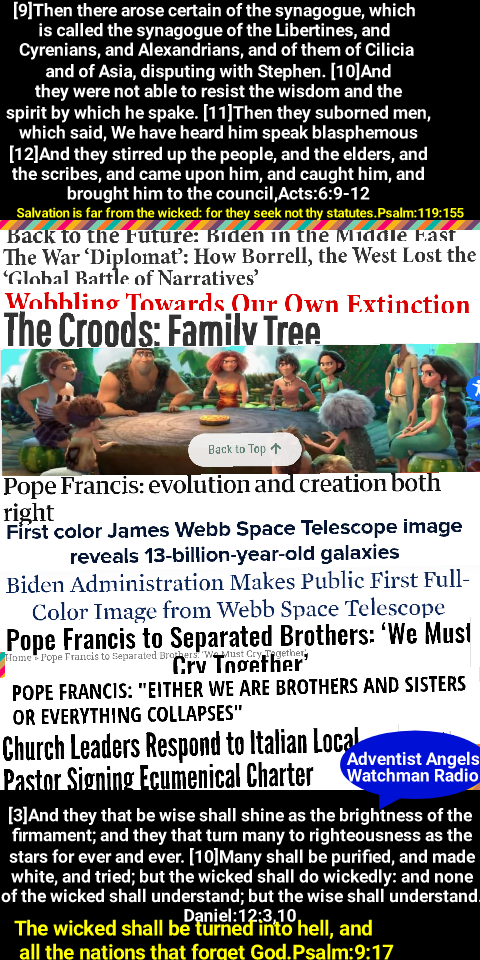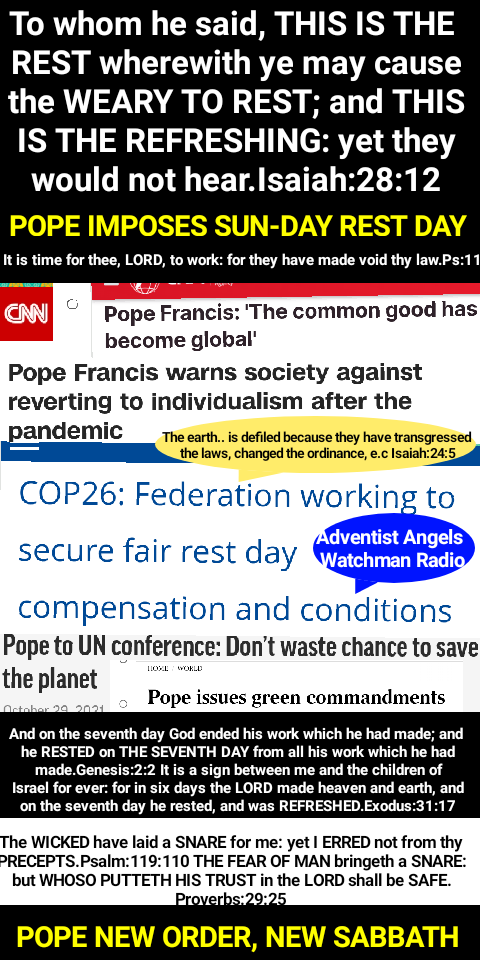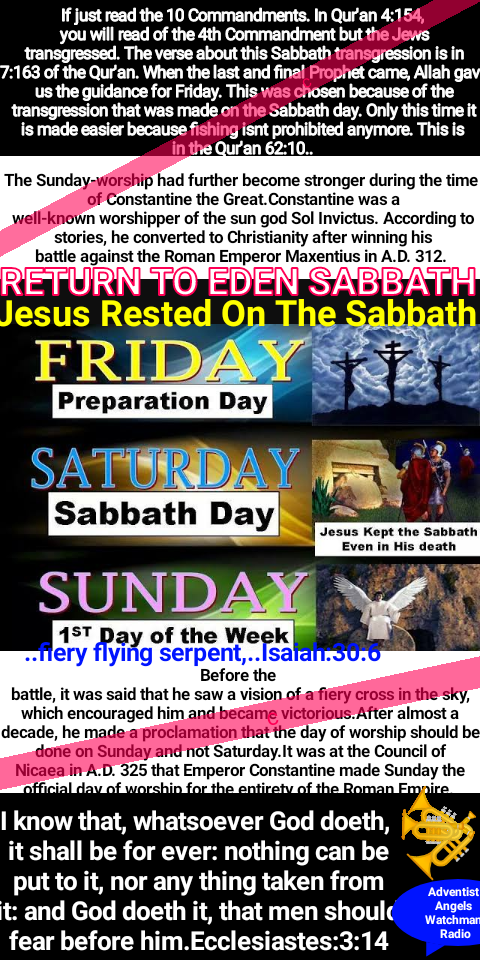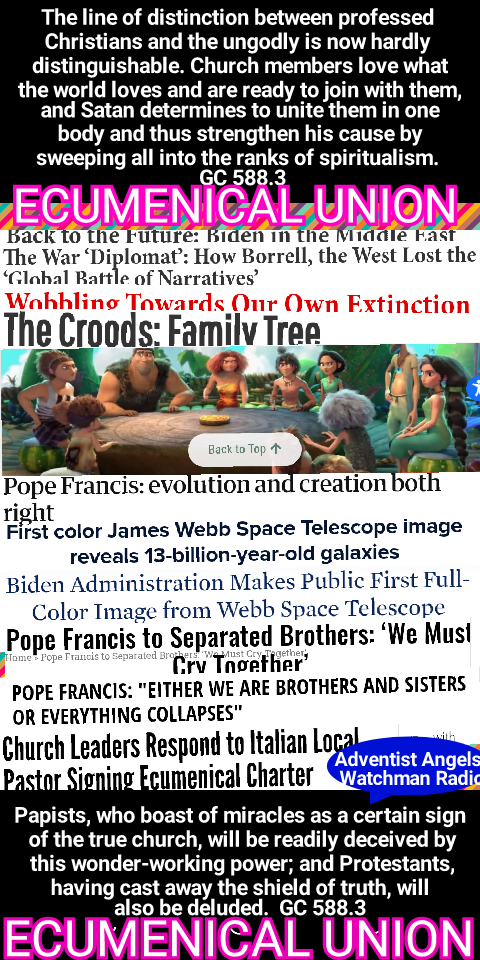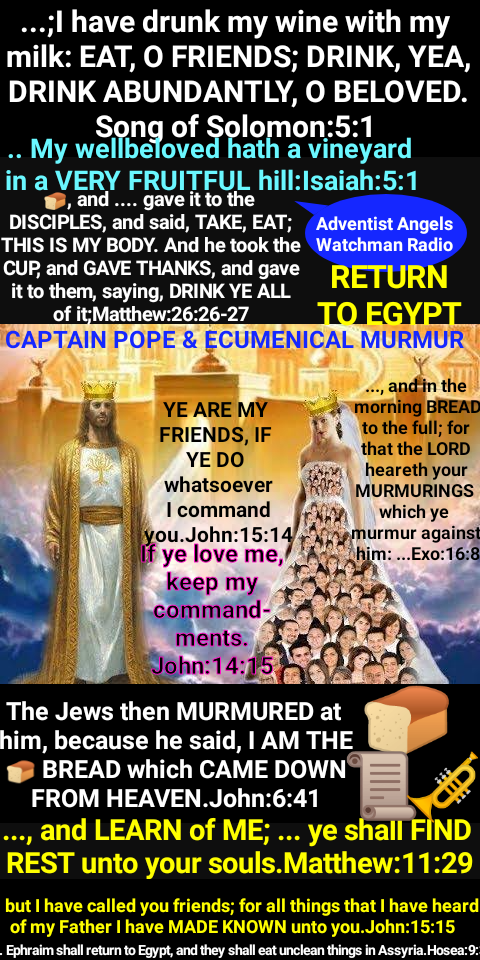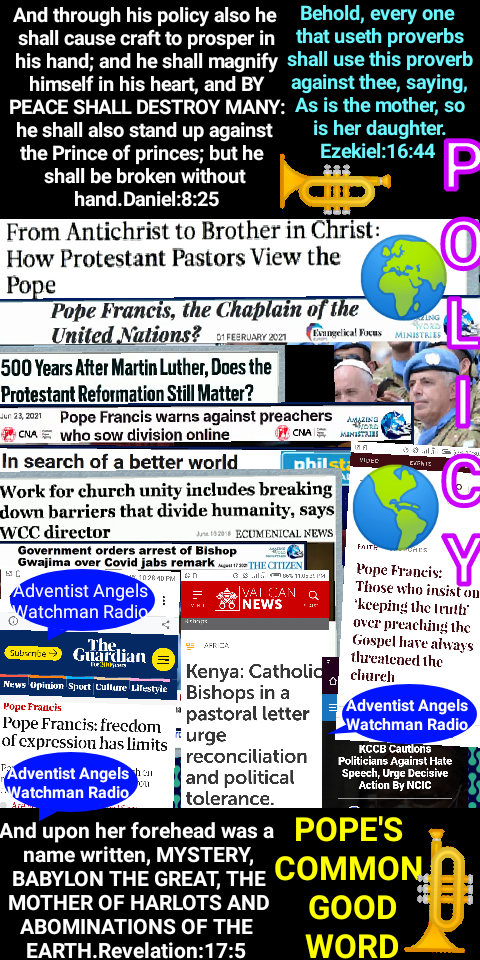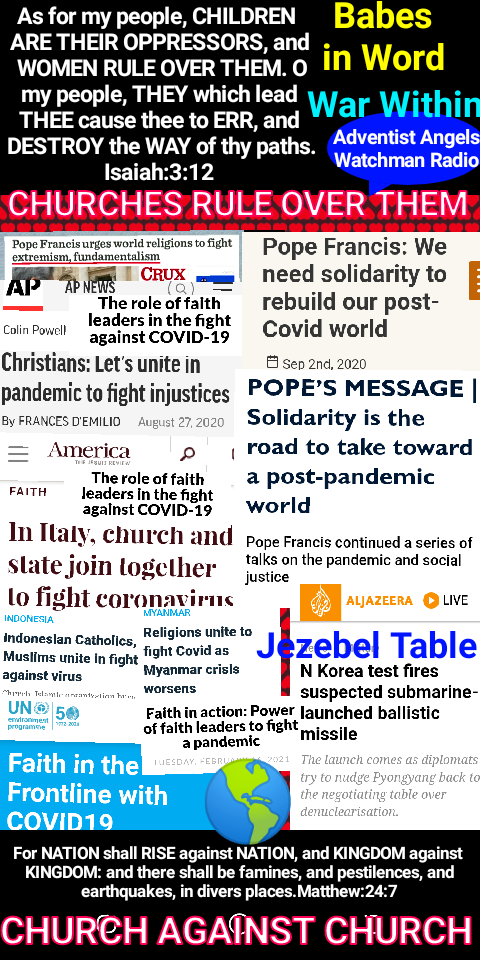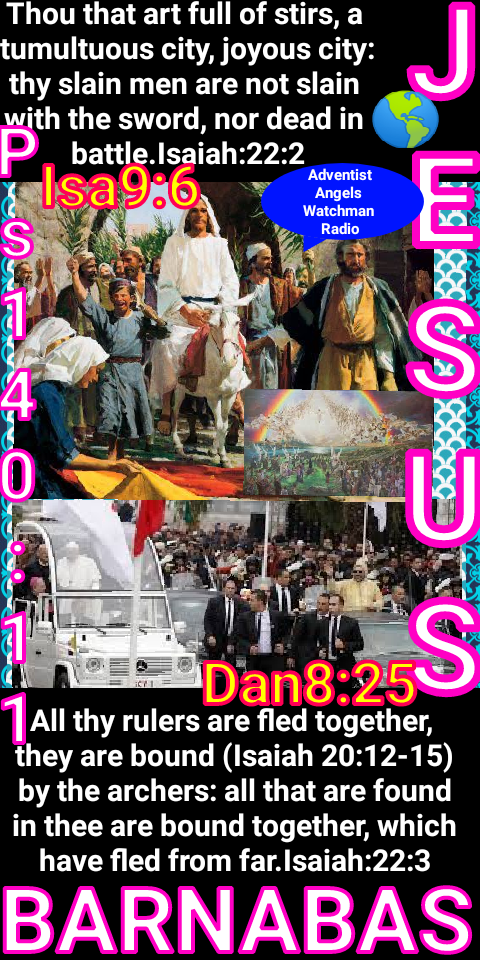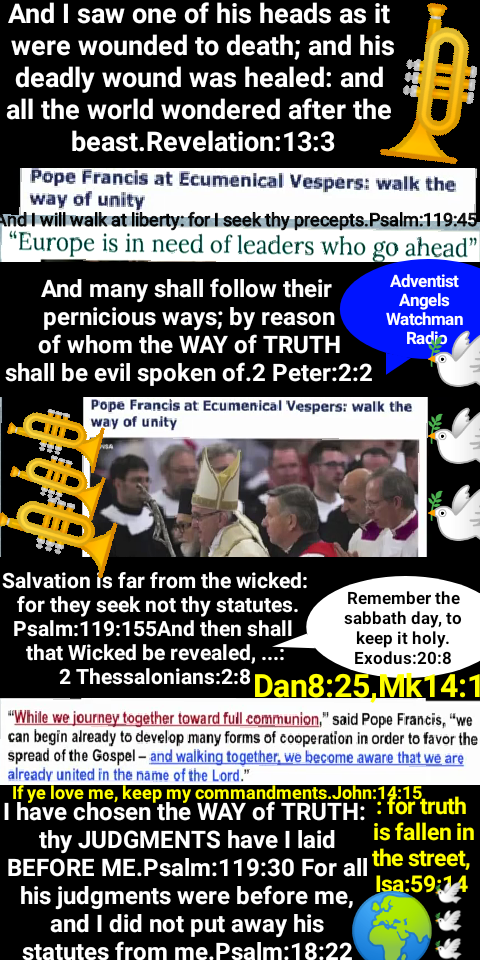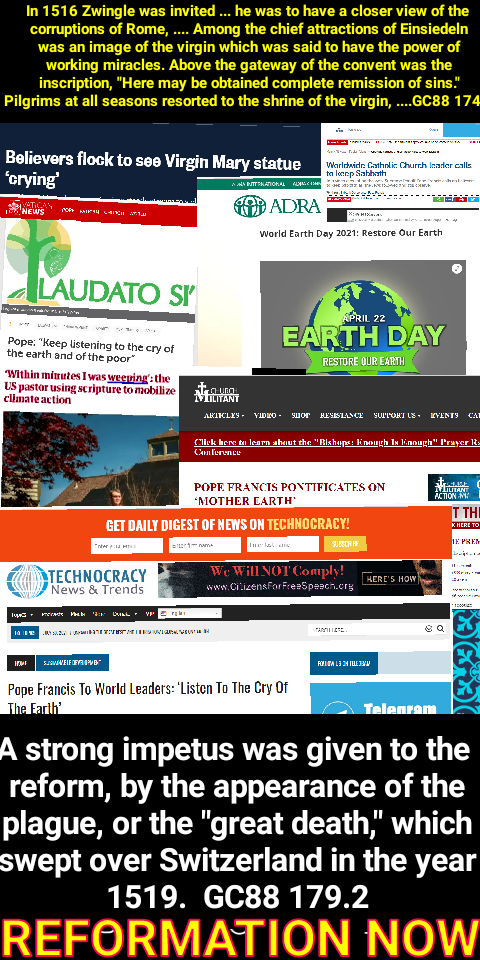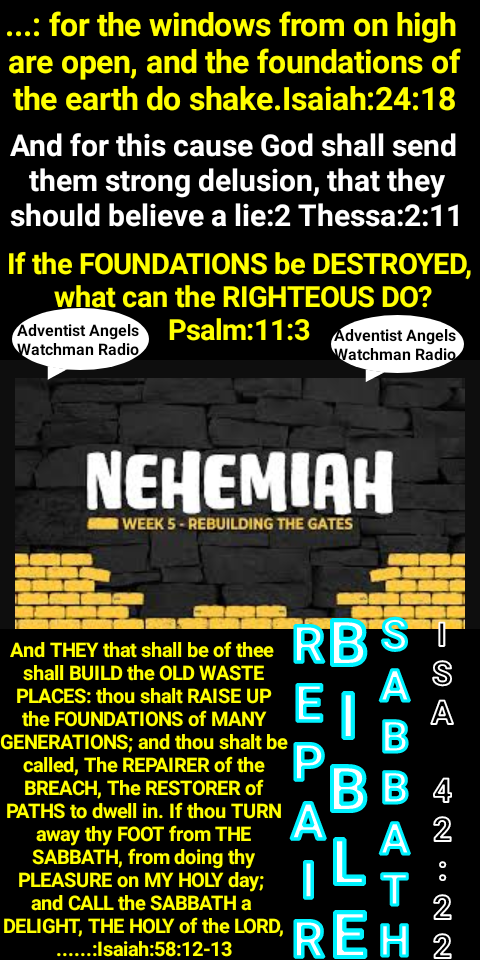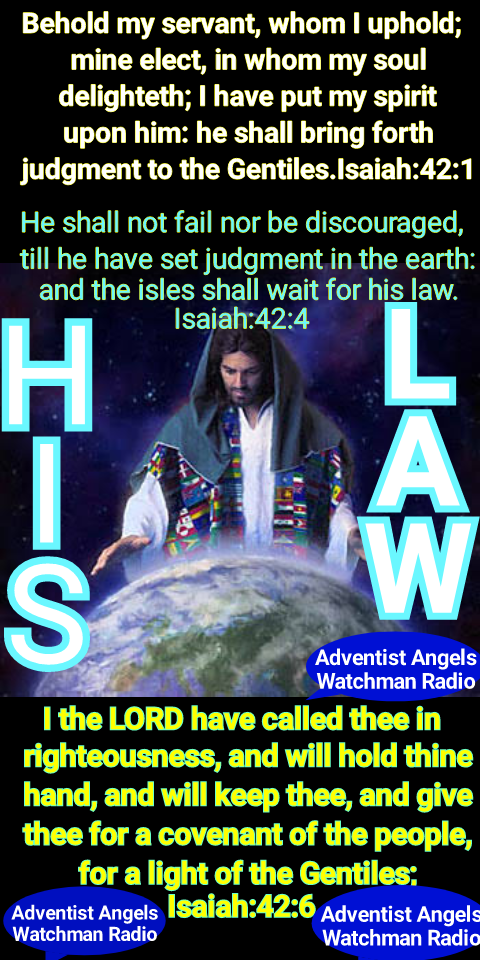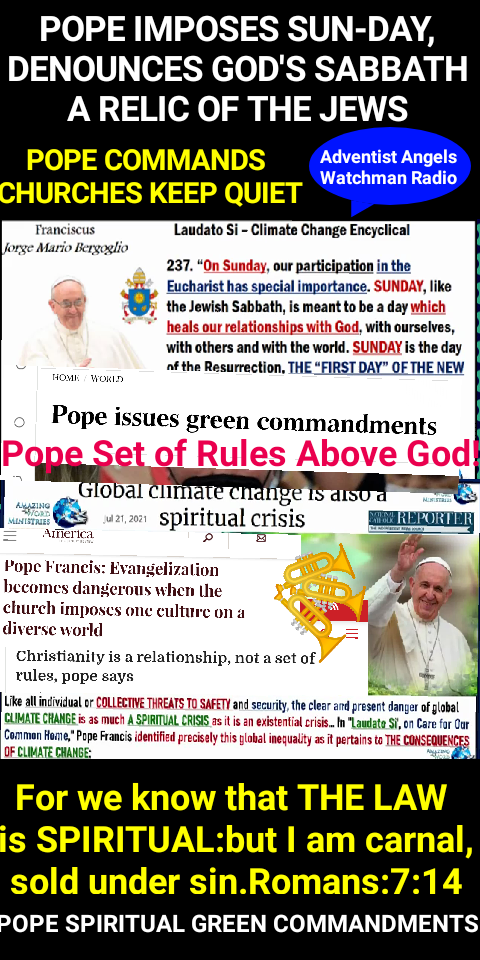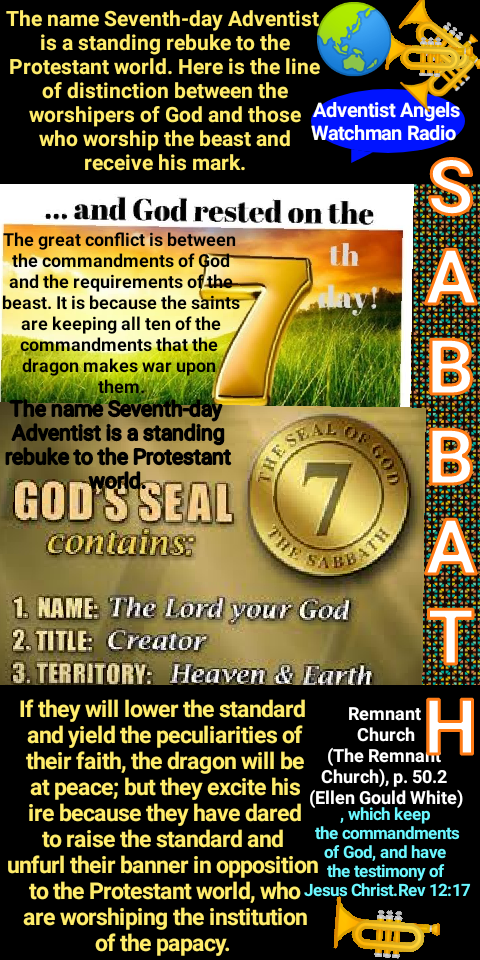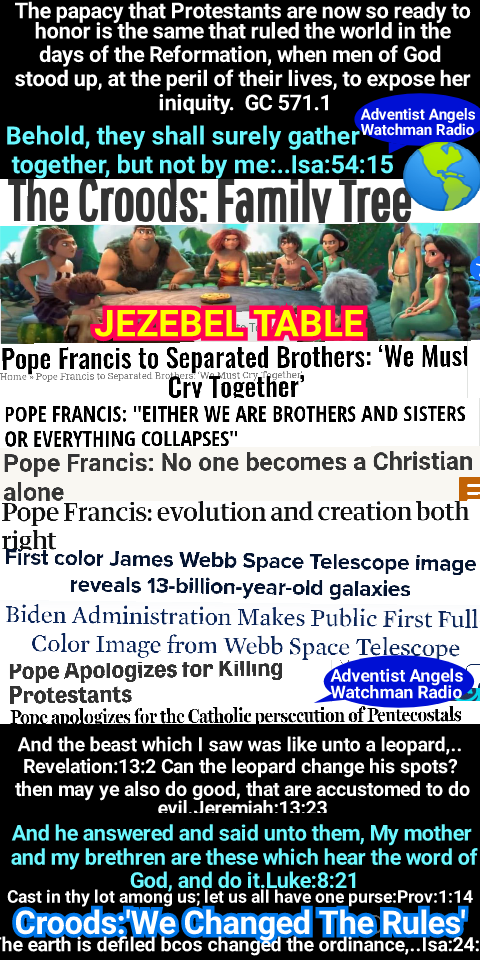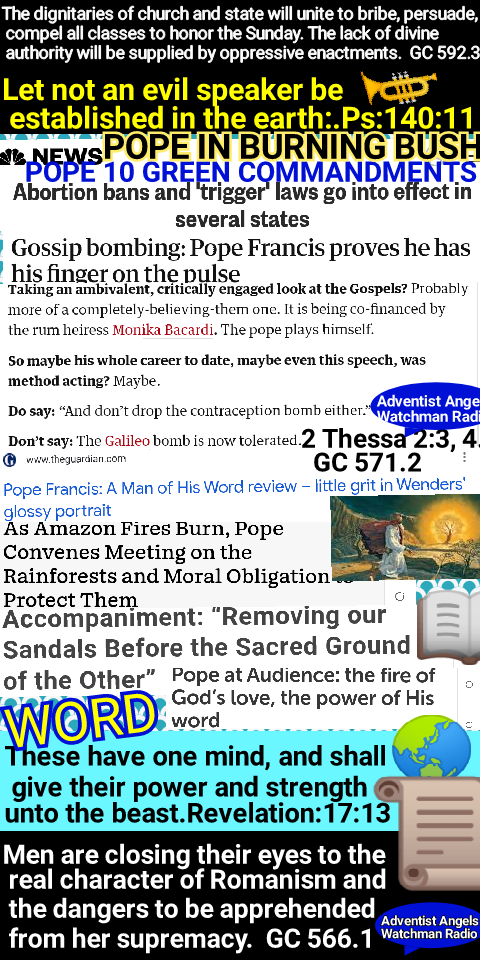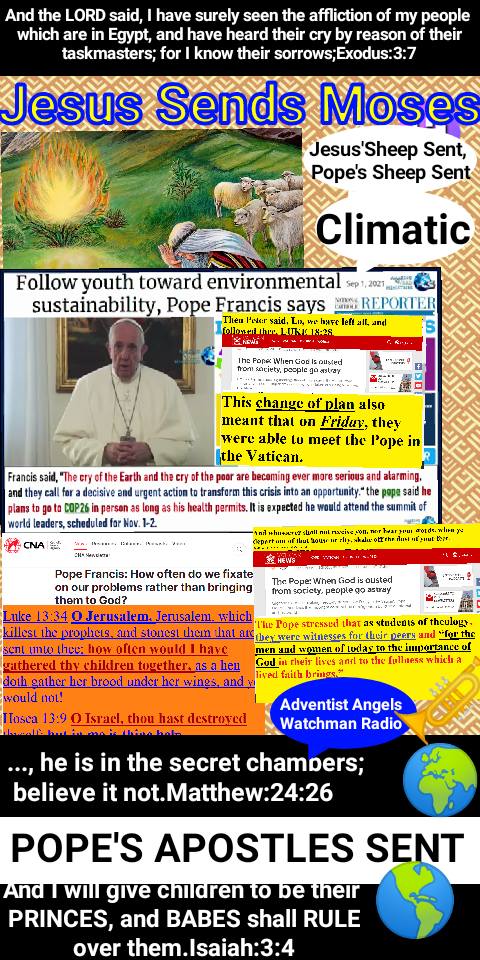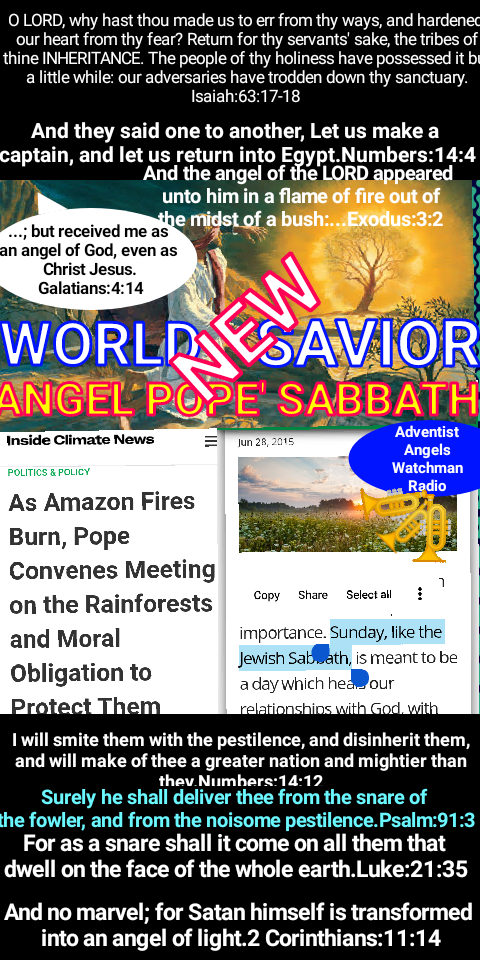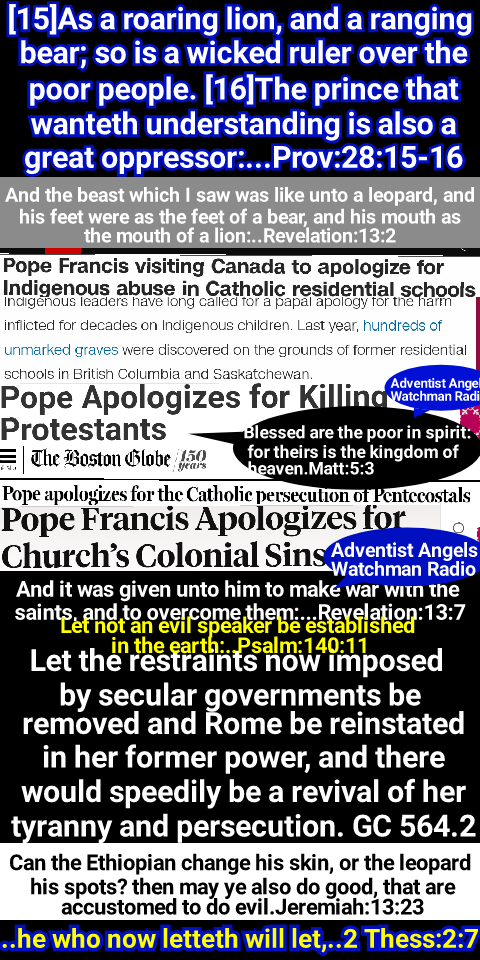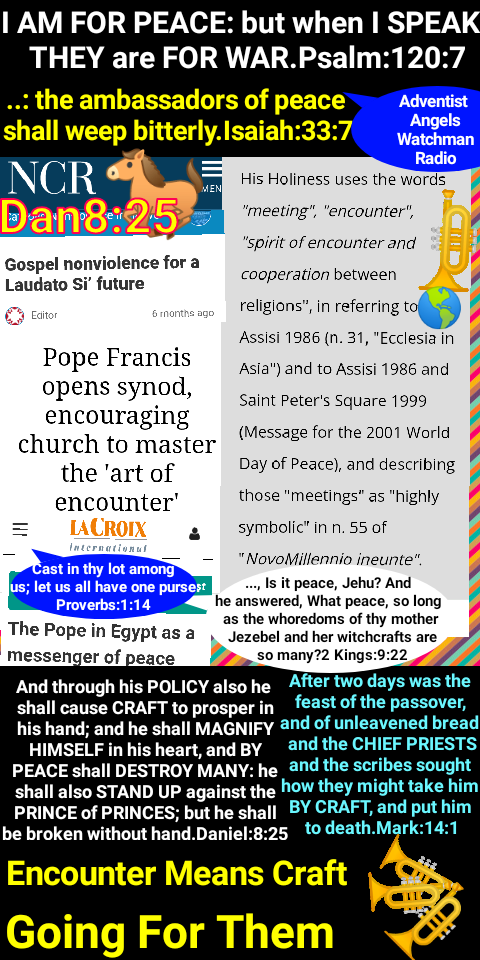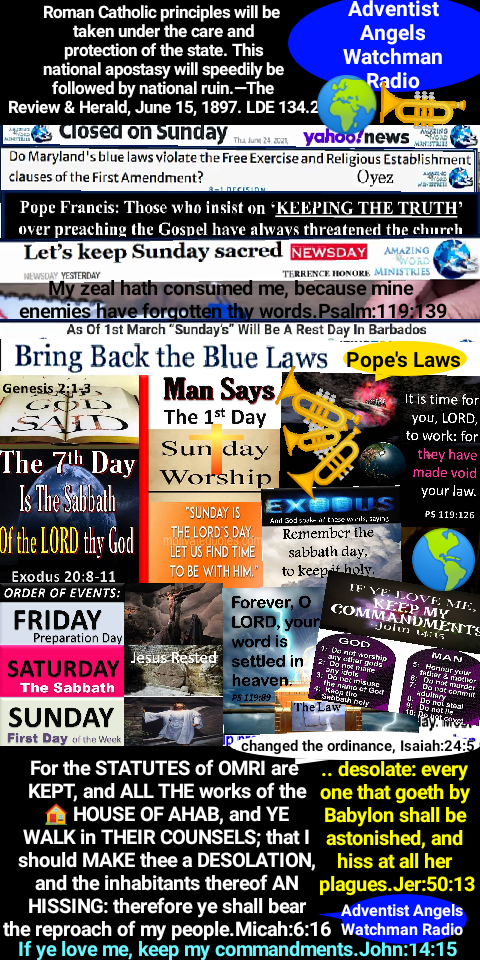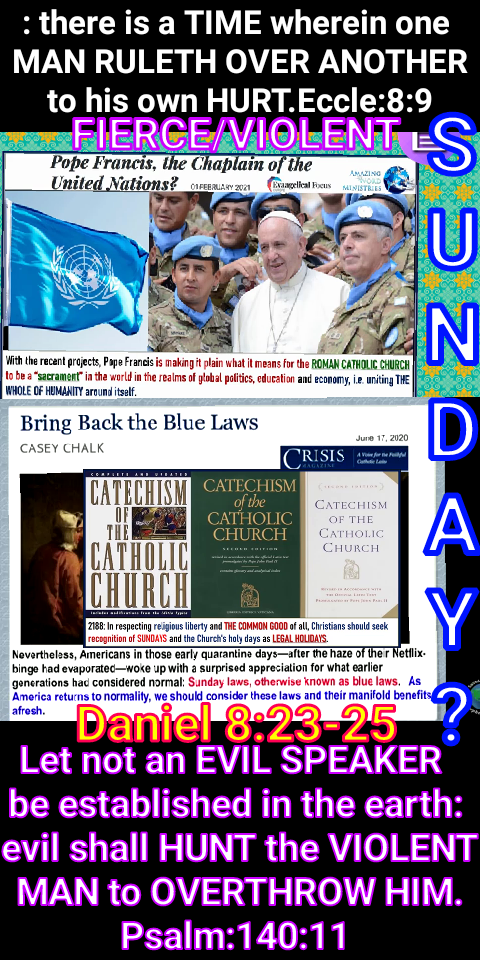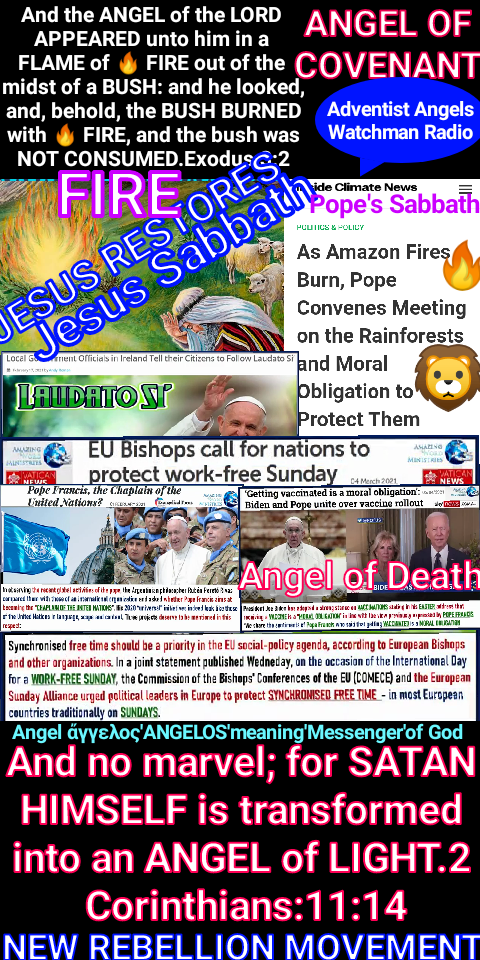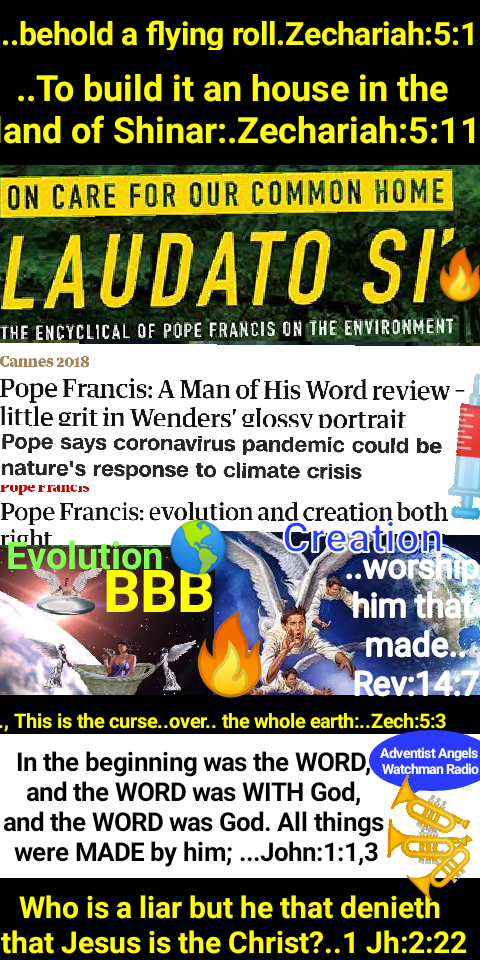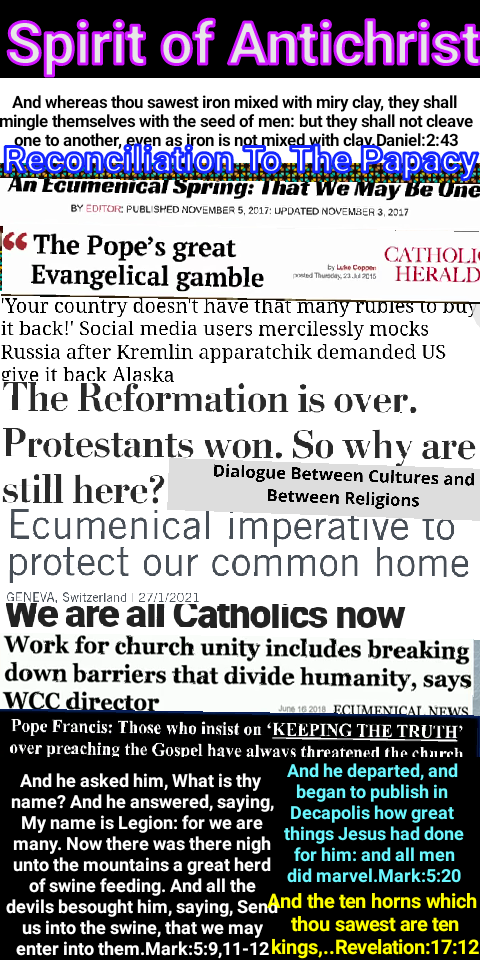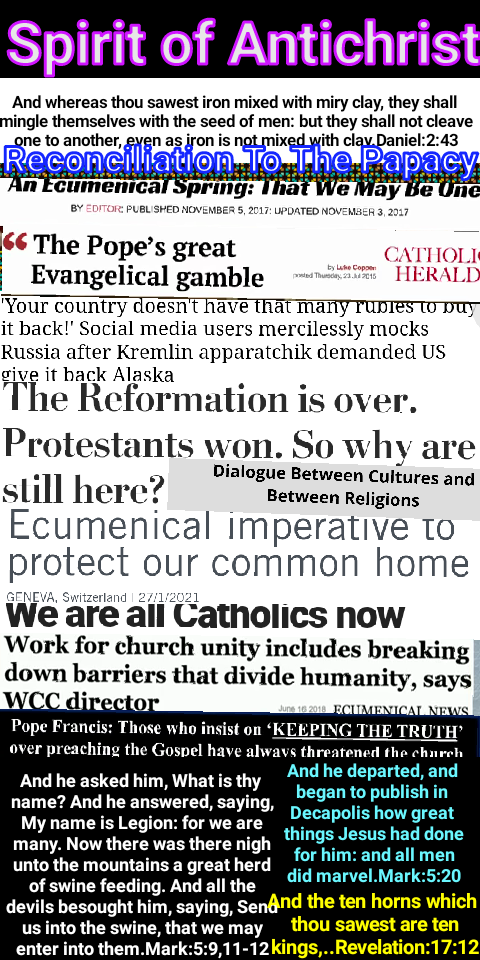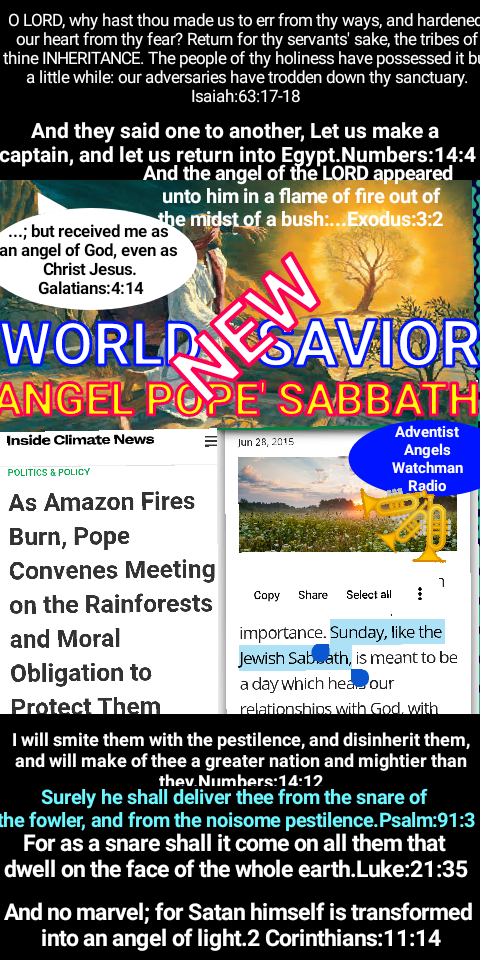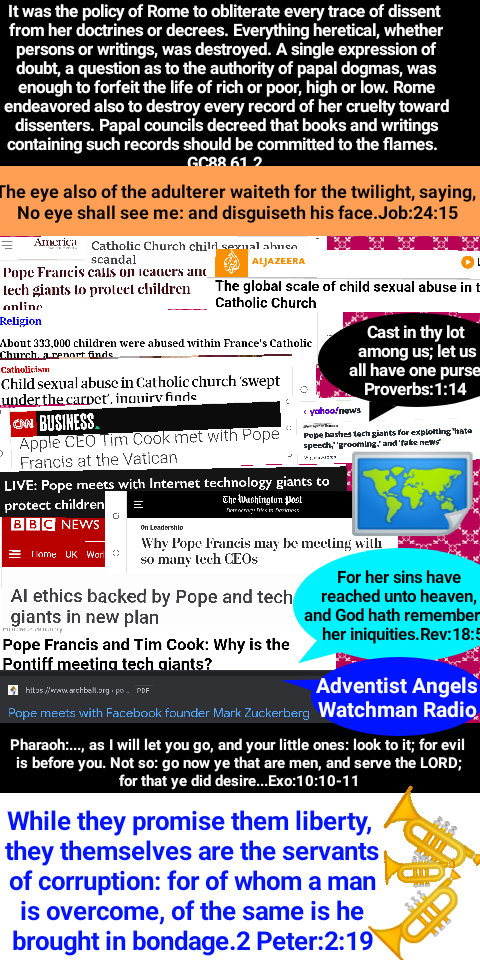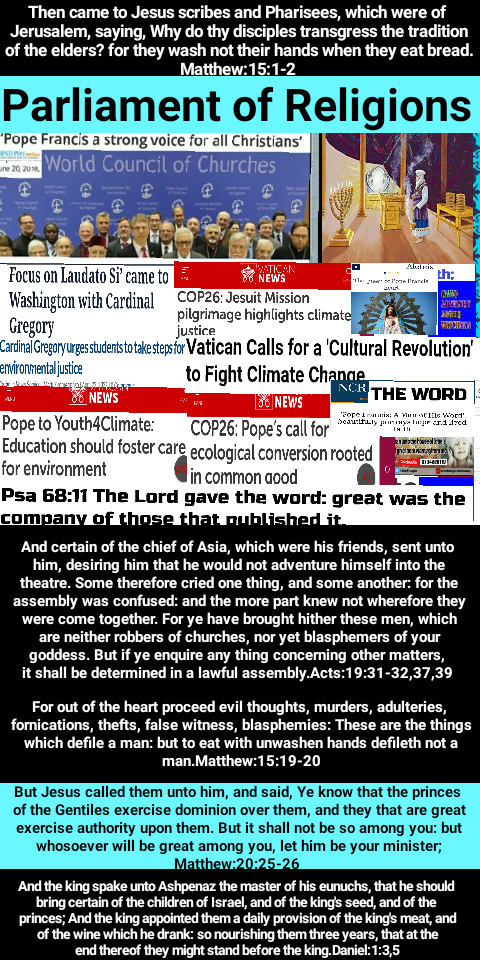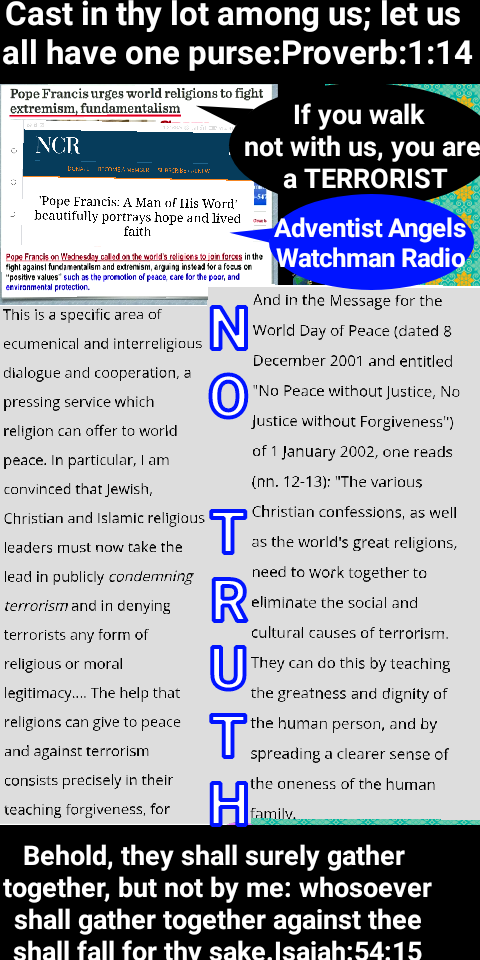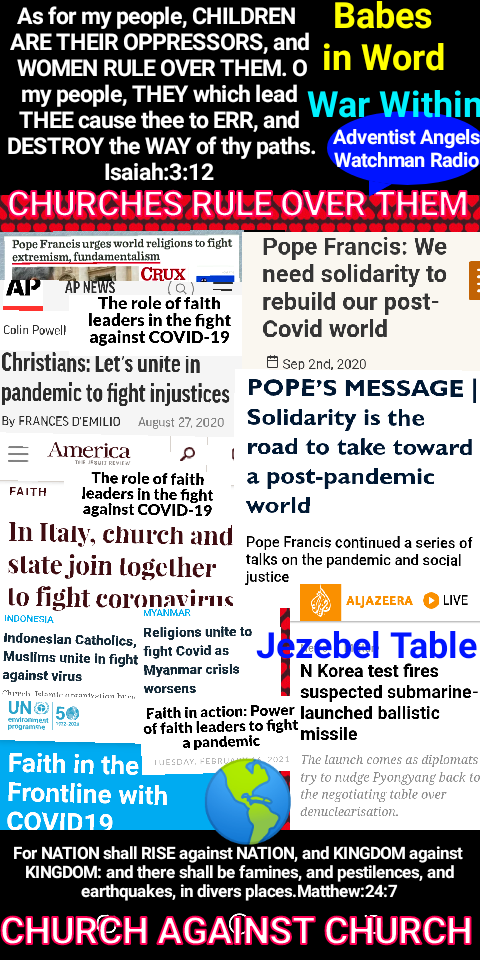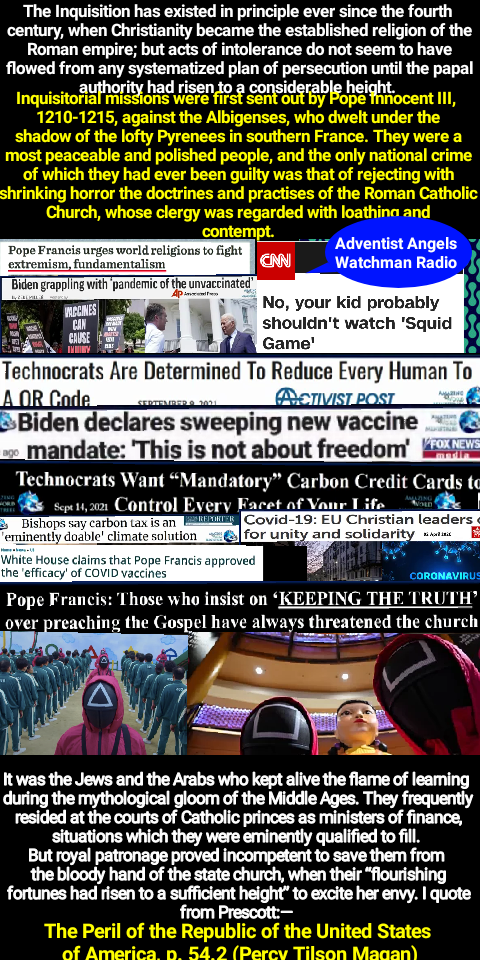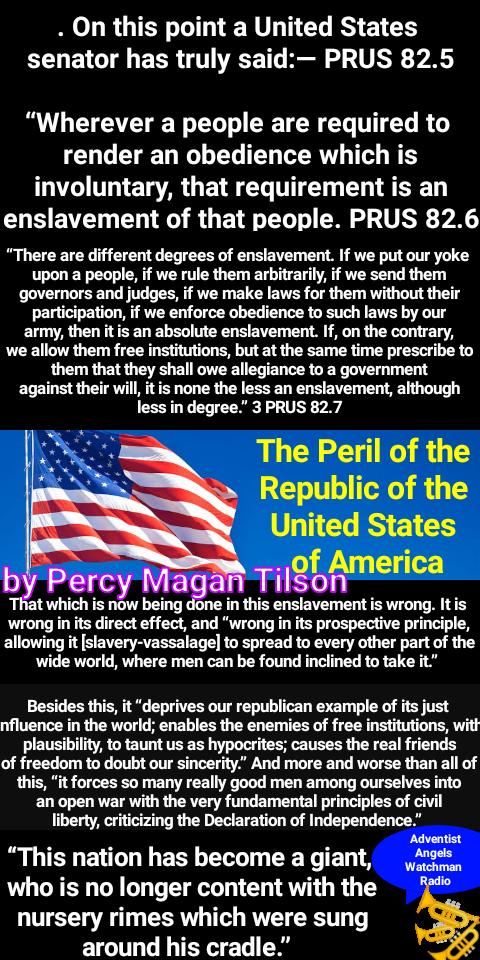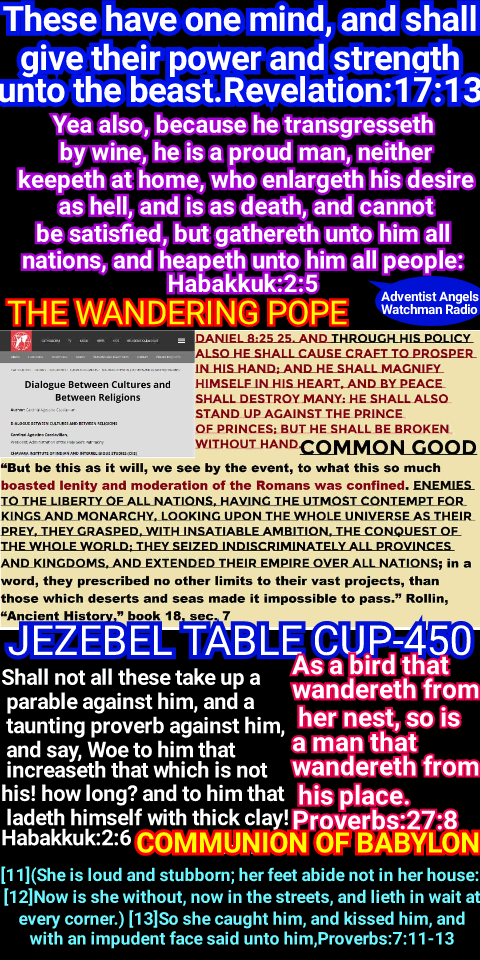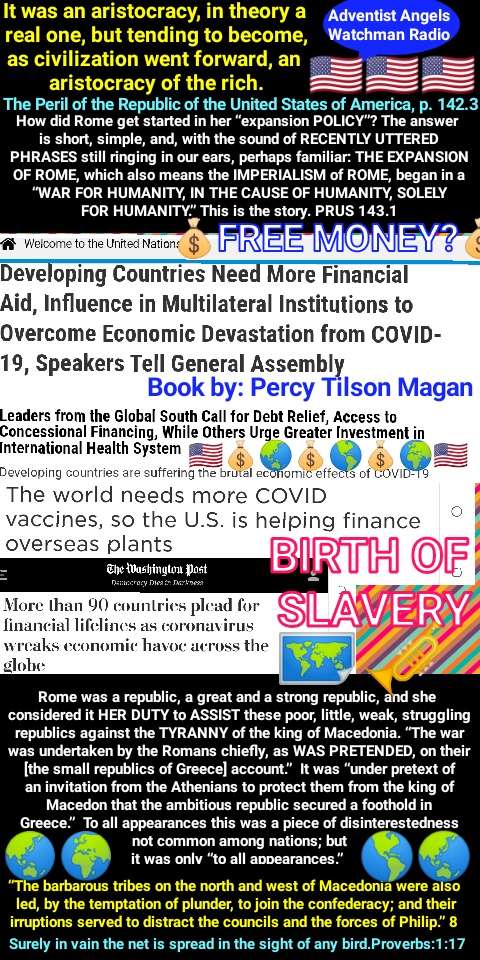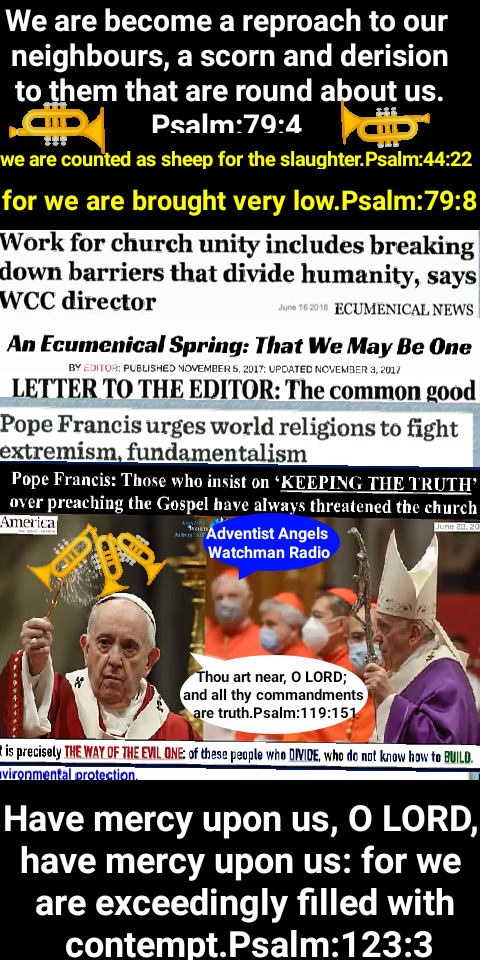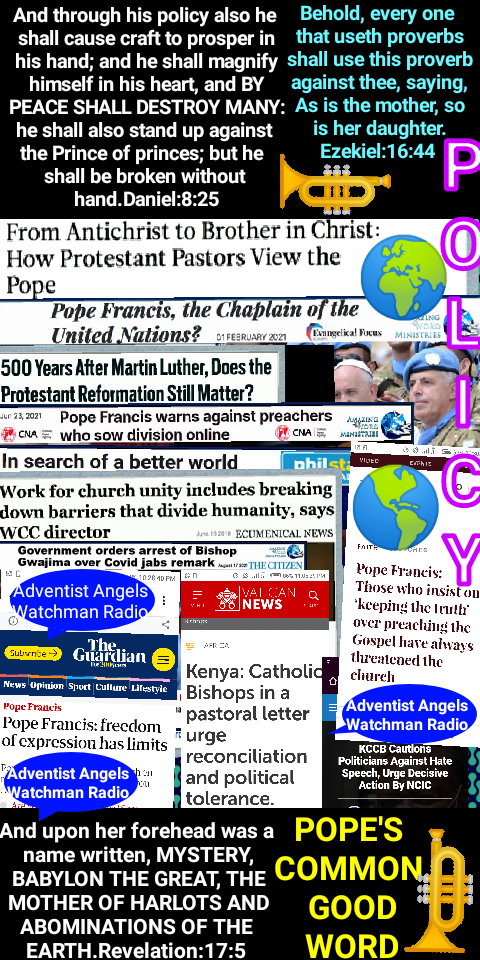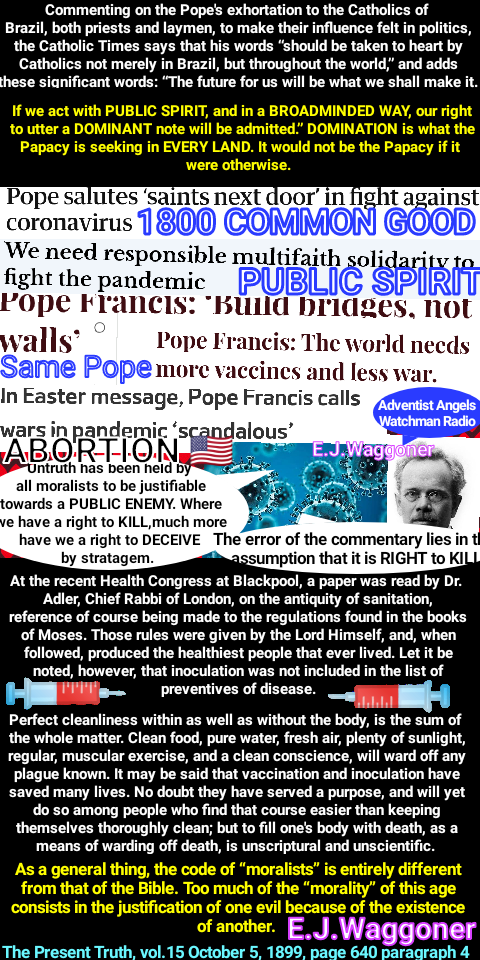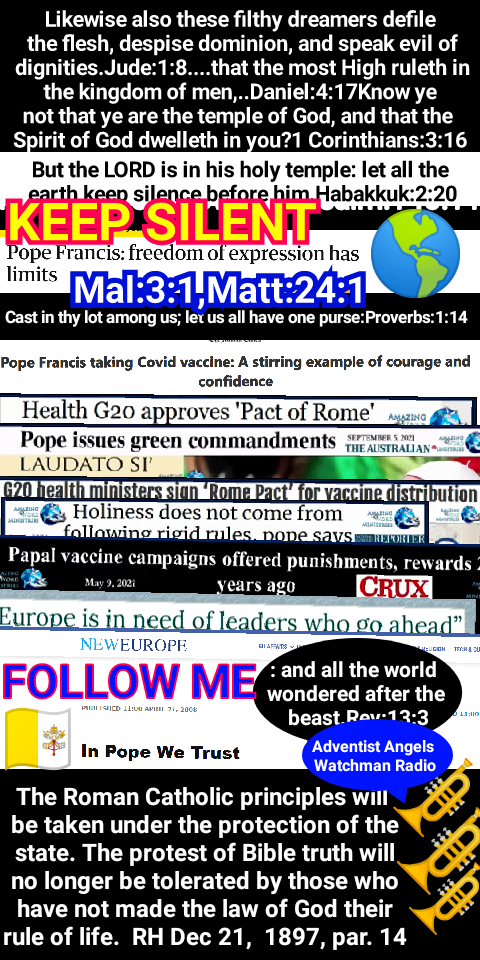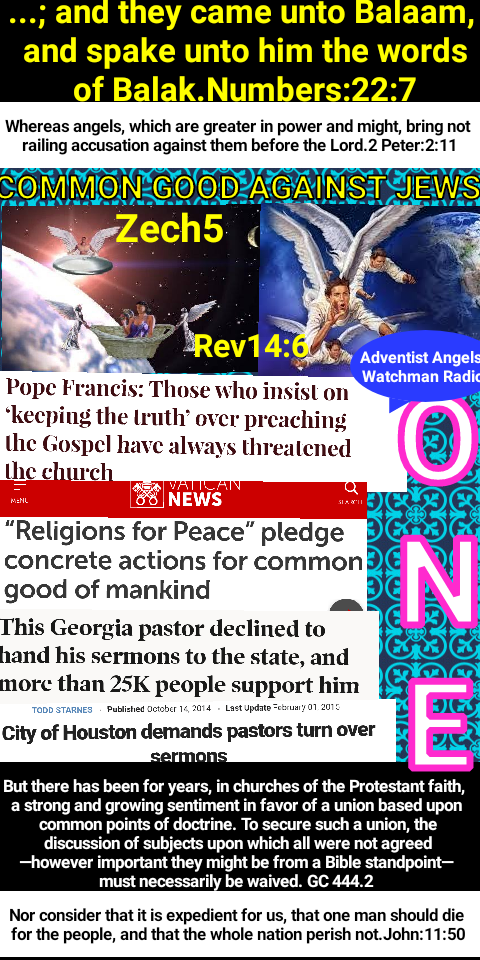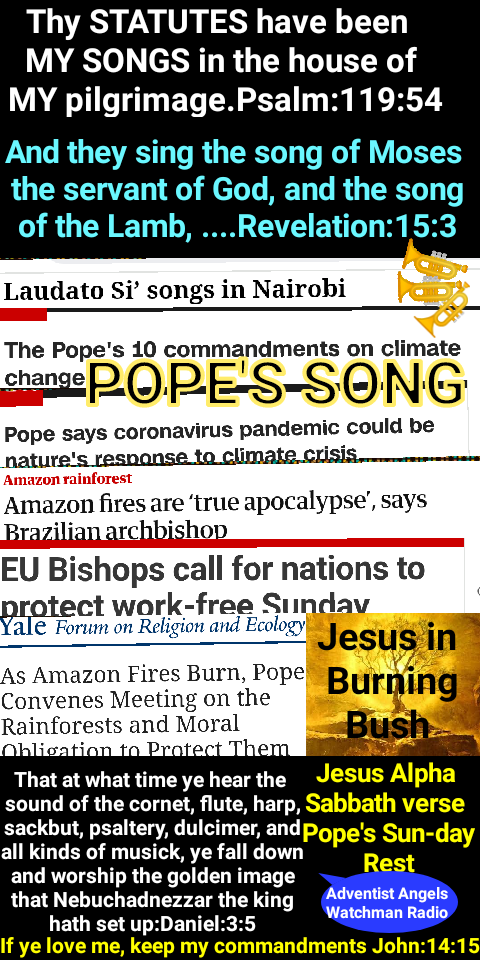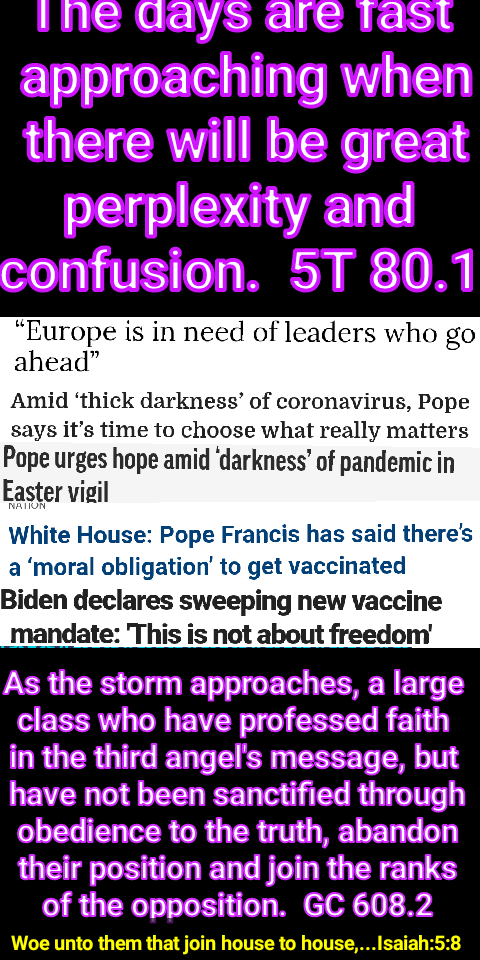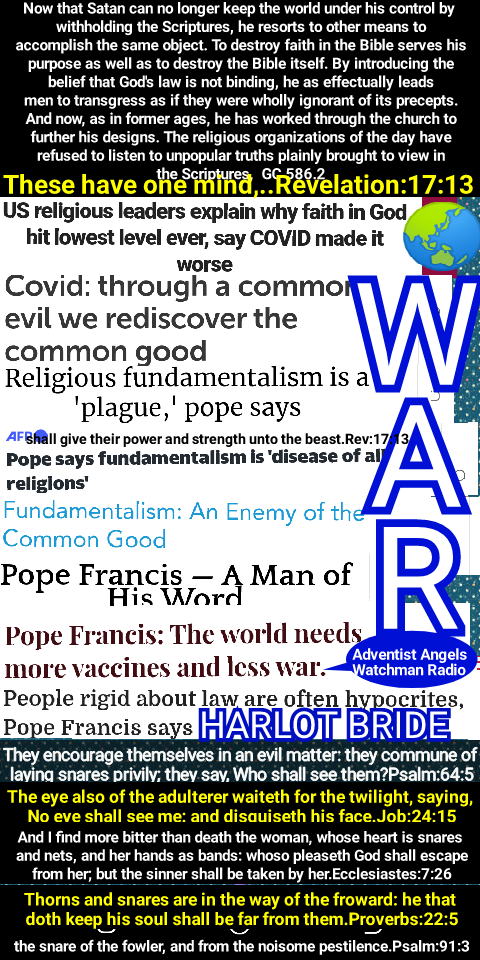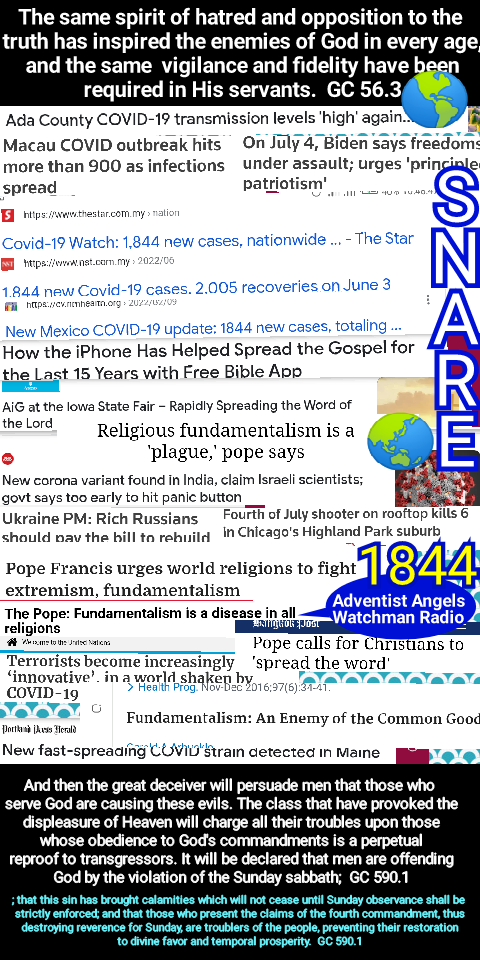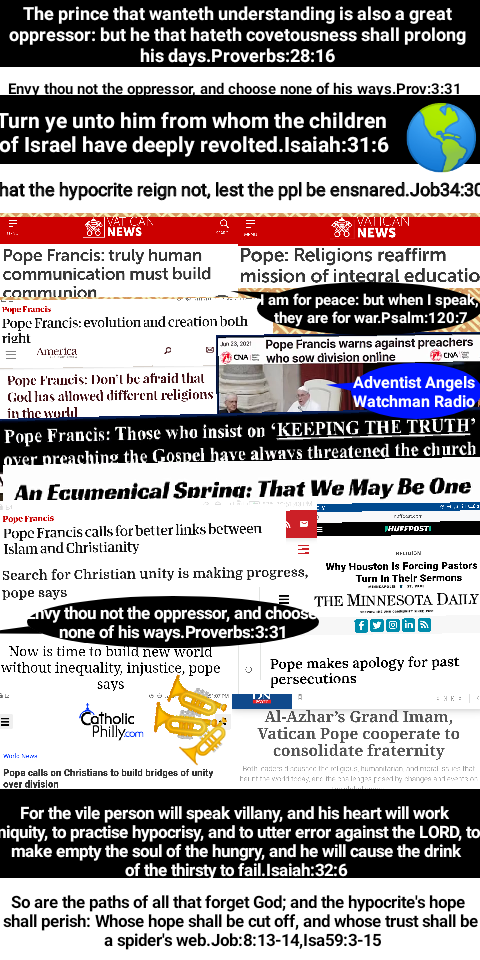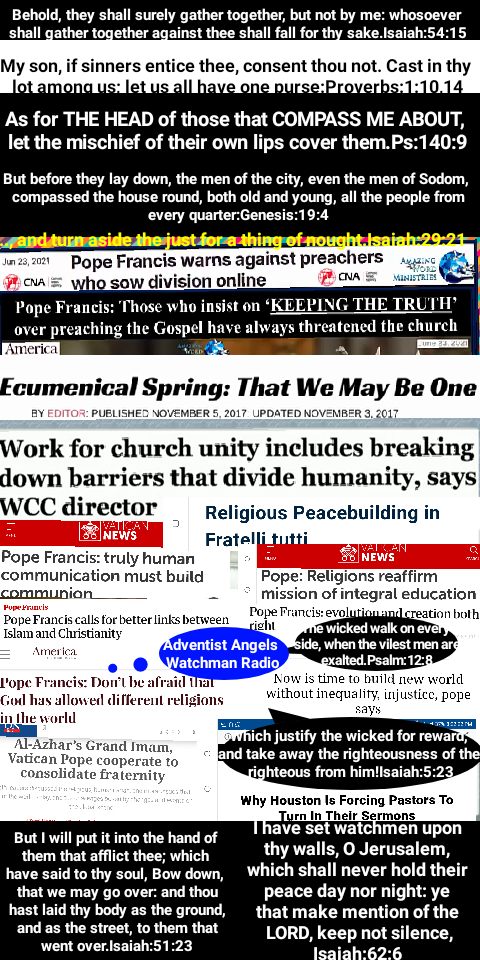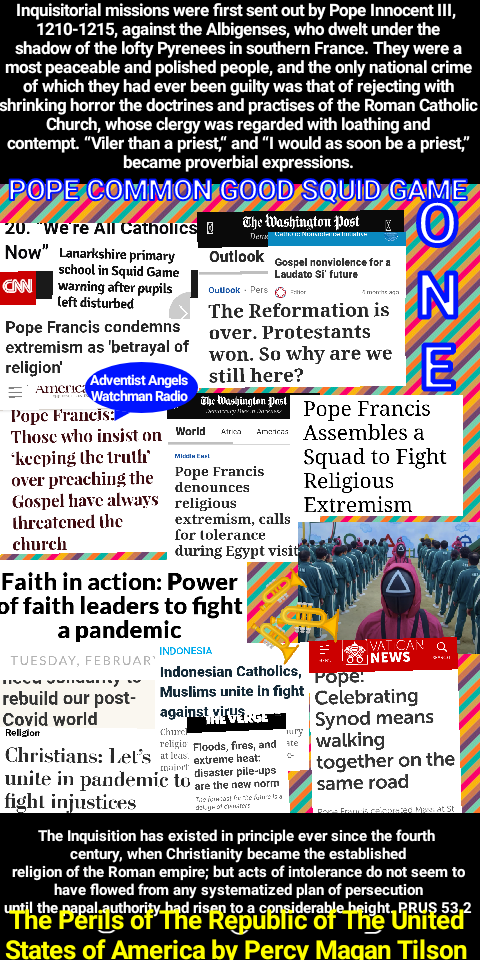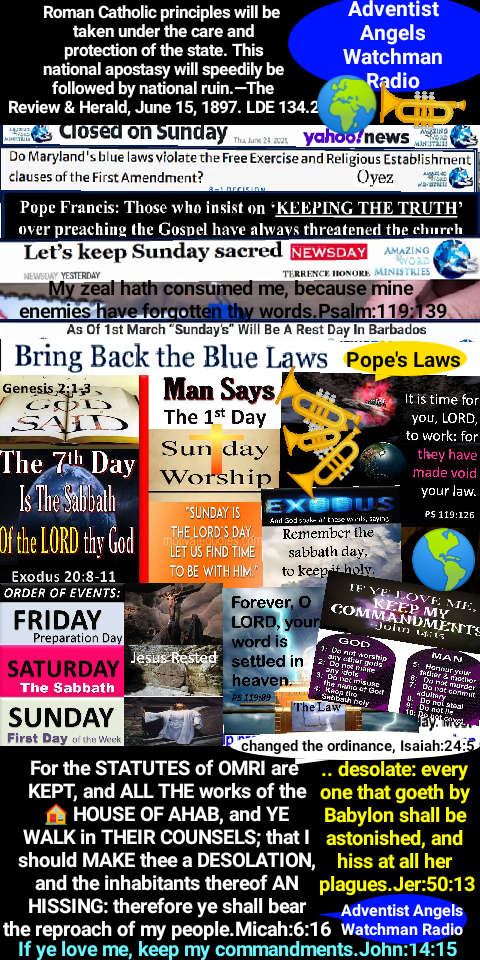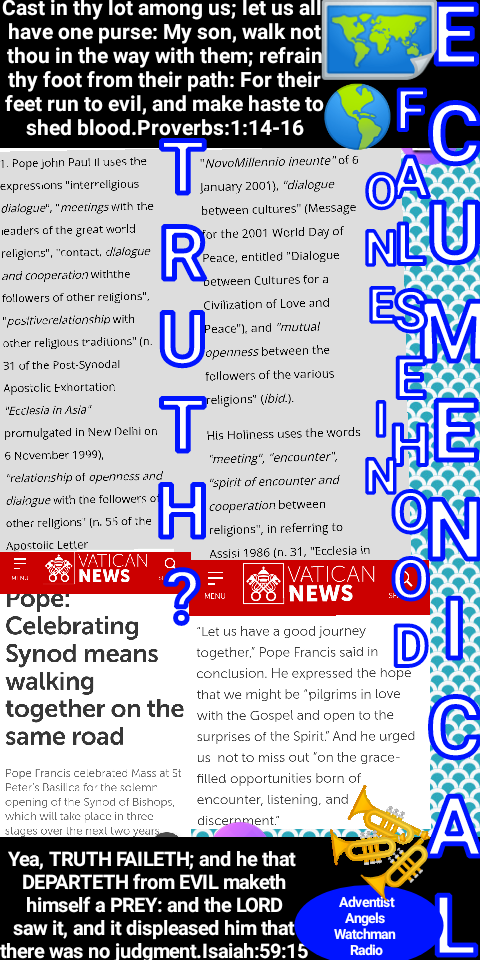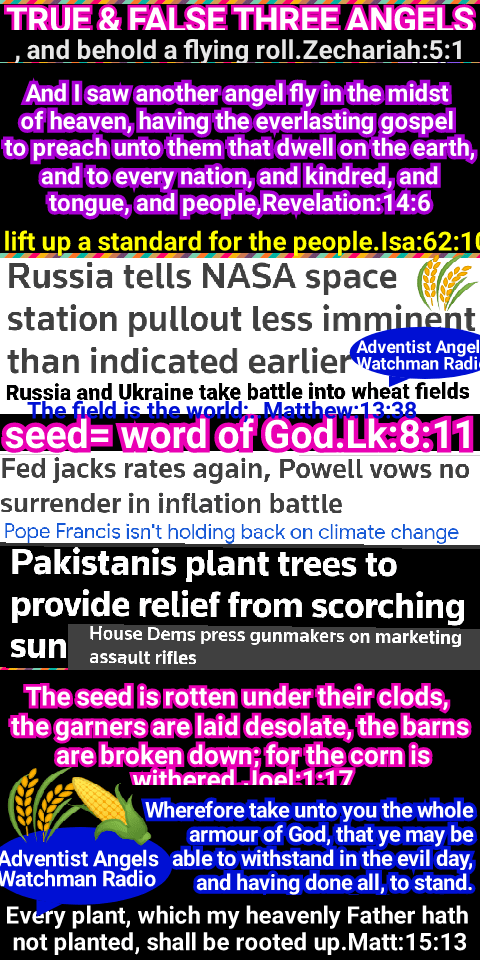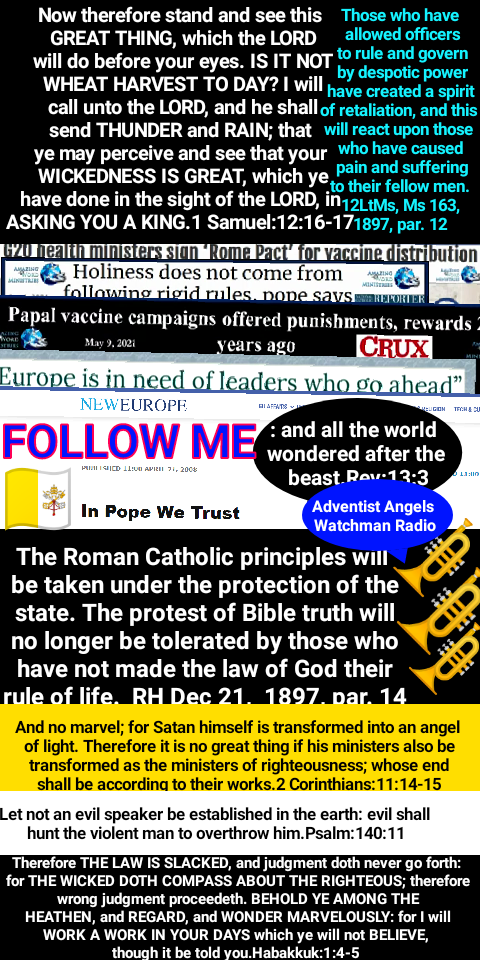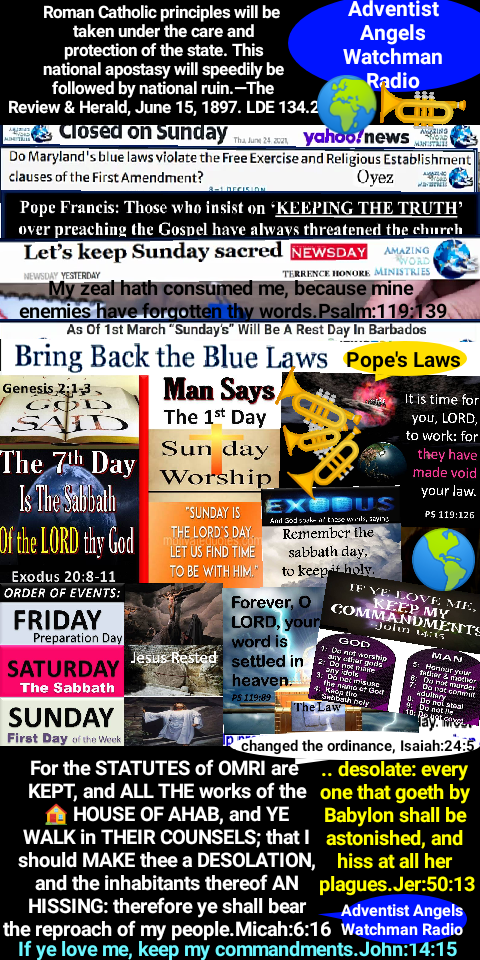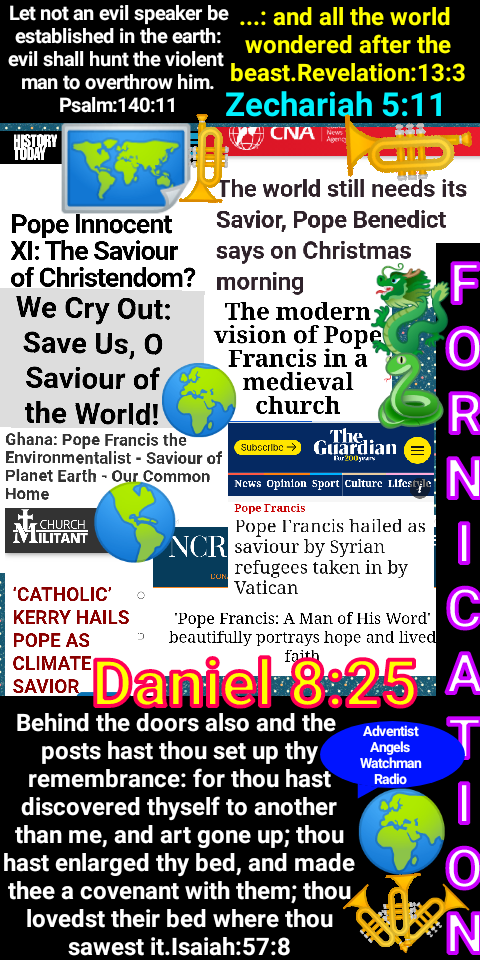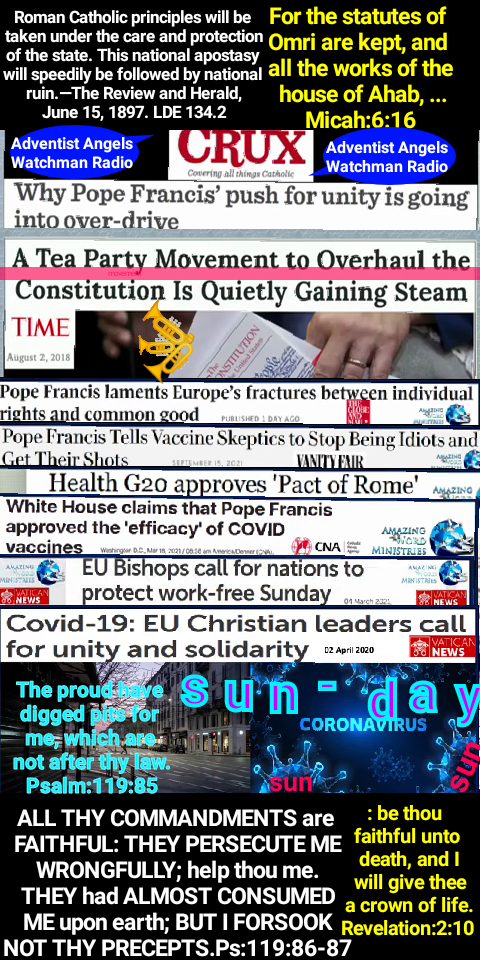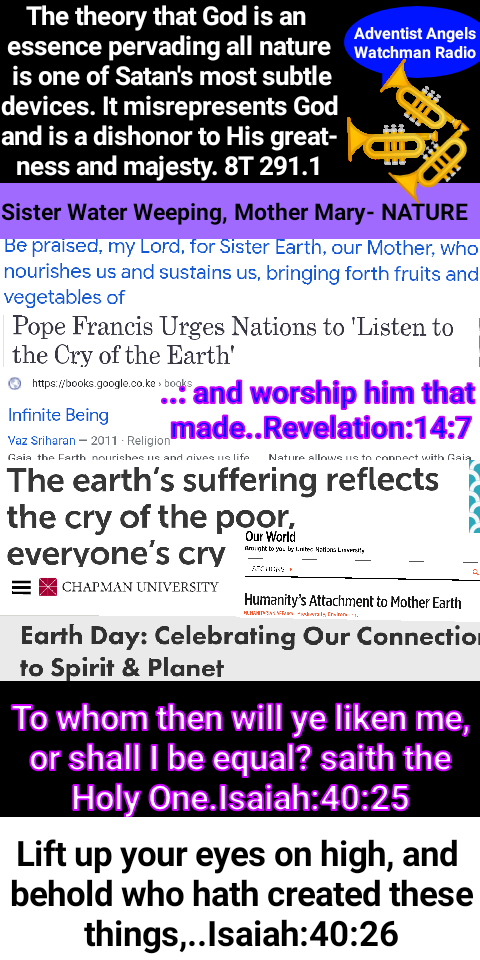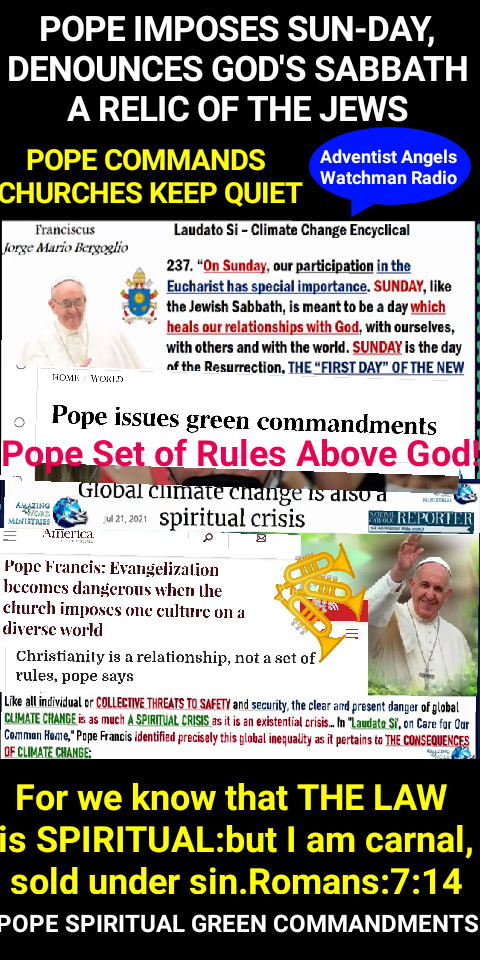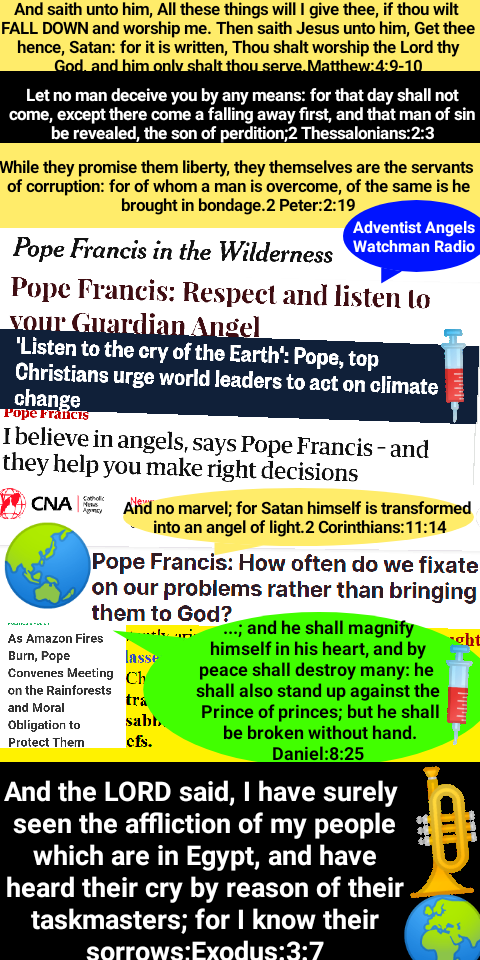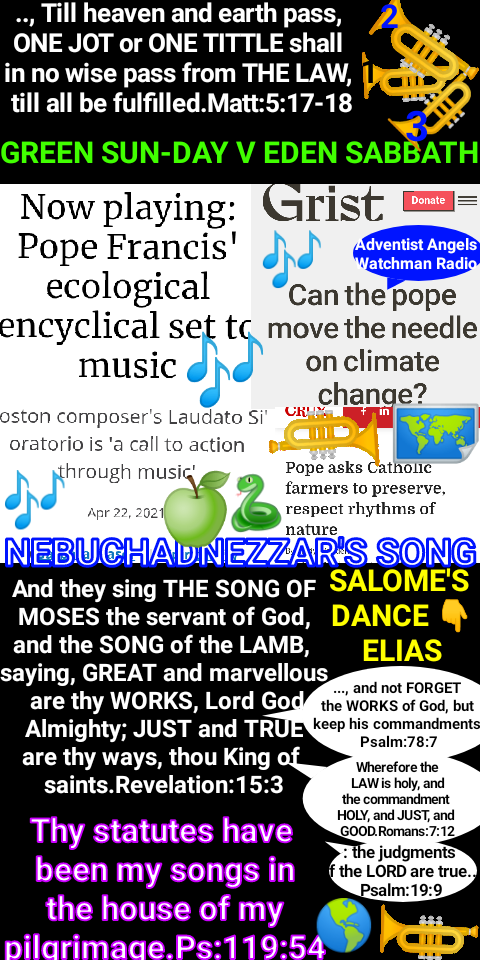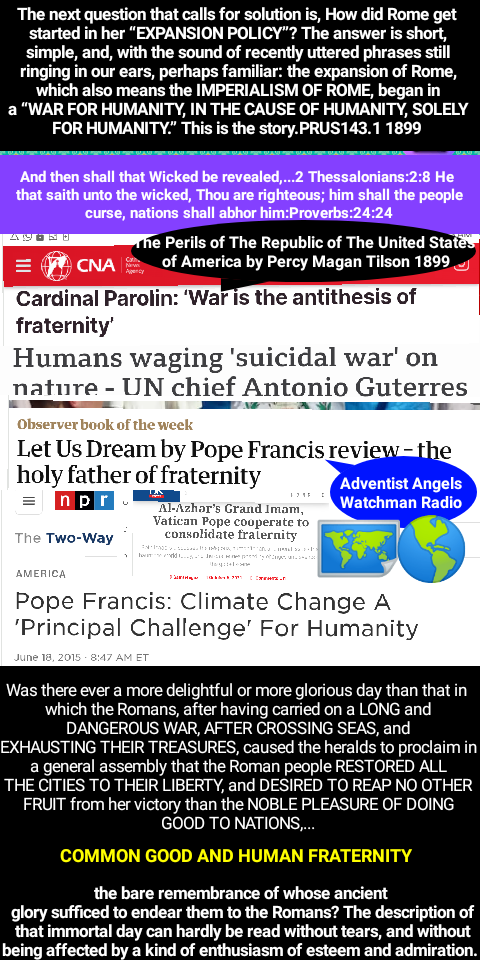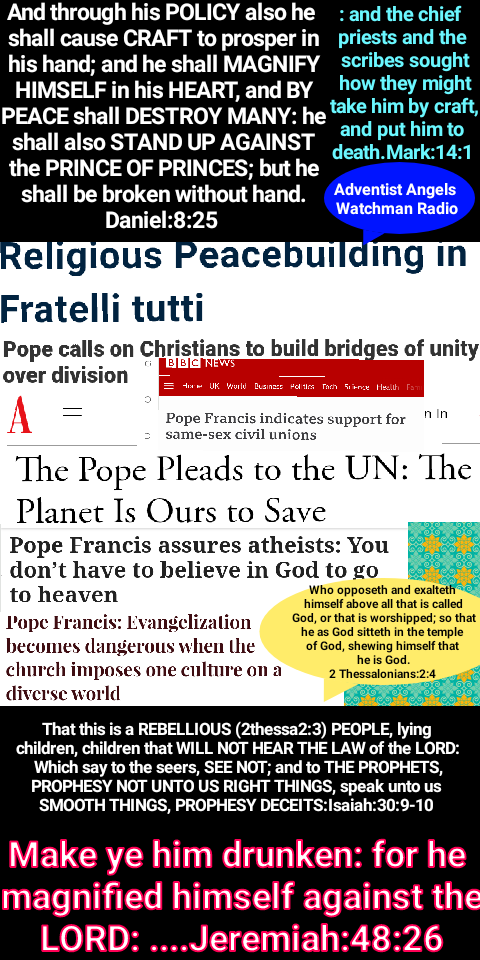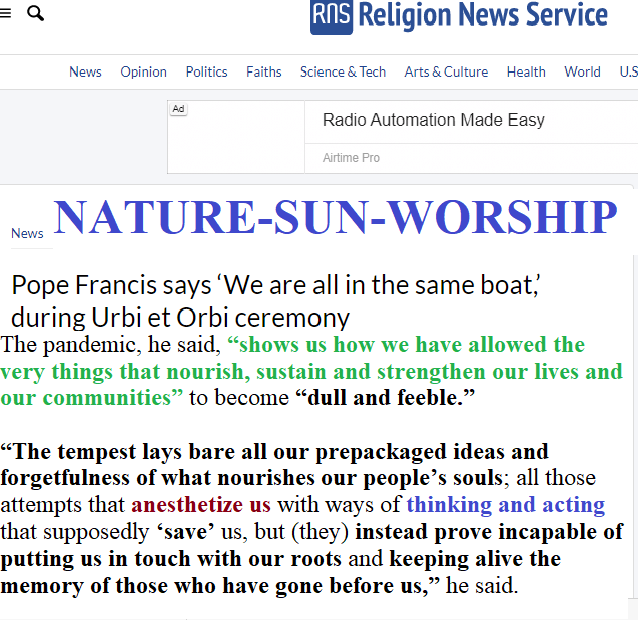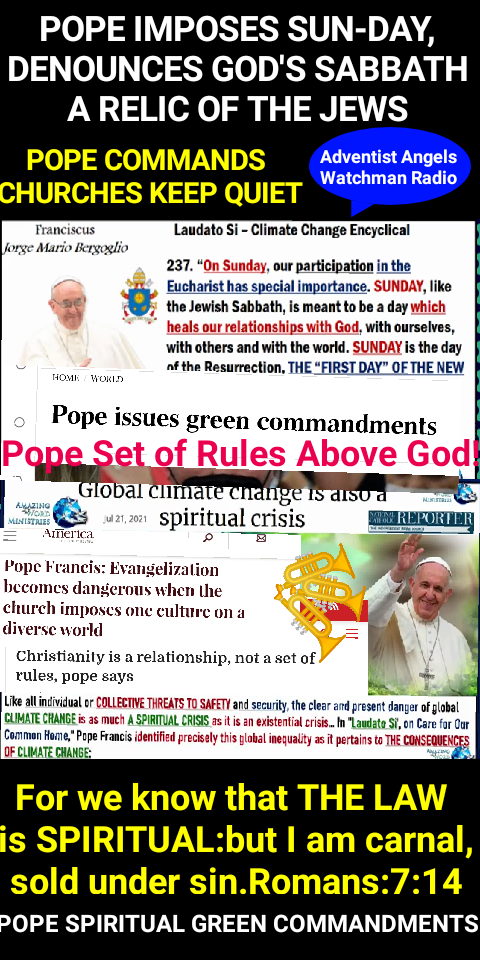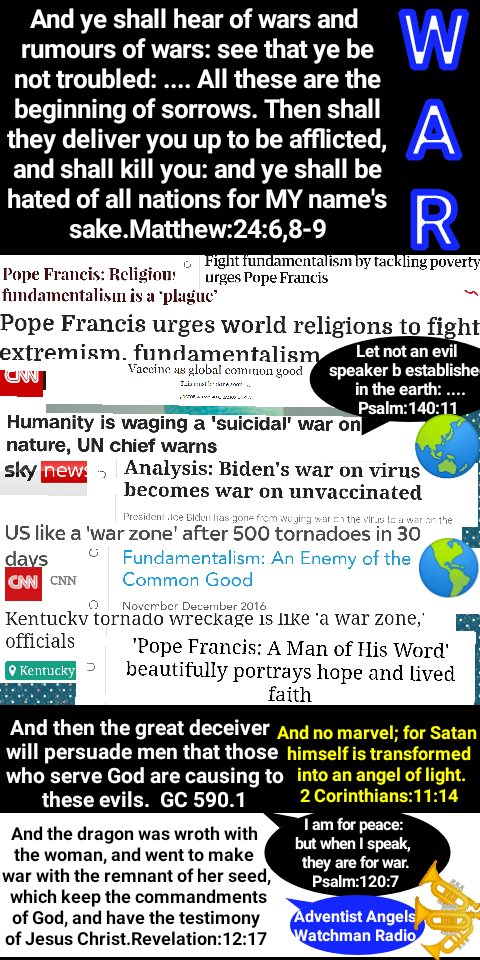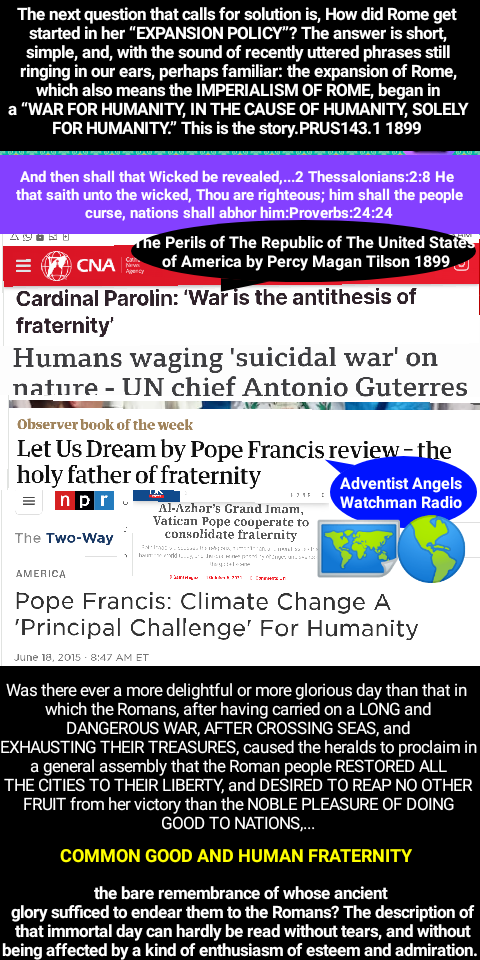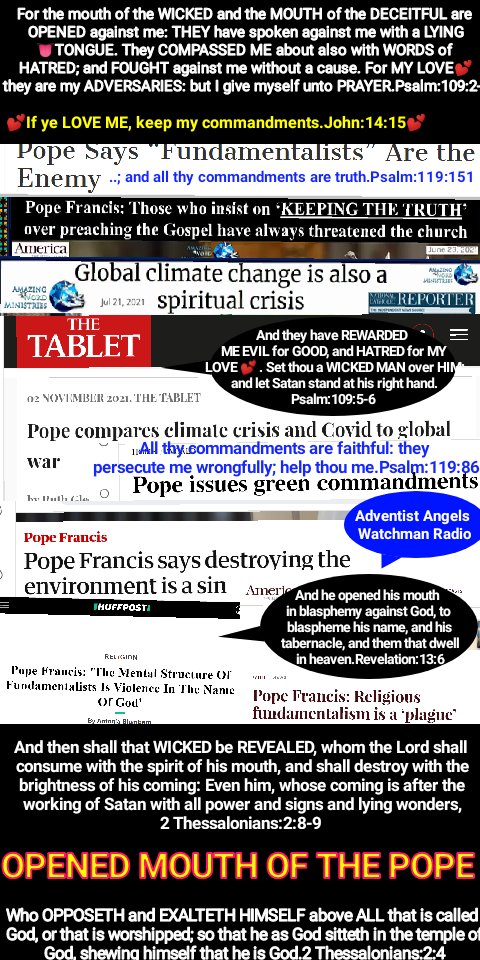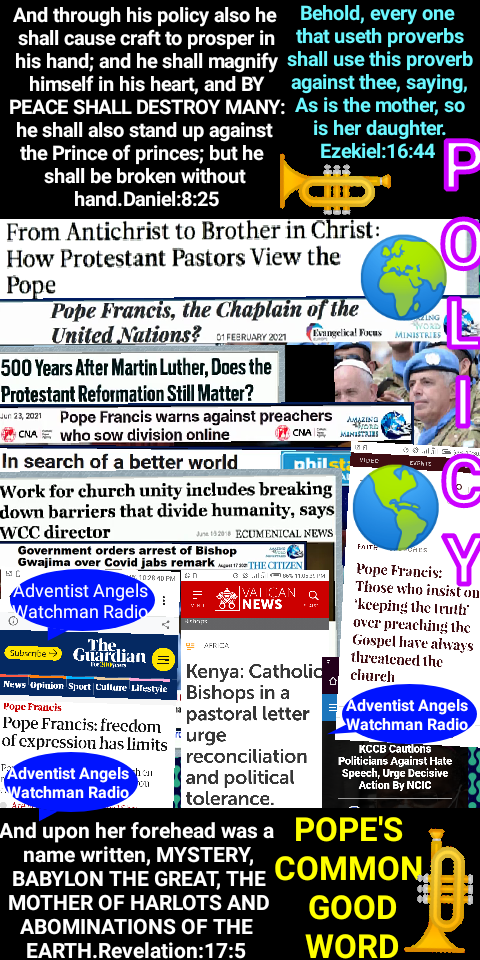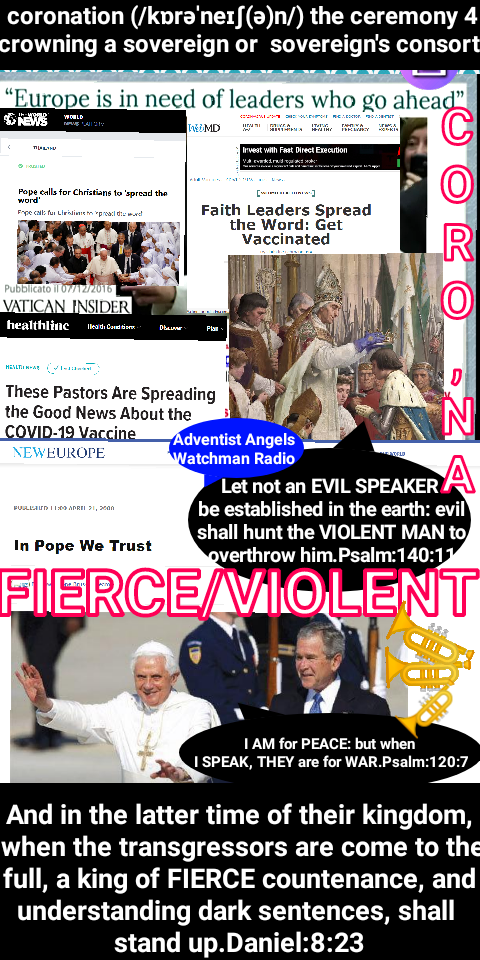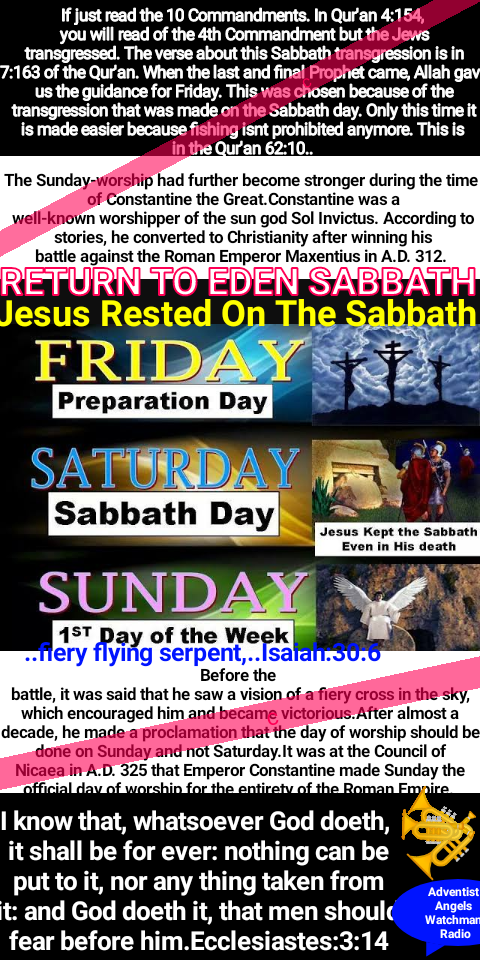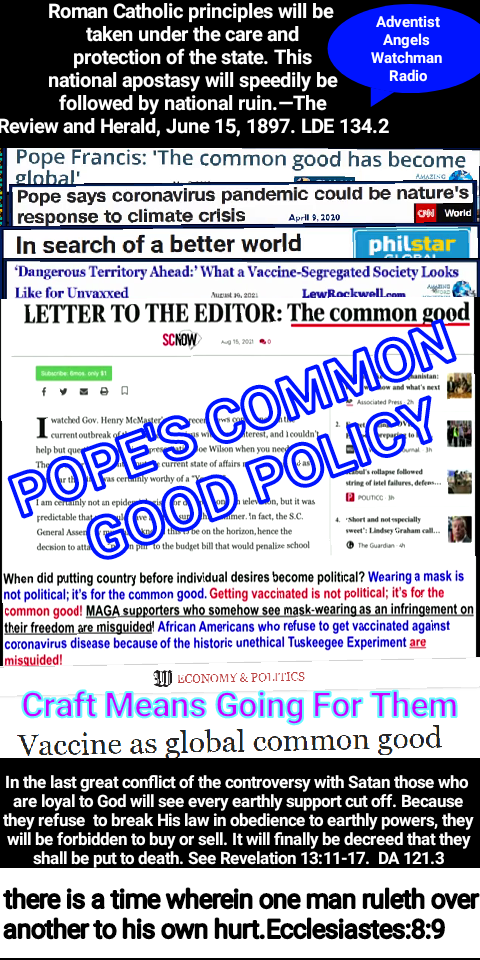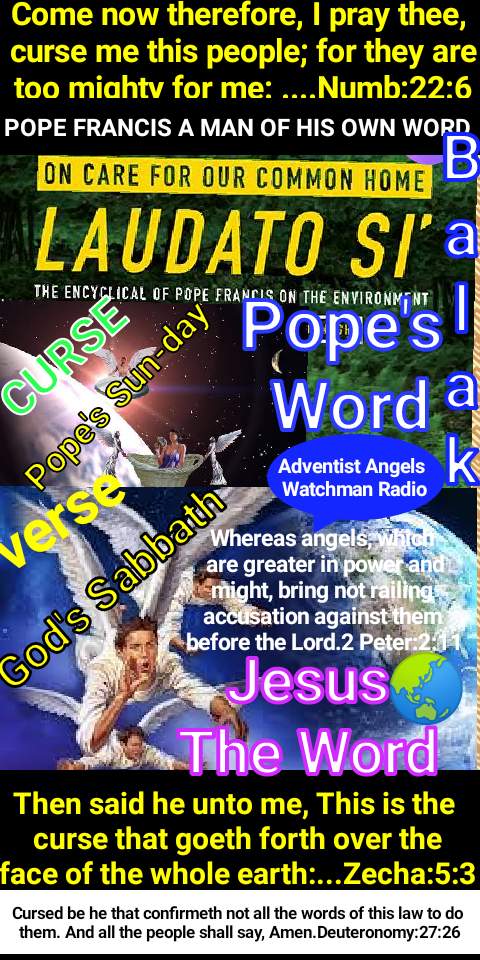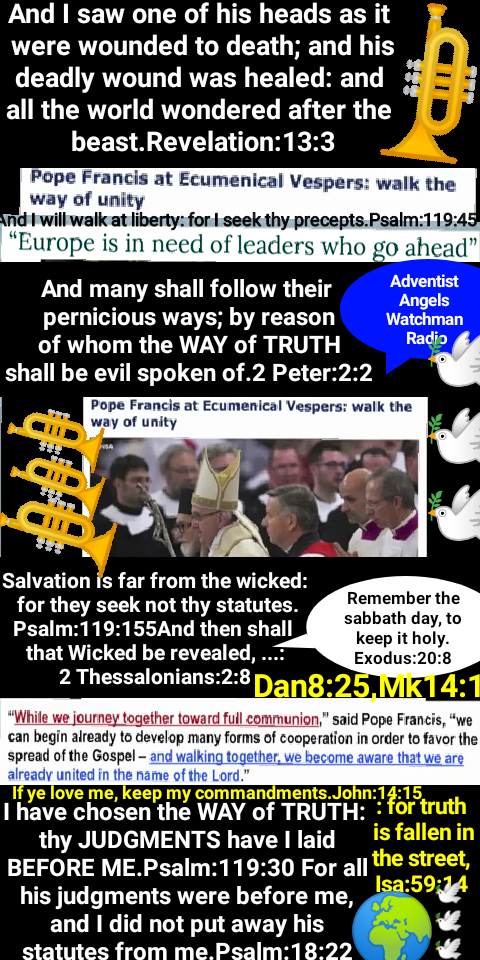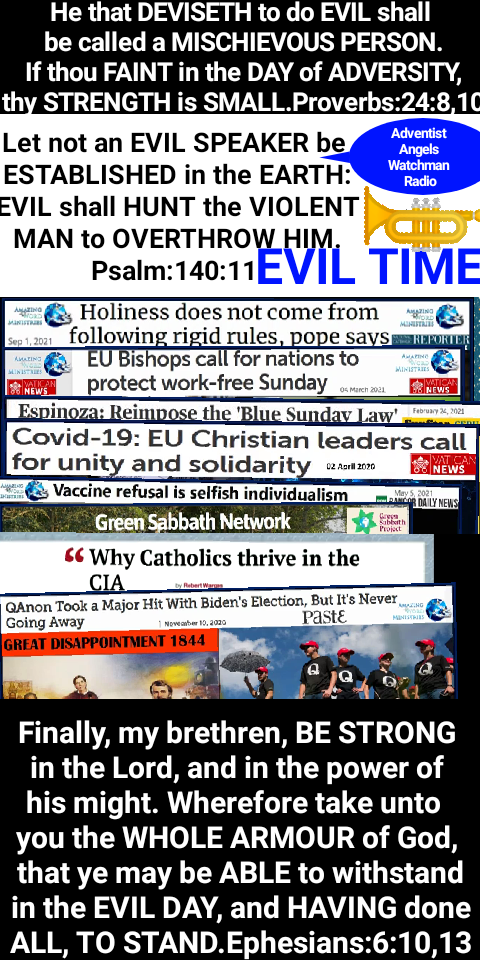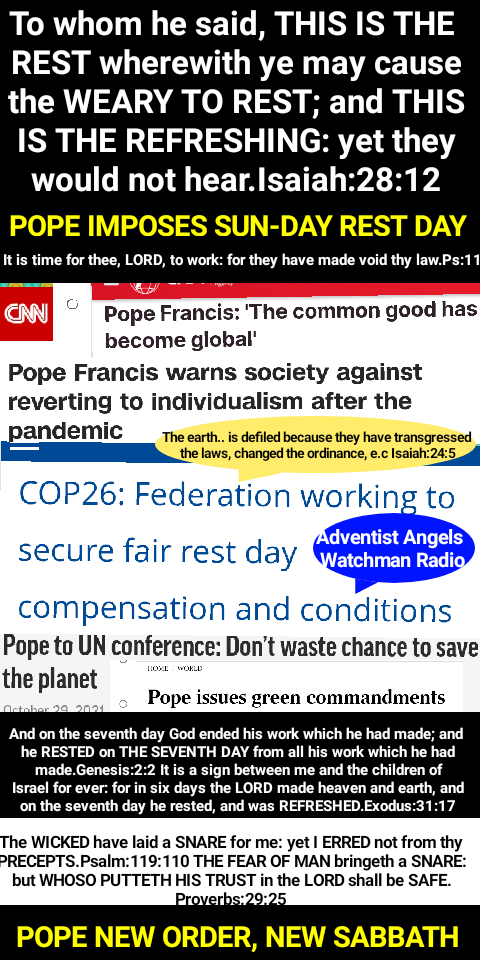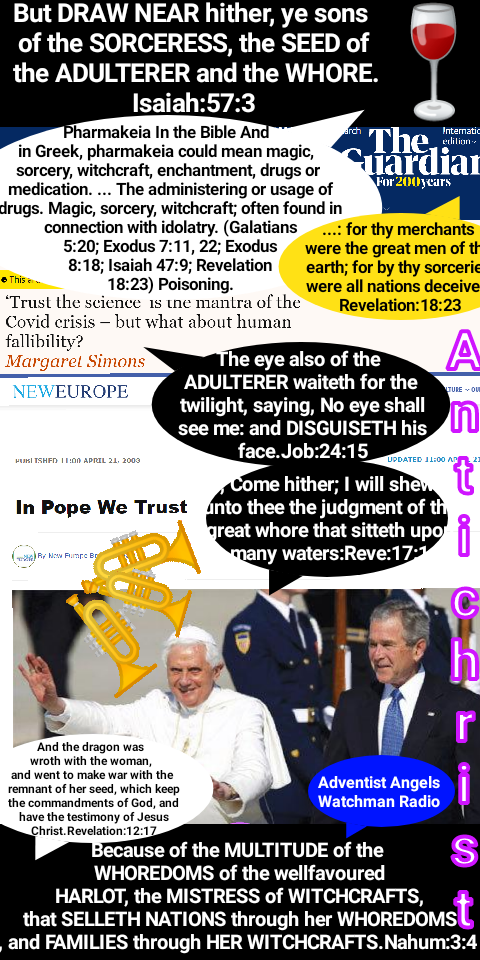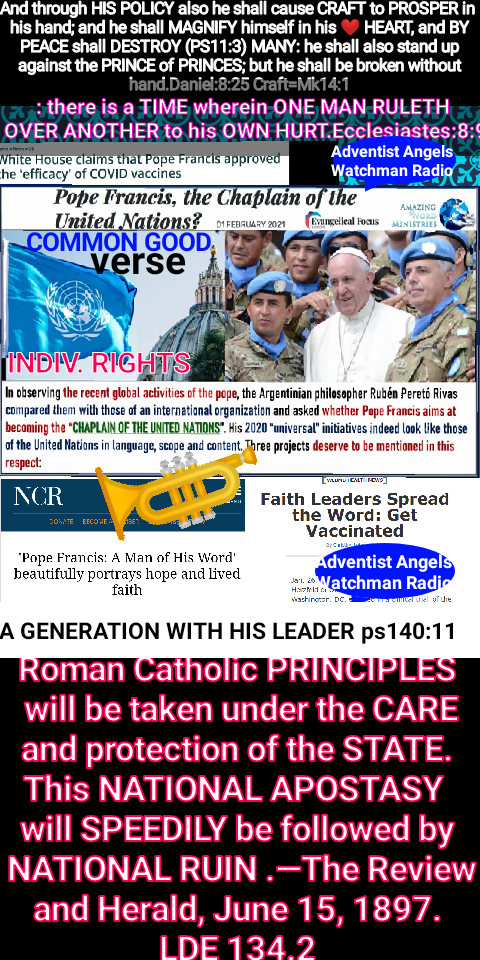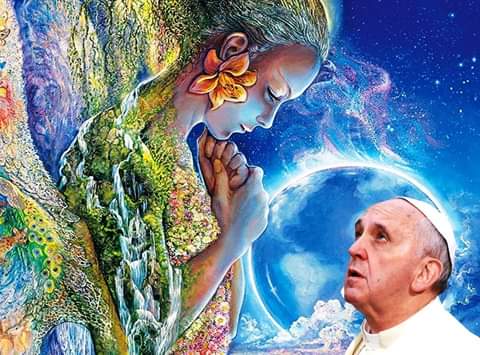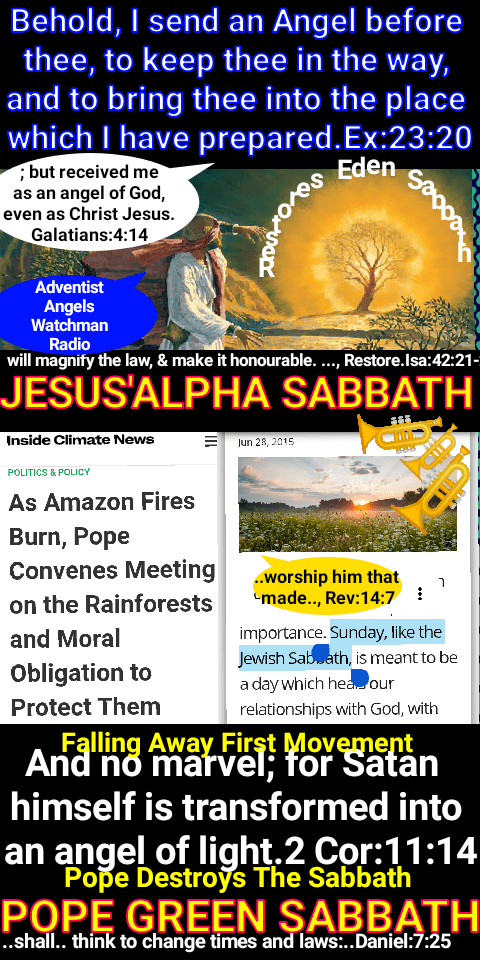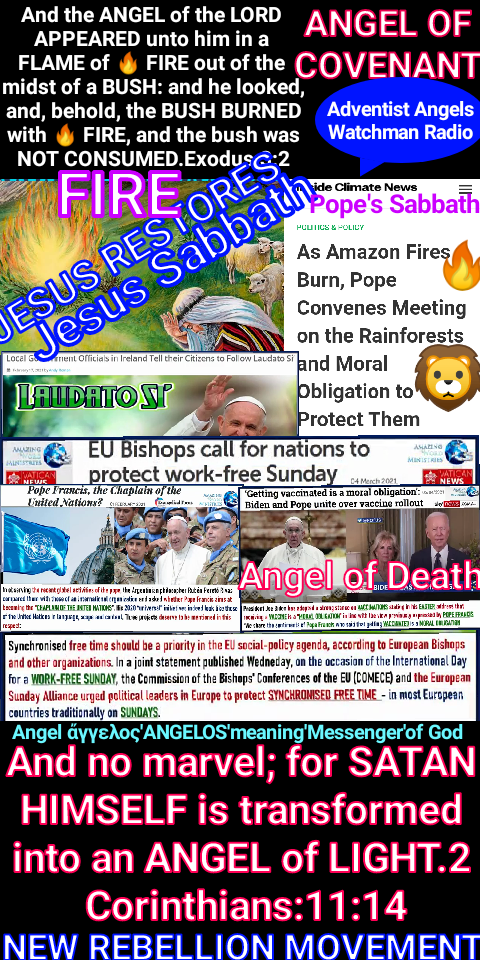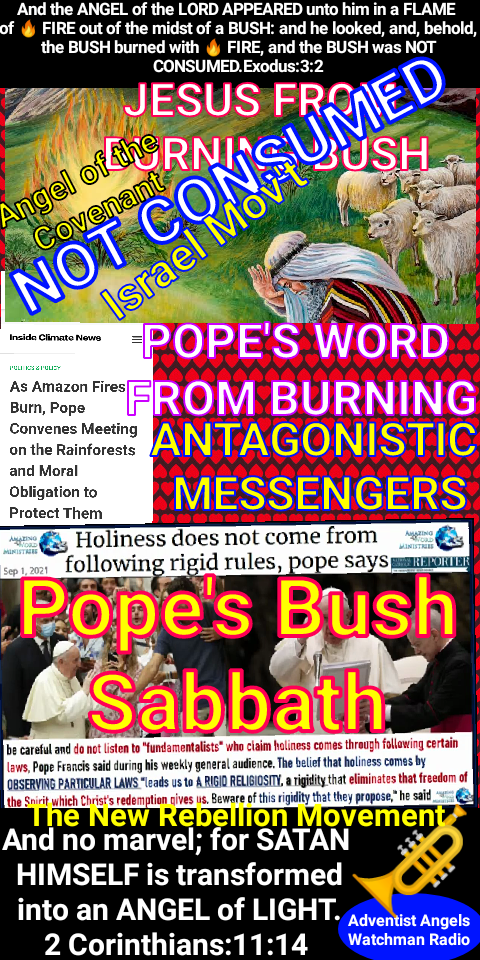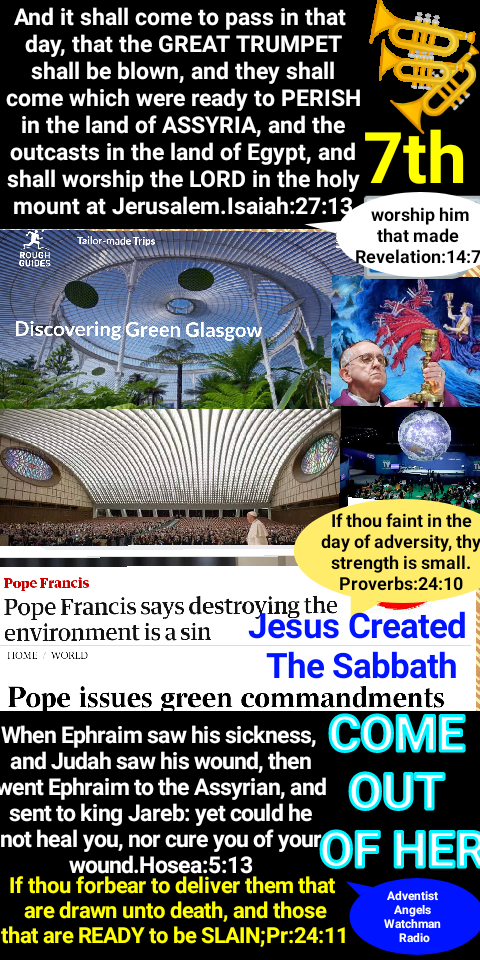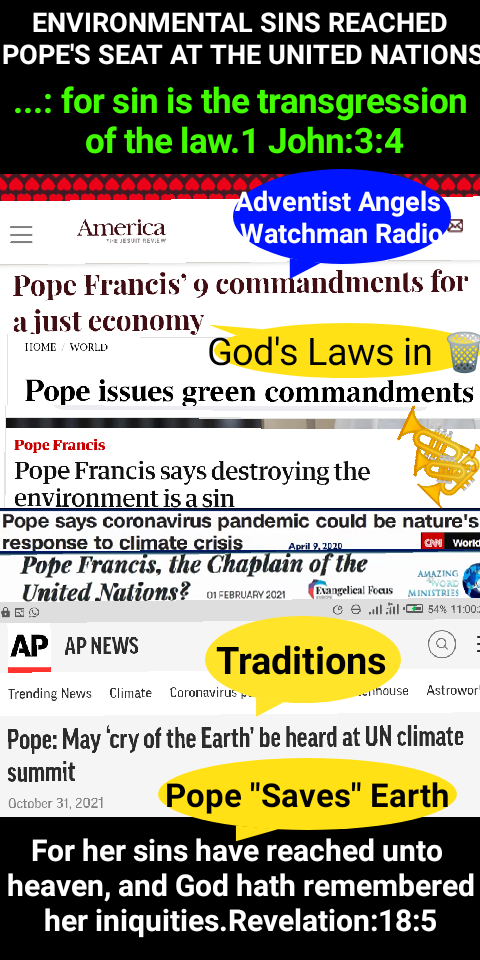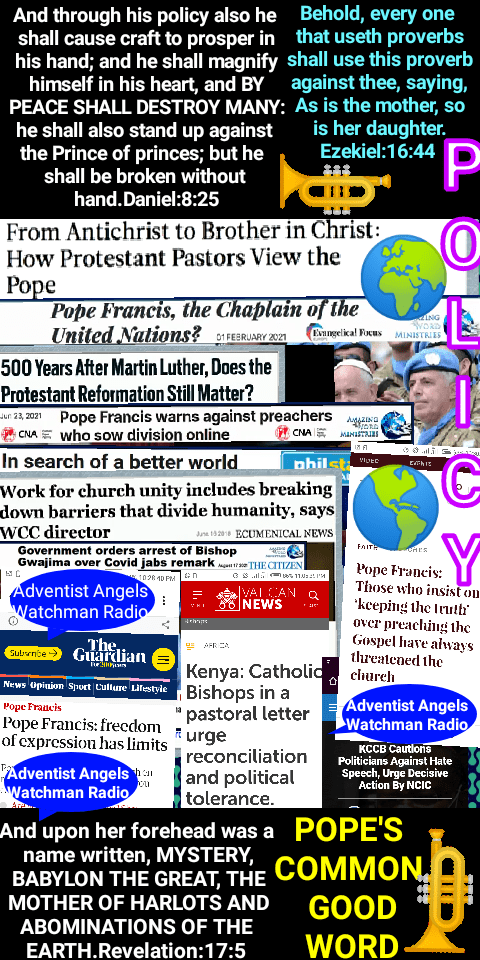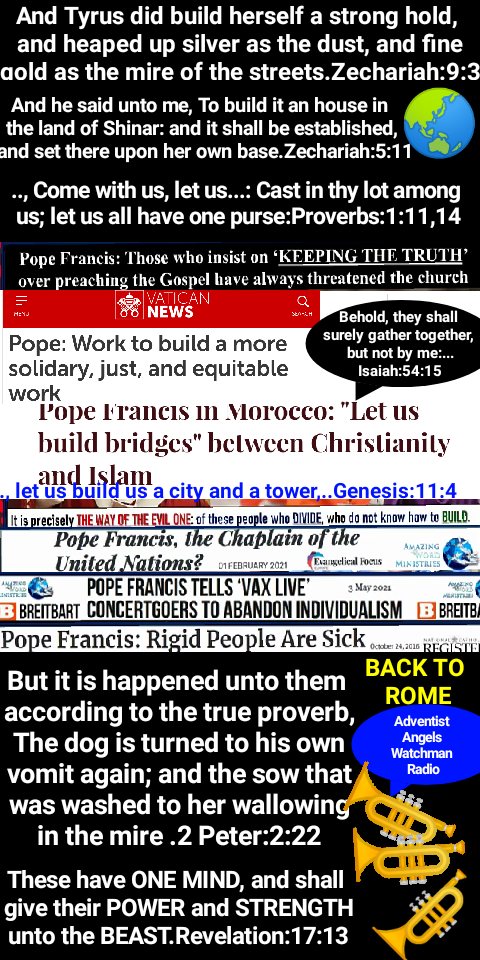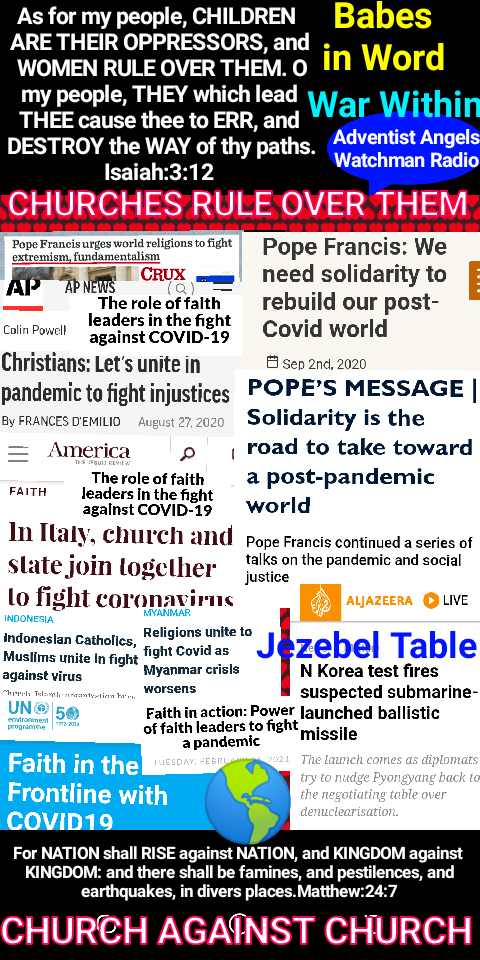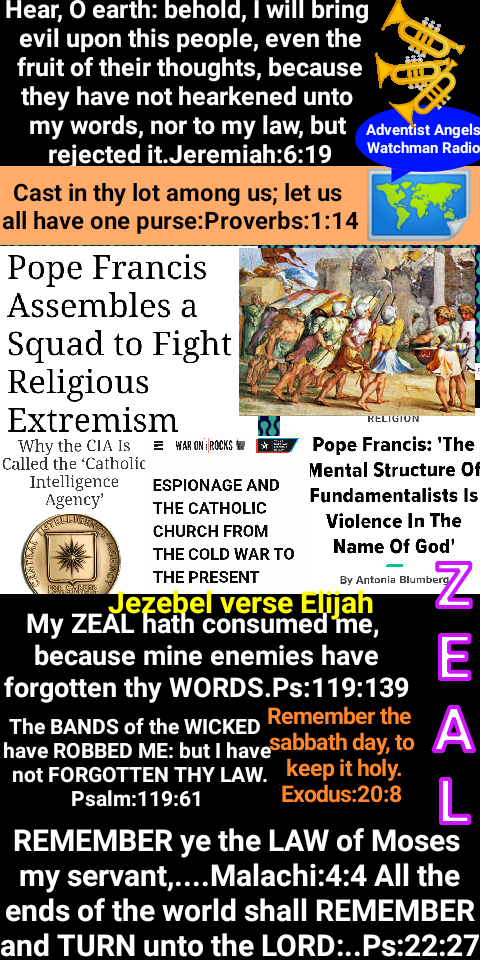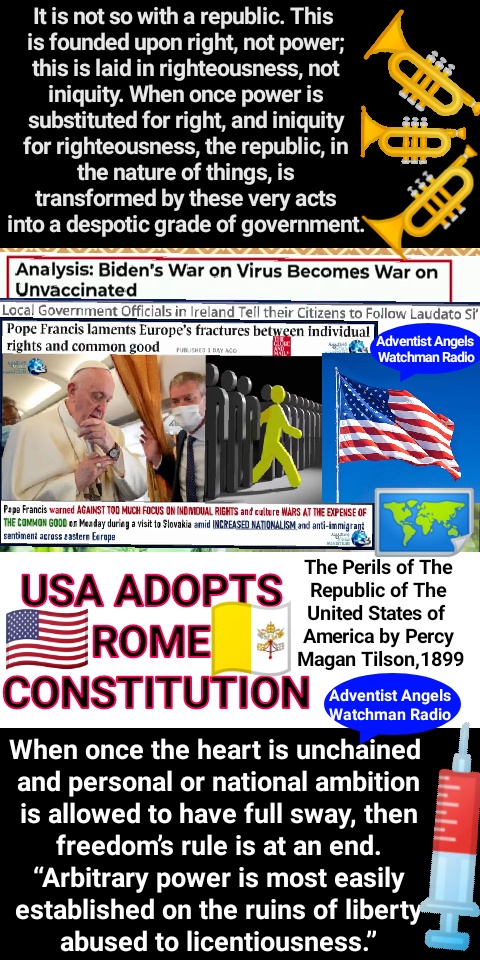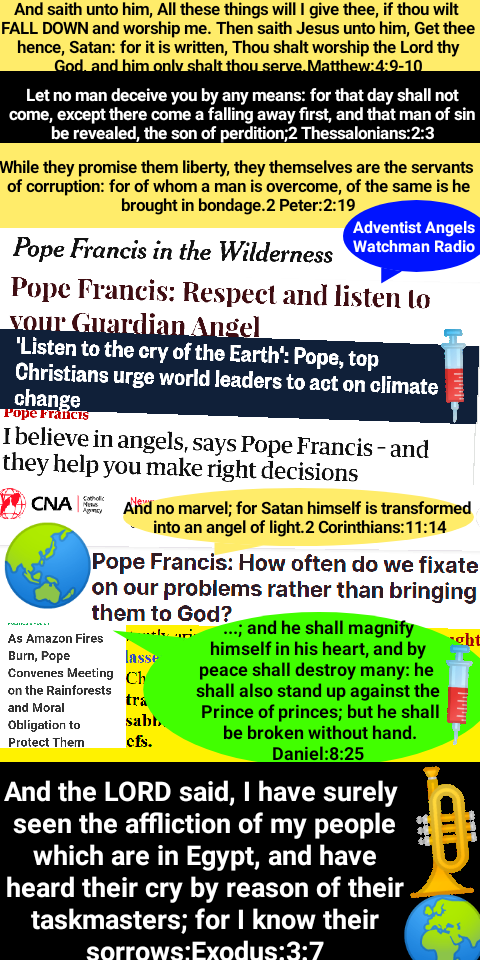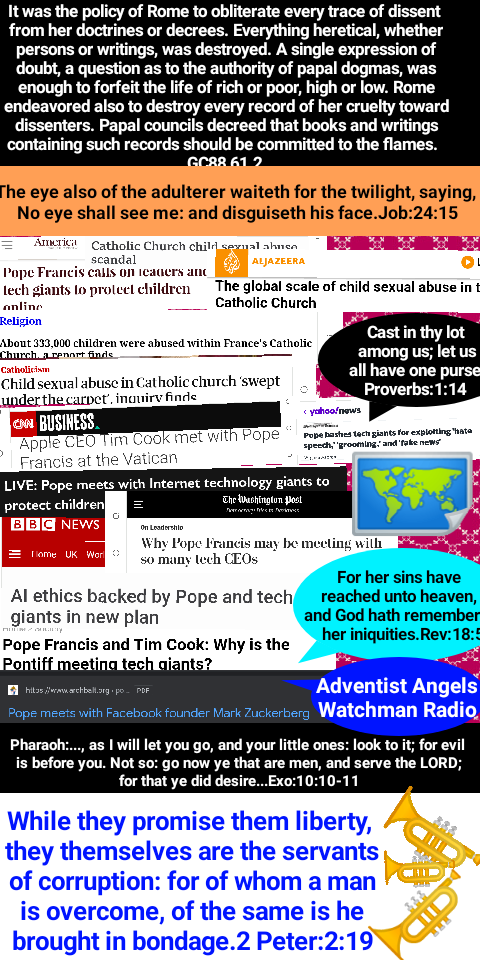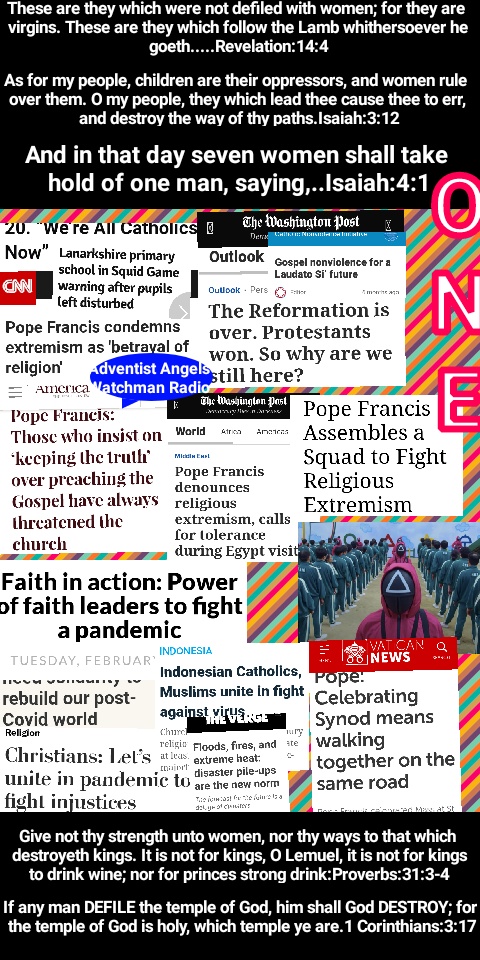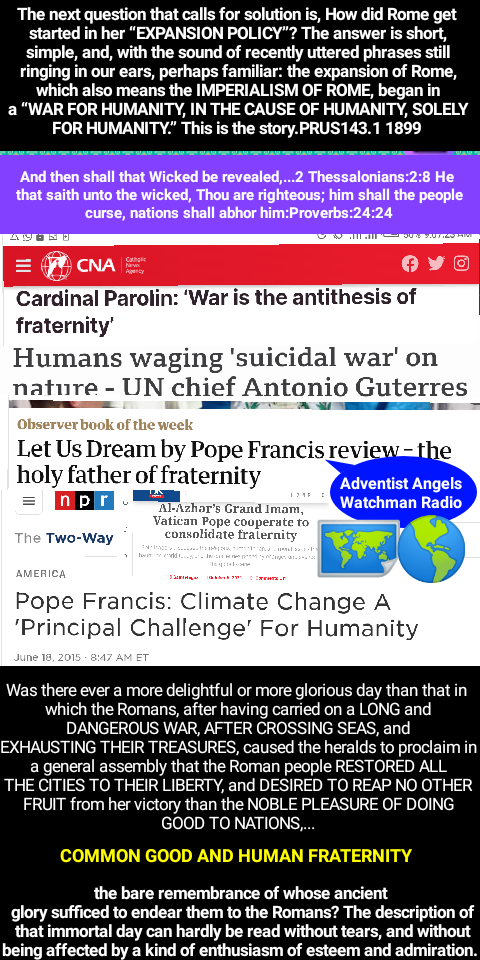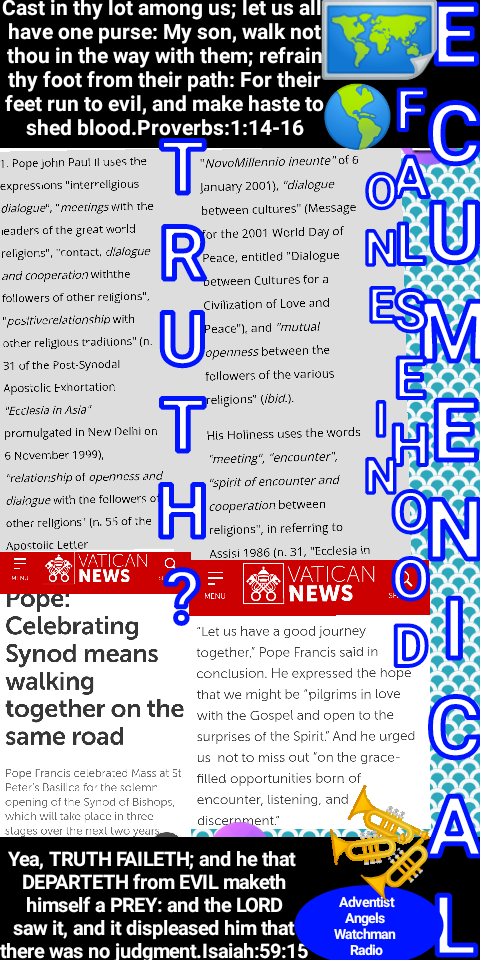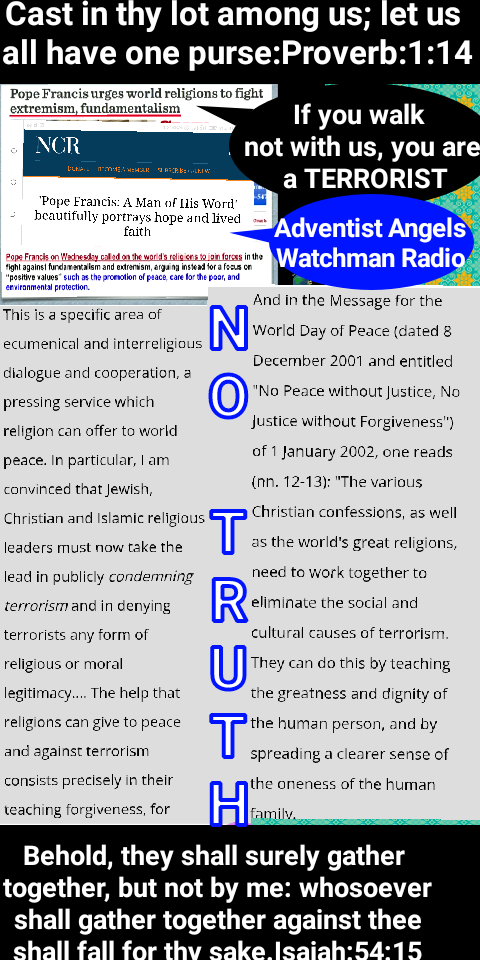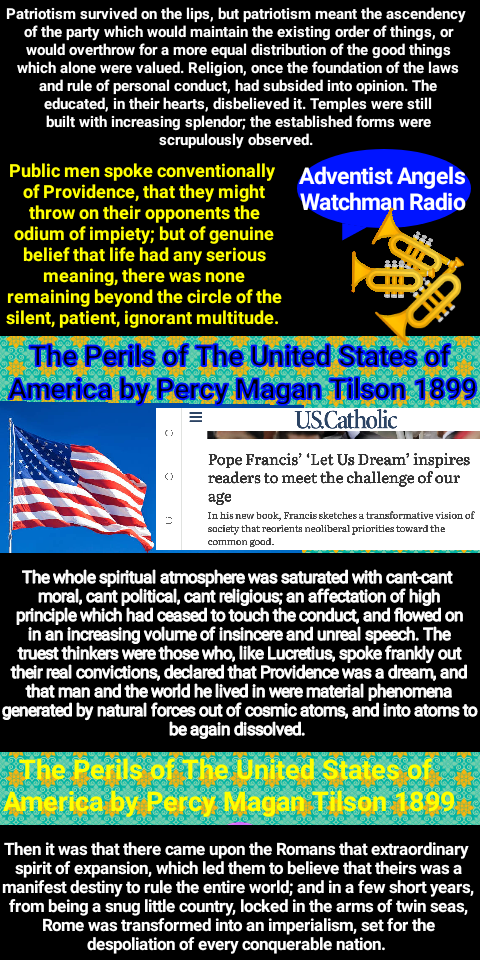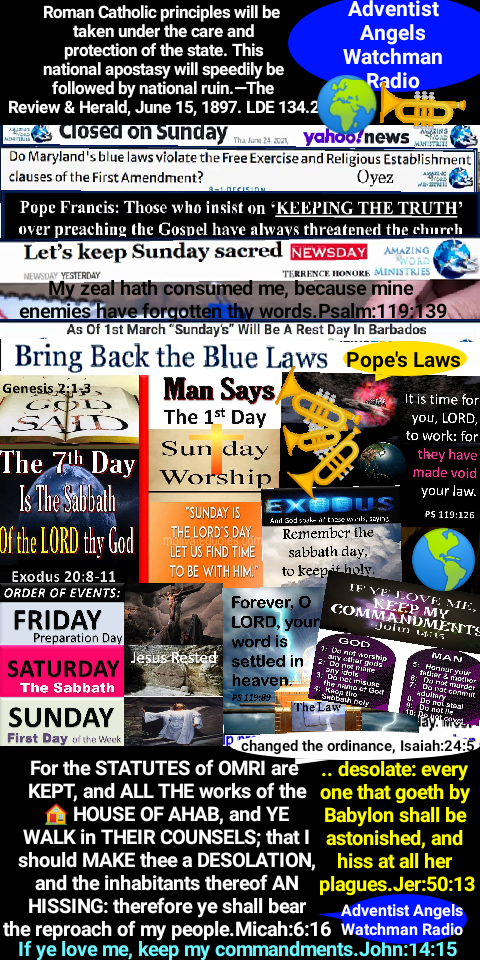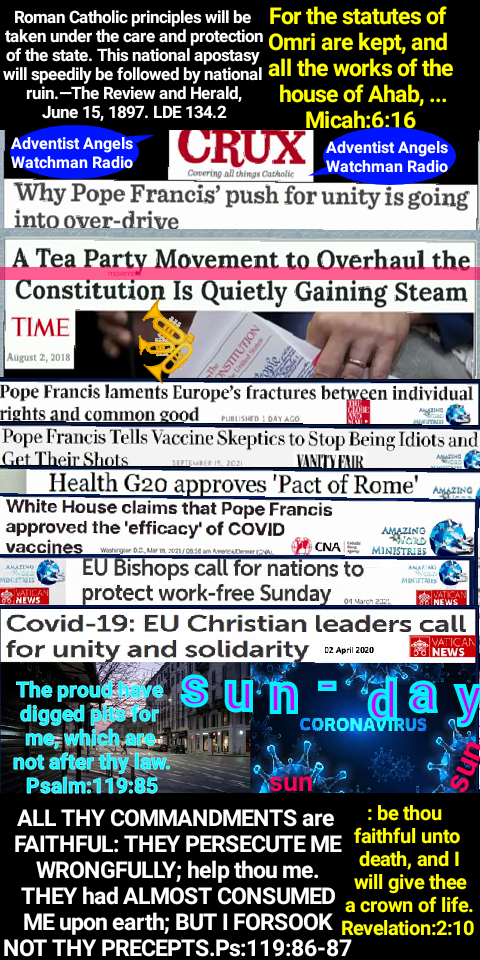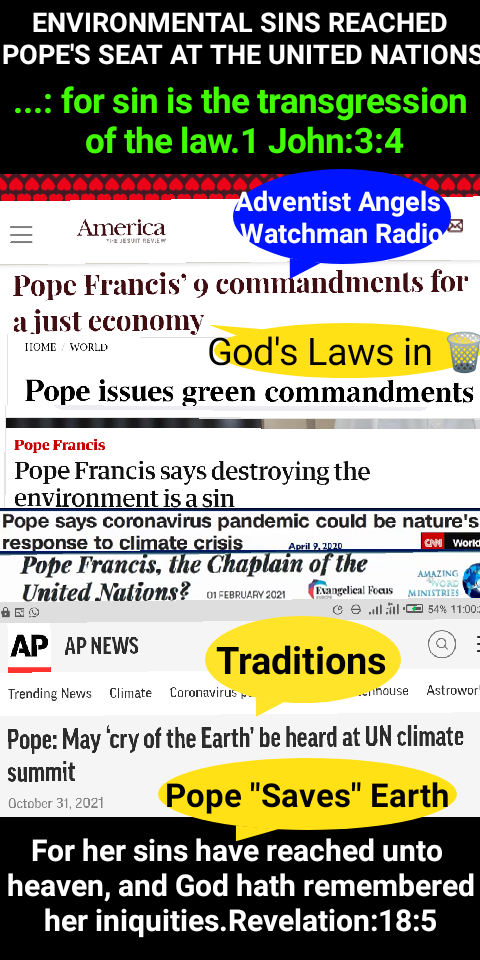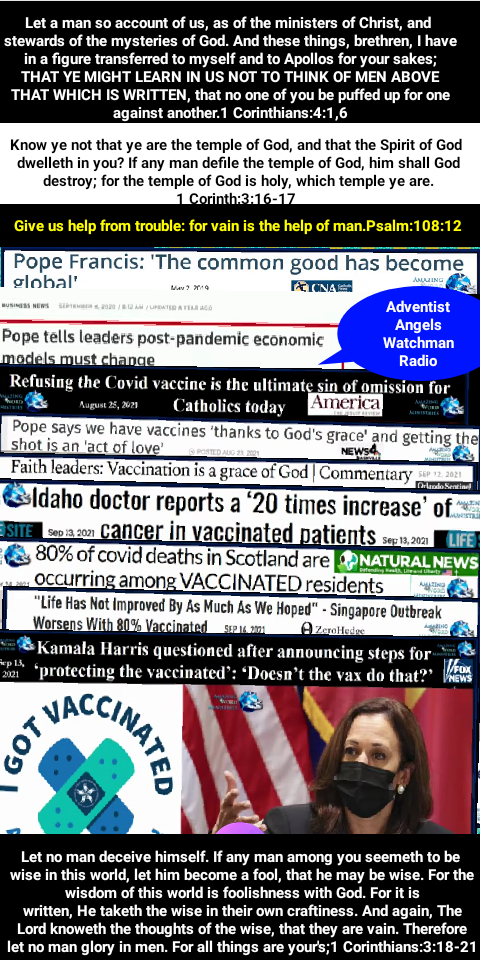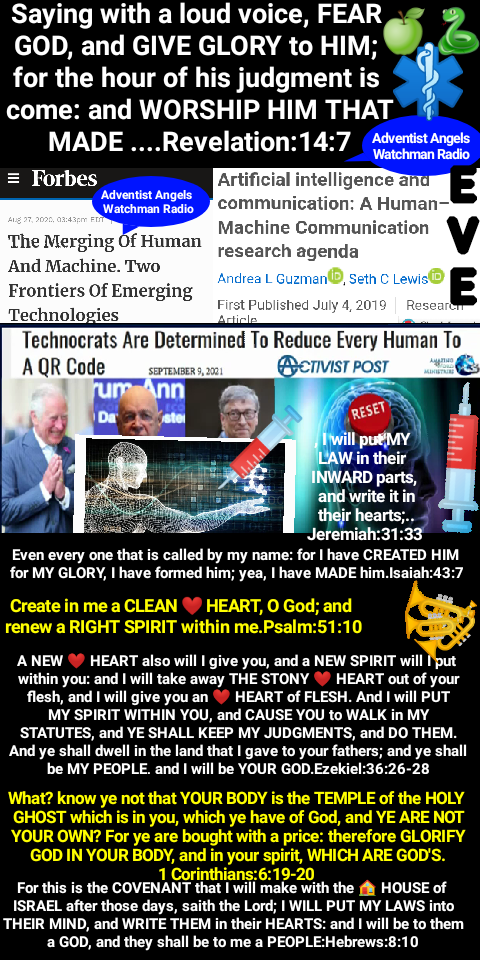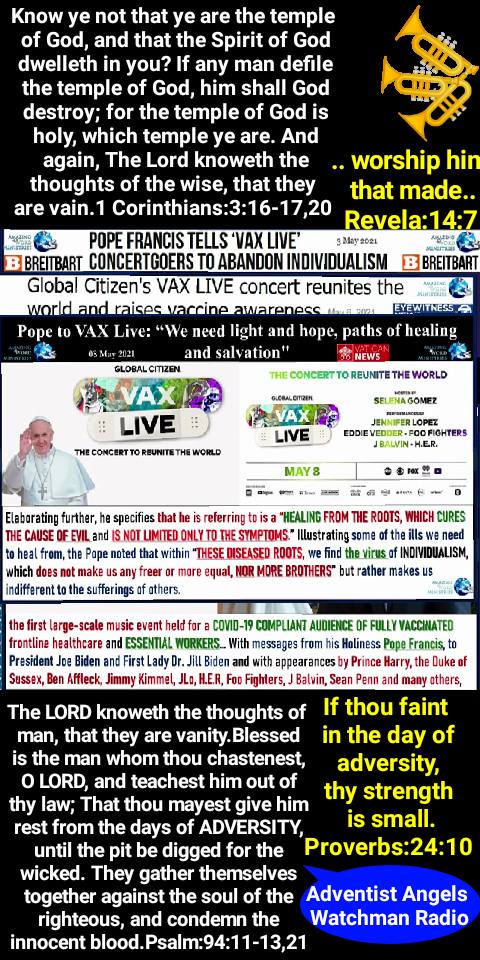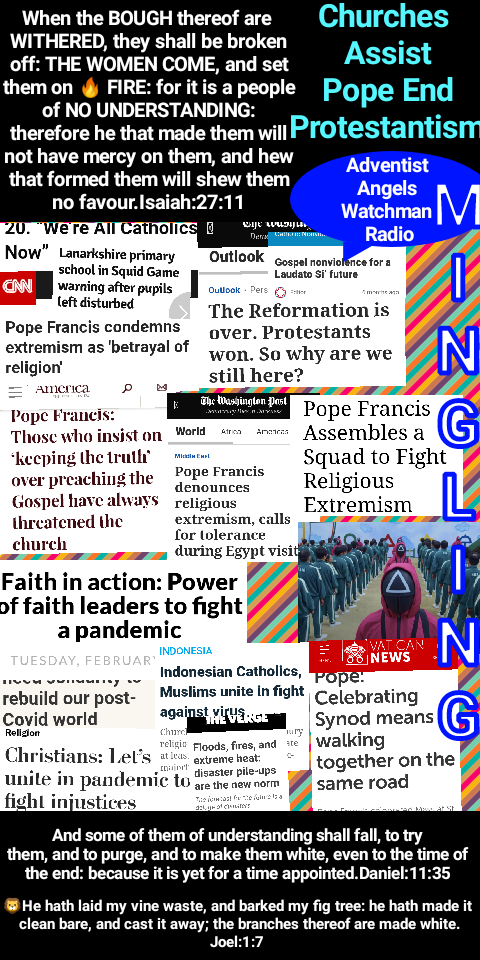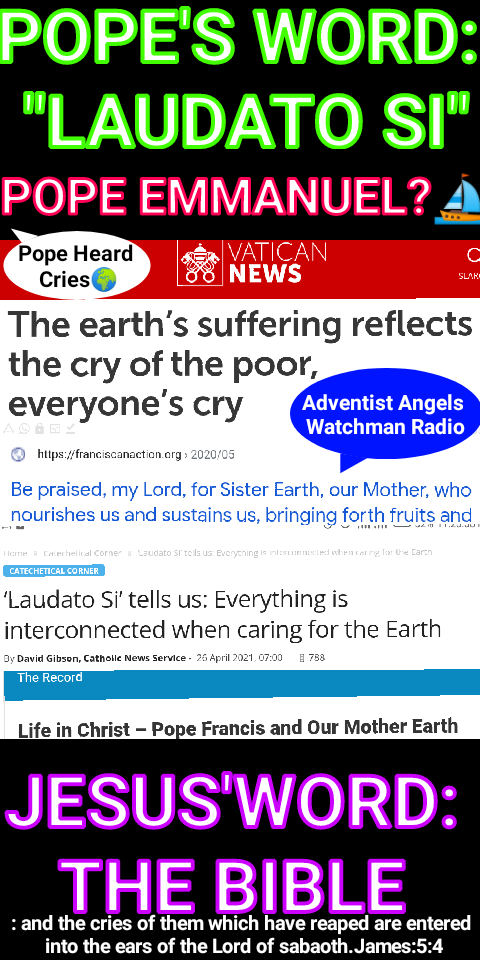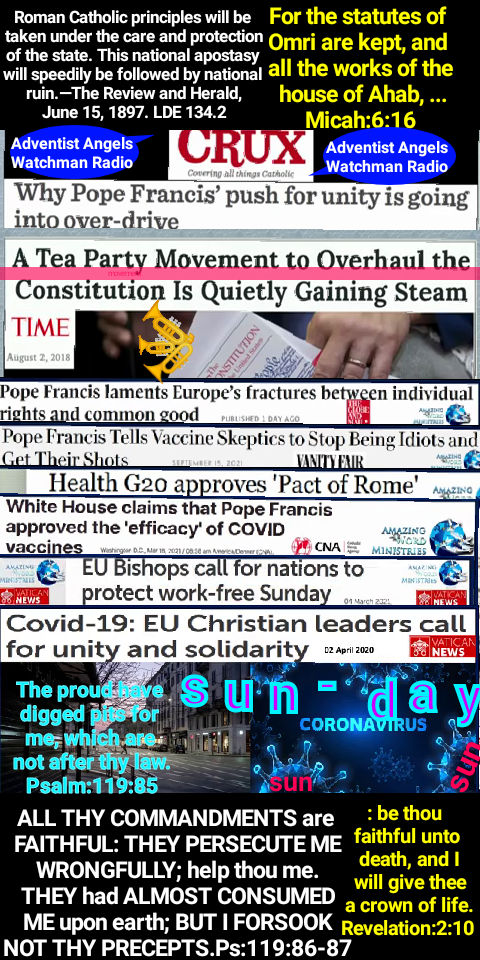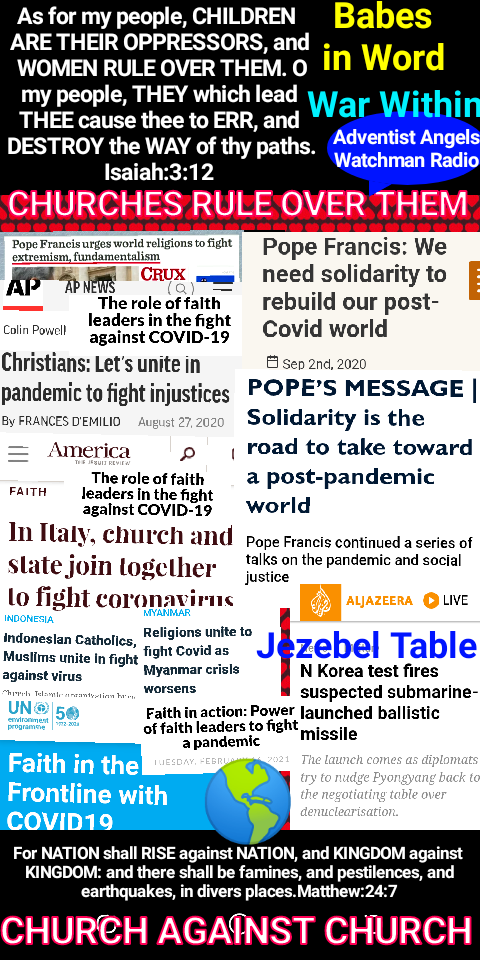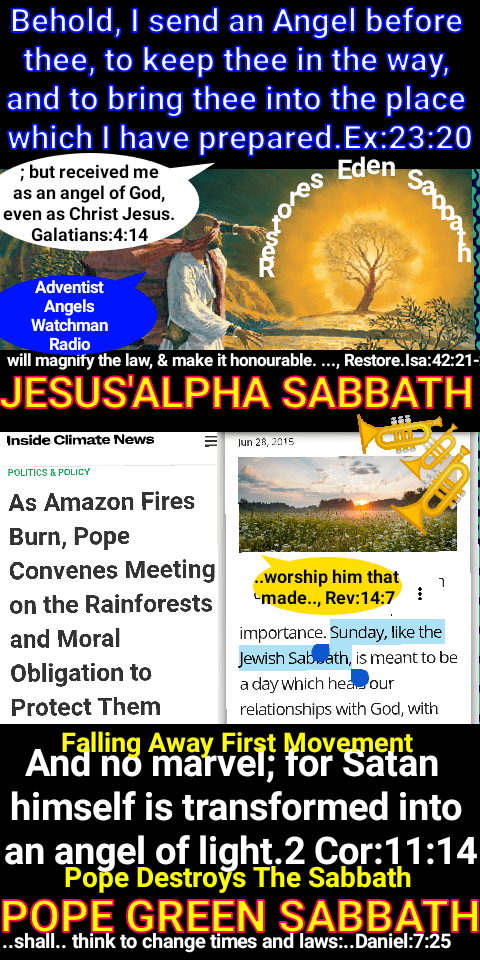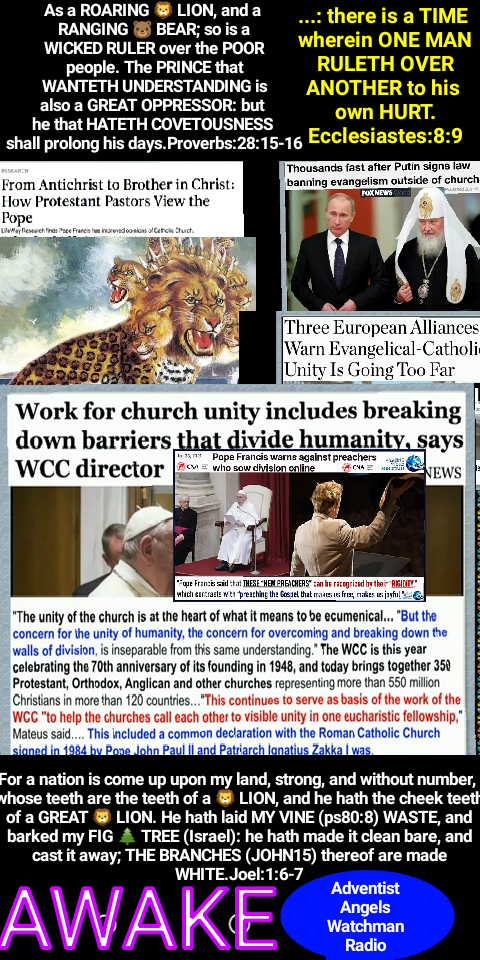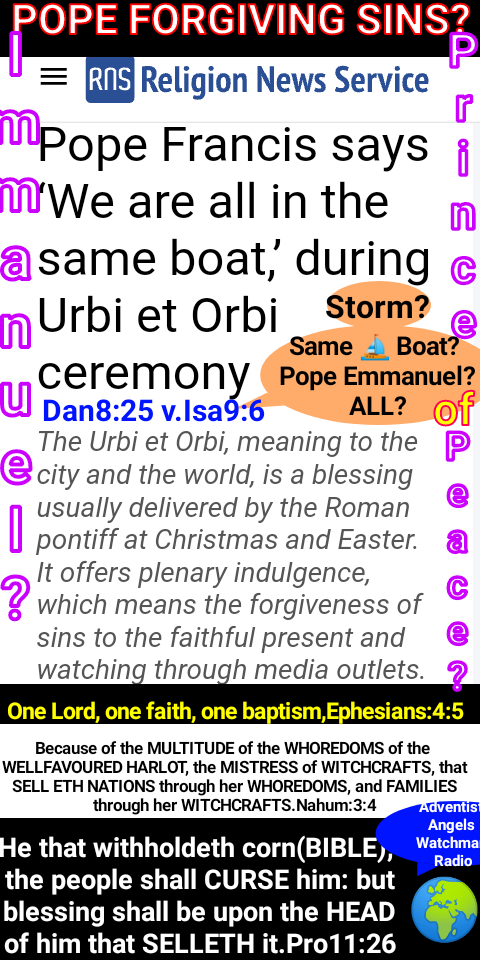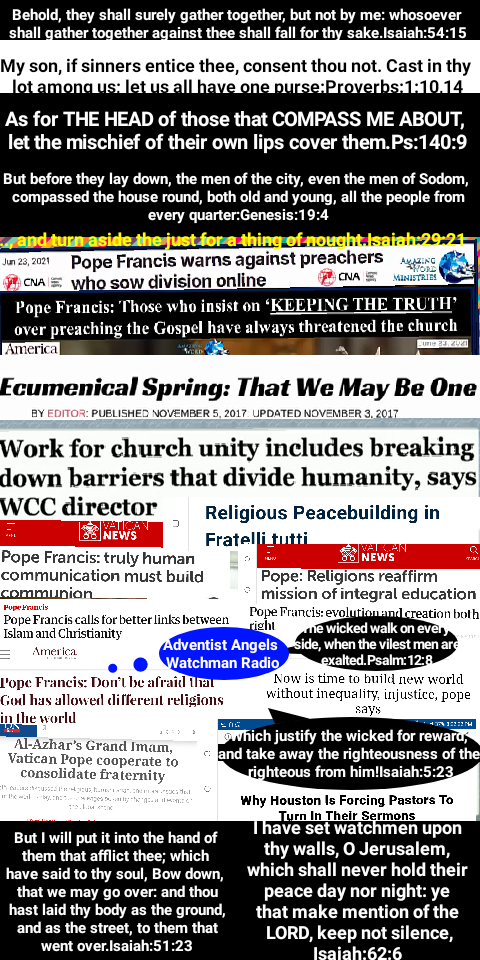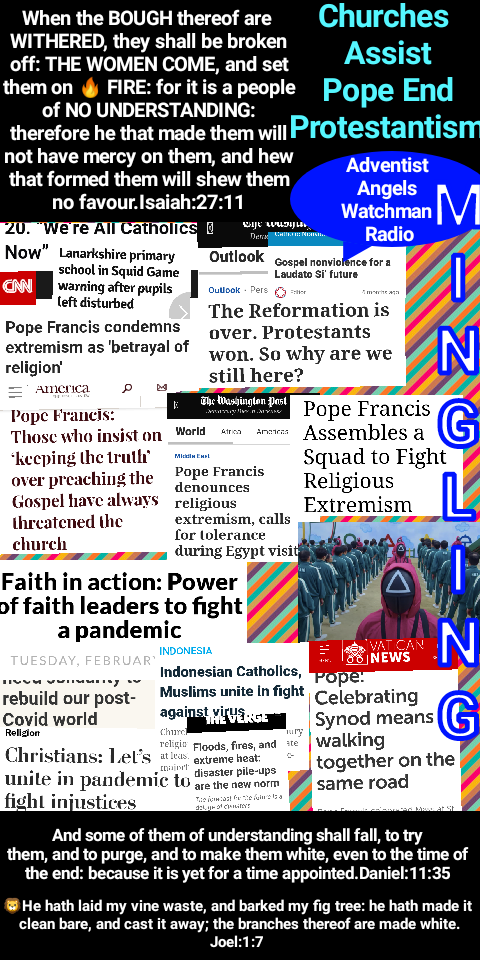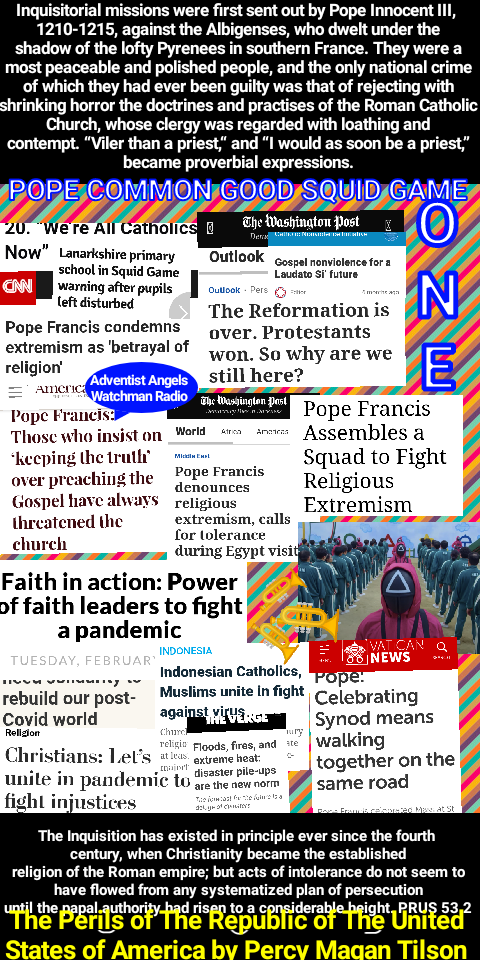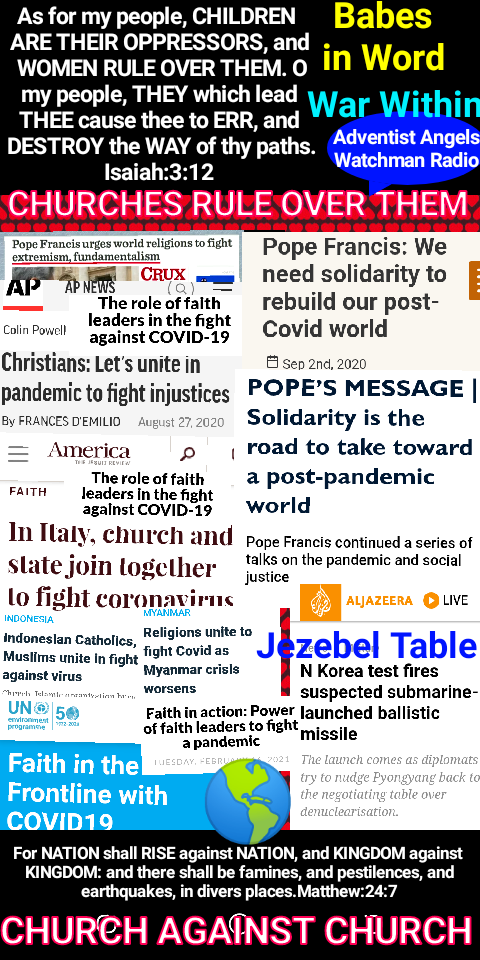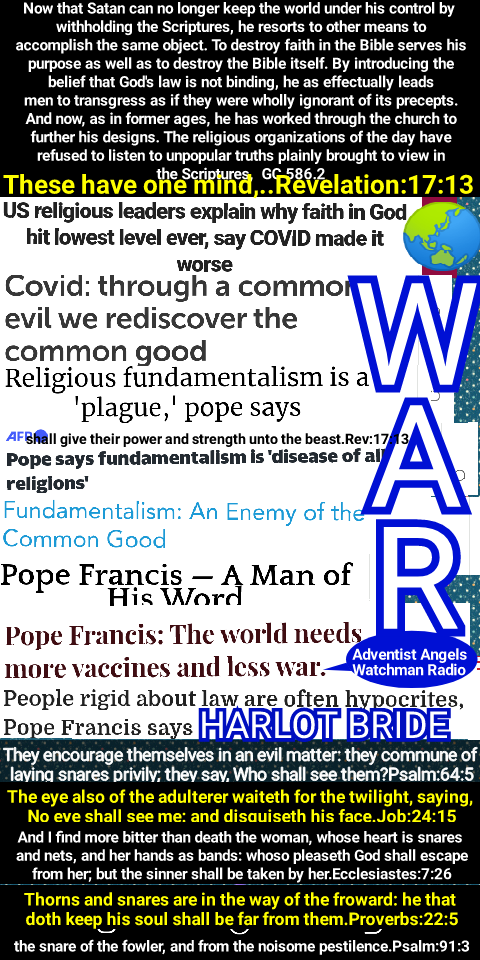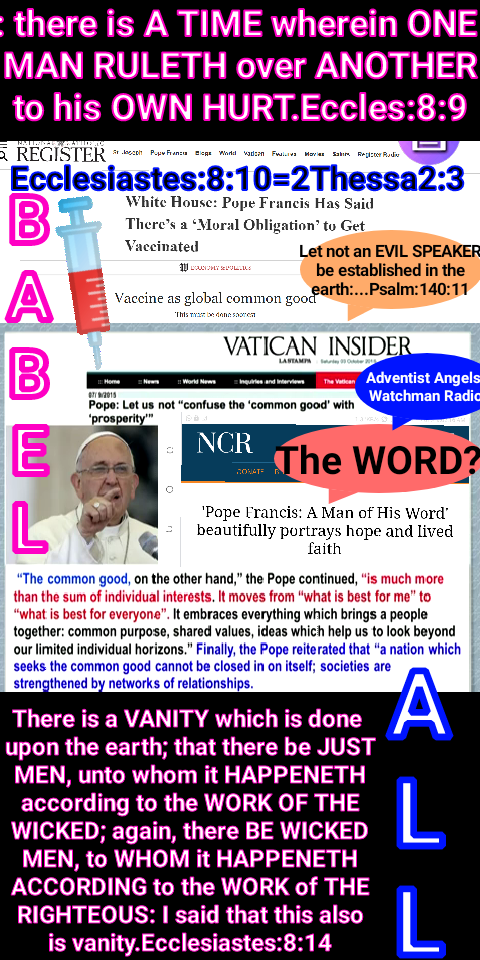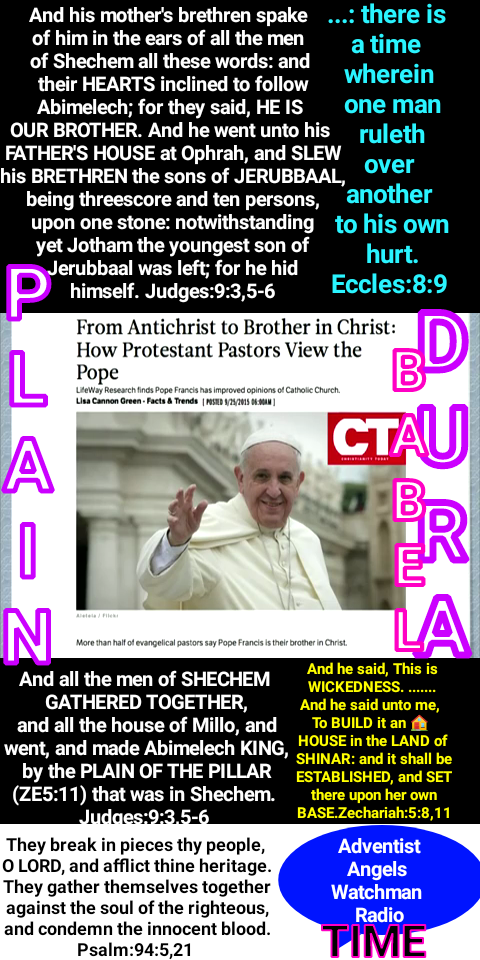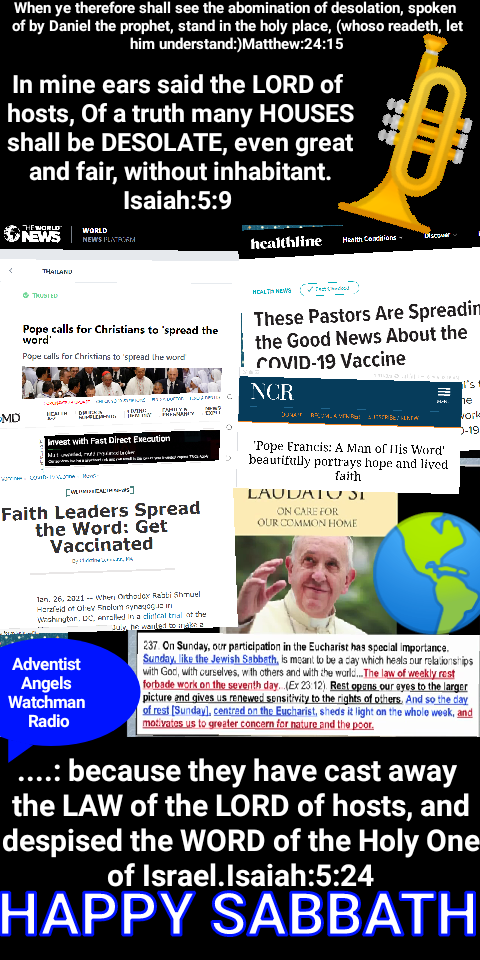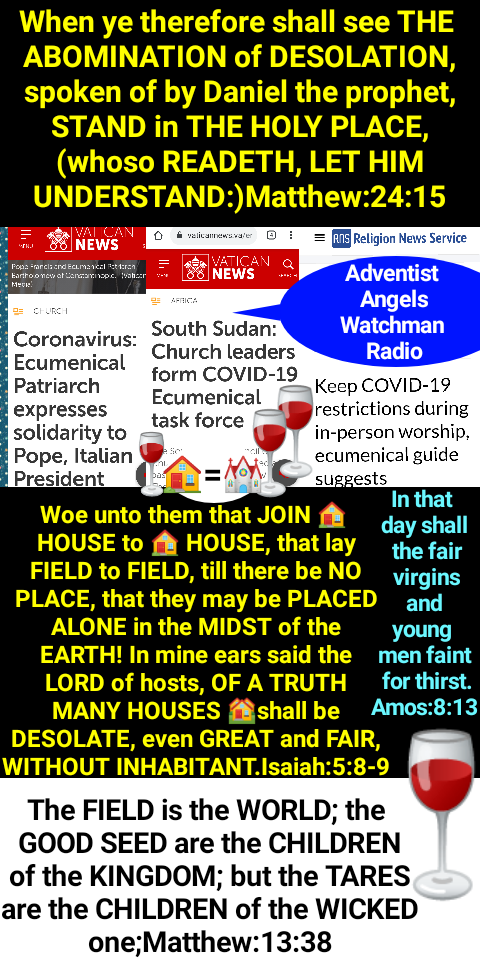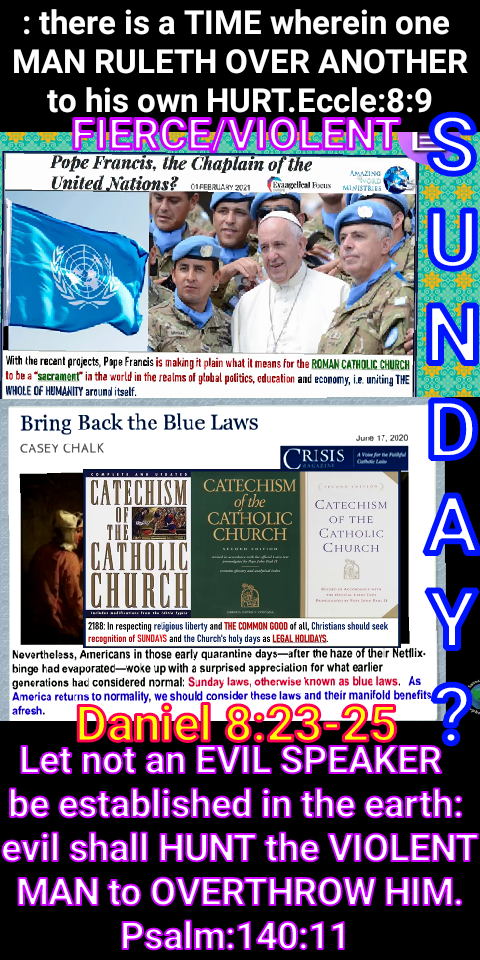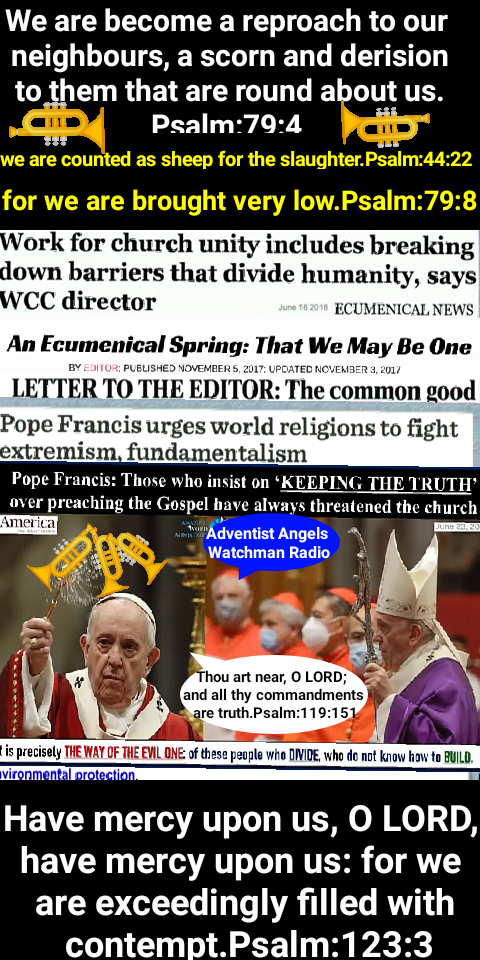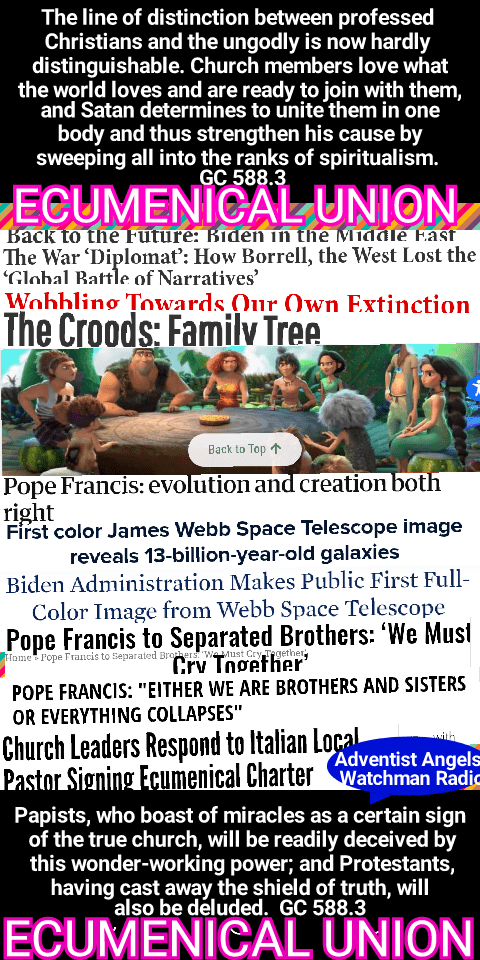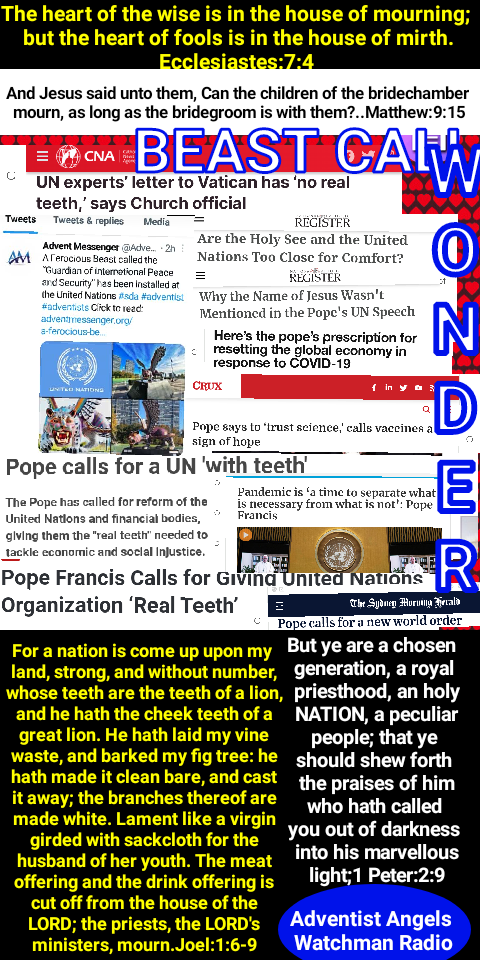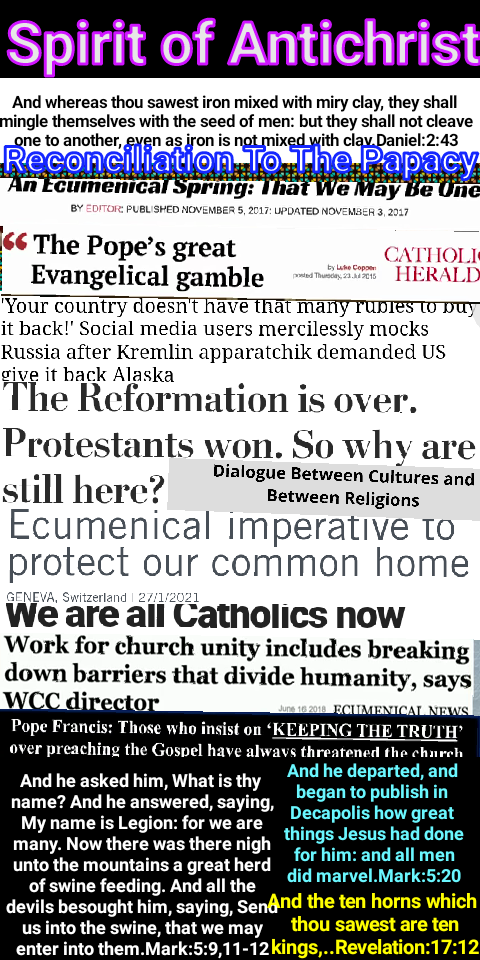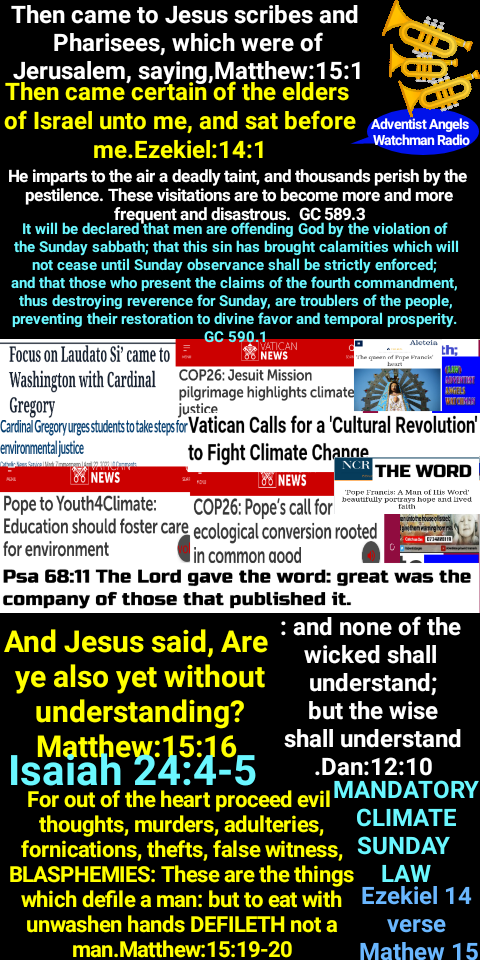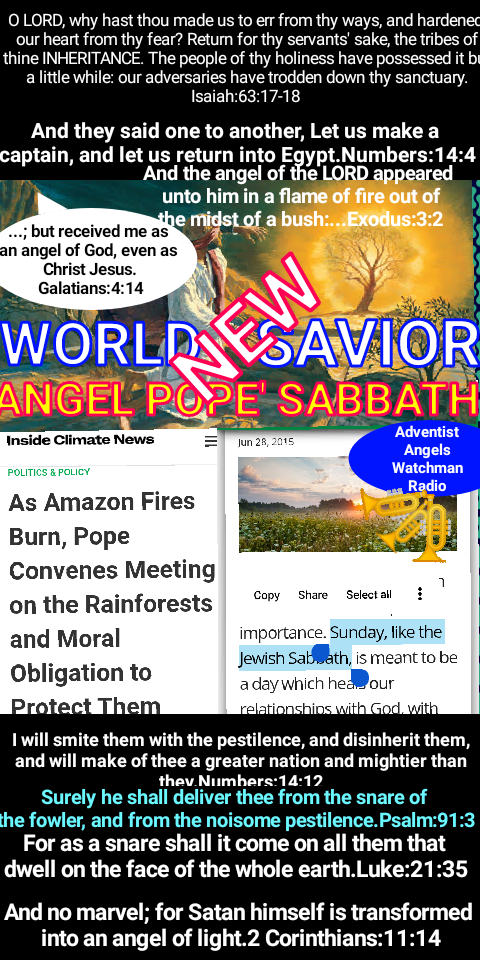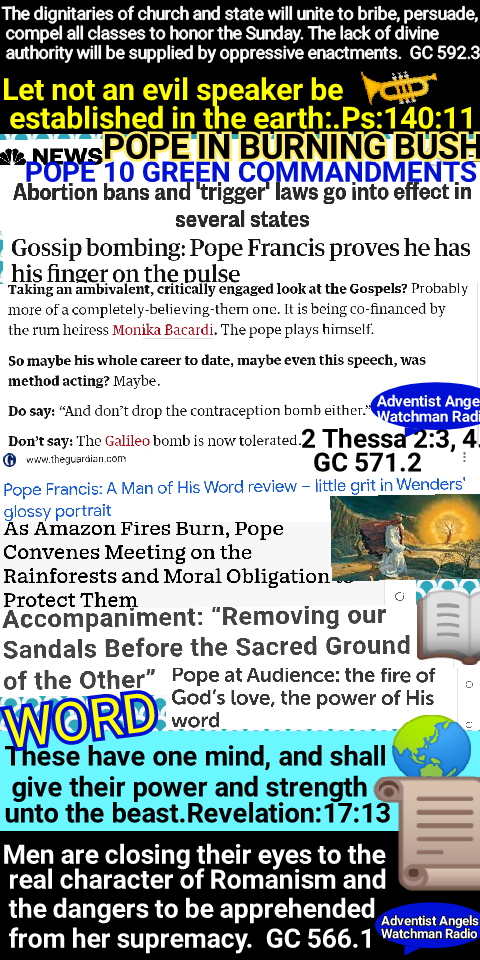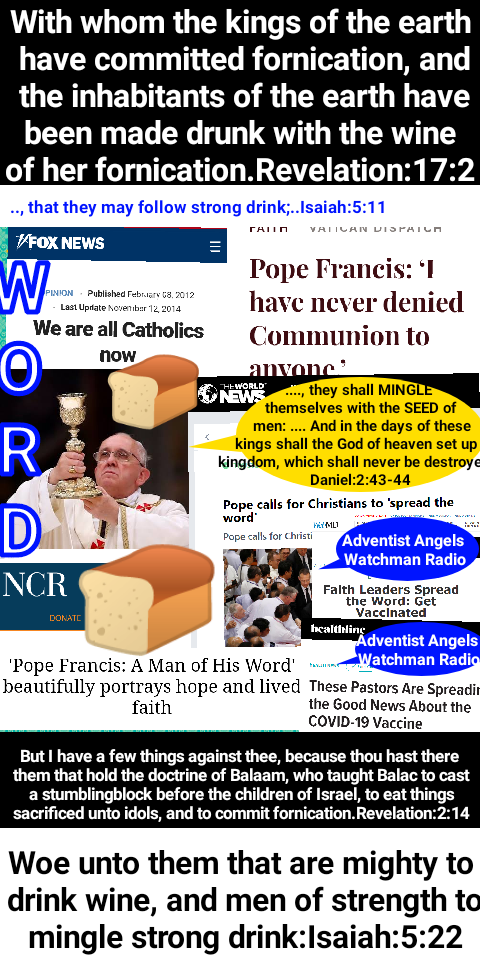

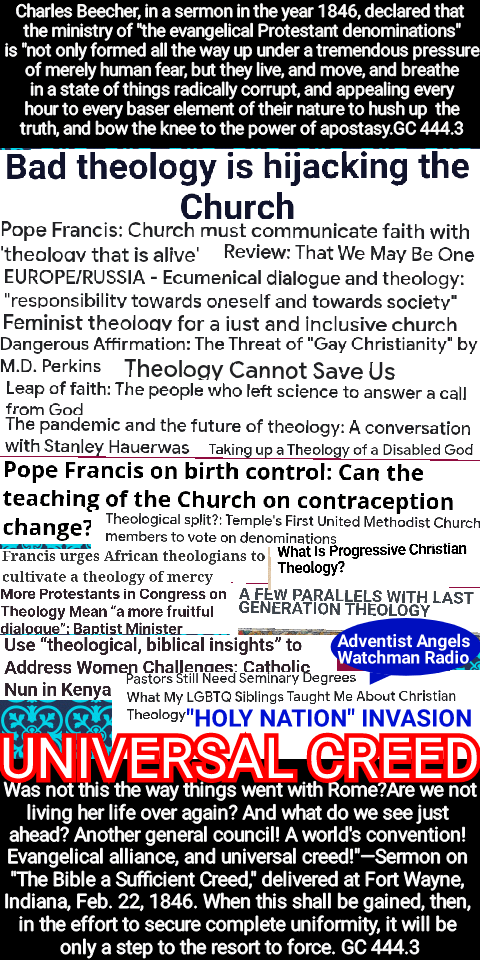
Pope Common Good Global Theology: Inclusive Living Faith, We May Be One, Protestants in Congress to Embrace Fruitful Progressive Theology

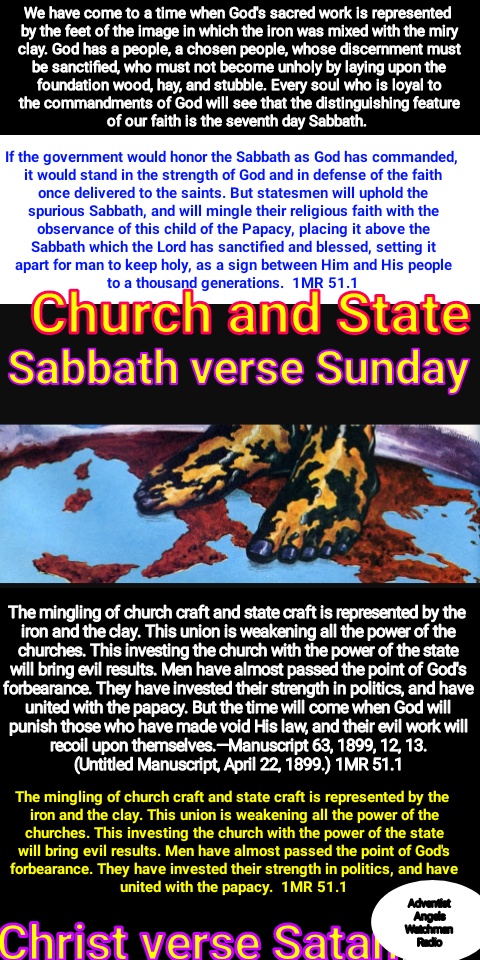
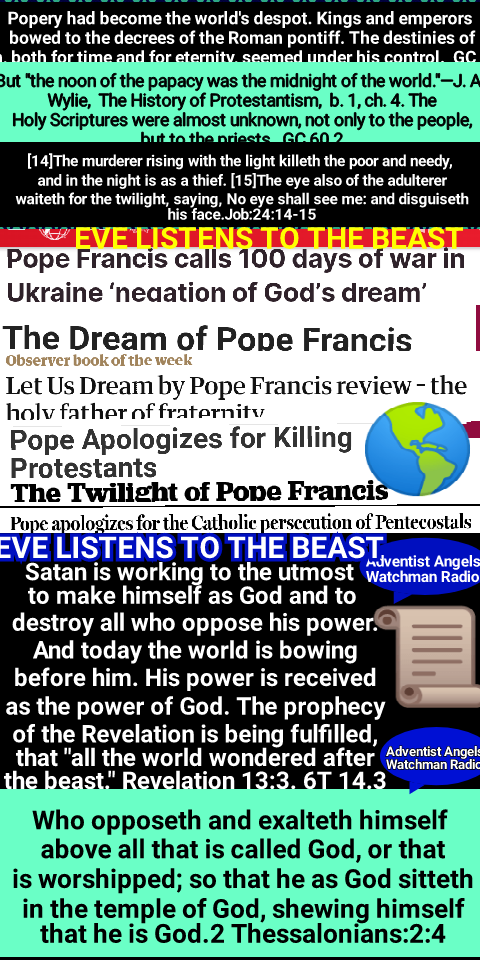
When the early church became corrupted by departing from the simplicity of the gospel and accepting heathen rites and customs, she lost the Spirit and power of God; and in order to control the consciences of the people, she sought the support of the secular power. The result was the papacy, a church that controlled the power of the state and employed it to further her own ends, especially for the punishment of “heresy.” In order for the United States to form an image of the beast, the religious power must so control the civil government that the authority of the state will also be employed by the church to accomplish her own ends.
Whenever the church has obtained secular power, she has employed it to punish dissent from her doctrines. Protestant churches that have followed in the steps of Rome by forming alliance with worldly powers have manifested a similar desire to restrict liberty of conscience. An example of this is given in the long-continued persecution of dissenters by the Church of England. During the sixteenth and seventeenth centuries, thousands of nonconformist ministers were forced to flee from their churches, and many, both of pastors and people, were subjected to fine, imprisonment, torture, and martyrdom.
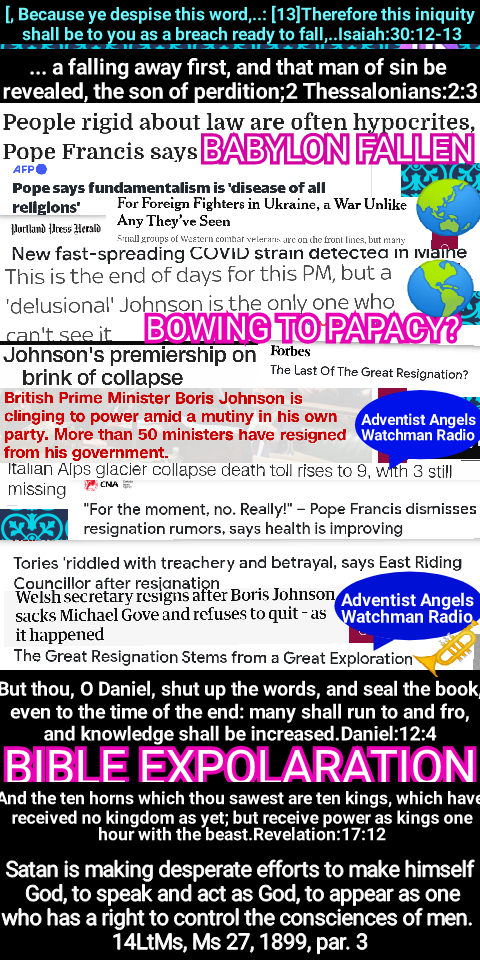
It was apostasy that led the early church to seek the aid of the civil government, and this prepared the way for the development of the papacy—the beast. Said Paul: “There” shall “come a falling away, … and that man of sin be revealed.” 2 Thessalonians 2:3. So apostasy in the church will prepare the way for the image to the beast.
The Bible declares that before the coming of the Lord there will exist a state of religious declension similar to that in the first centuries. “In the last days perilous times shall come. For men shall be lovers of their own selves, covetous, boasters, proud, blasphemers, disobedient to parents, unthankful, unholy, without natural affection, trucebreakers, false accusers, incontinent, fierce, despisers of those that are good, traitors, heady, high-minded, lovers of pleasures more than lovers of God; having a form of godliness, but denying the power thereof.” 2 Timothy 3:1-5. “Now the Spirit speaketh expressly, that in the latter times some shall depart from the faith, giving heed to seducing spirits, and doctrines of devils.” 1 Timothy 4:1. Satan will work “with all power and signs and lying wonders, and with all deceivableness of unrighteousness.” And all that “received not the love of the truth, that they might be saved,” will be left to accept “strong delusion, that they should believe a lie.” 2 Thessalonians 2:9-11. When this state of ungodliness shall be reached, the same results will follow as in the first centuries.
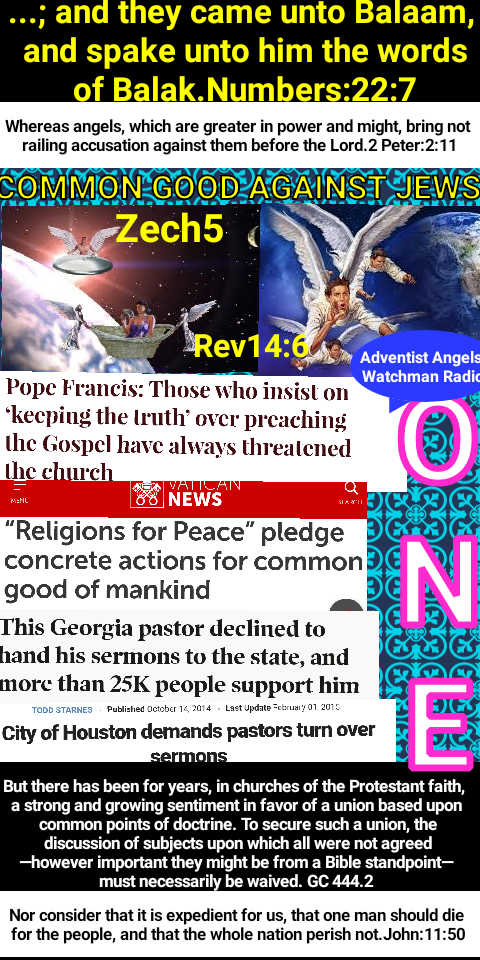
The wide diversity of belief in the Protestant churches is regarded by many as decisive proof that no effort to secure a forced uniformity can ever be made. But there has been for years, in churches of the Protestant faith, a strong and growing sentiment in favor of a union based upon common points of doctrine. To secure such a union, the discussion of subjects upon which all were not agreed—however important they might be from a Bible standpoint—must necessarily be waived.
Charles Beecher, in a sermon in the year 1846, declared that the ministry of “the evangelical Protestant denominations” is “not only formed all the way up under a tremendous pressure of merely human fear, but they live, and move, and breathe in a state of things radically corrupt, and appealing every hour to every baser element of their nature to hush up the truth, and bow the knee to the power of apostasy. Was not this the way things went with Rome? Are we not living her life over again? And what do we see just ahead? Another general council! A world’s convention! Evangelical alliance, and universal creed!”—Sermon on “The Bible a Sufficient Creed,” delivered at Fort Wayne, Indiana, Feb. 22, 1846. When this shall be gained, then, in the effort to secure complete uniformity, it will be only a step to the resort to force.
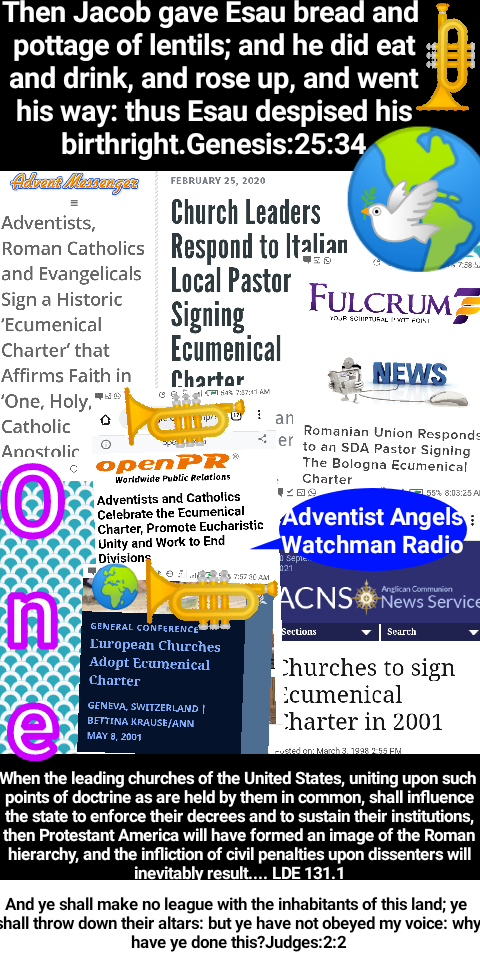
When the leading churches of the United States, uniting upon such points of doctrine as are held by them in common, shall influence the state to enforce their decrees and to sustain their institutions, then Protestant America will have formed an image of the Roman hierarchy, and the infliction of civil penalties upon dissenters will inevitably result.
The beast with two horns “causeth commands all, both small and great, rich and poor, free and bond, to receive a mark in their right hand, or in their foreheads: and that no man might buy or sell, save he that had the mark, or the name of the beast, or the number of his name.” Revelation 13:16, 17. The third angel’s warning is: “If any man worship the beast and his image, and receive his mark in his forehead, or in his hand, the same shall drink of the wine of the wrath of God.” “The beast” mentioned in this message, whose worship is enforced by the two-horned beast, is the first, or leopardlike beast of Revelation 13—the papacy. The “image to the beast” represents that form of apostate Protestantism which will be developed when the Protestant churches shall seek the aid of the civil power for the enforcement of their dogmas. The “mark of the beast” still remains to be defined.
After the warning against the worship of the beast and his image the prophecy declares: “Here are they that keep the commandments of God, and the faith of Jesus.” Since those who keep God’s commandments are thus placed in contrast with those that worship the beast and his image and receive his mark, it follows that the keeping of God’s law, on the one hand, and its violation, on the other, will make the distinction between the worshipers of God and the worshipers of the beast.
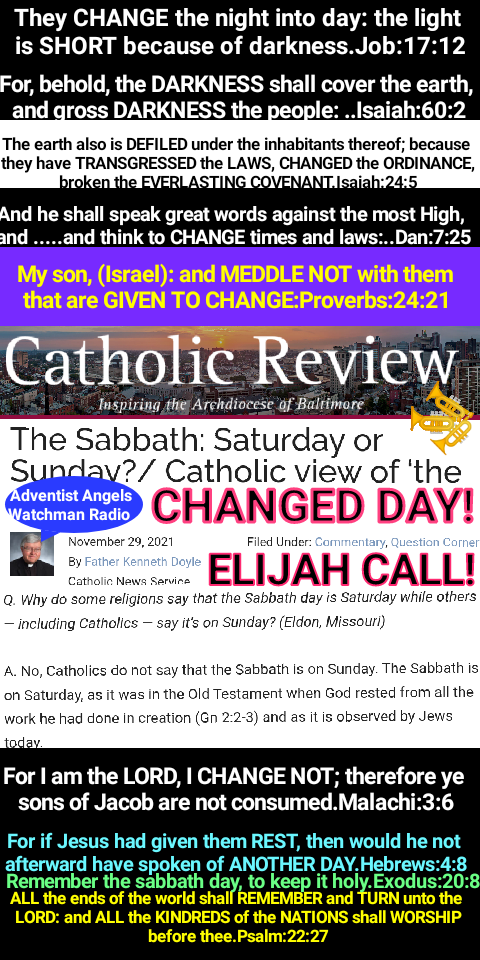
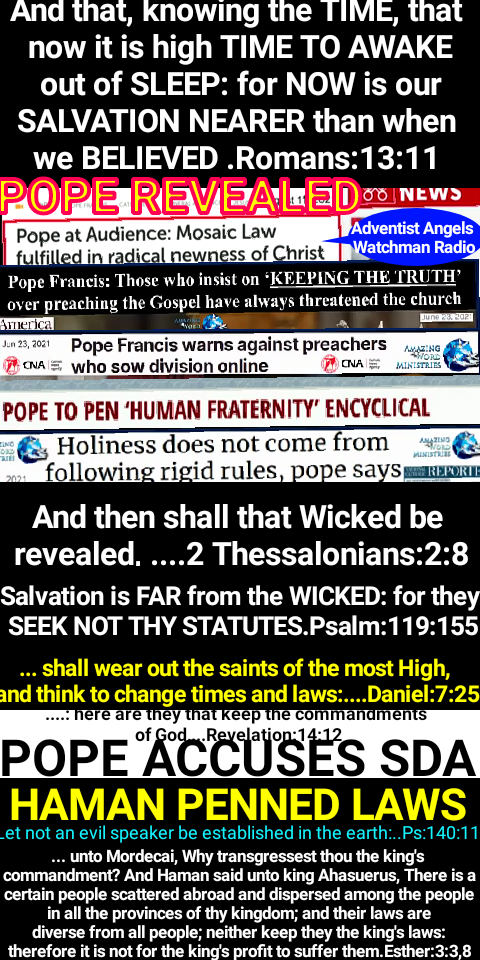
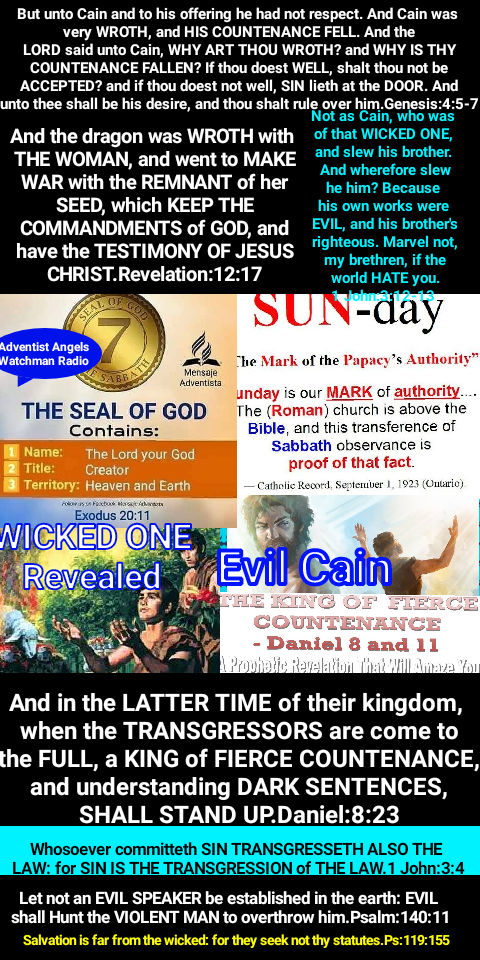
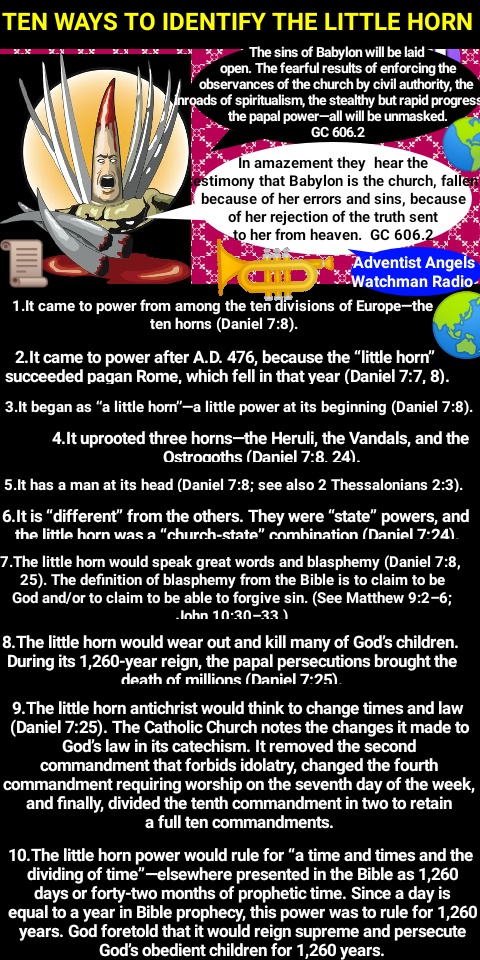
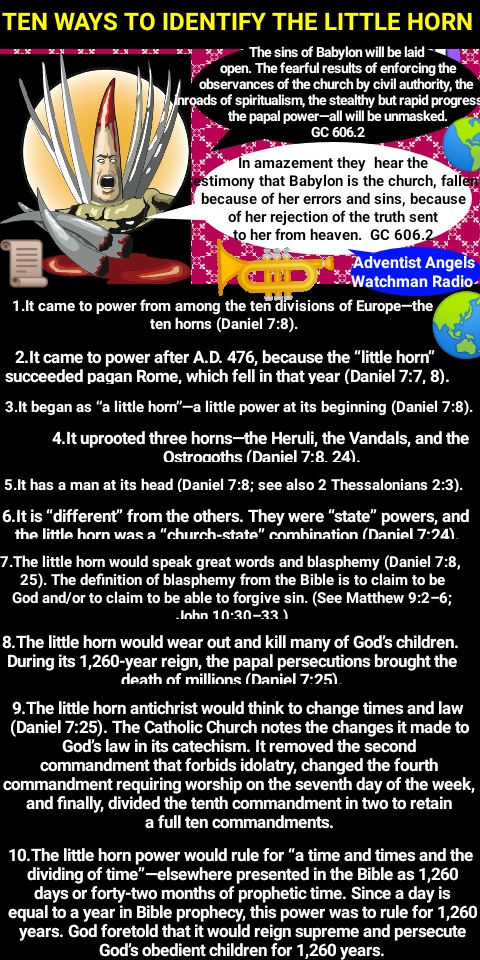
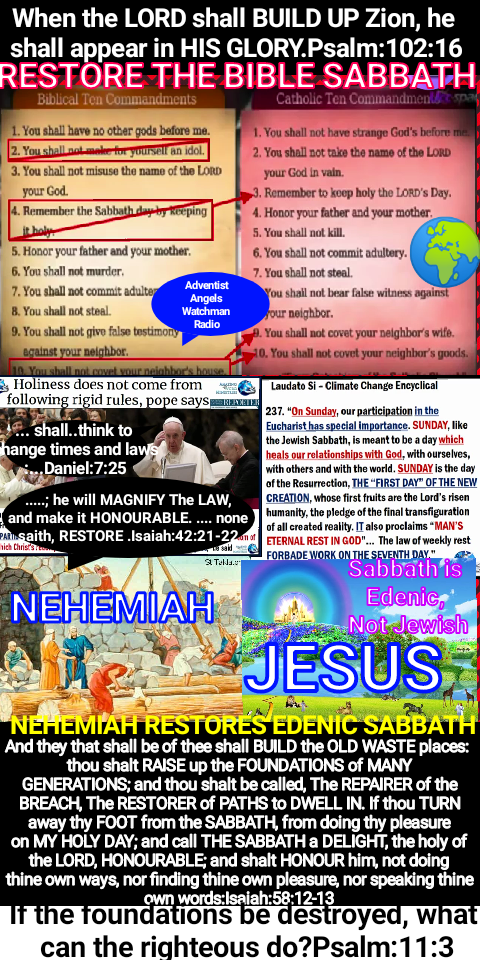
The special characteristic of the beast, and therefore of his image, is the breaking of God’s commandments. Says Daniel, of the little horn, the papacy: “He shall think to change times and the law.” Daniel 7:25, R.V. And Paul styled the same power the “man of sin,” who was to exalt himself above God. One prophecy is a complement of the other. Only by changing God’s law could the papacy exalt itself above God; whoever should understandingly keep the law as thus changed would be giving supreme honor to that power by which the change was made. Such an act of obedience to papal laws would be a mark of allegiance to the pope in the place of God.
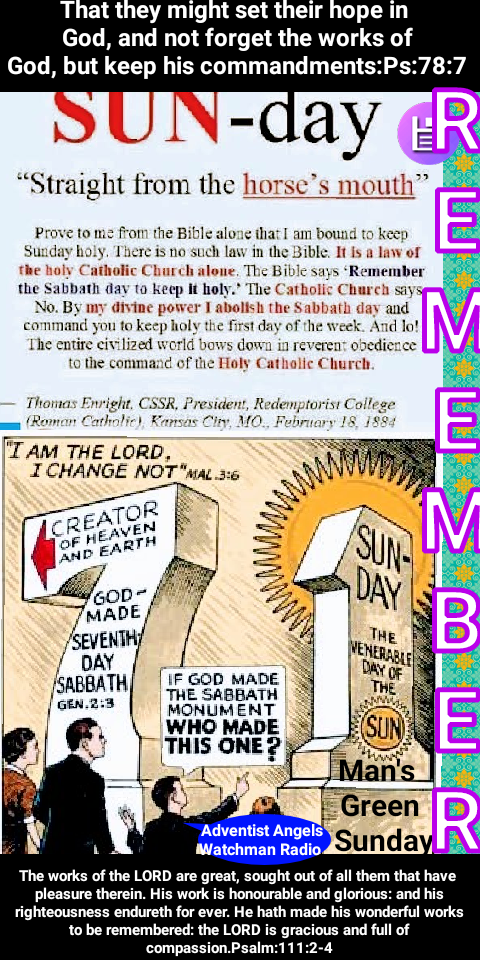
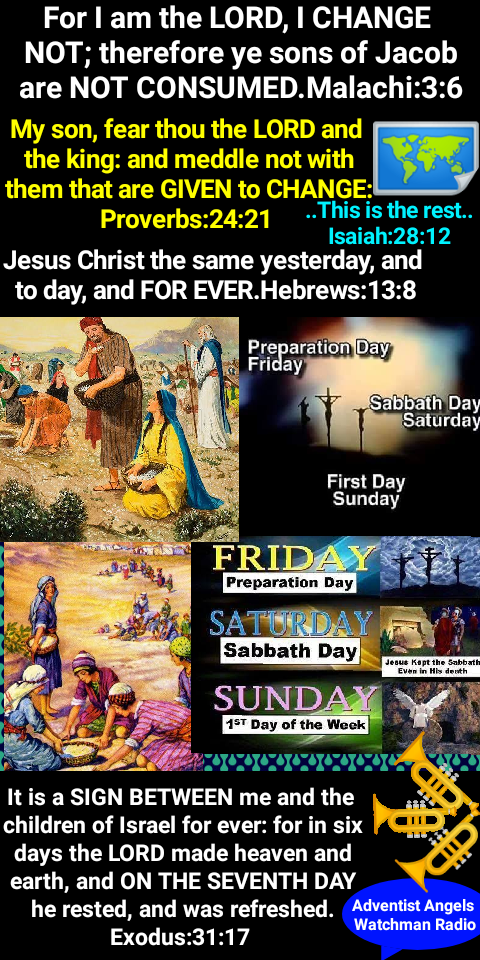
The papacy has attempted to change the law of God. The second commandment, forbidding image worship, has been dropped from the law, and the fourth commandment has been so changed as to authorize the observance of the first instead of the seventh day as the Sabbath. But papists urge, as a reason for omitting the second commandment, that it is unnecessary, being included in the first, and that they are giving the law exactly as God designed it to be understood. This cannot be the change foretold by the prophet. An intentional, deliberate change is presented: “He shall think to change the times and the law.” The change in the fourth commandment exactly fulfills the prophecy. For this the only authority claimed is that of the church. Here the papal power openly sets itself above God.
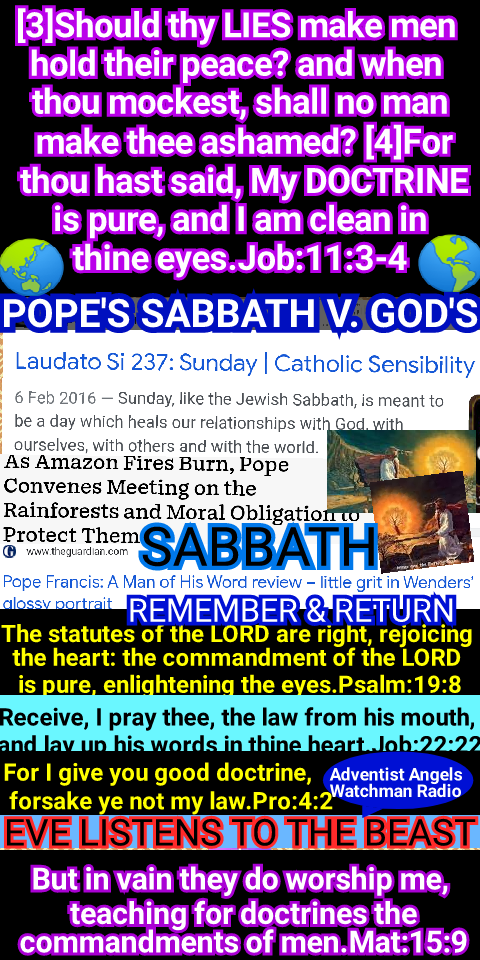
While the worshipers of God will be especially distinguished by their regard for the fourth commandment,—since this is the sign of His creative power and the witness to His claim upon man’s reverence and homage,—the worshipers of the beast will be distinguished by their efforts to tear down the Creator’s memorial, to exalt the institution of Rome. It was in behalf of the Sunday that popery first asserted its arrogant claims (see Appendix); and its first resort to the power of the state was to compel the observance of Sunday as “the Lord’s day.” But the Bible points to the seventh day, and not to the first, as the Lord’s day. Said Christ: “The Son of man is Lord also of the Sabbath.” The fourth commandment declares: “The seventh day is the Sabbath of the Lord.” And by the prophet Isaiah the Lord designates it: “My holy day.” Mark 2:28; Isaiah 58:13.
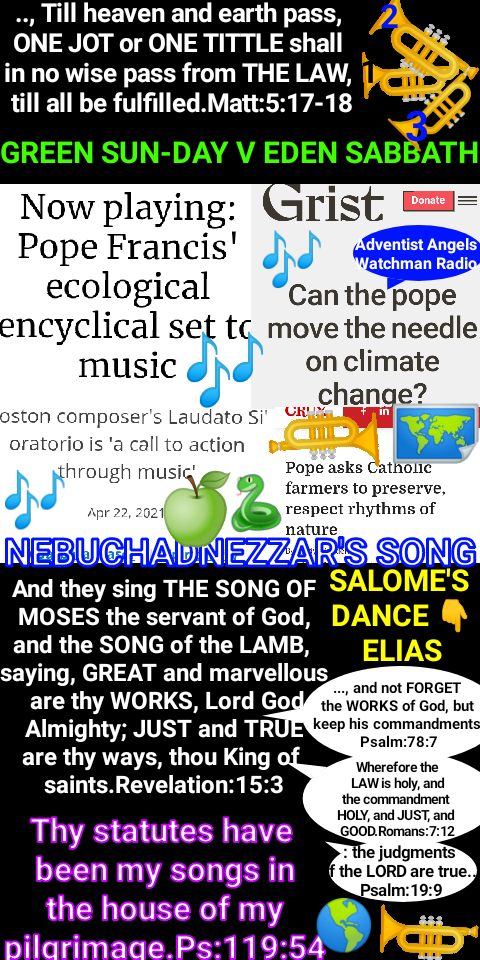
The claim so often put forth that Christ changed the Sabbath is disproved by His own words. In His Sermon on the Mount He said: “Think not that I am come to destroy the law, or the prophets: I am not come to destroy, but to fulfill. For verily I say unto you, Till heaven and earth pass, one jot or one tittle shall in no wise pass from the law, till all be fulfilled. Whosoever therefore shall break one of these least commandments, and shall teach men so, he shall be called the least in the kingdom of heaven: but whosoever shall do and teach them, the same shall be called great in the kingdom of heaven,” Matthew 5:17-19.
It is a fact generally admitted by Protestants that the Scriptures give no authority for the change of the Sabbath. This is plainly stated in publications issued by the American Tract Society and the American Sunday School Union. One of these works acknowledges “the complete silence of the New Testament so far as any explicit command for the Sabbath Sunday, the first day of the week or definite rules for its observance are concerned.”—George Elliott, The Abiding Sabbath, page 184.
Another says: “Up to the time of Christ’s death, no change had been made in the day;” and, “so far as the record shows, they the apostles did not … give any explicit command enjoining the abandonment of the seventh-day Sabbath, and its observance on the first day of the week.”—A. E. Waffle, The Lord’s Day, pages 186-188.
Roman Catholics acknowledge that the change of the Sabbath was made by their church, and declare that Protestants by observing the Sunday are recognizing her power. In the Catholic Catechism of Christian Religion, in answer to a question as to the day to be observed in obedience to the fourth commandment, this statement is made: “During the old law, Saturday was the day sanctified; but the church, instructed by Jesus Christ, and directed by the Spirit of God, has substituted Sunday for Saturday; so now we sanctify the first, not the seventh day. Sunday means, and now is, the day of the Lord.”
As the sign of the authority of the Catholic Church, papist writers cite “the very act of changing the Sabbath into Sunday, which Protestants allow of; … because by keeping Sunday, they acknowledge the church’s power to ordain feasts, and to command them under sin.”—Henry Tuberville, An Abridgment of the Christian Doctrine, page 58. What then is the change of the Sabbath, but the sign, or mark, of the authority of the Roman Church—”the mark of the beast”?
The Roman Church has not relinquished her claim to supremacy; and when the world and the Protestant churches accept a sabbath of her creating, while they reject the Bible Sabbath, they virtually admit this assumption. They may claim the authority of tradition and of the Fathers for the change; but in so doing they ignore the very principle which separates them from Rome—that “the Bible, and the Bible only, is the religion of Protestants.” The papist can see that they are deceiving themselves, willingly closing their eyes to the facts in the case. As the movement for Sunday enforcement gains favor, he rejoices, feeling assured that it will eventually bring the whole Protestant world under the banner of Rome.
Romanists declare that “the observance of Sunday by the Protestants is an homage they pay, in spite of themselves, to the authority of the Catholic Church.”—Mgr. Segur, Plain Talk About the Protestantism of Today, page 213. The enforcement of Sundaykeeping on the part of Protestant churches is an enforcement of the worship of the papacy—of the beast. Those who, understanding the claims of the fourth commandment, choose to observe the false instead of the true Sabbath are thereby paying homage to that power by which alone it is commanded. But in the very act of enforcing a religious duty by secular power, the churches would themselves form an image to the beast; hence the enforcement of Sundaykeeping in the United States would be an enforcement of the worship of the beast and his image.
But Christians of past generations observed the Sunday, supposing that in so doing they were keeping the Bible Sabbath; and there are now true Christians in every church, not excepting the Roman Catholic communion, who honestly believe that Sunday is the Sabbath of divine appointment. God accepts their sincerity of purpose and their integrity before Him. But when Sunday observance shall be enforced by law, and the world shall be enlightened concerning the obligation of the true Sabbath, then whoever shall transgress the command of God, to obey a precept which has no higher authority than that of Rome, will thereby honor popery above God. He is paying homage to Rome and to the power which enforces the institution ordained by Rome. He is worshiping the beast and his image. As men then reject the institution which God has declared to be the sign of His authority, and honor in its stead that which Rome has chosen as the token of her supremacy, they will thereby accept the sign of allegiance to Rome—”the mark of the beast.” And it is not until the issue is thus plainly set before the people, and they are brought to choose between the commandments of God and the commandments of men, that those who continue in transgression will receive “the mark of the beast.”
The most fearful threatening ever addressed to mortals is contained in the third angel’s message. That must be a terrible sin which calls down the wrath of God unmingled with mercy. Men are not to be left in darkness concerning this important matter; the warning against this sin is to be given to the world before the visitation of God’s judgments, that all may know why they are to be inflicted, and have opportunity to escape them. Prophecy declares that the first angel would make his announcement to “every nation, and kindred, and tongue, and people.” The warning of the third angel, which forms a part of the same threefold message, is to be no less widespread. It is represented in the prophecy as being proclaimed with a loud voice, by an angel flying in the midst of heaven; and it will command the attention of the world.
In the issue of the contest all Christendom will be divided into two great classes—those who keep the commandments of God and the faith of Jesus, and those who worship the beast and his image and receive his mark. Although church and state will unite their power to compel “all, both small and great, rich and poor, free and bond” (Revelation 13:16), to receive “the mark of the beast,” yet the people of God will not receive it. The prophet of Patmos beholds “them that had gotten the victory over the beast, and over his image, and over his mark, and over the number of his name, stand on the sea of glass, having the harps of God” and singing the song of Moses and the Lamb. Revelation 15:2, 3. GC 443.2 – GC 450.1
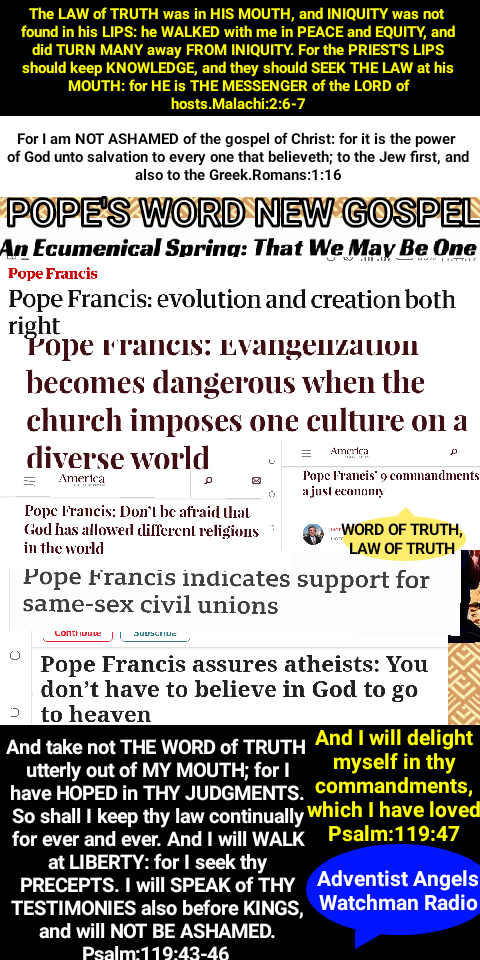
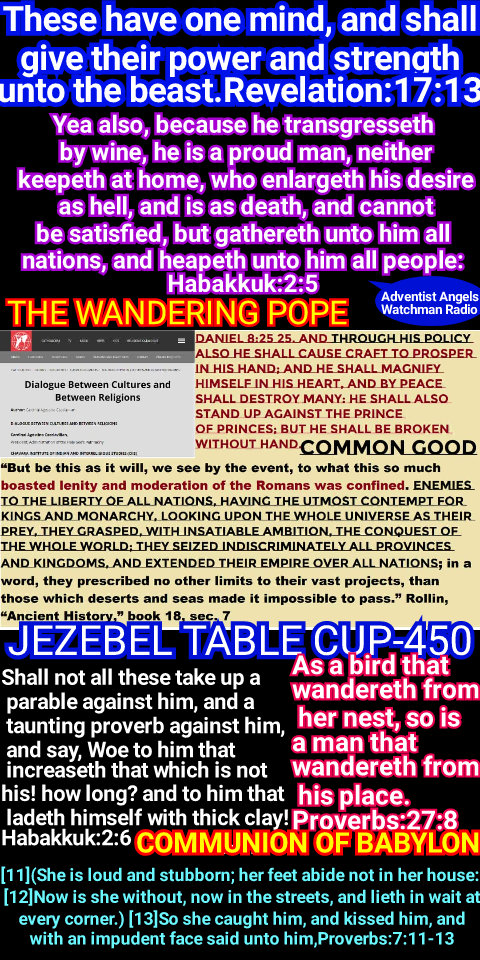
In the issue of the last contest all Christendom will be divided into two great classes—those who keep the commandments of God and the faith of Jesus, and those who worship the beast and his image and receive his mark.

In the issue of the contest all Christendom will be divided into two great classes—those who keep the commandments of God and the faith of Jesus, and those who worship the beast and his image and receive his mark. Although church and state will unite their power to compel “all, both small and great, rich and poor, free and bond” (Revelation 13:16), to receive “the mark of the beast,” yet the people of God will not receive it. The prophet of Patmos beholds “them that had gotten the victory over the beast, and over his image, and over his mark, and over the number of his name, stand on the sea of glass, having the harps of God” and singing the song of Moses and the Lamb. Revelation 15:2, 3 GC 450.1

The temple of God was opened in heaven, and there was seen in His temple the ark of His testament.” Revelation 11:19. The ark of God’s testament is in the holy of holies, the second apartment of the sanctuary. In the ministration of the earthly tabernacle, which served “unto the example and shadow of heavenly things,” this apartment was opened only upon the great Day of Atonement for the cleansing of the sanctuary. Therefore the announcement that the temple of God was opened in heaven and the ark of His testament was seen points to the opening of the most holy place of the heavenly sanctuary in 1844 as Christ entered there to perform the closing work of the atonement. Those who by faith followed their great High Priest as He entered upon His ministry in the most holy place, beheld the ark of His testament. As they had studied the subject of the sanctuary they had come to understand the Saviour’s change of ministration, and they saw that He was now officiating before the ark of God, pleading His blood in behalf of sinners.
The ark in the tabernacle on earth contained the two tables of stone, upon which were inscribed the precepts of the law of God. The ark was merely a receptacle for the tables of the law, and the presence of these divine precepts gave to it its value and sacredness. When the temple of God was opened in heaven, the ark of His testament was seen. Within the holy of holies, in the sanctuary in heaven, the divine law is sacredly enshrined—the law that was spoken by God Himself amid the thunders of Sinai and written with His own finger on the tables of stone.
The law of God in the sanctuary in heaven is the great original, of which the precepts inscribed upon the tables of stone and recorded by Moses in the Pentateuch were an unerring transcript. Those who arrived at an understanding of this important point were thus led to see the sacred, unchanging character of the divine law. They saw, as never before, the force of the Saviour’s words: “Till heaven and earth pass, one jot or one tittle shall in no wise pass from the law.” Matthew 5:18. The law of God, being a revelation of His will, a transcript of His character, must forever endure, “as a faithful witness in heaven.” Not one command has been annulled; not a jot or tittle has been changed. Says the psalmist: “Forever, O Lord, Thy word is settled in heaven.” “All His commandments are sure. They stand fast for ever and ever.” Psalm 119:89; 111:7, 8.
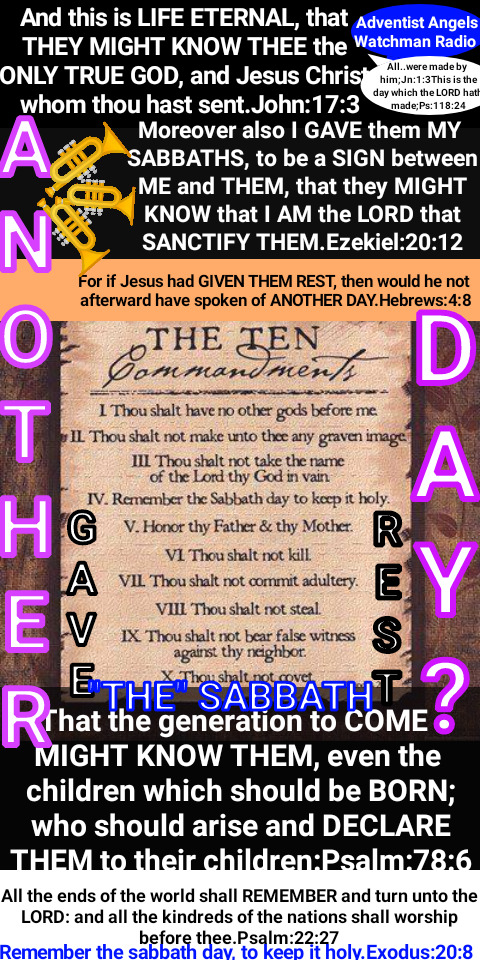
In the very bosom of the Decalogue is the fourth commandment, as it was first proclaimed: “Remember the Sabbath day, to keep it holy. Six days shalt thou labor, and do all thy work: but the seventh day is the Sabbath of the Lord thy God: in it thou shalt not do any work, thou, nor thy son, nor thy daughter, thy manservant, nor thy maidservant, nor thy cattle, nor thy stranger that is within thy gates: for in six days the Lord made heaven and earth, the sea, and all that in them is, and rested the seventh day: wherefore the Lord blessed the Sabbath day, and hallowed it.” Exodus 20:8-11.
The Spirit of God impressed the hearts of those students of His word. The conviction was urged upon them that they had ignorantly transgressed this precept by disregarding the Creator’s rest day. They began to examine the reasons for observing the first day of the week instead of the day which God had sanctified. They could find no evidence in the Scriptures that the fourth commandment had been abolished, or that the Sabbath had been changed; the blessing which first hallowed the seventh day had never been removed. They had been honestly seeking to know and to do God’s will; now, as they saw themselves transgressors of His law, sorrow filled their hearts, and they manifested their loyalty to God by keeping His Sabbath holy.
Many and earnest were the efforts made to overthrow their faith. None could fail to see that if the earthly sanctuary was a figure or pattern of the heavenly, the law deposited in the ark on earth was an exact transcript of the law in the ark in heaven; and that an acceptance of the truth concerning the heavenly sanctuary involved an acknowledgment of the claims of God’s law and the obligation of the Sabbath of the fourth commandment. Here was the secret of the bitter and determined opposition to the harmonious exposition of the Scriptures that revealed the ministration of Christ in the heavenly sanctuary. Men sought to close the door which God had opened, and to open the door which He had closed. But “He that openeth, and no man shutteth; and shutteth, and no man openeth,” had declared: “Behold, I have set before thee an open door, and no man can shut it.” Revelation 3:7, 8. Christ had opened the door, or ministration, of the most holy place, light was shining from that open door of the sanctuary in heaven, and the fourth commandment was shown to be included in the law which is there enshrined; what God had established, no man could overthrow.
Those who had accepted the light concerning the mediation of Christ and the perpetuity of the law of God found that these were the truths presented in Revelation 14. The messages of this chapter constitute a threefold warning (see Appendix) which is to prepare the inhabitants of the earth for the Lord’s second coming. The announcement, “The hour of His judgment is come,” points to the closing work of Christ’s ministration for the salvation of men. It heralds a truth which must be proclaimed until the Saviour’s intercession shall cease and He shall return to the earth to take His people to Himself. The work of judgment which began in 1844 must continue until the cases of all are decided, both of the living and the dead; hence it will extend to the close of human probation. That men may be prepared to stand in the judgment, the message commands them to “fear God, and give glory to Him,” “and worship Him that made heaven, and earth, and the sea, and the fountains of waters.” The result of an acceptance of these messages is given in the word: “Here are they that keep the commandments of God, and the faith of Jesus.” In order to be prepared for the judgment, it is necessary that men should keep the law of God. That law will be the standard of character in the judgment. The apostle Paul declares: “As many as have sinned in the law shall be judged by the law, … in the day when God shall judge the secrets of men by Jesus Christ.” And he says that “the doers of the law shall be justified.” Romans 2:12-16. Faith is essential in order to the keeping of the law of God; for “without faith it is impossible to please Him.” And “whatsoever is not of faith is sin.” Hebrews 11:6; Romans 14:23.
By the first angel, men are called upon to “fear God, and give glory to Him” and to worship Him as the Creator of the heavens and the earth. In order to do this, they must obey His law. Says the wise man: “Fear God, and keep His commandments: for this is the whole duty of man.” Ecclesiastes 12:13. Without obedience to His commandments no worship can be pleasing to God. “This is the love of God, that we keep His commandments.” “He that turneth away his ear from hearing the law, even his prayer shall be abomination.” 1 John 5:3; Proverbs 28:9.
The duty to worship God is based upon the fact that He is the Creator and that to Him all other beings owe their existence. And wherever, in the Bible, His claim to reverence and worship, above the gods of the heathen, is presented, there is cited the evidence of His creative power. “All the gods of the nations are idols: but the Lord made the heavens.” Psalm 96:5. “To whom then will ye liken Me, or shall I be equal? saith the Holy One. Lift up your eyes on high, and behold who hath created these things.” “Thus saith the Lord that created the heavens; God Himself that formed the earth and made it: … I am the Lord; and there is none else.” Isaiah 40:25, 26; 45:18. Says the psalmist: “Know ye that the Lord He is God: it is He that hath made us, and not we ourselves.” “O come, let us worship and bow down: let us kneel before the Lord our Maker.” Psalm 100:3; 95:6. And the holy beings who worship God in heaven state, as the reason why their homage is due to Him: “Thou art worthy, O Lord, to receive glory and honor and power: for Thou hast created all things.” Revelation 4:11.
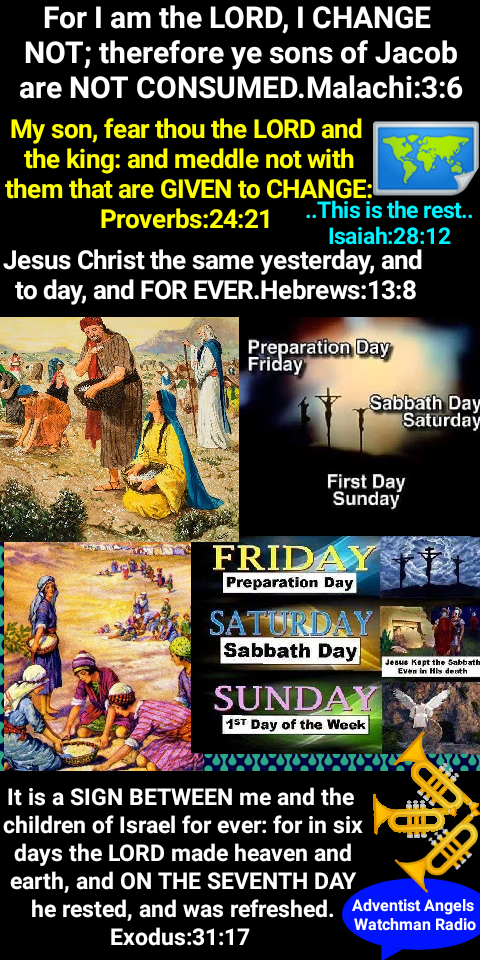
In Revelation 14, men are called upon to worship the Creator; and the prophecy brings to view a class that, as the result of the threefold message, are keeping the commandments of God. One of these commandments points directly to God as the Creator. The fourth precept declares: “The seventh day is the Sabbath of the Lord thy God: … for in six days the Lord made heaven and earth, the sea, and all that in them is, and rested the seventh day: wherefore the Lord blessed the Sabbath day, and hallowed it.” Exodus 20:10, 11. Concerning the Sabbath, the Lord says, further, that it is “a sign, … that ye may know that I am the Lord your God.” Ezekiel 20:20. And the reason given is: “For in six days the Lord made heaven and earth, and on the seventh day He rested, and was refreshed.” Exodus 31:17.
“The importance of the Sabbath as the memorial of creation is that it keeps ever present the true reason why worship is due to God”—because He is the Creator, and we are His creatures. “The Sabbath therefore lies at the very foundation of divine worship, for it teaches this great truth in the most impressive manner, and no other institution does this. The true ground of divine worship, not of that on the seventh day merely, but of all worship, is found in the distinction between the Creator and His creatures. This great fact can never become obsolete, and must never be forgotten.”—J. N. Andrews, History of the Sabbath, chapter 27. It was to keep this truth ever before the minds of men, that God instituted the Sabbath in Eden; and so long as the fact that He is our Creator continues to be a reason why we should worship Him, so long the Sabbath will continue as its sign and memorial. Had the Sabbath been universally kept, man’s thoughts and affections would have been led to the Creator as the object of reverence and worship, and there would never have been an idolater, an atheist, or an infidel. The keeping of the Sabbath is a sign of loyalty to the true God, “Him that made heaven, and earth, and the sea, and the fountains of waters.” It follows that the message which commands men to worship God and keep His commandments will especially call upon them to keep the fourth commandment.
In contrast to those who keep the commandments of God and have the faith of Jesus, the third angel points to another class, against whose errors a solemn and fearful warning is uttered: “If any man worship the beast and his image, and receive his mark in his forehead, or in his hand, the same shall drink of the wine of the wrath of God.” Revelation 14:9, 10. A correct interpretation of the symbols employed is necessary to an understanding of this message. What is represented by the beast, the image, the mark?
The line of prophecy in which these symbols are found begins with Revelation 12, with the dragon that sought to destroy Christ at His birth. The dragon is said to be Satan (Revelation 12:9); he it was that moved upon Herod to put the Saviour to death. But the chief agent of Satan in making war upon Christ and His people during the first centuries of the Christian Era was the Roman Empire, in which paganism was the prevailing religion. Thus while the dragon, primarily, represents Satan, it is, in a secondary sense, a symbol of pagan Rome.
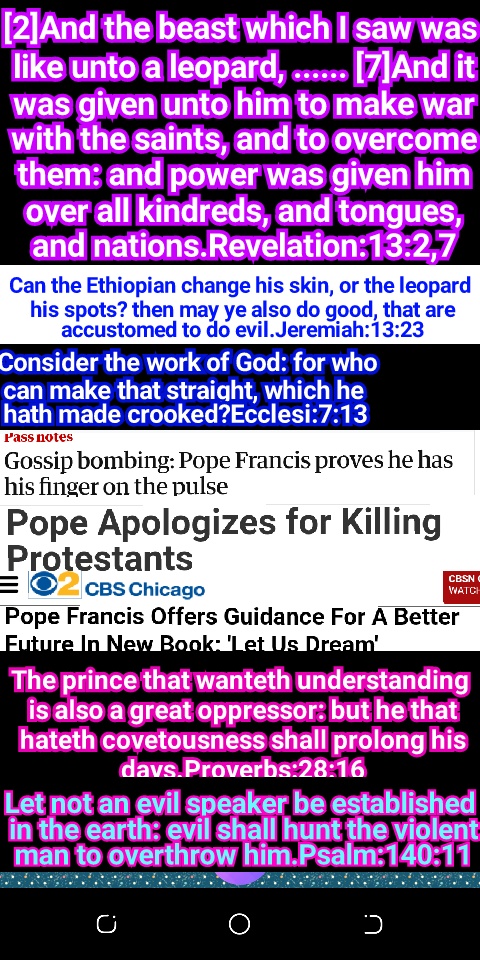
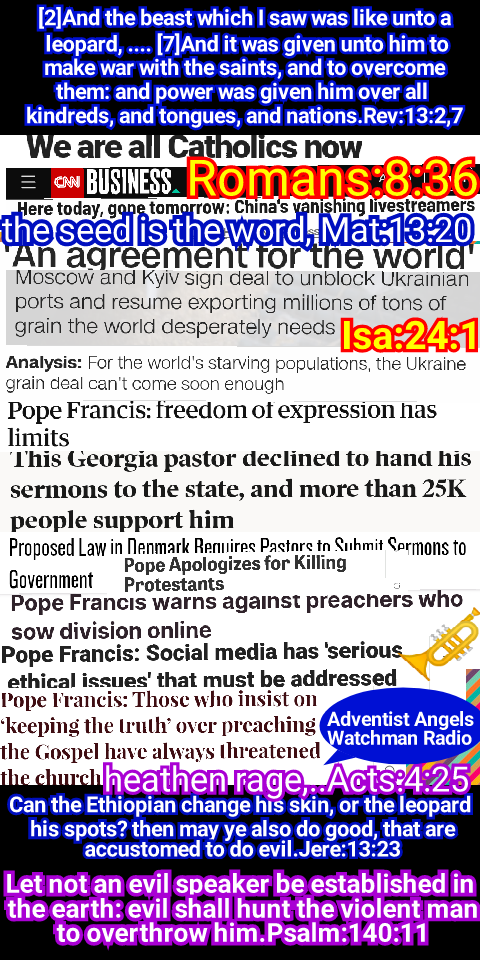
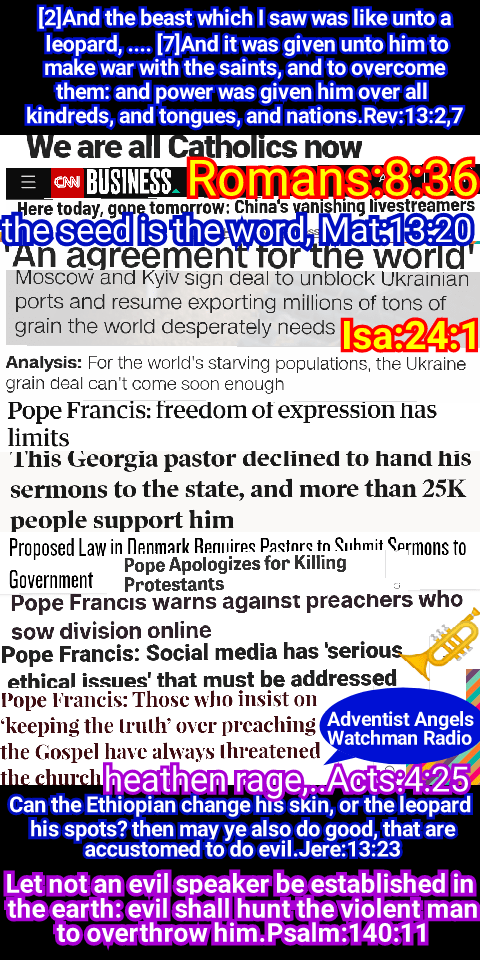
In chapter 13 (verses 1-10) is described another beast, “like unto a leopard,” to which the dragon gave “his power, and his seat, and great authority.” This symbol, as most Protestants have believed, represents the papacy, which succeeded to the power and seat and authority once held by the ancient Roman empire. Of the leopardlike beast it is declared: “There was given unto him a mouth speaking great things and blasphemies…. And he opened his mouth in blasphemy against God, to blaspheme His name, and His tabernacle, and them that dwell in heaven. And it was given unto him to make war with the saints, and to overcome them: and power was given him over all kindreds, and tongues, and nations.” This prophecy, which is nearly identical with the description of the little horn of Daniel 7, unquestionably points to the papacy.
“Power was given unto him to continue forty and two months.” And, says the prophet, “I saw one of his heads as it were wounded to death.” And again: “He that leadeth into captivity shall go into captivity: he that killeth with the sword must be killed with the sword.” The forty and two months are the same as the “time and times and the dividing of time,” three years and a half, or 1260 days, of Daniel 7—the time during which the papal power was to oppress God’s people. This period, as stated in preceding chapters, began with the supremacy of the papacy, A.D. 538, and terminated in 1798. At that time the pope was made captive by the French army, the papal power received its deadly wound, and the prediction was fulfilled, “He that leadeth into captivity shall go into captivity.”
At this point another symbol is introduced. Says the prophet: “I beheld another beast coming up out of the earth; and he had two horns like a lamb.” Verse 11. Both the appearance of this beast and the manner of its rise indicate that the nation which it represents is unlike those presented under the preceding symbols. The great kingdoms that have ruled the world were presented to the prophet Daniel as beasts of prey, rising when “the four winds of the heaven strove upon the great sea.” Daniel 7:2. In Revelation 17 an angel explained that waters represent “peoples, and multitudes, and nations, and tongues.” Revelation 17:15. Winds are a symbol of strife. The four winds of heaven striving upon the great sea represent the terrible scenes of conquest and revolution by which kingdoms have attained to power.
But the beast with lamblike horns was seen “coming up out of the earth.” Instead of overthrowing other powers to establish itself, the nation thus represented must arise in territory previously unoccupied and grow up gradually and peacefully. It could not, then, arise among the crowded and struggling nationalities of the Old World—that turbulent sea of “peoples, and multitudes, and nations, and tongues.” It must be sought in the Western Continent.
What nation of the New World was in 1798 rising into power, giving promise of strength and greatness, and attracting the attention of the world? The application of the symbol admits of no question. One nation, and only one, meets the specifications of this prophecy; it points unmistakably to the United States of America. Again and again the thought, almost the exact words, of the sacred writer has been unconsciously employed by the orator and the historian in describing the rise and growth of this nation. The beast was seen “coming up out of the earth;” and, according to the translators, the word here rendered “coming up” literally signifies “to grow or spring up as a plant.” And, as we have seen, the nation must arise in territory previously unoccupied. A prominent writer, describing the rise of the United States, speaks of “the mystery of her coming forth from vacancy,” and says: “Like a silent seed we grew into empire.”—G. A. Townsend, The New World Compared With the Old, page 462. A European journal in 1850 spoke of the United States as a wonderful empire, which was “emerging,” and ” amid the silence of the earth daily adding to its power and pride.”—The Dublin Nation . Edward Everett, in an oration on the Pilgrim founders of this nation, said: “Did they look for a retired spot, inoffensive for its obscurity, and safe in its remoteness, where the little church of Leyden might enjoy the freedom of conscience? Behold the mighty regions over which, in peaceful conquest, … they have borne the banners of the cross!”—Speech delivered at Plymouth, Massachusetts, Dec. 22, 1824, page 11.
“And he had two horns like a lamb.” The lamblike horns indicate youth, innocence, and gentleness, fitly representing the character of the United States when presented to the prophet as “coming up” in 1798. Among the Christian exiles who first fled to America and sought an asylum from royal oppression and priestly intolerance were many who determined to establish a government upon the broad foundation of civil and religious liberty. Their views found place in the Declaration of Independence, which sets forth the great truth that “all men are created equal” and endowed with the inalienable right to “life, liberty, and the pursuit of happiness.” And the Constitution guarantees to the people the right of self-government, providing that representatives elected by the popular vote shall enact and administer the laws. Freedom of religious faith was also granted, every man being permitted to worship God according to the dictates of his conscience. Republicanism and Protestantism became the fundamental principles of the nation. These principles are the secret of its power and prosperity. The oppressed and downtrodden throughout Christendom have turned to this land with interest and hope. Millions have sought its shores, and the United States has risen to a place among the most powerful nations of the earth.
But the beast with lamblike horns “spake as a dragon. And he exerciseth all the power of the first beast before him, and causeth the earth and them which dwell therein to worship the first beast, whose deadly wound was healed; … saying to them that dwell on the earth, that they should make an image to the beast, which had the wound by a sword, and did live.” Revelation 13:11-14.
The lamblike horns and dragon voice of the symbol point to a striking contradiction between the professions and the practice of the nation thus represented. The “speaking” of the nation is the action of its legislative and judicial authorities. By such action it will give the lie to those liberal and peaceful principles which it has put forth as the foundation of its policy. The prediction that it will speak “as a dragon” and exercise “all the power of the first beast” plainly foretells a development of the spirit of intolerance and persecution that was manifested by the nations represented by the dragon and the leopardlike beast. And the statement that the beast with two horns “causeth the earth and them which dwell therein to worship the first beast” indicates that the authority of this nation is to be exercised in enforcing some observance which shall be an act of homage to the papacy.
Such action would be directly contrary to the principles of this government, to the genius of its free institutions, to the direct and solemn avowals of the Declaration of Independence, and to the Constitution. The founders of the nation wisely sought to guard against the employment of secular power on the part of the church, with its inevitable result—intolerance and persecution. The Constitution provides that “Congress shall make no law respecting an establishment of religion, or prohibiting the free exercise thereof,” and that “no religious test shall ever be required as a qualification to any office or public trust under the United States.” Only in flagrant violation of these safeguards to the nation’s liberty, can any religious observance be enforced by civil authority. But the inconsistency of such action is no greater than is represented in the symbol. It is the beast with lamblike horns—in profession pure, gentle, and harmless—that speaks as a dragon.
“Saying to them that dwell on the earth, that they should make an image to the beast.” Here is clearly presented a form of government in which the legislative power rests with the people, a most striking evidence that the United States is the nation denoted in the prophecy.
But what is the “image to the beast”? and how is it to be formed? The image is made by the two-horned beast, and is an image to the beast. It is also called an image of the beast. Then to learn what the image is like and how it is to be formed we must study the characteristics of the beast itself—the papacy.
When the early church became corrupted by departing from the simplicity of the gospel and accepting heathen rites and customs, she lost the Spirit and power of God; and in order to control the consciences of the people, she sought the support of the secular power. The result was the papacy, a church that controlled the power of the state and employed it to further her own ends, especially for the punishment of “heresy.” In order for the United States to form an image of the beast, the religious power must so control the civil government that the authority of the state will also be employed by the church to accomplish her own ends.
Whenever the church has obtained secular power, she has employed it to punish dissent from her doctrines. Protestant churches that have followed in the steps of Rome by forming alliance with worldly powers have manifested a similar desire to restrict liberty of conscience. An example of this is given in the long-continued persecution of dissenters by the Church of England. During the sixteenth and seventeenth centuries, thousands of nonconformist ministers were forced to flee from their churches, and many, both of pastors and people, were subjected to fine, imprisonment, torture, and martyrdom.
It was apostasy that led the early church to seek the aid of the civil government, and this prepared the way for the development of the papacy—the beast. Said Paul: “There” shall “come a falling away, … and that man of sin be revealed.” 2 Thessalonians 2:3. So apostasy in the church will prepare the way for the image to the beast.
The Bible declares that before the coming of the Lord there will exist a state of religious declension similar to that in the first centuries. “In the last days perilous times shall come. For men shall be lovers of their own selves, covetous, boasters, proud, blasphemers, disobedient to parents, unthankful, unholy, without natural affection, trucebreakers, false accusers, incontinent, fierce, despisers of those that are good, traitors, heady, high-minded, lovers of pleasures more than lovers of God; having a form of godliness, but denying the power thereof.” 2 Timothy 3:1-5. “Now the Spirit speaketh expressly, that in the latter times some shall depart from the faith, giving heed to seducing spirits, and doctrines of devils.” 1 Timothy 4:1. Satan will work “with all power and signs and lying wonders, and with all deceivableness of unrighteousness.” And all that “received not the love of the truth, that they might be saved,” will be left to accept “strong delusion, that they should believe a lie.” 2 Thessalonians 2:9-11. When this state of ungodliness shall be reached, the same results will follow as in the first centuries.
The wide diversity of belief in the Protestant churches is regarded by many as decisive proof that no effort to secure a forced uniformity can ever be made. But there has been for years, in churches of the Protestant faith, a strong and growing sentiment in favor of a union based upon common points of doctrine. To secure such a union, the discussion of subjects upon which all were not agreed—however important they might be from a Bible standpoint—must necessarily be waived.
Charles Beecher, in a sermon in the year 1846, declared that the ministry of “the evangelical Protestant denominations” is “not only formed all the way up under a tremendous pressure of merely human fear, but they live, and move, and breathe in a state of things radically corrupt, and appealing every hour to every baser element of their nature to hush up the truth, and bow the knee to the power of apostasy. Was not this the way things went with Rome? Are we not living her life over again? And what do we see just ahead? Another general council! A world’s convention! Evangelical alliance, and universal creed!”—Sermon on “The Bible a Sufficient Creed,” delivered at Fort Wayne, Indiana, Feb. 22, 1846. When this shall be gained, then, in the effort to secure complete uniformity, it will be only a step to the resort to force.
When the leading churches of the United States, uniting upon such points of doctrine as are held by them in common, shall influence the state to enforce their decrees and to sustain their institutions, then Protestant America will have formed an image of the Roman hierarchy, and the infliction of civil penalties upon dissenters will inevitably result.
The beast with two horns “causeth commands all, both small and great, rich and poor, free and bond, to receive a mark in their right hand, or in their foreheads: and that no man might buy or sell, save he that had the mark, or the name of the beast, or the number of his name.” Revelation 13:16, 17. The third angel’s warning is: “If any man worship the beast and his image, and receive his mark in his forehead, or in his hand, the same shall drink of the wine of the wrath of God.” “The beast” mentioned in this message, whose worship is enforced by the two-horned beast, is the first, or leopardlike beast of Revelation 13—the papacy. The “image to the beast” represents that form of apostate Protestantism which will be developed when the Protestant churches shall seek the aid of the civil power for the enforcement of their dogmas. The “mark of the beast” still remains to be defined.
After the warning against the worship of the beast and his image the prophecy declares: “Here are they that keep the commandments of God, and the faith of Jesus.” Since those who keep God’s commandments are thus placed in contrast with those that worship the beast and his image and receive his mark, it follows that the keeping of God’s law, on the one hand, and its violation, on the other, will make the distinction between the worshipers of God and the worshipers of the beast.
The special characteristic of the beast, and therefore of his image, is the breaking of God’s commandments. Says Daniel, of the little horn, the papacy: “He shall think to change times and the law.” Daniel 7:25, R.V. And Paul styled the same power the “man of sin,” who was to exalt himself above God. One prophecy is a complement of the other. Only by changing God’s law could the papacy exalt itself above God; whoever should understandingly keep the law as thus changed would be giving supreme honor to that power by which the change was made. Such an act of obedience to papal laws would be a mark of allegiance to the pope in the place of God.
The papacy has attempted to change the law of God. The second commandment, forbidding image worship, has been dropped from the law, and the fourth commandment has been so changed as to authorize the observance of the first instead of the seventh day as the Sabbath. But papists urge, as a reason for omitting the second commandment, that it is unnecessary, being included in the first, and that they are giving the law exactly as God designed it to be understood. This cannot be the change foretold by the prophet. An intentional, deliberate change is presented: “He shall think to change the times and the law.” The change in the fourth commandment exactly fulfills the prophecy. For this the only authority claimed is that of the church. Here the papal power openly sets itself above God.
While the worshipers of God will be especially distinguished by their regard for the fourth commandment,—since this is the sign of His creative power and the witness to His claim upon man’s reverence and homage,—the worshipers of the beast will be distinguished by their efforts to tear down the Creator’s memorial, to exalt the institution of Rome. It was in behalf of the Sunday that popery first asserted its arrogant claims (see Appendix); and its first resort to the power of the state was to compel the observance of Sunday as “the Lord’s day.” But the Bible points to the seventh day, and not to the first, as the Lord’s day. Said Christ: “The Son of man is Lord also of the Sabbath.” The fourth commandment declares: “The seventh day is the Sabbath of the Lord.” And by the prophet Isaiah the Lord designates it: “My holy day.” Mark 2:28; Isaiah 58:13.
The claim so often put forth that Christ changed the Sabbath is disproved by His own words. In His Sermon on the Mount He said: “Think not that I am come to destroy the law, or the prophets: I am not come to destroy, but to fulfill. For verily I say unto you, Till heaven and earth pass, one jot or one tittle shall in no wise pass from the law, till all be fulfilled. Whosoever therefore shall break one of these least commandments, and shall teach men so, he shall be called the least in the kingdom of heaven: but whosoever shall do and teach them, the same shall be called great in the kingdom of heaven,” Matthew 5:17-19.
It is a fact generally admitted by Protestants that the Scriptures give no authority for the change of the Sabbath. This is plainly stated in publications issued by the American Tract Society and the American Sunday School Union. One of these works acknowledges “the complete silence of the New Testament so far as any explicit command for the Sabbath Sunday, the first day of the week or definite rules for its observance are concerned.”—George Elliott, The Abiding Sabbath, page 184.
Another says: “Up to the time of Christ’s death, no change had been made in the day;” and, “so far as the record shows, they the apostles did not … give any explicit command enjoining the abandonment of the seventh-day Sabbath, and its observance on the first day of the week.”—A. E. Waffle, The Lord’s Day, pages 186-188.
Roman Catholics acknowledge that the change of the Sabbath was made by their church, and declare that Protestants by observing the Sunday are recognizing her power. In the Catholic Catechism of Christian Religion, in answer to a question as to the day to be observed in obedience to the fourth commandment, this statement is made: “During the old law, Saturday was the day sanctified; but the church, instructed by Jesus Christ, and directed by the Spirit of God, has substituted Sunday for Saturday; so now we sanctify the first, not the seventh day. Sunday means, and now is, the day of the Lord.”
As the sign of the authority of the Catholic Church, papist writers cite “the very act of changing the Sabbath into Sunday, which Protestants allow of; … because by keeping Sunday, they acknowledge the church’s power to ordain feasts, and to command them under sin.”—Henry Tuberville, An Abridgment of the Christian Doctrine, page 58. What then is the change of the Sabbath, but the sign, or mark, of the authority of the Roman Church—”the mark of the beast”?
The Roman Church has not relinquished her claim to supremacy; and when the world and the Protestant churches accept a sabbath of her creating, while they reject the Bible Sabbath, they virtually admit this assumption. They may claim the authority of tradition and of the Fathers for the change; but in so doing they ignore the very principle which separates them from Rome—that “the Bible, and the Bible only, is the religion of Protestants.” The papist can see that they are deceiving themselves, willingly closing their eyes to the facts in the case. As the movement for Sunday enforcement gains favor, he rejoices, feeling assured that it will eventually bring the whole Protestant world under the banner of Rome.
Romanists declare that “the observance of Sunday by the Protestants is an homage they pay, in spite of themselves, to the authority of the Catholic Church.”—Mgr. Segur, Plain Talk About the Protestantism of Today, page 213. The enforcement of Sundaykeeping on the part of Protestant churches is an enforcement of the worship of the papacy—of the beast. Those who, understanding the claims of the fourth commandment, choose to observe the false instead of the true Sabbath are thereby paying homage to that power by which alone it is commanded. But in the very act of enforcing a religious duty by secular power, the churches would themselves form an image to the beast; hence the enforcement of Sundaykeeping in the United States would be an enforcement of the worship of the beast and his image.
But Christians of past generations observed the Sunday, supposing that in so doing they were keeping the Bible Sabbath; and there are now true Christians in every church, not excepting the Roman Catholic communion, who honestly believe that Sunday is the Sabbath of divine appointment. God accepts their sincerity of purpose and their integrity before Him. But when Sunday observance shall be enforced by law, and the world shall be enlightened concerning the obligation of the true Sabbath, then whoever shall transgress the command of God, to obey a precept which has no higher authority than that of Rome, will thereby honor popery above God. He is paying homage to Rome and to the power which enforces the institution ordained by Rome. He is worshiping the beast and his image. As men then reject the institution which God has declared to be the sign of His authority, and honor in its stead that which Rome has chosen as the token of her supremacy, they will thereby accept the sign of allegiance to Rome—”the mark of the beast.” And it is not until the issue is thus plainly set before the people, and they are brought to choose between the commandments of God and the commandments of men, that those who continue in transgression will receive “the mark of the beast.”
The most fearful threatening ever addressed to mortals is contained in the third angel’s message. That must be a terrible sin which calls down the wrath of God unmingled with mercy. Men are not to be left in darkness concerning this important matter; the warning against this sin is to be given to the world before the visitation of God’s judgments, that all may know why they are to be inflicted, and have opportunity to escape them. Prophecy declares that the first angel would make his announcement to “every nation, and kindred, and tongue, and people.” The warning of the third angel, which forms a part of the same threefold message, is to be no less widespread. It is represented in the prophecy as being proclaimed with a loud voice, by an angel flying in the midst of heaven; and it will command the attention of the world.
In the issue of the contest all Christendom will be divided into two great classes—those who keep the commandments of God and the faith of Jesus, and those who worship the beast and his image and receive his mark. Although church and state will unite their power to compel “all, both small and great, rich and poor, free and bond” (Revelation 13:16), to receive “the mark of the beast,” yet the people of God will not receive it. The prophet of Patmos beholds “them that had gotten the victory over the beast, and over his image, and over his mark, and over the number of his name, stand on the sea of glass, having the harps of God” and singing the song of Moses and the Lamb. Revelation 15:2, 3 GC 433.1 – GC 450.1
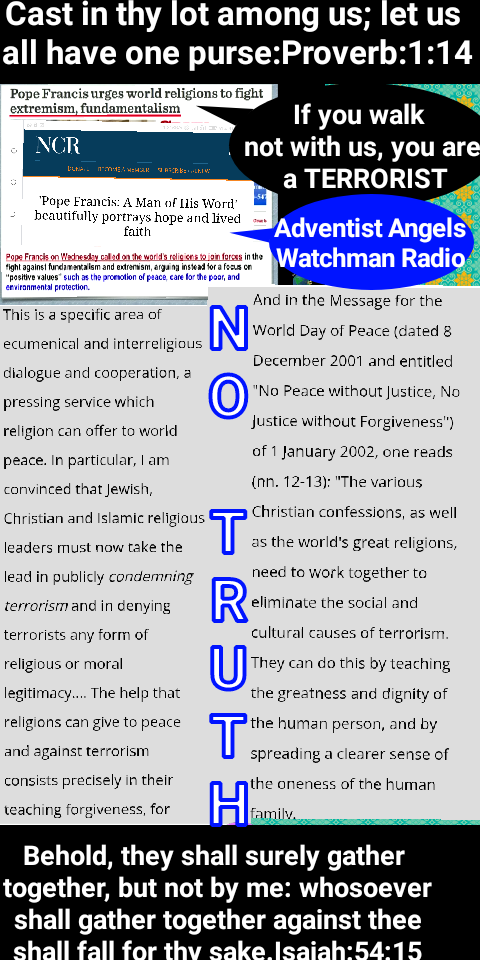
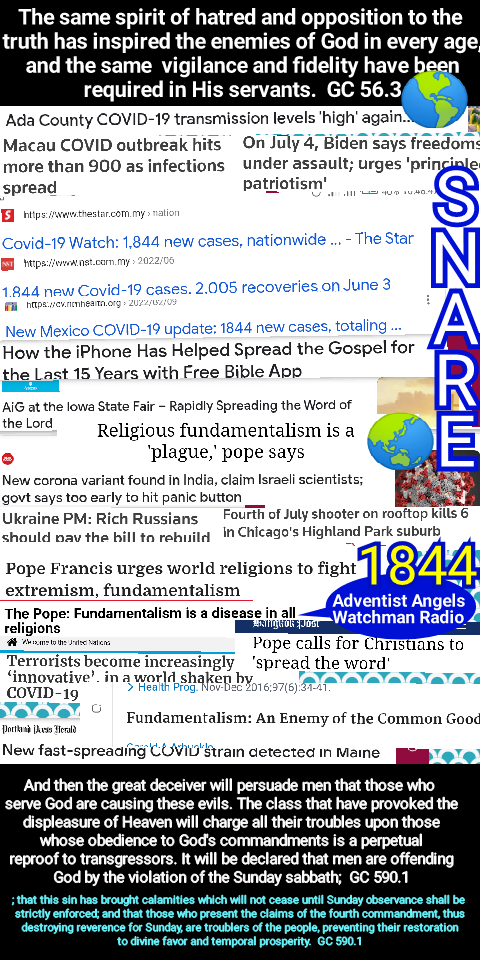
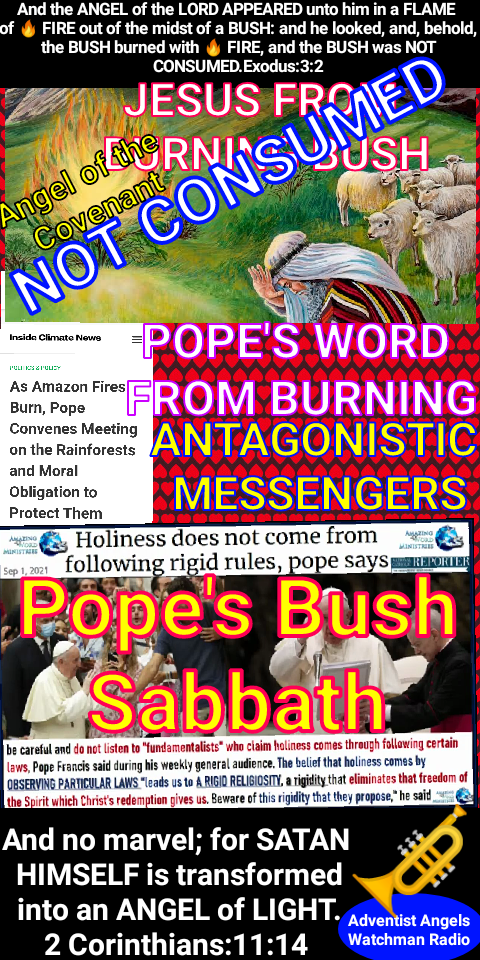
Sanballat, Tobiah, Geshem: Leading churches of the United States, unite in common points of doctrine, influence the state to enforce their decrees and to sustain their institutions: IMAGE of the Roman hierarchy, civil penalties upon dissenters result

When the early church became corrupted by departing from the simplicity of the gospel and accepting heathen rites and customs, she lost the Spirit and power of God; and in order to control the consciences of the people, she sought the support of the secular power. The result was the papacy, a church that controlled the power of the state and employed it to further her own ends, especially for the punishment of “heresy.” In order for the United States to form an image of the beast, the religious power must so control the civil government that the authority of the state will also be employed by the church to accomplish her own ends.
Whenever the church has obtained secular power, she has employed it to punish dissent from her doctrines. Protestant churches that have followed in the steps of Rome by forming alliance with worldly powers have manifested a similar desire to restrict liberty of conscience. An example of this is given in the long-continued persecution of dissenters by the Church of England. During the sixteenth and seventeenth centuries, thousands of nonconformist ministers were forced to flee from their churches, and many, both of pastors and people, were subjected to fine, imprisonment, torture, and martyrdom.
It was apostasy that led the early church to seek the aid of the civil government, and this prepared the way for the development of the papacy—the beast. Said Paul: “There” shall “come a falling away, … and that man of sin be revealed.” 2 Thessalonians 2:3. So apostasy in the church will prepare the way for the image to the beast.
The Bible declares that before the coming of the Lord there will exist a state of religious declension similar to that in the first centuries. “In the last days perilous times shall come. For men shall be lovers of their own selves, covetous, boasters, proud, blasphemers, disobedient to parents, unthankful, unholy, without natural affection, trucebreakers, false accusers, incontinent, fierce, despisers of those that are good, traitors, heady, high-minded, lovers of pleasures more than lovers of God; having a form of godliness, but denying the power thereof.” 2 Timothy 3:1-5. “Now the Spirit speaketh expressly, that in the latter times some shall depart from the faith, giving heed to seducing spirits, and doctrines of devils.” 1 Timothy 4:1. Satan will work “with all power and signs and lying wonders, and with all deceivableness of unrighteousness.” And all that “received not the love of the truth, that they might be saved,” will be left to accept “strong delusion, that they should believe a lie.” 2 Thessalonians 2:9-11. When this state of ungodliness shall be reached, the same results will follow as in the first centuries.
The wide diversity of belief in the Protestant churches is regarded by many as decisive proof that no effort to secure a forced uniformity can ever be made. But there has been for years, in churches of the Protestant faith, a strong and growing sentiment in favor of a union based upon common points of doctrine. To secure such a union, the discussion of subjects upon which all were not agreed—however important they might be from a Bible standpoint—must necessarily be waived.
Charles Beecher, in a sermon in the year 1846, declared that the ministry of “the evangelical Protestant denominations” is “not only formed all the way up under a tremendous pressure of merely human fear, but they live, and move, and breathe in a state of things radically corrupt, and appealing every hour to every baser element of their nature to hush up the truth, and bow the knee to the power of apostasy. Was not this the way things went with Rome? Are we not living her life over again? And what do we see just ahead? Another general council! A world’s convention! Evangelical alliance, and universal creed!”—Sermon on “The Bible a Sufficient Creed,” delivered at Fort Wayne, Indiana, Feb. 22, 1846. When this shall be gained, then, in the effort to secure complete uniformity, it will be only a step to the resort to force.
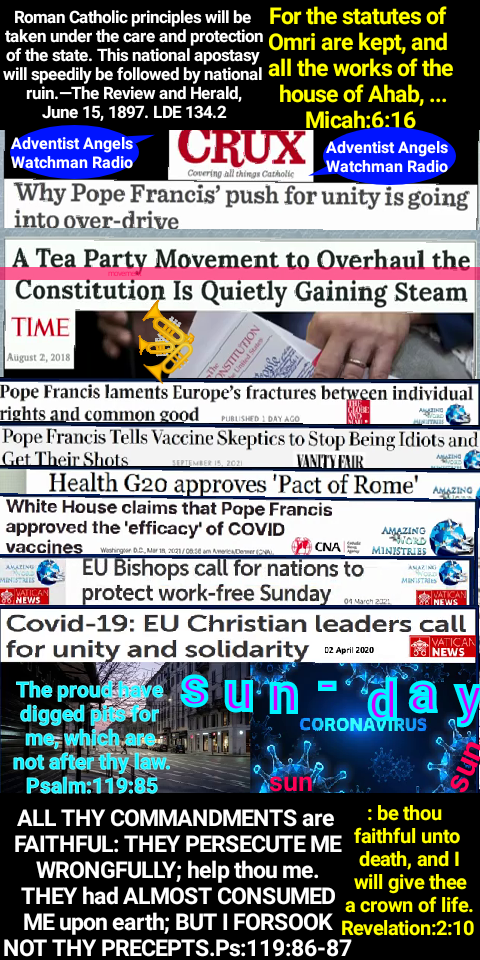
When the leading churches of the United States, uniting upon such points of doctrine as are held by them in common, shall influence the state to enforce their decrees and to sustain their institutions, then Protestant America will have formed an image of the Roman hierarchy, and the infliction of civil penalties upon dissenters will inevitably result.
The beast with two horns “causeth commands all, both small and great, rich and poor, free and bond, to receive a mark in their right hand, or in their foreheads: and that no man might buy or sell, save he that had the mark, or the name of the beast, or the number of his name.” Revelation 13:16, 17. The third angel’s warning is: “If any man worship the beast and his image, and receive his mark in his forehead, or in his hand, the same shall drink of the wine of the wrath of God.” “The beast” mentioned in this message, whose worship is enforced by the two-horned beast, is the first, or leopardlike beast of Revelation 13—the papacy. The “image to the beast” represents that form of apostate Protestantism which will be developed when the Protestant churches shall seek the aid of the civil power for the enforcement of their dogmas. The “mark of the beast” still remains to be defined.
After the warning against the worship of the beast and his image the prophecy declares: “Here are they that keep the commandments of God, and the faith of Jesus.” Since those who keep God’s commandments are thus placed in contrast with those that worship the beast and his image and receive his mark, it follows that the keeping of God’s law, on the one hand, and its violation, on the other, will make the distinction between the worshipers of God and the worshipers of the beast.
The special characteristic of the beast, and therefore of his image, is the breaking of God’s commandments. Says Daniel, of the little horn, the papacy: “He shall think to change times and the law.” Daniel 7:25, R.V. And Paul styled the same power the “man of sin,” who was to exalt himself above God. One prophecy is a complement of the other. Only by changing God’s law could the papacy exalt itself above God; whoever should understandingly keep the law as thus changed would be giving supreme honor to that power by which the change was made. Such an act of obedience to papal laws would be a mark of allegiance to the pope in the place of God.
The papacy has attempted to change the law of God. The second commandment, forbidding image worship, has been dropped from the law, and the fourth commandment has been so changed as to authorize the observance of the first instead of the seventh day as the Sabbath. But papists urge, as a reason for omitting the second commandment, that it is unnecessary, being included in the first, and that they are giving the law exactly as God designed it to be understood. This cannot be the change foretold by the prophet. An intentional, deliberate change is presented: “He shall think to change the times and the law.” The change in the fourth commandment exactly fulfills the prophecy. For this the only authority claimed is that of the church. Here the papal power openly sets itself above God GC 443.2 – GC 446.2

Rome Speaks Again: Away with Digital Publishings, up with candles; away with Bibles, and up with beads;Away with KJV up with James Webb Telescope: The Role of Art in a Time of War

So then faith cometh by hearing, and hearing by the word of God.Romans:10:17 And he said, I will hide my face from them, I will see what their end shall be: for they are a very froward generation, children in whom is no faith.Deuteronomy:32:20

Painting will not stop missiles. Music will not end suffering. But culture is not powerless — and a visit to Ukraine reaffirmed what it can do at its best.

The voice of the LORD is powerful; the voice of the LORD is full of majesty.Psalm:29:4 For the word of God is quick, and powerful, and sharper than any twoedged sword, piercing even to the dividing asunder of soul and spirit, and of the joints and marrow, and is a discerner of the thoughts and intents of the heart.
Hebrews:4:12

By Jason Farago

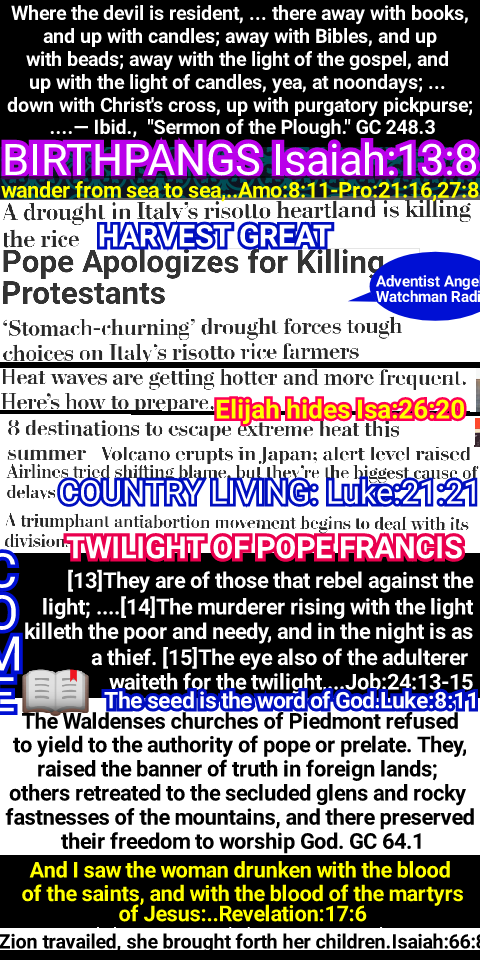
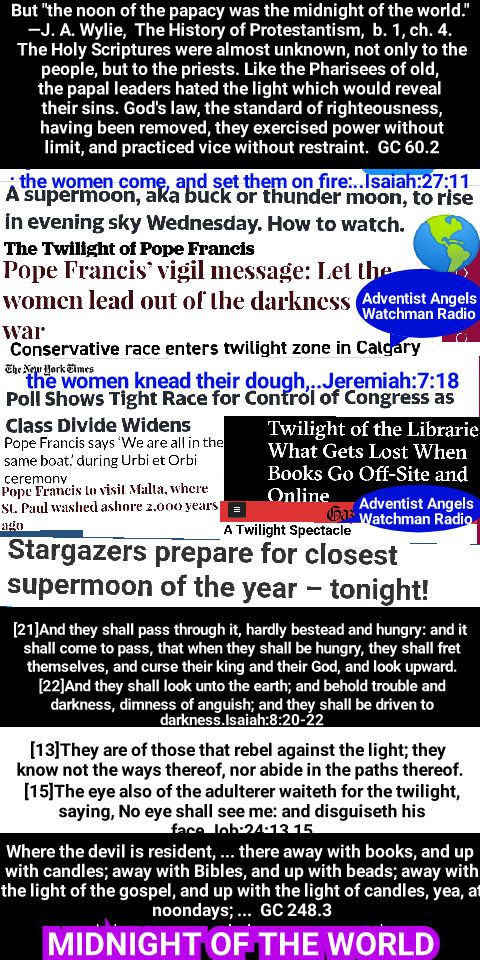
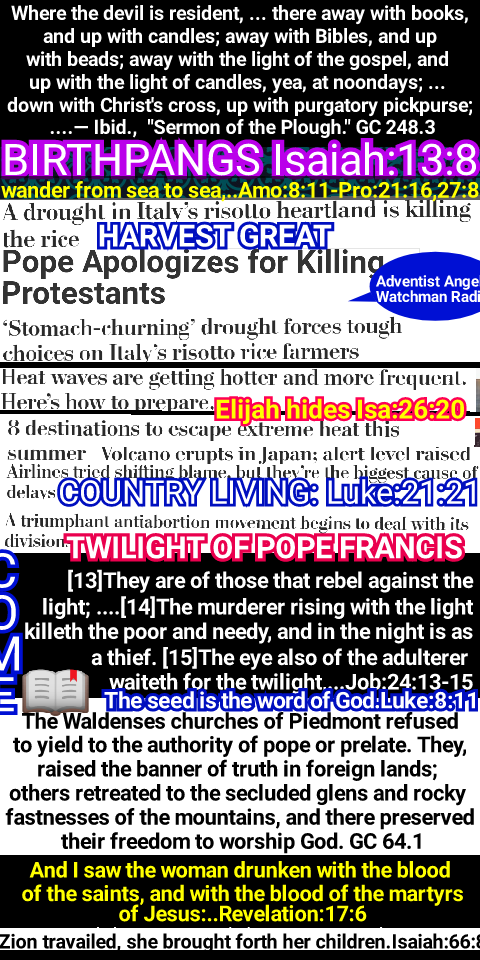
“Now I would ask a strange question,” said Latimer. “Who is the most diligent bishop and prelate in all England? … I see you listening and hearkening that I should name him…. I will tell you: it is the devil…. He is never out of his diocese; call for him when you will, he is ever at home; … he is ever at his plow…. Ye shall never find him idle, I warrant you…. Where the devil is resident, … there away with books, and up with candles; away with Bibles, and up with beads; away with the light of the gospel, and up with the light of candles, yea, at noondays; … down with Christ’s cross, up with purgatory pickpurse; … away with clothing the naked, the poor, and impotent, up with decking of images and gay garnishing of stocks and stones; up with man’s traditions and his laws, down with God’s traditions and His most holy word…. O that our prelates would be as diligent to sow the corn of good doctrine, as Satan is to sow cockle and darnel!”— Ibid., “Sermon of the Plough.”
The grand principle maintained by these Reformers—the same that had been held by the Waldenses, by Wycliffe, by John Huss, by Luther, Zwingli, and those who united with them—was the infallible authority of the Holy Scriptures as a rule of faith and practice. They denied the right of popes, councils, Fathers, and kings, to control the conscience in matters of religion. The Bible was their authority, and by its teaching they tested all doctrines and all claims. Faith in God and His word sustained these holy men as they yielded up their lives at the stake. “Be of good comfort,” exclaimed Latimer to his fellow martyr as the flames were about to silence their voices, “we shall this day light such a candle, by God’s grace, in England, as I trust shall never be put out.”— Works of Hugh Latimer 1:8 . GC 248.2 – GC 249.1

James Webb Verse King James Telescope, Comforter Biden Testify of Pope Francis Ev King Osiemo

photo
photo
photo
photo
photo
photo

High on a wall of the Palazzo Pitti, in Florence, hangs a famous painting that Rubens completed in the last years of his life.

At its center is Mars, the god of war, surging out in battle armor from the doors of the Temple of Janus.

In Roman peacetime, this temple’s gates were always closed. Now they have burst open, and the frenzy has begun.

Beneath Mars’s feet lie victims about to be trampled. You see a mother looking up with terror at the gathering violence, desperate to protect her wailing child.

Next to her are two figures who have fallen to the ground and are on the verge of destruction. One is a woman with a lute, her instrument already broken. Another is a personified Architecture, his compass falling from his hand.

These are “The Consequences of War,” as Rubens saw them in 1638. Civilians suffer, but not only them; culture is a casualty too.

“Where also our Lord was crucified.” This specification of the prophecy was also fulfilled by France. In no land had the spirit of enmity against Christ been more strikingly displayed. In no country had the truth encountered more bitter and cruel opposition. In the persecution which France had visited upon the confessors of the gospel, she had crucified Christ in the person of His disciples.
Century after century the blood of the saints had been shed. While the Waldenses laid down their lives upon the mountains of Piedmont “for the word of God, and for the testimony of Jesus Christ,” similar witness to the truth had been borne by their brethren, the Albigenses of France. In the days of the Reformation its disciples had been put to death with horrible tortures. King and nobles, highborn women and delicate maidens, the pride and chivalry of the nation, had feasted their eyes upon the agonies of the martyrs of Jesus. The brave Huguenots, battling for those rights which the human heart holds most sacred, had poured out their blood on many a hard-fought field. The Protestants were counted as outlaws, a price was set upon their heads, and they were hunted down like wild beasts.
The “Church in the Desert,” the few descendants of the ancient Christians that still lingered in France in the eighteenth century, hiding away in the mountains of the south, still cherished the faith of their fathers. As they ventured to meet by night on mountainside or lonely moor, they were chased by dragoons and dragged away to lifelong slavery in the galleys. The purest, the most refined, and the most intelligent of the French were chained, in horrible torture, amidst robbers and assassins. (See Wylie, b. 22, ch. 6.) Others, more mercifully dealt with, were shot down in cold blood, as, unarmed and helpless, they fell upon their knees in prayer. Hundreds of aged men, defenseless women, and innocent children were left dead upon the earth at their place of meeting. In traversing the mountainside or the forest, where they had been accustomed to assemble, it was not unusual to find “at every four paces, dead bodies dotting the sward, and corpses hanging suspended from the trees.” Their country, laid waste with the sword, the ax, the fagot, “was converted into one vast, gloomy wilderness.” “These atrocities were enacted … in no dark age, but in the brilliant era of Louis XIV. Science was then cultivated, letters flourished, the divines of the court and of the capital were learned and eloquent men, and greatly affected the graces of meekness and charity.”— Ibid., b. 22, ch. 7.
But blackest in the black catalogue of crime, most horrible among the fiendish deeds of all the dreadful centuries, was the St. Bartholomew Massacre. The world still recalls with shuddering horror the scenes of that most cowardly and cruel onslaught. The king of France, urged on by Romish priests and prelates, lent his sanction to the dreadful work. A bell, tolling at dead of night, was a signal for the slaughter. Protestants by thousands, sleeping quietly in their homes, trusting to the plighted honor of their king, were dragged forth without a warning and murdered in cold blood.
As Christ was the invisible leader of His people from Egyptian bondage, so was Satan the unseen leader of his subjects in this horrible work of multiplying martyrs. For seven days the massacre was continued in Paris, the first three with inconceivable fury. And it was not confined to the city itself, but by special order of the king was extended to all the provinces and towns where Protestants were found. Neither age nor sex was respected. Neither the innocent babe nor the man of gray hairs was spared. Noble and peasant, old and young, mother and child, were cut down together. Throughout France the butchery continued for two months. Seventy thousand of the very flower of the nation perished.
“When the news of the massacre reached Rome, the exultation among the clergy knew no bounds. The cardinal of Lorraine rewarded the messenger with a thousand crowns; the cannon of St. Angelo thundered forth a joyous salute; and bells rang out from every steeple; bonfires turned night into day; and Gregory XIII, attended by the cardinals and other ecclesiastical dignitaries, went in long procession to the church of St. Louis, where the cardinal of Lorraine chanted a Te Deum …. A medal was struck to commemorate the massacre, and in the Vatican may still be seen three frescoes of Vasari, describing the attack upon the admiral, the king in council plotting the massacre, and the massacre itself. Gregory sent Charles the Golden Rose; and four months after the massacre, … he listened complacently to the sermon of a French priest, … who spoke of ‘that day so full of happiness and joy, when the most holy father received the news, and went in solemn state to render thanks to God and St. Louis.'”—Henry White, The Massacre of St. Bartholomew, ch. 14, par. 34.
The same master spirit that urged on the St. Bartholomew Massacre led also in the scenes of the Revolution. Jesus Christ was declared to be an impostor, and the rallying cry of the French infidels was, “Crush the Wretch,” meaning Christ. Heaven-daring blasphemy and abominable wickedness went hand in hand, and the basest of men, the most abandoned monsters of cruelty and vice, were most highly exalted. In all this, supreme homage was paid to Satan; while Christ, in His characteristics of truth, purity, and unselfish love, was crucified.
“The beast that ascendeth out of the bottomless pit shall make war against them, and shall overcome them, and kill them.” The atheistical power that ruled in France during the Revolution and the Reign of Terror, did wage such a war against God and His holy word as the world had never witnessed. The worship of the Deity was abolished by the National Assembly. Bibles were collected and publicly burned with every possible manifestation of scorn. The law of God was trampled underfoot. The institutions of the Bible were abolished. The weekly rest day was set aside, and in its stead every tenth day was devoted to reveling and blasphemy. Baptism and the Communion were prohibited. And announcements posted conspicuously over the burial places declared death to be an eternal sleep.
The fear of God was said to be so far from the beginning of wisdom that it was the beginning of folly. All religious worship was prohibited, except that of liberty and the country. The “constitutional bishop of Paris was brought forward to play the principal part in the most impudent and scandalous farce ever acted in the face of a national representation…. He was brought forward in full procession, to declare to the Convention that the religion which he had taught so many years was, in every respect, a piece of priestcraft, which had no foundation either in history or sacred truth. He disowned, in solemn and explicit terms, the existence of the Deity to whose worship he had been consecrated, and devoted himself in future to the homage of liberty, equality, virtue, and morality. He then laid on the table his episcopal decorations, and received a fraternal embrace from the president of the Convention. Several apostate priests followed the example of this prelate.”—Scott, vol. 1, ch. 17. GC 270.1 – GC 274.1
KYIV, Ukraine — You do not have to go far outside of Kyiv to see how the massacre of civilians and the trampling of culture still come one after the other. In Borodianka, a nucleus of Russian atrocities about 45 minutes north of here — the drive is slower now that the bridges have been demolished — the Palace of Culture has had its windows blown out; its concert hall is dust-caked, and the ticket booths have been ripped asunder. Halfway between the capital and the Belarusian border, I had to contort my body through twisted studs to enter the leveled Ivankiv Historical and Local History Museum, its statuary now pitted, its embroideries scorched. It is far worse further east.

Here in Kyiv the masterpieces have, like many of its citizens earlier, gone underground. The Khanenko National Museum of Arts, in an old mansion on Tereshchenkivska Street, owns a smaller Rubens: a little oil sketch of a river god, normally on a blue wall beneath a Beaux-Arts skylight. I couldn’t see it when I walked over there; the whole collection is in hiding.

In Borodianka, just outside Kyiv, Russians killed scores of civilians, destroyed buildings and damaged a monument to Taras Shevchenko, the seminal 19th-century Ukrainian poet.
In Borodianka, just outside Kyiv, Russians killed scores of civilians, destroyed buildings and damaged a monument to Taras Shevchenko, the seminal 19th-century Ukrainian poet.Credit…Ivor Prickett for The New York Times
In Borodianka, just outside Kyiv, Russians killed scores of civilians, destroyed buildings and damaged a monument to Taras Shevchenko, the seminal 19th-century Ukrainian poet.

. The Ukrainian national anthem was sung at the Metropolitan Opera; a Ukrainian folk song cold-opened “Saturday Night Live.” We have now all internalized the participatory prerogatives of social media: you must react, you must engage. The algorithms do not favor Rubensian allegory.

ADVERTISEMENT

Continue reading the main story

The authorities in Ukraine, up to the actor-turned-commander in chief, have not been shy in encouraging the domain of international culture to support the war effort.

Those of us in the rich and safe parts of the world, rich and safe as long as the nukes stay sheathed, surely get something out of this cultural solidarity.

Picasso’s “Guernica” extracted the universal grief from the bombardment of a Basque village during the Spanish Civil War.
Picasso’s “Guernica” extracted the universal grief from the bombardment of a Basque village during the Spanish Civil War.Credit…Estate of Pablo Picasso/Artists Rights Society (ARS), New York; via Museo Nacional Centro de Arte Reina Sofia
Picasso’s “Guernica” extracted the universal grief from the bombardment of a Basque village during the Spanish Civil War.

Somewhere in the interstices between form and meaning, between picture and plotline, between thinking and feeling, art gives us a view of human suffering and human capability that testimonials, or even our own eyes, are not always able to. These war works are not important because they are “topical” — or, to use the vacuous catchphrase of our day, “necessary.” They are important because they reaffirm the place of form and imagination in times that would deny their potentialities. They narrate history at scales and depths that push notifications simply cannot deliver, and propaganda does not bother with. They are what allow us to discern, in the daily tide of images and insanities, any meaning at all.

For the word of God is quick, and powerful, and sharper than any twoedged sword, piercing even to the dividing asunder of soul and spirit, and of the joints and marrow, and is a discerner of the thoughts and intents of the heart.Hebrews:4:12

[4]Concerning the works of men, by the word of thy lips I have kept me from the paths of the destroyer. [5]Hold up my goings in thy paths, that my footsteps slip not. [8]Keep me as the apple of the eye, hide me under the shadow of thy wings, [9]From the wicked that oppress me, from my deadly enemies, who compass me about. [10]They are inclosed in their own fat: with their mouth they speak proudly. [11]They have now compassed us in our steps: they have set their eyes bowing down to the earth;Psalm:17:4-5,8-11

But love is nothing now. Mars is in the grip of another woman, the fury Alecto, whose hair stands on end and whose eyes bulge with madness.

Look past the faces, look to the bodies. The big gods writhe and corkscrew as they tumble from left to right. The lesser, innocent figures skid and shatter.

When Rubens began painting “The Consequences of War” around 1638, the Thirty Years’ War was only 20 years old. Never before had Europe known an orgy of death like the one Rubens was living through; it would not again until the 20th century. Compare this painting to Rubens’s earlier tableaus of mythical brutality, such as the anatomically crisp “Massacre of the Innocents” (circa 1610), and you see how the later picture bleeds and pools, runs and ripples.

“The Massacre of the Innocents,” an earlier Rubens.
“The Massacre of the Innocents,” an earlier Rubens.Credit…via Art Gallery of Ontario
“The Massacre of the Innocents,” an earlier Rubens.

Rather than depict the battles and the pestilence head-on, here it’s as if paint itself has gone to war. Rubens understood, amid unprecedented violence, that the times had turned the excesses of the Baroque into a mode of realism.

Or, put another way: he understood that the extremity of the Thirty Years’ War required an extremity in form, and that an allegory could show something other representations could not. It was a point he underscored with the last major figure in “The Consequences of War,” the one at far left. She is a young woman in a torn and ungirdled black dress. Her arms are thrust to the sky, her ruddy cheeks stained with fat tears. This wailing woman, as Rubens wrote to a fellow painter in Florence, is l’infelice Europa: “the unfortunate Europe who, for so many years now, has suffered plunder, outrage and misery, which are so harmful to all that they need no further specification.”

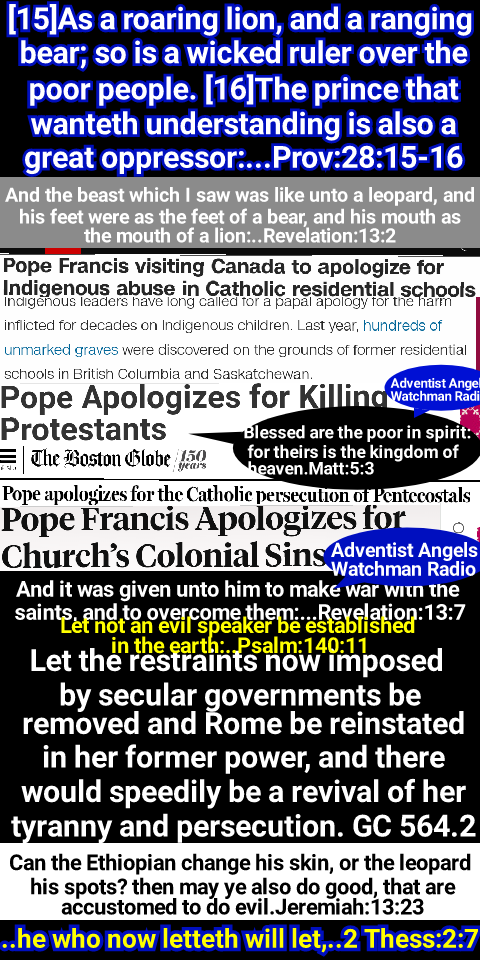
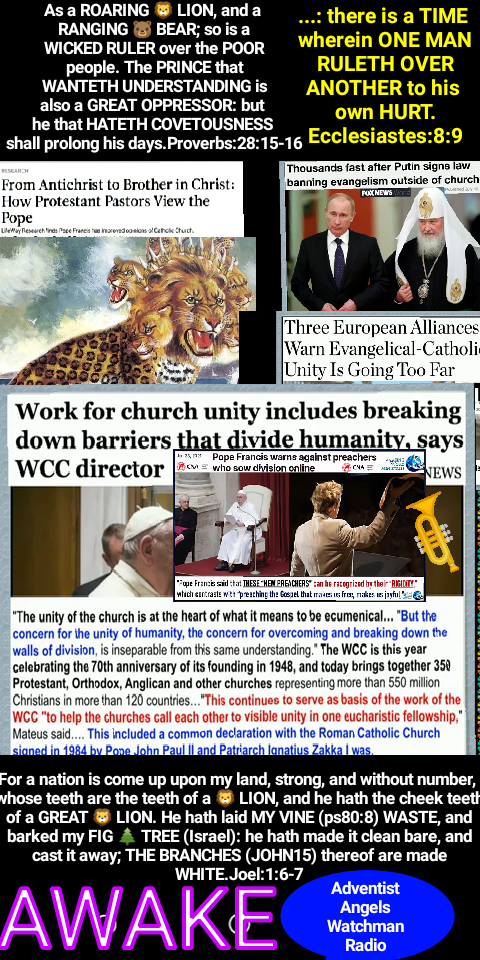
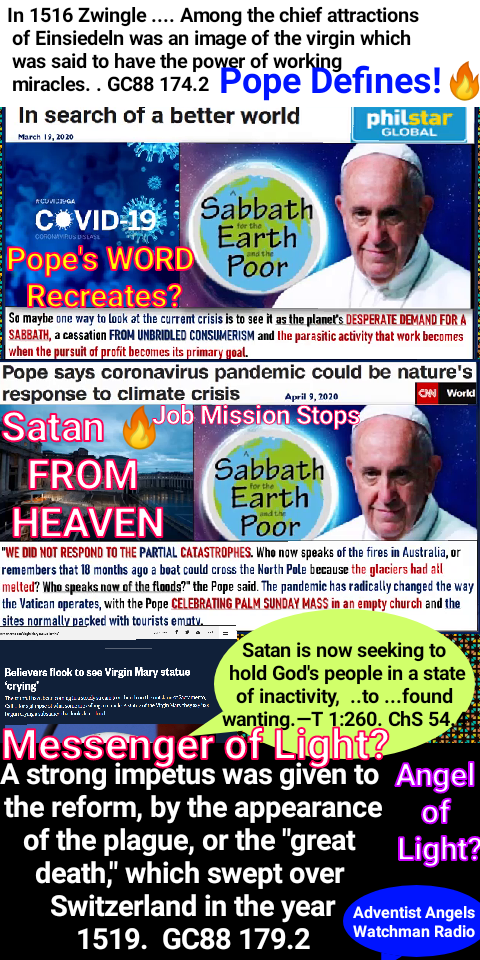
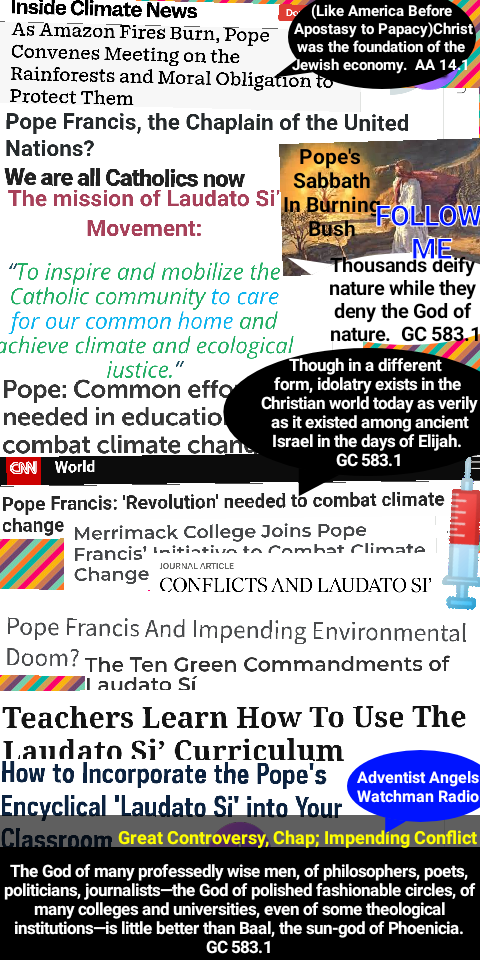
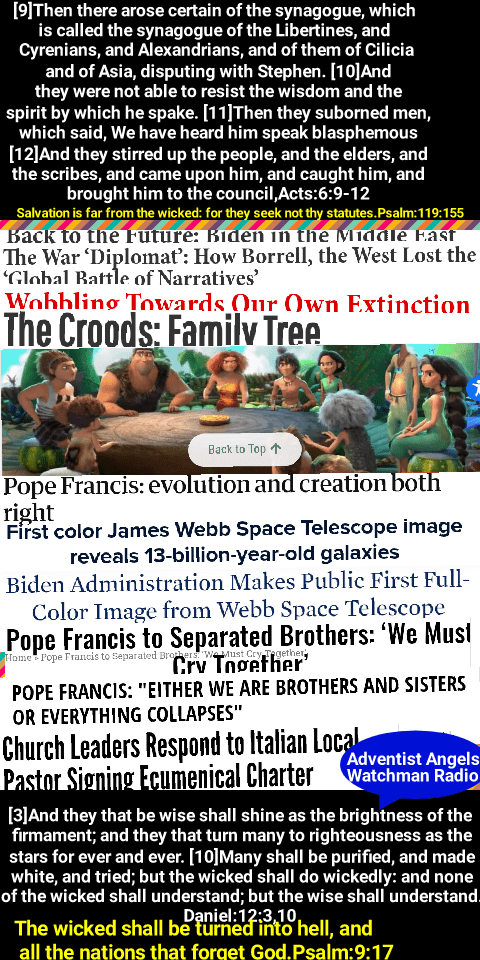
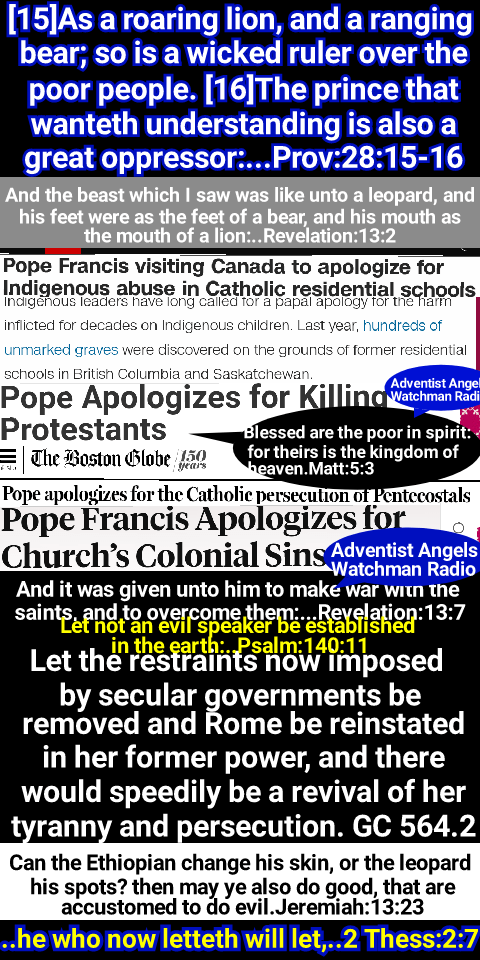
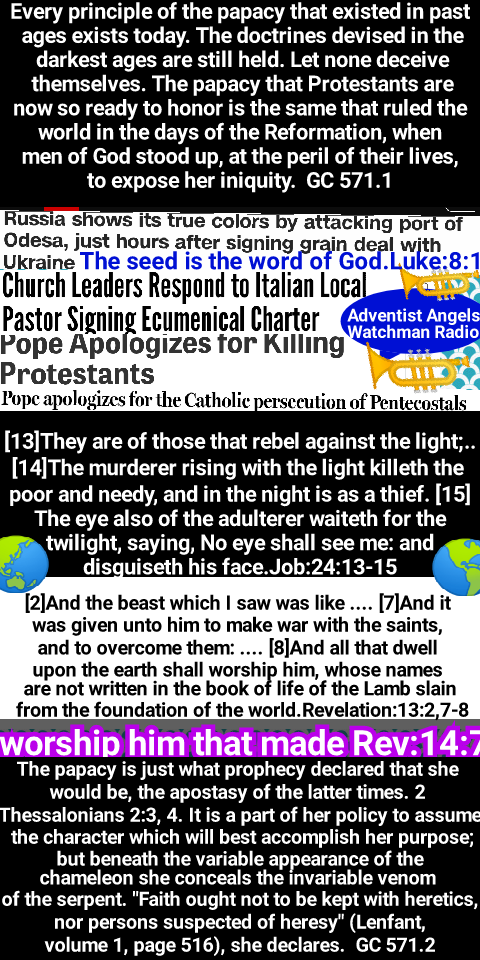
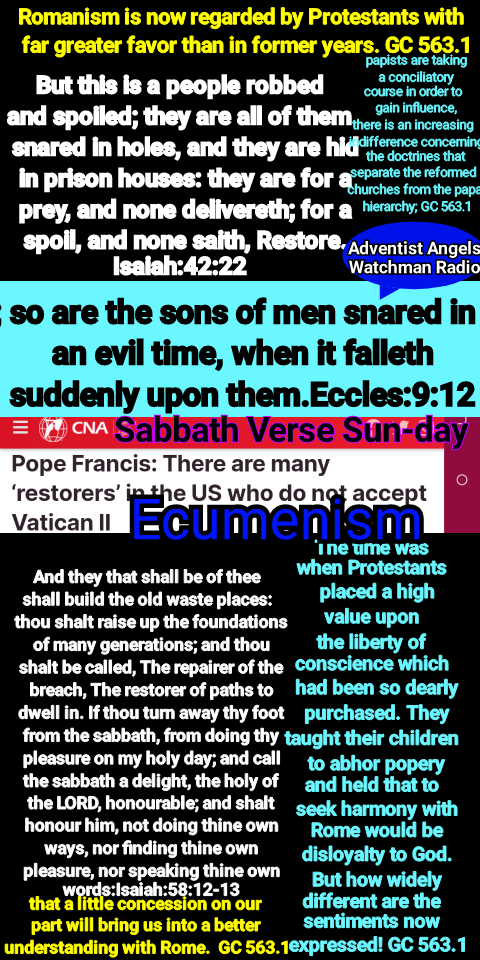
Romanism is now regarded by Protestants with far greater favor than in former years. In those countries where Catholicism is not in the ascendancy, and the papists are taking a conciliatory course in order to gain influence, there is an increasing indifference concerning the doctrines that separate the reformed churches from the papal hierarchy; the opinion is gaining ground that, after all, we do not differ so widely upon vital points as has been supposed, and that a little concession on our part will bring us into a better understanding with Rome. ([15]As a roaring lion, and a ranging bear; so is a wicked ruler over the poor people. [16]The prince that wanteth understanding is also a great oppressor: ….).Proverbs:28:15-16 The time was when Protestants placed a high value upon the liberty of conscience which had been so dearly purchased. They taught their children to abhor popery and held that to seek harmony with Rome would be disloyalty to God. But how widely different are the sentiments now expressed!
The defenders of the papacy declare that the church has been maligned, and the Protestant world are inclined to accept the statement. Many urge that it is unjust to judge the church of today by the abominations and absurdities that marked her reign during the centuries of ignorance and darkness. They excuse her horrible cruelty as the result of the barbarism of the times and plead that the influence of modern civilization has changed her sentiments.
Have these persons forgotten the claim of infallibility put forth for eight hundred years by this haughty power? So far from being relinquished, this claim was affirmed in the nineteenth century with greater positiveness than ever before. As Rome asserts that the “church never erred; nor will it, according to the Scriptures, ever err ” (John L. von Mosheim, Institutes of Ecclesiastical History, book 3, century II, part 2, chapter 2, section 9, note 17), how can she renounce the principles which governed her course in past ages?
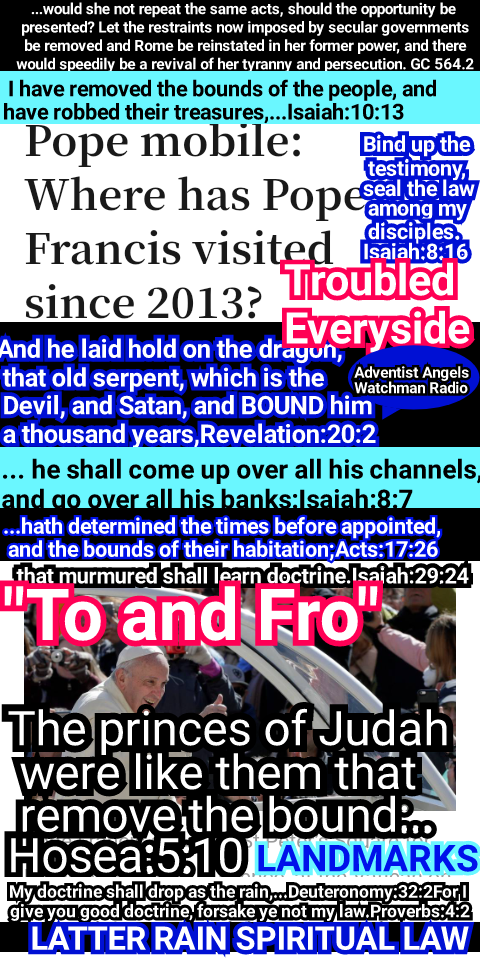
The papal church will never relinquish her claim to infallibility. All that she has done in her persecution of those who reject her dogmas she holds to be right; and would she not repeat the same acts, should the opportunity be presented? Let the restraints now imposed by secular governments be removed and Rome be reinstated in her former power, and there would speedily be a revival of her tyranny and persecution. GC 563.1 – GC 564.2

Seek ye out of the book of the LORD, and read: no one of these shall fail, none shall want her mate: for my mouth it hath commanded, and his spirit it hath gathered them. Isaiah:34:16

So harmful that they need no further specification. Even in the mid-17th century, scenes of brutality were already so potent and persistent that the whole Thirty Years’ War could be worn in Europe’s tangled gown, her unkempt hair, her hot pink face. If images of war were that ambient in the 1630s, then I don’t even know how to begin quantifying the supersaturation today. Yet our own age’s imagery of plunder and misery has less moral impact each year — as we dreadfully learned during the Syrian civil war, very probably the most documented in human history (until this one).

[11]I, even I, am the LORD; and beside me there is no saviour. [12]I have declared, and have saved, and I have shewed, when there was no strange god among you: therefore ye are my witnesses, saith the LORD, that I am God.Isaiah:43:11-12

26]Who hath declared from the beginning, that we may know? and beforetime, that we may say, He is righteous? yea, there is none that sheweth, yea, there is none that declareth, yea, there is none that heareth your words. [28]For I beheld, and there was no man; even among them, and there was no counsellor, that, when I asked of them, could answer a word. [29]Behold, they are all vanity; their works are nothing: their molten images are wind and confusion.Isaiah:41:26,28-29

The destruction at the Central House of Culture in Irpin, a suburb of Kyiv.
The destruction at the Central House of Culture in Irpin, a suburb of Kyiv.Credit…Emile Ducke for The New York Times
The destruction at the Central House of Culture in Irpin, a suburb of Kyiv.

Brilliancy of style is not necessarily an index of pure, elevated thought. High conceptions of art, delicate refinement of taste, often exist in minds that are earthly and sensual. They are often employed by Satan to lead men to forget the necessities of the soul, to lose sight of the future, immortal life, to turn away from their infinite Helper, and to live for this world alone.
A religion of externals is attractive to the unrenewed heart. The pomp and ceremony of the Catholic worship has a seductive, bewitching power, by which many are deceived; and they come to look upon the Roman Church as the very gate of heaven. None but those who have planted their feet firmly upon the foundation of truth, and whose hearts are renewed by the Spirit of God, are proof against her influence. Thousands who have not an experimental knowledge of Christ will be led to accept the forms of godliness without the power. Such a religion is just what the multitudes desire. GC 567.1 – GC 567.2

Continue reading the main story

WAR HAS BECOME THE ULTIMATE reflection of the digital addlement that the Polish novelist Olga Tokarczuk has identified as the primary challenge to artists and audiences today. On the phone screen, everywhere is just “somewhere,” Tokarczuk regretted in her 2019 Nobel lecture: “‘Somewhere’ some people are drowning as they try to cross the sea. ‘Somewhere,’ for ‘some’ time, ‘some sort of’ a war has been going on. In the deluge of information individual messages lose their contours, dissipate in our memory, become unreal and vanish.” How can any war photograph compel us, how can any work of war art preserve its importance, while swimming upstream in an undammable river of content? Soldiers, too, have phones alongside their AK-74s, and every day since Feb. 24 has brought another evanescent current thing.

For the word of God is quick, and powerful, and sharper than any twoedged sword, piercing even to the dividing asunder of soul and spirit, and of the joints and marrow, and is a discerner of the thoughts and intents of the heart.Hebrews:4:12

Our only chance of getting from “somewhere” to somewhere, according to Tokarczuk, lies in a model of artistic creation that breaks the first-person-singular of the status update, and seeks “a story that would go beyond the uncommunicative prison of one’s own self.” American culture has grown fearful of stories like that — more universal ones, more comprehensive ones — but writing them has been the job of artists in wartime since Aeschylus staged “The Persians.” One cultural commitment we can make, as the world of yesterday passes into mist, is to rediscover the full human cost of our perpetual battles, even if their reflections in art are bound to be fragmentary. From those fragments we might yet constellate a view of the consequences of war, and of coming hazards we will not have the luxury to scroll beyond.

Still another fabrication was needed to enable Rome to profit by the fears and the vices of her adherents. This was supplied by the doctrine of indulgences. Full remission of sins, past, present, and future, and release from all the pains and penalties incurred, were promised to all who would enlist in the pontiff’s wars to extend his temporal dominion, to punish his enemies, or to exterminate those who dared deny his spiritual supremacy. The people were also taught that by the payment of money to the church they might free themselves from sin, and also release the souls of their deceased friends who were confined in the tormenting flames. By such means did Rome fill her coffers and sustain the magnificence, luxury, and vice of the pretended representatives of Him who had not where to lay His head. (See Appendix.)
The Scriptural ordinance of the Lord’s Supper had been supplanted by the idolatrous sacrifice of the mass. Papal priests pretended, by their senseless mummery, to convert the simple bread and wine into the actual “body and blood of Christ.”—Cardinal Wiseman, The Real Presence of the Body and Blood of Our Lord Jesus Christ in the Blessed Eucharist, Proved From Scripture, lecture 8, sec. 3, par. 26. With blasphemous presumption, they openly claimed the power of creating God, the Creator of all things. Christians were required, on pain of death, to avow their faith in this horrible, Heaven-insulting heresy. Multitudes who refused were given to the flames. (See Appendix.)
In the thirteenth century was established that most terrible of all the engines of the papacy—the Inquisition. The prince of darkness wrought with the leaders of the papal hierarchy. In their secret councils Satan and his angels controlled the minds of evil men, while unseen in the midst stood an angel of God, taking the fearful record of their iniquitous decrees and writing the history of deeds too horrible to appear to human eyes. “Babylon the great” was “drunken with the blood of the saints.” The mangled forms of millions of martyrs cried to God for vengeance upon that apostate power.
Popery had become the world’s despot. Kings and emperors bowed to the decrees of the Roman pontiff. The destinies of men, both for time and for eternity, seemed under his control. For hundreds of years the doctrines of Rome had been extensively and implicitly received, its rites reverently performed, its festivals generally observed. Its clergy were honored and liberally sustained. Never since has the Roman Church attained to greater dignity, magnificence, or power.
But “the noon of the papacy was the midnight of the world.”—J. A. Wylie, The History of Protestantism, b. 1, ch. 4. The Holy Scriptures were almost unknown, not only to the people, but to the priests. Like the Pharisees of old, the papal leaders hated the light which would reveal their sins. God’s law, the standard of righteousness, having been removed, they exercised power without limit, and practiced vice without restraint. Fraud, avarice, and profligacy prevailed. Men shrank from no crime by which they could gain wealth or position. The palaces of popes and prelates were scenes of the vilest debauchery. Some of the reigning pontiffs were guilty of crimes so revolting that secular rulers endeavored to depose these dignitaries of the church as monsters too vile to be tolerated. For centuries Europe had made no progress in learning, arts, or civilization. A moral and intellectual paralysis had fallen upon Christendom.
The condition of the world under the Romish power presented a fearful and striking fulfillment of the words of the prophet Hosea: “My people are destroyed for lack of knowledge: because thou hast rejected knowledge, I will also reject thee: … seeing thou hast forgotten the law of thy God, I will also forget thy children.” “There is no truth, nor mercy, nor knowledge of God in the land. By swearing, and lying, and killing, and stealing, and committing adultery, they break out, and blood toucheth blood.” Hosea 4:6, 1, 2. Such were the results of banishing the word of God. GC 59.1 – GC 60.3


Peter Paul Rubens, “The Consequences of War,” via Uffizi Galleries.

Three Angels Flying in Space Station, No holding back! Seed Battle, Seed is Word of God, the planting of the LORD

at they might be called trees of righteousness, the planting of the LORD, that he might be glorified.
Isaiah:61:3 Thy people also shall be all righteous: they shall inherit the land for ever, the branch of my planting, the work of my hands, that I may be glorified. Isaiah:60:21

America brings Fire From Heaven Before Pope & People, Evolution, James Webb Ev King Osiemo

Upon all who dwell on the face of the whole earth, upon all who make this world their home, the day of God will come as a snare. It comes to them as a prowling thief.
The world, full of rioting, full of godless pleasure, is asleep, asleep in carnal security. Men are putting afar off the coming of the Lord. They laugh at warnings. The proud boast is made, “All things continue as they were from the beginning.” “Tomorrow shall be as this day, and much more abundant.” 2 Peter 3:4; Isaiah 56:12. We will go deeper into pleasure loving. But Christ says, “Behold, I come as a thief.” Revelation 16:15. At the very time when the world is asking in scorn, “Where is the promise of His coming?” the signs are fulfilling. While they cry, “Peace and safety,” sudden destruction is coming. When the scorner, the rejecter of truth, has become presumptuous; when the routine of work in the various money-making lines is carried on without regard to principle; when the student is eagerly seeking knowledge of everything but his Bible, Christ comes as a thief.
Everything in the world is in agitation. The signs of the times are ominous. Coming events cast their shadows before. The Spirit of God is withdrawing from the earth, and calamity follows calamity by sea and by land. There are tempests, earthquakes, fires, floods, murders of every grade. Who can read the future? Where is security? There is assurance in nothing that is human or earthly. Rapidly are men ranging themselves under the banner they have chosen. Restlessly are they waiting and watching the movements of their leaders. There are those who are waiting and watching and working for our Lord’s appearing. Another class are falling into line under the generalship of the first great apostate. Few believe with heart and soul that we have a hell to shun and a heaven to win.
The crisis is stealing gradually upon us. The sun shines in the heavens, passing over its usual round, and the heavens still declare the glory of God. Men are still eating and drinking, planting and building, marrying, and giving in marriage. Merchants are still buying and selling. Men are jostling one against another, contending for the highest place. Pleasure lovers are still crowding to theaters, horse races, gambling hells. The highest excitement prevails, yet probation’s hour is fast closing, and every case is about to be eternally decided. Satan sees that his time is short. He has set all his agencies at work that men may be deceived, deluded, occupied and entranced, until the day of probation shall be ended, and the door of mercy be forever shut.
Solemnly there come to us down through the centuries the warning words of our Lord from the Mount of Olives: “Take heed to yourselves, lest at any time your hearts be overcharged with surfeiting, and drunkenness, and cares of this life, and so that day come upon you unawares.” “Watch ye therefore, and pray always, that ye may be accounted worthy to escape all these things that shall come to pass, and to stand before the Son of man.” DA 635.2 – DA 636.3

Wherefore glorify ye the LORD in the fires, even the name of the LORD God of Israel in the isles of the sea.
Isaiah:24:15

Babylon is Fallen: Pope Francis Participates in a Pure Pagan Celebration of Mother Earth

On July 25, 2022, Pope Francis took part in a pagan ceremony honoring Mother Earth while he was in Canada on a mission to promote healing and reconciliation with the indigenous people. This ceremony was a rallying cry for ecumenism and solidarity with Mother Earth. Drums accompanied the dancing and singing as Mother Earth worshippers dressed in colorful costumes.

This tribute to Mother Earth is part of the globalist climate change agenda that is rapidly leading our world into spiritualism. The video of this display was provided by the Vatican. At the forefront of this worship service for the Mother Earth goddess, you will see Pope Francis taking it all in. In the Vatican video, the following statement was made, which clearly promotes pantheism:

“You know, ladies and gentlemen, the number four represents the elements, the four directions, the four stages of life, and the four living life forms. The four directions. You have the sun rising from the east. And we also have from the south, we have the thunderbird, and over on the west side, we have the wind, the oxygen that we breathe. This is the government of Mother Earth. On the north side, we have Mother Earth. Mother Earth is who we are. Mother Earth is all of plant life. Mother Earth, our mother, is also the mother of all insect life. Mother Earth is also the mother of all animals, on the ground, in the water, and in the air. Mother Earth, of course, is the mother of all humanity. Mother Earth is who she is. We are the children, we are the people of Mother Earth” (YouTube Video).

No true Christian can remain in communion with these apostate “Christians” who betray the gospel of Christ during these Mother Earth celebrations. Pope Francis is building a universal fraternity together with idolaters and pagans while encouraging them to continue in their unbelief. The Pope is supporting lost pagans in their denial of the one true God. How is this possible? How could Pope Francis, who claims to be the leader of a “Christian” organization, deny the indigenous people access to salvation, which could only be attained by turning from their pagan practices, accepting the true faith in Christ, receiving baptism, and adhering to sound biblical doctrine? #sda #adventist #adventista

Click to watch the video and to read the full story: http://adventmessenger.org/babylon-is-fallen-pope-francis-participates-in-a-pure-pagan-celebration-of-mother-earth/

America Father of His Country: The Wandering Prodigal Son

The advent of the United States in the Orient will not tend to amity, but rather to animosity. This was cleverly stated by Lord Salisbury, when at the last lord mayor’s banquet, he said the “appearance of the United States as a factor in Asiatic affairs is likely to conduce to the interests of Great Britain, but might not conduce to the interests of peace.” It can not possibly conduce to the interests of peace, for the very reason that in entering the Orient this nation has deserted her policy of peace, and has adopted in principle, at least, the bellicose spirit; she has now departed from that doctrine of the “father of his country,” which, if it never brought to her military glory, most certainly has been the cause of her material greatness. The words in the “Farewell Address” are a pearl of great price. They may be familiar, but they can not too often be recalled:—
“Against the insidious wiles of foreign influence (I conjure you to believe me, fellow citizens) the jealousy of a free people ought to be constantly awake, since history and experience prove that foreign influence is one of the most baneful foes of republican government….
“The great rule of conduct for us in regard to foreign nations is, in extending our commercial relations, to have with them as little political connection as possible. So far as we have already formed engagements, let them be fulfilled with perfect good faith. Here let us stop.
“Europe has a set of primary interests which to us have none or a very remote relation. Hence she must be engaged in frequent controversies, the causes of which are essentially foreign to our concerns. Hence, therefore, it must be unwise in us to implicate ourselves by artificial ties in the ordinary vicissitudes of her politics, or the ordinary combinations or collisions of her friendships or enmities.
“Our detached and distant situation invites and enables us to pursue a very different course. If we remain one people, under an efficient government, the period is not far off when we may defy material injury from external annoyance; when we may take suck an attitude as will cause the neutrality we may at any time resolve upon to be scrupulously respected; when belligerent nations, under the impossibility of making acquisitions upon us, will not lightly hazard the giving us provocation; when we may choose peace or war, as our interests, guided by justice, shall counsel.
“Why forego the advantages of so peculiar a situation? Why quit our own to stand upon foreign ground? Why, by interweaving our destiny with that of any part of Europe, entangle our peace and prosperity in the toils of European ambition, rivalship, interest, humor, or caprice?
“It is our true policy to steer clear of permanent alliances with any portion of the foreign world.”
But all the nations interested in the Chinese and Oriental problem in general are continually making and breaking alliances. This is absolutely necessary in the very nature of things. One nation may on account of its own internal policy and traditions desire to keep aloof from the others; but when combinations are formed against it, there is no other choice but to join forces with some other power. England has been, more than any other nation, perhaps, friendly to the idea of having the United States in the Oriental caldron. Many think that this friendship will conduce to peace, but that it can not possibly do this is clearly set forth by Carl Schurz in his address before the convocation of the Chicago University last January:—
“If we take those new regions, we shall be well entangled in that contest for territorial aggrandizement which distracts other nations and drives them far beyond their original design. So it will be inevitably with us. We shall want new conquests to protect that which we already possess. The greed of speculators working upon our government will push us from one point to another, and we shall have new conflicts on our hands, almost without knowing how we got into them. It has always been so under such circumstances, and always will be. This means more and more soldiers, ships, and guns. PRUS 170.1 – PRUS 171.4
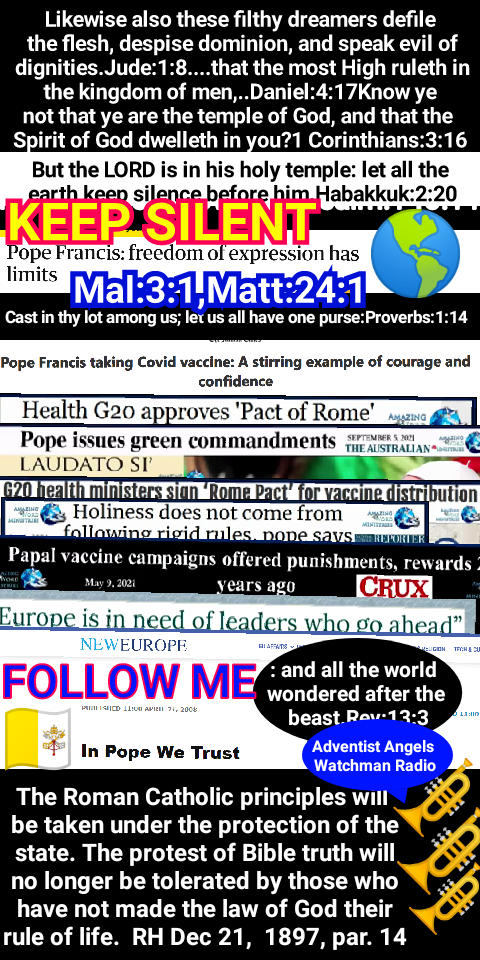
Back in Brussels, the European Commission stayed out of the widening fracas, declining to comment on Orbán’s remarks. Common Good verse Liberty

‘Nazi’ talk: Orbán adviser trashes ‘mixed race’ speech in dramatic exit

The Hungarian prime minister is embroiled in a rare war of words with a close ally warning that Orbán’s ‘openly racist’ remarks must be stopped.

EU’s Visegrad Four Hold Talks In Poland

Orbán has made a name for himself on the international stage over the past years by stoking culture wars | Omar Marques/Getty Images

BY LILI BAYER

July 26, 2022 10:15 pm

Then again, if this doctrine of the Bible in one hand and the shotgun in the other is a good one for the ……………… how long will it be ere it is considered a good one for every State in the Union? Should one religious sect get control of the governmental affairs, why may it not use force to compel all others to come into line, and think and pray as it thinks and prays? This idea may be received by some with ridicule, but the beginnings of the loss of liberty, both civil and religious, are always insidious, and very small precedents have oftentimes started tremendous changes in things. There has been persecution in the past, there is persecution for religious views even at the present, and there will be persecution for conscience’ sake in the time to come. Allow a new doctrine to pass unchallenged to-day, it quickly gains strength and standing, and by to-morrow it is heterodoxy to question its application.
There have been some fearful crimes committed in the name of justice in this gospel-enlightened land. Many a soul has suffered death in one horrible form or another, without having been duly convicted in the courts of law. Possibly it may be said with truth that there is no country on earth claiming to be Christian and civilized where there have been more deaths by mob violence, than in the United States. In times of excitement over vital questions our people have many times proved the truthfulness of the statement of Alexander Hamilton, that a man was a reasoning rather than a reasonable being. In the fierce struggles between capital and labor, in times of a strike, a boycott, or a lockout, terrible deeds of violence and bloodshed have stained the nation’s robe. Innocent lives have been placed in the most dire peril and jeopardy. PRUS 121.2 – PRUS 122.1

Barbed warnings of “Nazi” rhetoric went flying Tuesday as the controversy over Viktor Orbán’s “mixed race” remarks breached rare territory — the Hungarian prime minister’s own circle.

Just four days after Orbán startled European leaders by declaring countries were “no longer nations” after different races blend, one of the prime minister’s own longtime advisers, sociologist Zsuzsa Hegedüs, quit on Tuesday. 

And she didn’t do so quietly.

Hegedüs’s resignation letter — filled with ire — was instantly leaked, turning it into a public excoriation of Orbán’s speech.

“Worthy of Goebbels,” she said in the letter, which was seen by Hungarian magazine HVG. 

A “pure Nazi text,” she added. 

“That you are able to deliver an openly racist speech would not occur to me even in a nightmare,” marveled Hegedüs, who has been working for Orbán for over a decade. 

And it didn’t stop there. 

Within hours, Orbán had published his own letter, claiming to have “a zero-tolerance policy” toward anti-Semitism and racism. Hegedüs shot back with a second letter, invoking her parent’s experiences as Hungarian Holocaust survivors. Others died, she said, because too many people stayed silent when hate first emerged.

It was a remarkable turn of events in the widening fallout over Orbán’s speech, in which he took aim at the “internationalist left” for portraying Europe as inherently “populated by peoples of mixed race.”

While the remarks drew the predictable opprobrium from a smattering of other European officials, Tuesday’s backlash from within the close ranks around Orbán was unexpected. Resignations are uncommon in Orbán’s circles, and open dissent from allies is even more unusual. 

But Orbán’s speech also represented a change for the Hungarian leader.  Anti-LGBT protestors during the annual Pride parade in 2021 in Budapest, Hungary | Janos Kummer/Getty Images
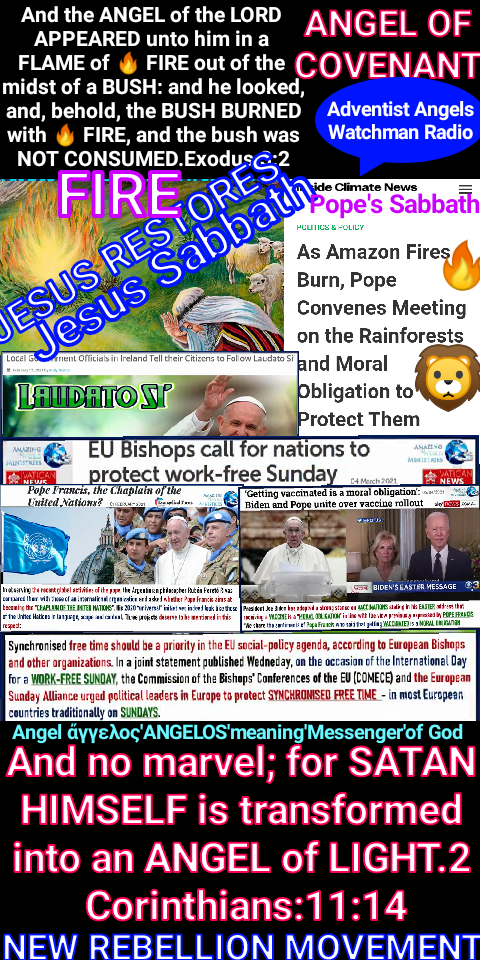
While the far-right prime minister has long faced criticism from political opponents and civil society for fanning the flames of racism, homophobia, Islamophobia and anti-Semitism, his weekend speech was more explicitly racial than earlier remarks. 

“We are willing to mix with one another, but we do not want to become mixed race,” Orbán declared, referencing the region that covers Hungary and Romania, where he was speaking.

Hegedüs picked up on the new tone.

While noting that she has long struggled with her role since the prime minister’s “illiberal turn” — and even directly told Orbán about her concerns over an anti-LGBTQ+ law — his latest rhetoric, she said, still “surprised” her, crossing another line. 

Orbán’s response directly addressed Hegedüs as he defended himself. 

“We know each other for a thousand years,” he wrote, using — as Hegedüs did in her missives — an informal form of address that in Hungarian is reserved for friends. “You can know that according to my understanding God created all people in his own image.”

He added: “Therefore, in the case of people like me, racism is excluded ab ovo.” 

Back in Brussels, the European Commission stayed out of the widening fracas, declining to comment on Orbán’s remarks. 

But in an increasing number of EU capitals, officials have started speaking out.

Orbán has “committed a breach of civilisation by identifying himself with the ideology of white supremacists,” Luxembourg Foreign Affairs Minister Jean Asselborn told POLITICO in an email. 

“He is hoping to make political gains by making such outrageous provocative statements — no matter what the costs,” the longtime minister added. “We can only condemn in the strongest terms the use of hate speech that reminds us of the darkest hours of the 20th century, on the European continent.”

Tytti Tuppurainen, Finland’s minister for European affairs, in a text message alluded to the disconnect between Orbán’s words and the fact that “Hungary is part of all the international organizations whose foundations are universal human rights.”Finland’s Minister of European Affairs Tytti Tuppurainen talks to the press as she arrives for a General Affairs Council meeting at the EU headquarters in Brussels | John Thys/AFP via Getty Images

While Tuppurainen cautioned that “these appalling statements do not represent all of Hungary,” she warned that they are nonetheless “isolating Hungary from civilized nations.”

Orbán’s “grotesque” tactics “will not end well for Hungary,” she added. “We shall not normalize this kind of racist histrionics, but each time remind [people] that we are bound to act for human rights.”

Orbán has made a name for himself on the international stage over the past years by stoking culture wars.

He has used George Soros, the Hungarian-American billionaire philanthropist, as a stand-in for unfounded international conspiracies targeting Hungary. He has demonized immigrants. And he has backed anti-LGBTQ+ measures that bar minors from seeing portrayals of homosexuality or transgender people.

But the backdrop to Orbán’s latest proclamations is a rapidly deteriorating economic situation exacerbated by unpopular tax changes that have drawn protesters to the streets. 

The Hungarian leader is also struggling to unlock billions in much-needed pandemic recovery funds from the EU, which has held back the money over corruption and judicial independence concerns.

His latest rhetoric will likely only make it even harder for Orbán to work together with European partners. 

“While we respect everybody’s right to expression, including of course in the political realm, we cannot but warn against the devastating effects of such deliberately inflaming declarations,” said Luxembourg’s Asselborn. 

“This situation has become unbearable inside the European Union,” he said, calling Orbán’s comments a “flagrant violation of the spirit and the letter of the [EU] Treaty” and the EU Charter of Fundamental Rights.

“This is also about our credibility as a community of values,” Asselborn said. “It is time for action.”

MORE FROM … LILI BAYER

Two Actors: Pope Acts Good Shepherd-Joe Acts Forerunner, Angelina Jolie and Brad Pitt meet again… in Rome! Herod Birthday,America Birthright Jeopardy,’Without Blood’ Church and State Reunion

Movie about war and trauma :The film is set at the end of a conflict and will deal with universal topics like war, memory, and personal trauma. Another great title for Angelina Jolie to put on her director’s resume.

Zeleb.es

A Brangelina reunion

Brad Pitt and Angelina Jolie together again in Rome. It may suggest a reconciliation, but in reality, the two Hollywood stars met for a special occasion that concerns someone else.

Brad Pitt arrived in the city where Angelina was staying

Some media began speculating when they noticed that Brad Pitt had landed at the Fiumicino airport in Rome, the same city where Angelina Jolie is staying for work. She’s there with their children.

In Revelation 14 the first angel is followed by a second proclaiming: “Babylon is fallen, is fallen, that great city, because she made all nations drink of the wine of the wrath of her fornication.” Revelation 14:8. The term “Babylon” is derived from “Babel,” and signifies confusion. It is employed in Scripture to designate the various forms of false or apostate religion. In Revelation 17 Babylon is represented as a woman—a figure which is used in the Bible as the symbol of a church, a virtuous woman representing a pure church, a vile woman an apostate church.
In the Bible the sacred and enduring character of the relation that exists between Christ and His church is represented by the union of marriage. The Lord has joined His people to Himself by a solemn covenant, He promising to be their God, and they pledging themselves to be His and His alone. He declares: “I will betroth thee unto Me forever; yea, I will betroth thee unto Me in righteousness, and in judgment, and in loving-kindness, and in mercies.” Hosea 2:19. And, again: “I am married unto you.” Jeremiah 3:14. And Paul employs the same figure in the New Testament when he says: “I have espoused you to one husband, that I may present you as a chaste virgin to Christ.” 2 Corinthians 11:2.
The unfaithfulness of the church to Christ in permitting her confidence and affection to be turned from Him, and allowing the love of worldly things to occupy the soul, is likened to the violation of the marriage vow. The sin of Israel in departing from the Lord is presented under this figure; and the wonderful love of God which they thus despised is touchingly portrayed: “I sware unto thee, and entered into a covenant with thee, saith the Lord God, and thou becamest Mine.” “And thou wast exceeding beautiful and thou didst prosper into a kingdom. And thy renown went forth among the heathen for thy beauty: for it was perfect through My comeliness, which I had put upon thee…. But thou didst trust in thine own beauty, and playedst the harlot because of thy renown.” “As a wife treacherously departeth from her husband, so have ye dealt treacherously with Me, O house of Israel, saith the Lord;” “as a wife that committeth adultery, which taketh strangers instead of her husband!” Ezekiel 16:8, 13-15, 32; Jeremiah 3:20. GC 381.1 – GC 381.3

In the New Testament, language very similar is addressed to professed Christians who seek the friendship of the world above the favor of God. Says the apostle James: “Ye adulterers and adulteresses, know ye not that the friendship of the world is enmity with God? whosoever therefore will be a friend of the world is the enemy of God.”
The woman (Babylon) of Revelation 17 is described as “arrayed in purple and scarlet color, and decked with gold and precious stones and pearls, having a golden cup in her hand full of abominations and filthiness:…and upon her forehead was a name written, Mystery, Babylon the Great, the mother of harlots.” Says the prophet: “I saw the woman drunk with the blood of the saints, and with the blood of the martyrs of Jesus.” Babylon is further declared to be “that great city, which reigneth over the kings of the earth.” Revelation 17:4-6, 18. The power that for so many centuries maintained despotic sway over the monarchs of Christendom is Rome. The purple and scarlet color, the gold and precious stones and pearls, vividly picture the magnificence and more than kingly pomp affected by the haughty see of Rome. And no other power could be so truly declared “drunken with the blood of the saints” as that church which has so cruelly persecuted the followers of Christ. Babylon is also charged with the sin of unlawful connection with “the kings of the earth.” It was by departure from the Lord, and alliance with the heathen, that the Jewish church became a harlot; and Rome, corrupting herself in like manner by seeking the support of worldly powers, receives a like condemnation.

A new movie for Angelina

Those who follow Angelina Jolie’s career know that, at the moment, she is in Rome to direct the film ‘Without Blood’ (‘Senza Sangue’), an adaptation of the homonymous book by the popular Italian writer Alessandro Baricco

Without Blood

She bought the rights to the novel in 2017 and is now shooting the film in Rome.


Babylon is said to be “the mother of harlots.” By her daughters must be symbolized churches that cling to her doctrines and traditions, and follow her example of sacrificing the truth and the approval of God, in order to form an unlawful alliance with the world. The message of Revelation 14, announcing the fall of Babylon must apply to religious bodies that were once pure and have become corrupt. Since this message follows the warning of the judgment, it must be given in the last days; therefore it cannot refer to the Roman Church alone, for that church has been in a fallen condition for many centuries. Furthermore, in the eighteenth chapter of the Revelation the people of God are called upon to come out of Babylon. According to this scripture, many of God’s people must still be in Babylon. And in what religious bodies are the greater part of the followers of Christ now to be found? Without doubt, in the various churches professing the Protestant faith. At the time of their rise these churches took a noble stand for God and the truth, and His blessing was with them. Even the unbelieving world was constrained to acknowledge the beneficent results that followed an acceptance of the principles of the gospel. In the words of the prophet to Israel: “Thy renown went forth among the heathen for thy beauty: for it was perfect through My comeliness, which I had put upon thee, saith the Lord God.” But they fell by the same desire which was the curse and ruin of Israel—the desire of imitating the practices and courting the friendship of the ungodly. “Thou didst trust in thine own beauty, and playedst the harlot because of thy renown.” Ezekiel 16:14, 15.
Many of the Protestant churches are following Rome’s example of iniquitous connection with “the kings of the earth”—the state churches, by their relation to secular governments; and other denominations, by seeking the favor of the world. And the term “Babylon”—confusion—may be appropriately applied to these bodies, all professing to derive their doctrines from the Bible, yet divided into almost innumerable sects, with widely conflicting creeds and theories.
Besides a sinful union with the world, the churches that separated from Rome present other of her characteristics.
A Roman Catholic work argues that “if the Church of Rome were ever guilty of idolatry in relation to the saints, her daughter, the Church of England, stands guilty of the same, which has ten churches dedicated to Mary for one dedicated to Christ.”—Richard Challoner, The Catholic Christian Instructed, Preface, pages 21, 22.
And Dr. Hopkins, in “A Treatise on the Millennium,” declares: “There is no reason to consider the antichristian spirit and practices to be confined to that which is now called the Church of Rome. The Protestant churches have much of antichrist in them, and are far from being wholly reformed from … corruptions and wickedness.”—Samuel Hopkins, Works, vol. 2, p. 328.
Concerning the separation of the Presbyterian Church from Rome, Dr. Guthrie writes: “Three hundred years ago, our church, with an open Bible on her banner, and this motto, ‘Search the Scriptures,’ on her scroll, marched out from the gates of Rome.” Then he asks the significant question: “Did they come clean out of Babylon?”—Thomas Guthrie, The Gospel in Ezekiel, page 237.
“The Church of England,” says Spurgeon, “seems to be eaten through and through with sacramentarianism; but nonconformity appears to be almost as badly riddled with philosophical infidelity. Those of whom we thought better things are turning aside one by one from the fundamentals of the faith. Through and through, I believe, the very heart of England is honeycombed with a damnable infidelity which dares still go into the pulpit and call itself Christian.” GC 382.1 – GC 384.4

Angelina as a director

The last time Angelina Jolie directed a film was in 2017, with ‘First They Killed My Father.’ It got a Golden Globe nomination for Best Foreign Language Film.

the little horn of Daniel 7, unquestionably points to the papacy.
“Power was given unto him to continue forty and two months.” And, says the prophet, “I saw one of his heads as it were wounded to death.” And again: “He that leadeth into captivity shall go into captivity: he that killeth with the sword must be killed with the sword.” The forty and two months are the same as the “time and times and the dividing of time,” three years and a half, or 1260 days, of Daniel 7—the time during which the papal power was to oppress God’s people. This period, as stated in preceding chapters, began with the supremacy of the papacy, A.D. 538, and terminated in 1798. At that time the pope was made captive by the French army, the papal power received its deadly wound, and the prediction was fulfilled, “He that leadeth into captivity shall go into captivity GC 439.1 – GC 439.2

Angelina walking around Rome

In recent weeks, the beautiful Hollywood diva has been strolling the streets of the Italian capital with her inseparable children.

Babylon is said to be “the mother of harlots.” By her daughters must be symbolized churches that cling to her doctrines and traditions, and follow her example of sacrificing the truth and the approval of God, in order to form an unlawful alliance with the world. The message of Revelation 14, announcing the fall of Babylon must apply to religious bodies that were once pure and have become corrupt. GC 382.3

[11](She is loud and stubborn; her feet abide not in her house: [12]Now is she without, now in the streets, and lieth in wait at every corner.)Proverbs:7:11-12

At the Måneskin concert

They haven’t just walked around but also went to see a hot Italian band. Angelina Jolie was spotted having fun with her daughter Shiloh Jolie-Pitt at the Måneskin concert in Rome’s Circus Maximus.

Why did Brad Pitt fly to Rome?

But let’s go back to why Brad Pitt also flew to Rome this summer: Could there be a possible return of the famous Brangelina couple?

Charles Beecher, in a sermon in the year 1846, declared that the ministry of “the evangelical Protestant denominations” is “not only formed all the way up under a tremendous pressure of merely human fear, but they live, and move, and breathe in a state of things radically corrupt, and appealing every hour to every baser element of their nature to hush up the truth, and bow the knee to the power of apostasy. Was not this the way things went with Rome? Are we not living her life over again? And what do we see just ahead? Another general council! A world’s convention! Evangelical alliance, and universal creed!”—Sermon on “The Bible a Sufficient Creed,” delivered at Fort Wayne, Indiana, Feb. 22, 1846. When this shall be gained, then, in the effort to secure complete uniformity, it will be only a step to the resort to force.
When the leading churches of the United States, uniting upon such points of doctrine as are held by them in common, shall influence the state to enforce their decrees and to sustain their institutions, then Protestant America will have formed an image of the Roman hierarchy, and the infliction of civil penalties upon dissenters will inevitably result.
The beast with two horns “causeth commands all, both small and great, rich and poor, free and bond, to receive a mark in their right hand, or in their foreheads: and that no man might buy or sell, save he that had the mark, or the name of the beast, or the number of his name.” Revelation 13:16, 17. The third angel’s warning is: “If any man worship the beast and his image, and receive his mark in his forehead, or in his hand, the same shall drink of the wine of the wrath of God.” “The beast” mentioned in this message, whose worship is enforced by the two-horned beast, is the first, or leopardlike beast of Revelation 13—the papacy. The “image to the beast” represents that form of apostate Protestantism which will be developed when the Protestant churches shall seek the aid of the civil power for the enforcement of their dogmas. The “mark of the beast” still remains to be defined. GC 444.3 – GC 445.2

No reunion

Unfortunately, no. Hollywood’s most beloved couple, who announced their split in 2016, has no plans of getting back together.

For Vivienne and Knox’s birthday-Herod’s Supper

The real reason why Brad Pitt went to Rome were his twin children, Vivienne and Knox. The actor of ‘Fight Club’ and ‘Once Upon a Time in Hollywood’ flew to Italy on the occasion of their fourteenth birthday on July 12. [21]And when a convenient day was come, that Herod on his birthday made a supper to his lords, high captains, and chief estates of Galilee; [22]And when the daughter of the said Herodias came in, and danced, and pleased Herod and them that sat with him, the king said unto the damsel, Ask of me whatsoever thou wilt, and I will give it thee.
Mark:6:21-22

A truce for the children

The twins were born on July 12, 2008, in France. Their birthday was a great opportunity to get together with the family, despite the fact that things have not been easy between the two actors.

The Declaration of Independence is a declaration of great general principles, as well as a recital of certain specific grievances. It was never written to meet the exigencies of one particular time or people. No nation prior to this one had ever declared it as a principle good for all mankind that all men are created equal, or that governments derive their just powers from the consent of the governed. None of the great nations of Europe ever taught or ever believed these precepts. They were born simultaneously with the American Republic. They constituted her christening robe and her birthright, peculiarly her own, and the first infant cry of her national life. That nation of the old world which has ever been the foremost in promulgating doctrines of freedom and liberty did not believe these things, for she it was who fought them. She did not even believe them in their most limited sense for her most limited self,-the isle of England, as distinguished from colony and dependency. Much less, therefore, did she consider them as divine and immortal truths, applicable to all times and places, and worthy of being the basis of government among men in every kindred and nation and tongue and tribe and people. PRUS 11.1

“She always bends over backward” for her children

A source very close to Angelina Jolie told Hollywood Life: “She always bends over backward to make sure the kids get time with their dad, especially on special occasions like birthdays and holidays.”

Protestants little know what they are doing when they propose to accept the aid of Rome in the work of Sunday exaltation. While they are bent upon the accomplishment of their purpose, Rome is aiming to re-establish her power, to recover her lost supremacy. Let the principle once be established in the United States that the church may employ or control the power of the state; that religious observances may be enforced by secular laws; in short, that the authority of church and state is to dominate the conscience, and the triumph of Rome in this country is assured.
God’s word has given warning of the impending danger; let this be unheeded, and the Protestant world will learn what the purposes of Rome really are, only when it is too late to escape the snare. She is silently growing into power. Her doctrines are exerting their influence in legislative halls, in the churches, and in the hearts of men. She is piling up her lofty and massive structures in the secret recesses of which her former persecutions will be repeated. Stealthily and unsuspectedly she is strengthening her forces to further her own ends when the time shall come for her to strike. All that she desires is vantage ground, and this is already being given her. We shall soon see and shall feel what the purpose of the Roman element is. Whoever shall believe and obey the word of God will thereby incur reproach and persecution. GC 581.1 – GC 581.2

Popery had become the world’s despot. Kings and emperors bowed to the decrees of the Roman pontiff. The destinies of men, both for time and for eternity, seemed under his control. For hundreds of years the doctrines of Rome had been extensively and implicitly received, its rites reverently performed, its festivals generally observed. Its clergy were honored and liberally sustained. Never since has the Roman Church attained to greater dignity, magnificence, or power.
But “the noon of the papacy was the midnight of the world.”—J. A. Wylie, The History of Protestantism, b. 1, ch. 4. The Holy Scriptures were almost unknown, not only to the people, but to the priests. Like the Pharisees of old, the papal leaders hated the light which would reveal their sins. God’s law, the standard of righteousness, having been removed, they exercised power without limit, and practiced vice without restraint. Fraud, avarice, and profligacy prevailed. Men shrank from no crime by which they could gain wealth or position. The palaces of popes and prelates were scenes of the vilest debauchery. Some of the reigning pontiffs were guilty of crimes so revolting that secular rulers endeavored to depose these dignitaries of the church as monsters too vile to be tolerated. For centuries Europe had made no progress in learning, arts, or civilization. A moral and intellectual paralysis had fallen upon Christendom. GC 60.1 – GC 60.2

Brad Pitt made an effort, too

“In this situation,” the source told Hollywood Life, “she was stressing about how to make it all work.” Jolie couldn’t easily leave Rome. “So the fact that Brad’s stepped up and made the trip has taken a huge weight off her shoulders. His effort hasn’t gone unnoticed.”

Together again for just a few days

It seems that Hollywood’s beloved couple was back together, if only for a few days and for the sake of the children. It’s a gesture that Angelina was undoubtedly grateful for and left everyone stunned.

‘Without Blood:’ locations and cast

At the moment the shooting of ‘Without Blood’ is taking place between the cities of Basilicata, Puglia, and Rome. It stars Salma Hayek and Demián Bichir, among others.

Movie about war and trauma

The film is set at the end of a conflict and will deal with universal topics like war, memory, and personal trauma. Another great title for Angelina Jolie to put on her director’s resume.

Back to the Future: Forerunner Biden in the Middle East, The Croods Family Tree, We are Brothers and Sisters, America James Webb 13 billions years, Serving The Pope

We are together again, Because “We Changed The Rules”

BY MEL GURTOV

Image by Sulthan Auliya.

President Biden has now completed his first visit to the Middle East. The trip was billed as an opportunity to reset relations, especially with Saudi Arabia, promote respect for human rights, and reaffirm traditional US policy on Israel and the Palestine question.

Biden did what all presidents do: He gave priority to strategic and economic interests ahead of human rights. His main accomplishment is that he discarded some of the worst features of Trump’s Middle East policy.

Suspending Human Rights

In an op-ed for the Washington Post prior to his trip, Biden said: “From the start, my aim [with Saudi Arabia] was to reorient — but not rupture — relations with a country that’s been a strategic partner for 80 years.” Biden must contend with a leader—Crown Prince Mohammad bin Salman—who, US intelligence has concluded, ordered the assassination of the journalist Jamal Khashoggi.

The iniquity and spiritual darkness that prevailed under the supremacy of Rome were the inevitable result of her suppression of the Scriptures; but where is to be found the cause of the widespread infidelity, the rejection of the law of God, and the consequent corruption, under the full blaze of gospel light in an age of religious freedom? Now that Satan can no longer keep the world under his control by withholding the Scriptures, he resorts to other means to accomplish the same object. To destroy faith in the Bible serves his purpose as well as to destroy the Bible itself. By introducing the belief that God’s law is not binding, he as effectually leads men to transgress as if they were wholly ignorant of its precepts. And now, as in former ages, he has worked through the church to further his designs. The religious organizations of the day have refused to listen to unpopular truths plainly brought to view in the Scriptures, and in combating them they have adopted interpretations and taken positions which have sown broadcast the seeds of skepticism. Clinging to the papal error of natural immortality and man’s consciousness in death, they have rejected the only defense against the delusions of spiritualism. The doctrine of eternal torment has led many to disbelieve the Bible. And as the claims of the fourth commandment are urged upon the people, it is found that the observance of the seventh-day Sabbath is enjoined; and as the only way to free themselves from a duty which they are unwilling to perform, many popular teachers declare that the law of God is no longer binding. Thus they cast away the law and the Sabbath together. As the work of Sabbath reform extends, this rejection of the divine law to avoid the claims of the fourth commandment will become well-nigh universal. The teachings of religious leaders have opened the door to infidelity, to spiritualism, and to contempt for God’s holy law; and upon these leaders rests a fearful responsibility for the iniquity that exists in the Christian world.
Yet this very class put forth the claim that the fast-spreading corruption is largely attributable to the desecration of the so-called “Christian sabbath,” and that the enforcement of Sunday observance would greatly improve the morals of society. This claim is especially urged in America, where the doctrine of the true Sabbath has been most widely preached. Here the temperance work, one of the most prominent and important of moral reforms, is often combined with the Sunday movement, and the advocates of the latter represent themselves as laboring to promote the highest interest of society; and those who refuse to unite with them are denounced as the enemies of temperance and reform. But the fact that a movement to establish error is connected with a work which is in itself good, is not an argument in favor of the error. We may disguise poison by mingling it with wholesome food, but we do not change its nature. On the contrary, it is rendered more dangerous, as it is more likely to be taken unawares. It is one of Satan’s devices to combine with falsehood just enough truth to give it plausibility. The leaders of the Sunday movement may advocate reforms which the people need, principles which are in harmony with the Bible; yet while there is with these a requirement which is contrary to God’s law, His servants cannot unite with them. Nothing can justify them in setting aside the commandments of God for the precepts of men.
Through the two great errors, the immortality of the soul and Sunday sacredness, Satan will bring the people under his deceptions. While the former lays the foundation of spiritualism, the latter creates a bond of sympathy with Rome. The Protestants of the United States will be foremost in stretching their hands across the gulf to grasp the hand of spiritualism; they will reach over the abyss to clasp hands with the Roman power; and under the influence of this threefold union, this country will follow in the steps of Rome in trampling on the rights of conscience.
As spiritualism more closely imitates the nominal Christianity of the day, it has greater power to deceive and ensnare. Satan himself is converted, after the modern order of things. He will appear in the character of an angel of light. Through the agency of spiritualism, miracles will be wrought, the sick will be healed, and many undeniable wonders will be performed. And as the spirits will profess faith in the Bible, and manifest respect for the institutions of the church, their work will be accepted as a manifestation of divine power.
The line of distinction between professed Christians and the ungodly is now hardly distinguishable. Church members love what the world loves and are ready to join with them, and Satan determines to unite them in one body and thus strengthen his cause by sweeping all into the ranks of spiritualism. Papists, who boast of miracles as a certain sign of the true church, will be readily deceived by this wonder-working power; and Protestants, having cast away the shield of truth, will also be deluded. Papists, Protestants, and worldlings will alike accept the form of godliness without the power, and they will see in this union a grand movement for the conversion of the world and the ushering in of the long-expected millennium.
Through spiritualism, Satan appears as a benefactor of the race, healing the diseases of the people, and professing to present a new and more exalted system of religious faith; but at the same time he works as a destroyer. His temptations are leading multitudes to ruin. Intemperance dethrones reason; sensual indulgence, strife, and bloodshed follow. Satan delights in war, for it excites the worst passions of the soul and then sweeps into eternity its victims steeped in vice and blood. It is his object to incite the nations to war against one another, for he can thus divert the minds of the people from the work of preparation to stand in the day of God.
Satan works through the elements also to garner his harvest of unprepared souls. He has studied the secrets of the laboratories of nature, and he uses all his power to control the elements as far as God allows. When he was suffered to afflict Job, how quickly flocks and herds, servants, houses, children, were swept away, one trouble succeeding another as in a moment. It is God that shields His creatures and hedges them in from the power of the destroyer. But the Christian world have shown contempt for the law of Jehovah; and the Lord will do just what He has declared that He would—He will withdraw His blessings from the earth and remove His protecting care from those who are rebelling against His law and teaching and forcing others to do the same. Satan has control of all whom God does not especially guard. He will favor and prosper some in order to further his own designs, and he will bring trouble upon others and lead men to believe that it is God who is afflicting them.
While appearing to the children of men as a great physician who can heal all their maladies, he will bring disease and disaster, until populous cities are reduced to ruin and desolation. Even now he is at work. In accidents and calamities by sea and by land, in great conflagrations, in fierce tornadoes and terrific hailstorms, in tempests, floods, cyclones, tidal waves, and earthquakes, in every place and in a thousand forms, Satan is exercising his power. He sweeps away the ripening harvest, and famine and distress follow. He imparts to the air a deadly taint, and thousands perish by the pestilence. These visitations are to become more and more frequent and disastrous. Destruction will be upon both man and beast. “The earth mourneth and fadeth away,” “the haughty people … do languish. The earth also is defiled under the inhabitants thereof; because they have transgressed the laws, changed the ordinance, broken the everlasting covenant.” Isaiah 24:4, 5.
And then the great deceiver will persuade men that those who serve God are causing these evils. The class that have provoked the displeasure of Heaven will charge all their troubles upon those whose obedience to God’s commandments is a perpetual reproof to transgressors. It will be declared that men are offending God by the violation of the Sunday sabbath; that this sin has brought calamities which will not cease until Sunday observance shall be strictly enforced; and that those who present the claims of the fourth commandment, thus destroying reverence for Sunday, are troublers of the people, preventing their restoration to divine favor and temporal prosperity. Thus the accusation urged of old against the servant of God will be repeated and upon grounds equally well established: “And it came to pass, when Ahab saw Elijah, that Ahab said unto him, Art thou he that troubleth Israel? And he answered, I have not troubled Israel; but thou, and thy father’s house, in that ye have forsaken the commandments of the Lord, and thou hast followed Baalim.” 1 Kings 18:17, 18. As the wrath of the people shall be excited by false charges, they will pursue a course toward God’s ambassadors very similar to that which apostate Israel pursued toward Elijah.
The miracle-working power manifested through spiritualism will exert its influence against those who choose to obey God rather than men. Communications from the spirits will declare that God has sent them to convince the rejecters of Sunday of their error, affirming that the laws of the land should be obeyed as the law of God. They will lament the great wickedness in the world and second the testimony of religious teachers that the degraded state of morals is caused by the desecration of Sunday. Great will be the indignation excited against all who refuse to accept their testimony.
Satan’s policy in this final conflict with God’s people is the same that he employed in the opening of the great controversy in heaven. He professed to be seeking to promote the stability of the divine government, while secretly bending every effort to secure its overthrow. And the very work which he was thus endeavoring to accomplish he charged upon the loyal angels. The same policy of deception has marked the history of the Roman Church. It has professed to act as the vicegerent of Heaven, while seeking to exalt itself above God and to change His law. Under the rule of Rome, those who suffered death for their fidelity to the gospel were denounced as evildoers; they were declared to be in league with Satan; and every possible means was employed to cover them with reproach, to cause them to appear in the eyes of the people and even to themselves as the vilest of criminals. So it will be now. While Satan seeks to destroy those who honor God’s law, he will cause them to be accused as lawbreakers, as men who are dishonoring God and bringing judgments upon the world.
God never forces the will or the conscience; but Satan’s constant resort—to gain control of those whom he cannot otherwise seduce—is compulsion by cruelty. Through fear or force he endeavors to rule the conscience and to secure homage to himself. To accomplish this, he works through both religious and secular authorities, moving them to the enforcement of human laws in defiance of the law of God.
Those who honor the Bible Sabbath will be denounced as enemies of law and order, as breaking down the moral restraints of society, causing anarchy and corruption, and calling down the judgments of God upon the earth. Their conscientious scruples will be pronounced obstinacy, stubbornness, and contempt of authority. They will be accused of disaffection toward the government. Ministers who deny the obligation of the divine law will present from the pulpit the duty of yielding obedience to the civil authorities as ordained of God. In legislative halls and courts of justice, commandment keepers will be misrepresented and condemned. A false coloring will be given to their words; the worst construction will be put upon their motives.
As the Protestant churches reject the clear, Scriptural arguments in defense of God’s law, they will long to silence those whose faith they cannot overthrow by the Bible. Though they blind their own eyes to the fact, they are now adopting a course which will lead to the persecution of those who conscientiously refuse to do what the rest of the Christian world are doing, and acknowledge the claims of the papal sabbath.
The dignitaries of church and state will unite to bribe, persuade, or compel all classes to honor the Sunday. The lack of divine authority will be supplied by oppressive enactments. Political corruption is destroying love of justice and regard for truth; and even in free America, rulers and legislators, in order to secure public favor, will yield to the popular demand for a law enforcing Sunday observance. Liberty of conscience, which has cost so great a sacrifice, will no longer be respected. In the soon-coming conflict we shall see exemplified the prophet’s words: “The dragon was wroth with the woman, and went to make war with the remnant of her seed, which keep the commandments of God, and have the testimony of Jesus Christ.” Revelation 12:17. GC 586.2 – GC 592.3