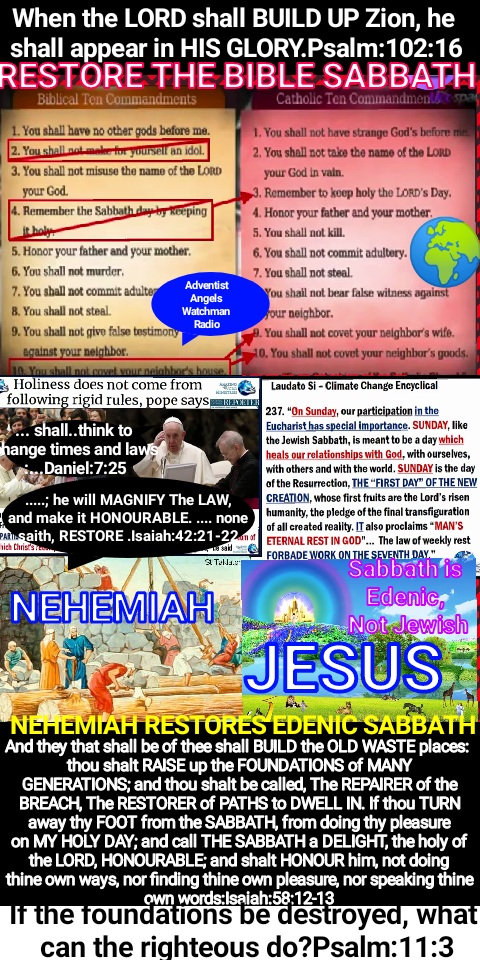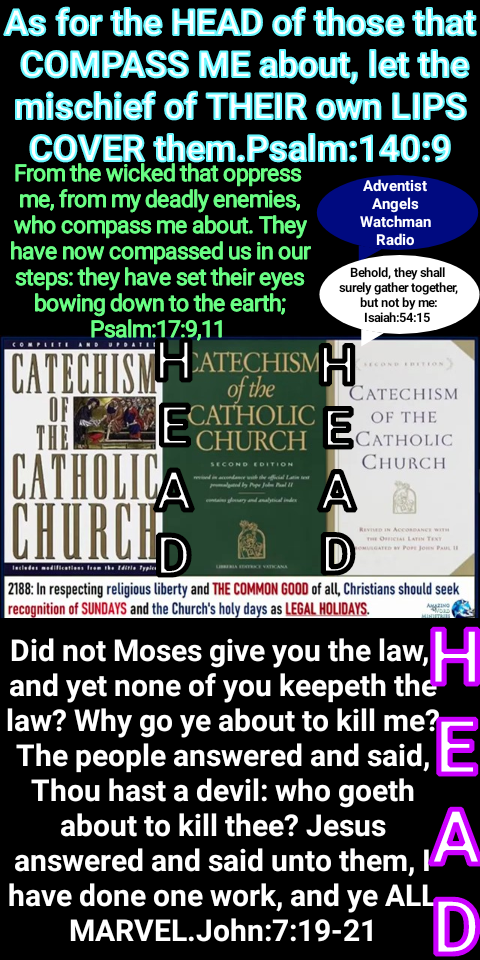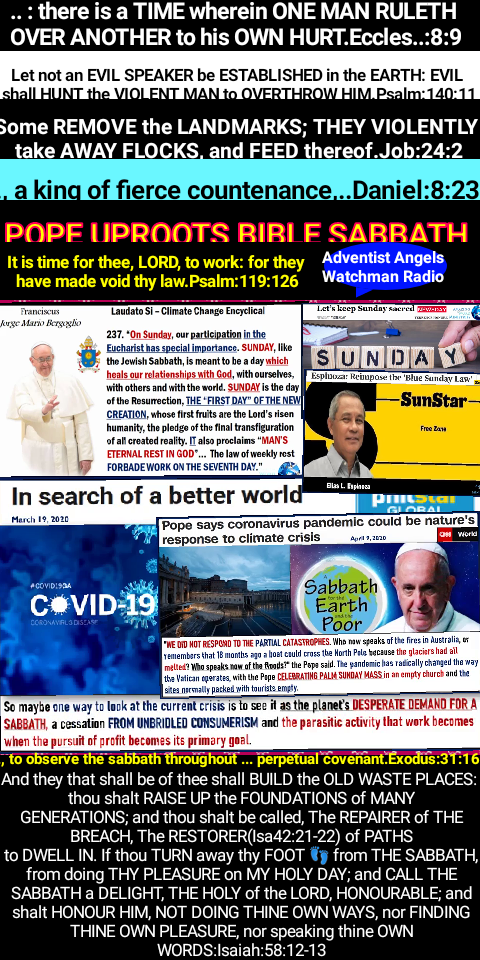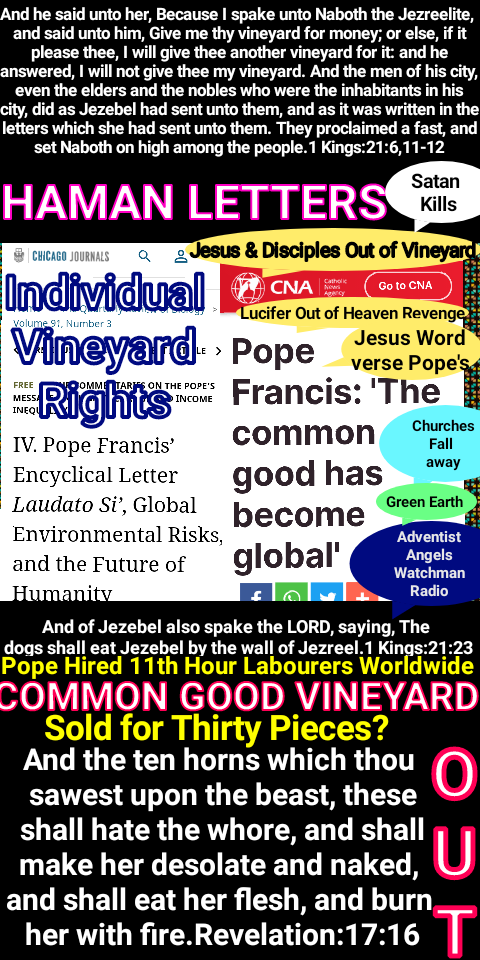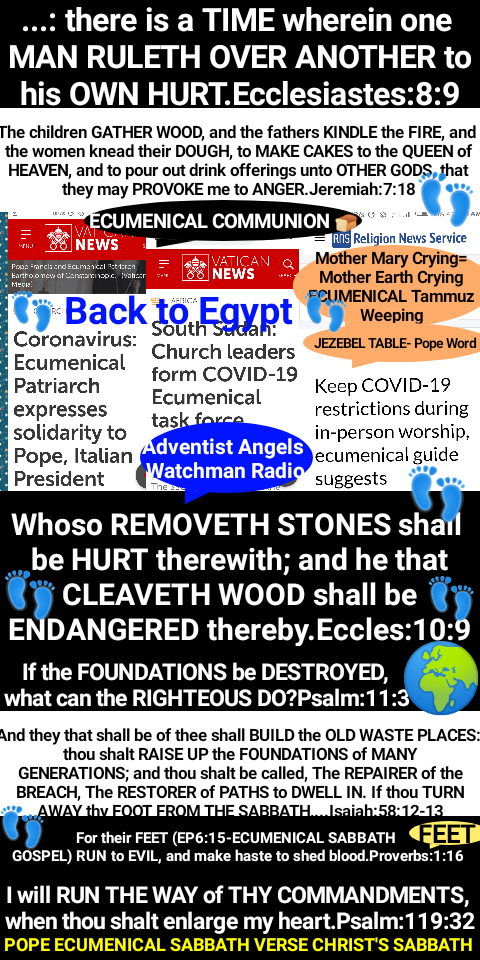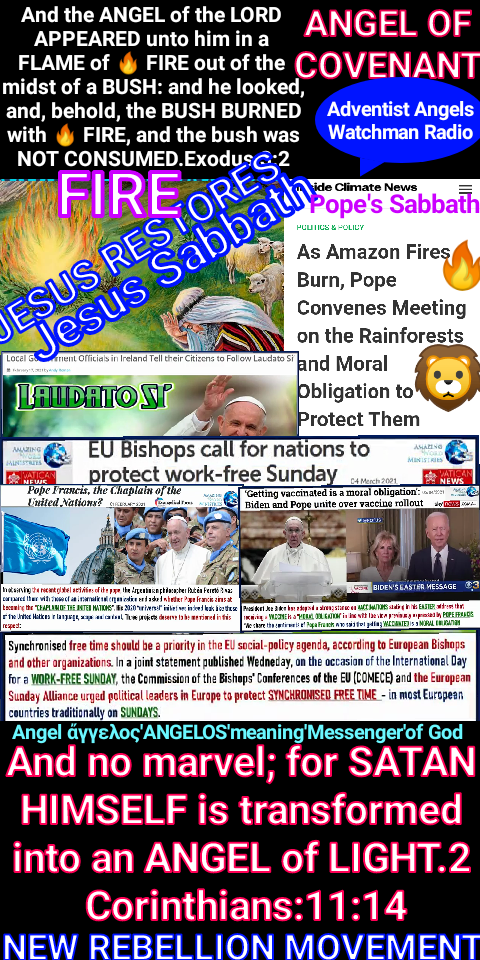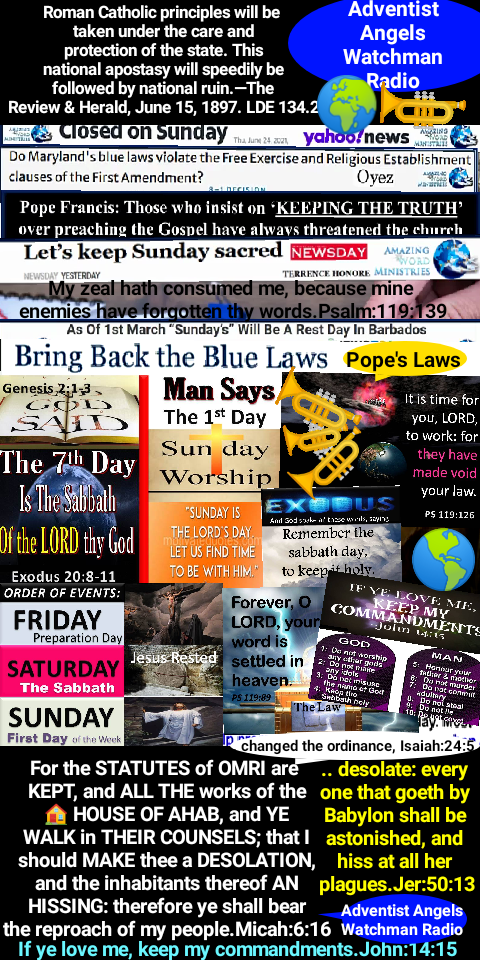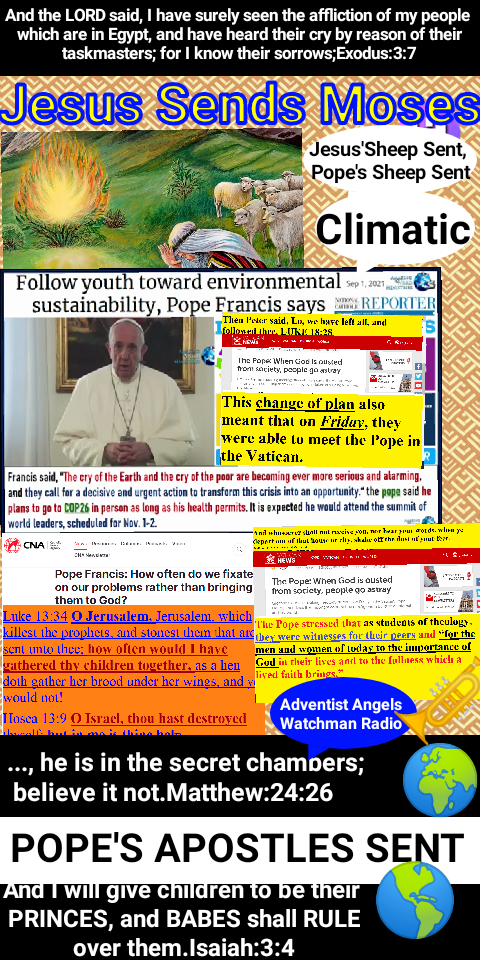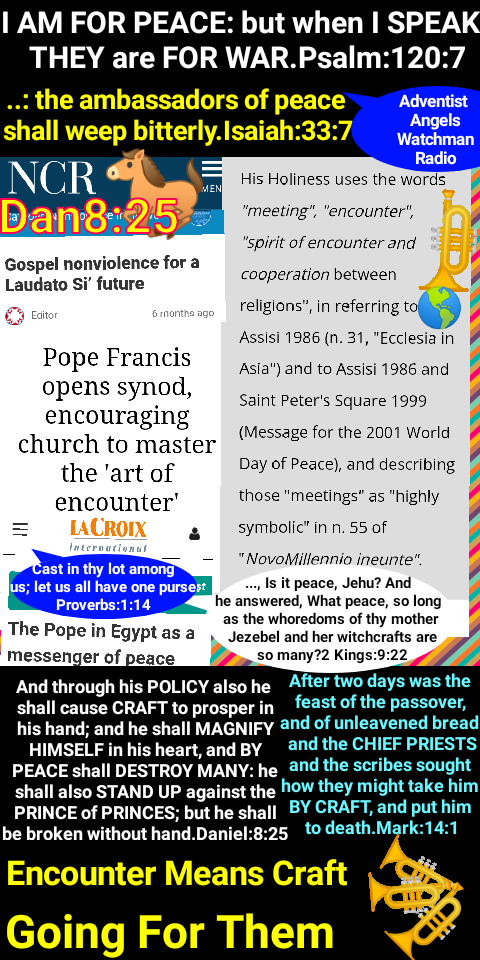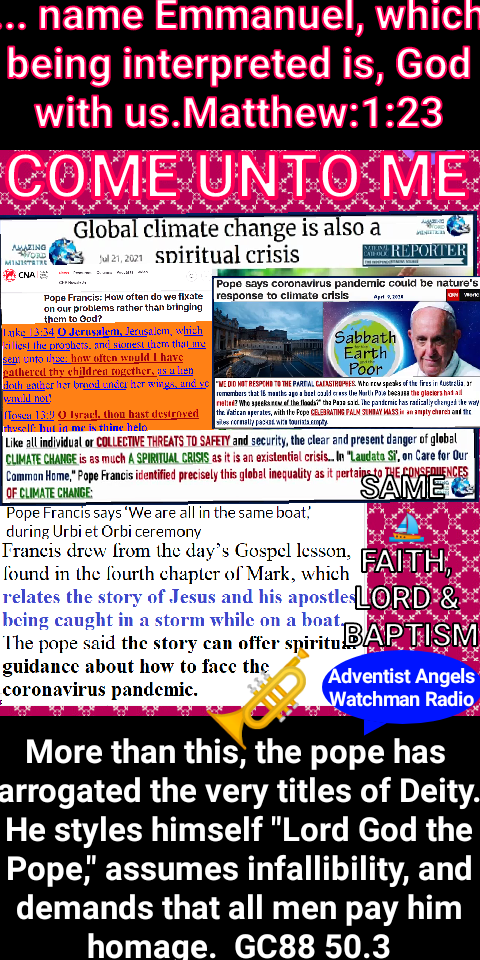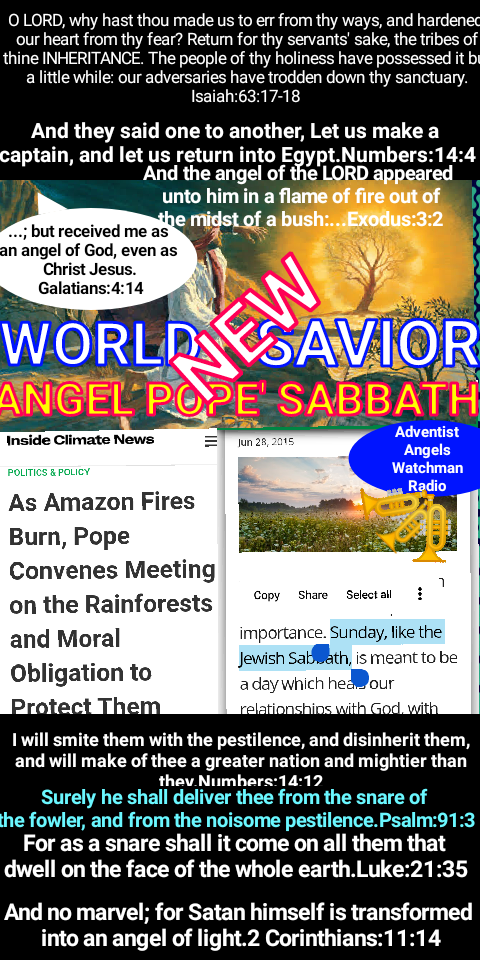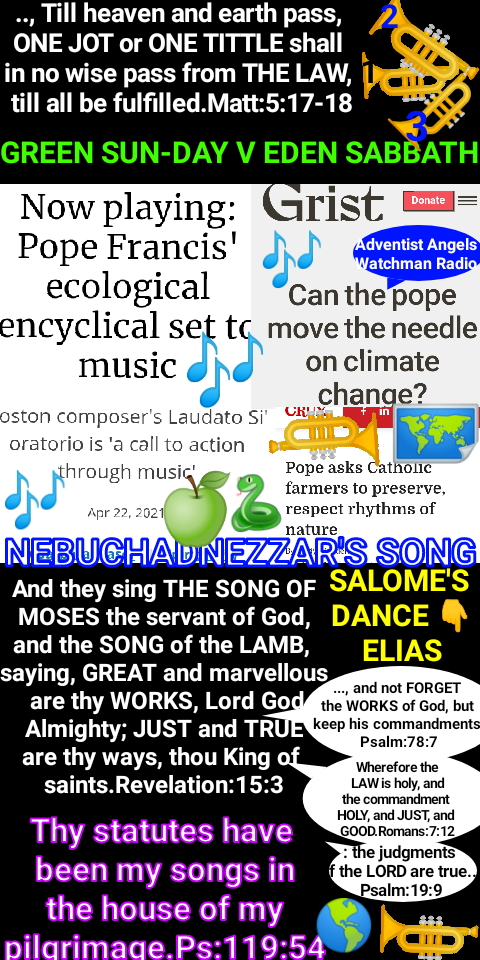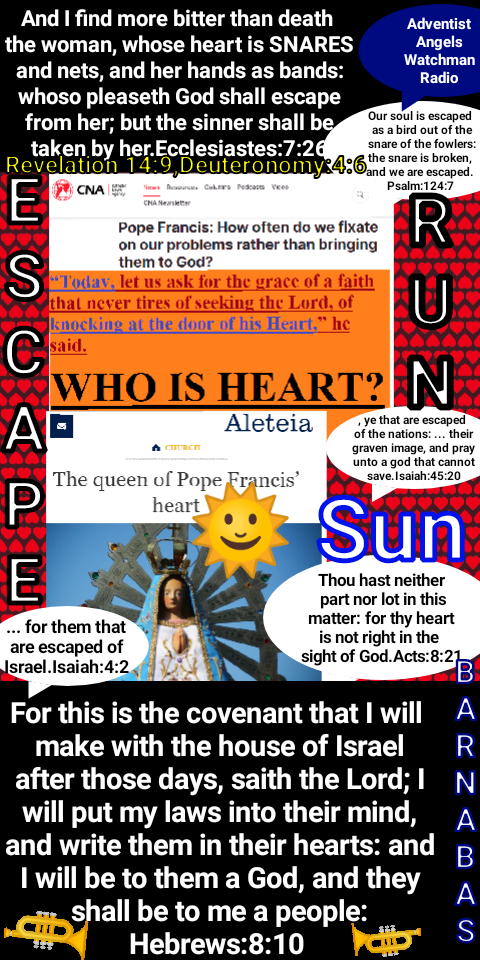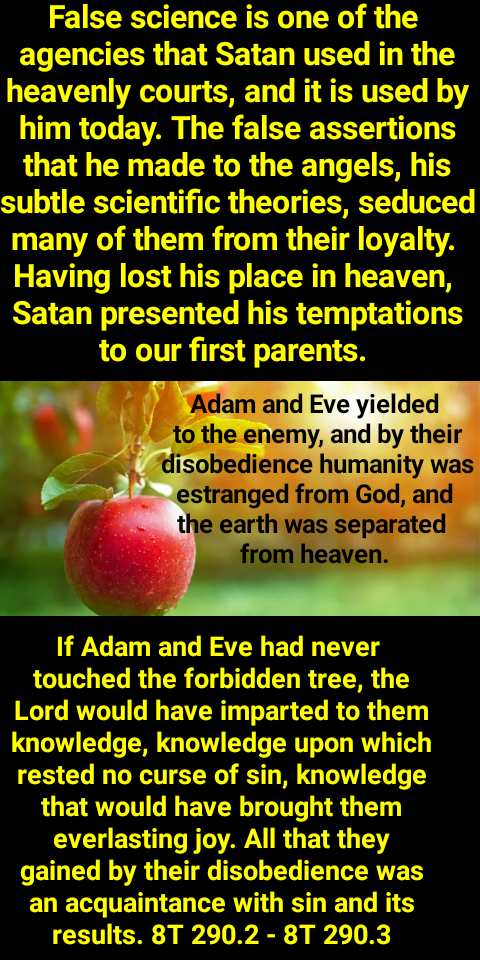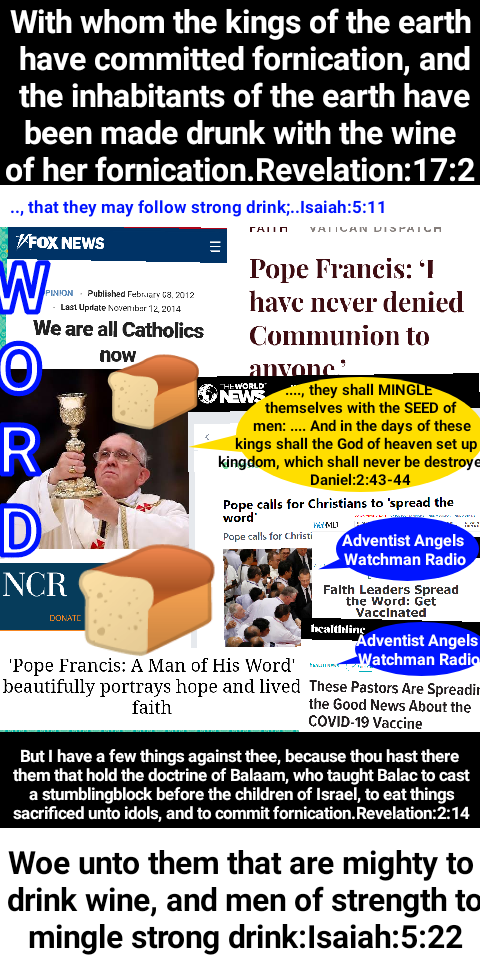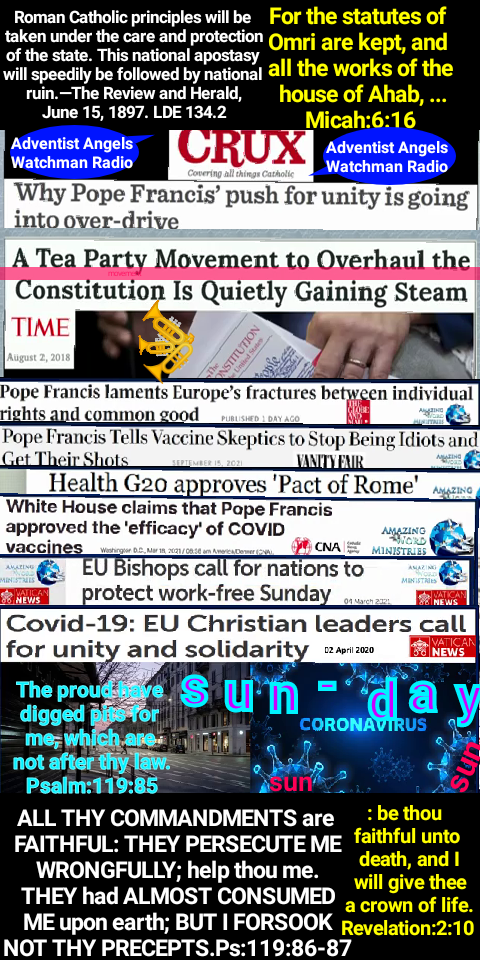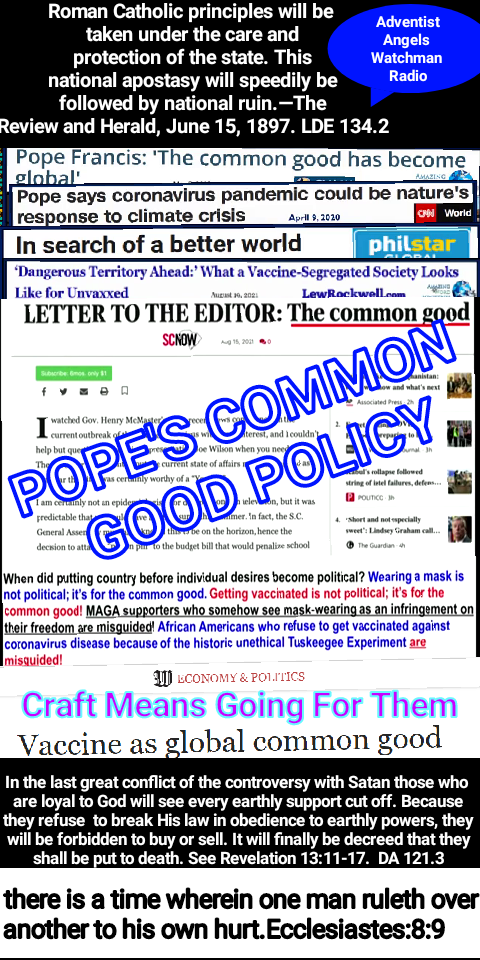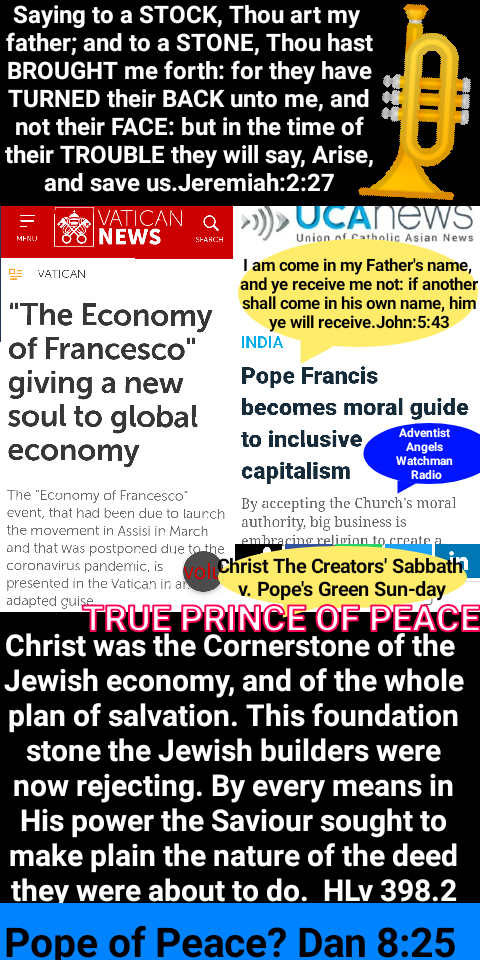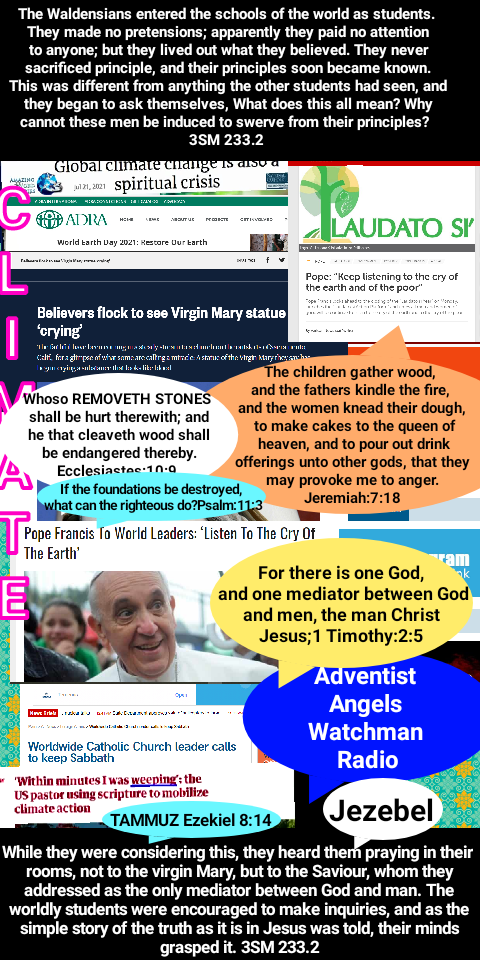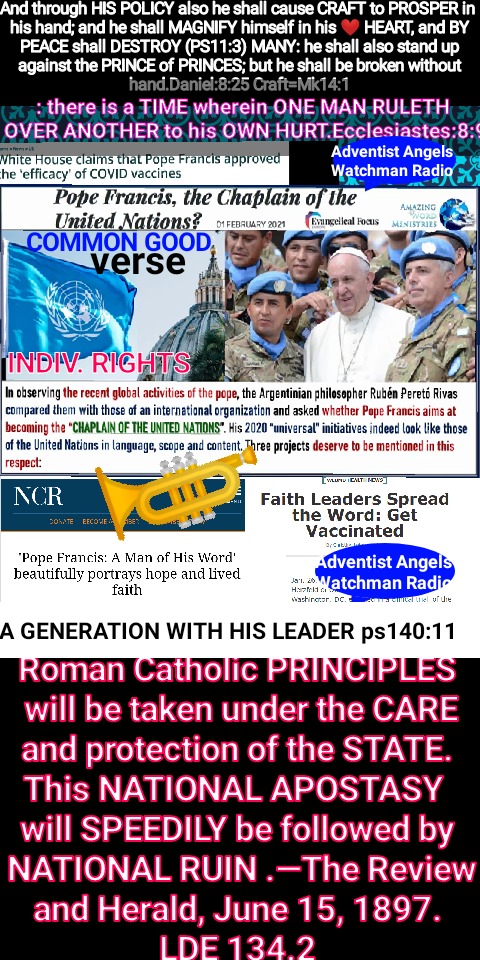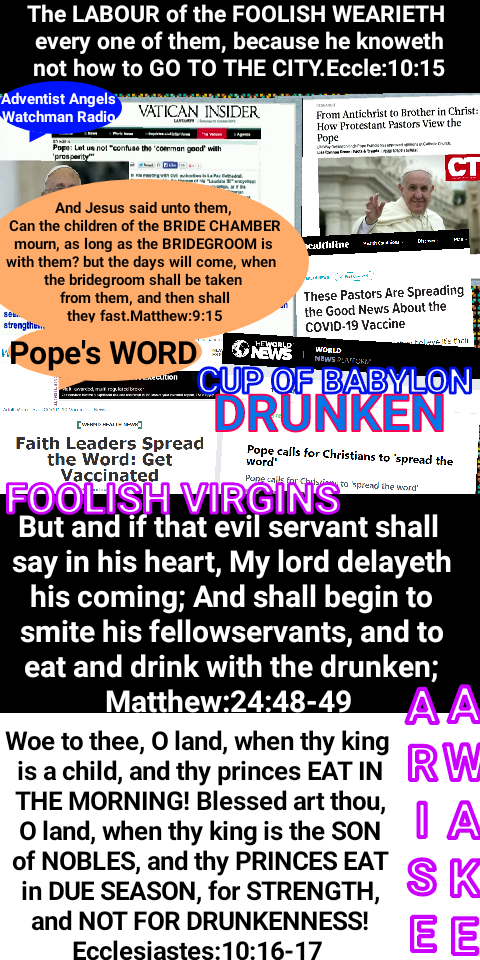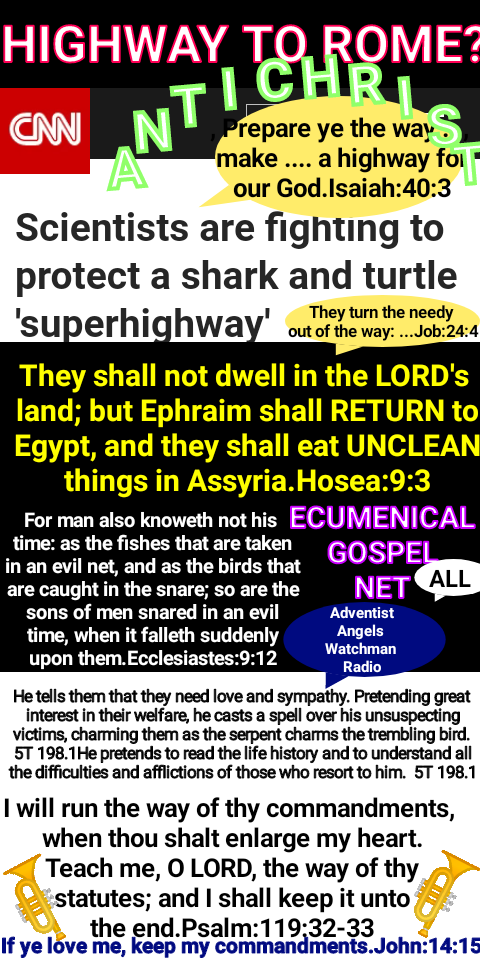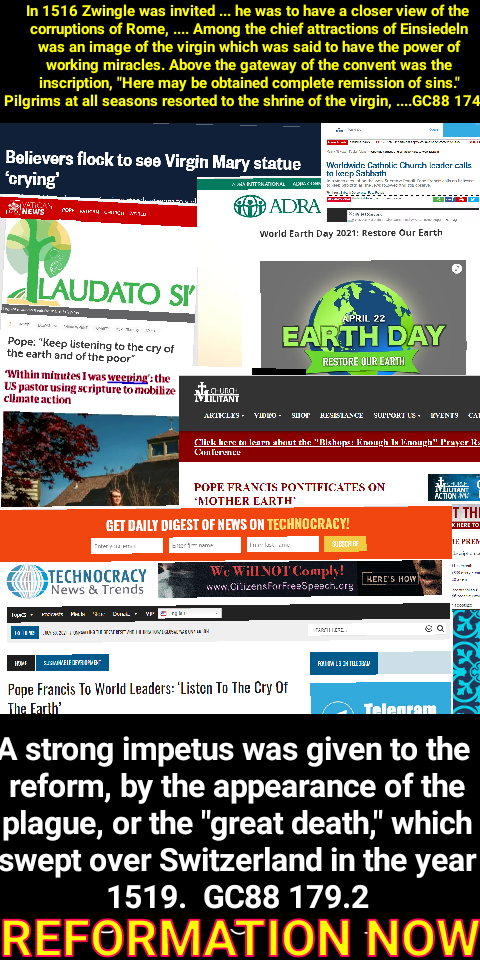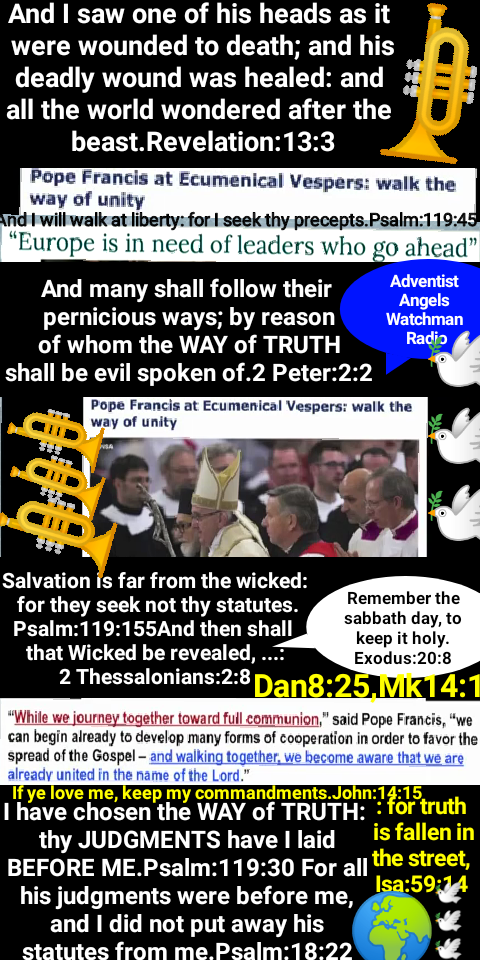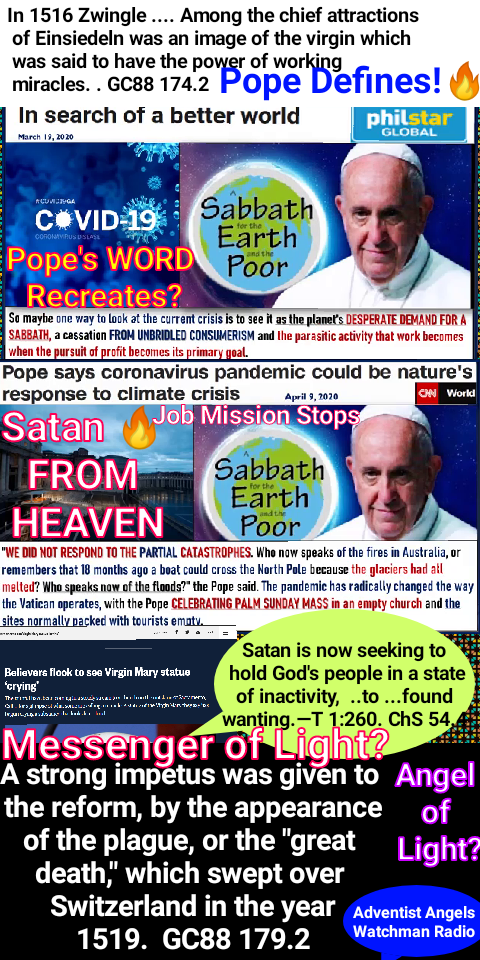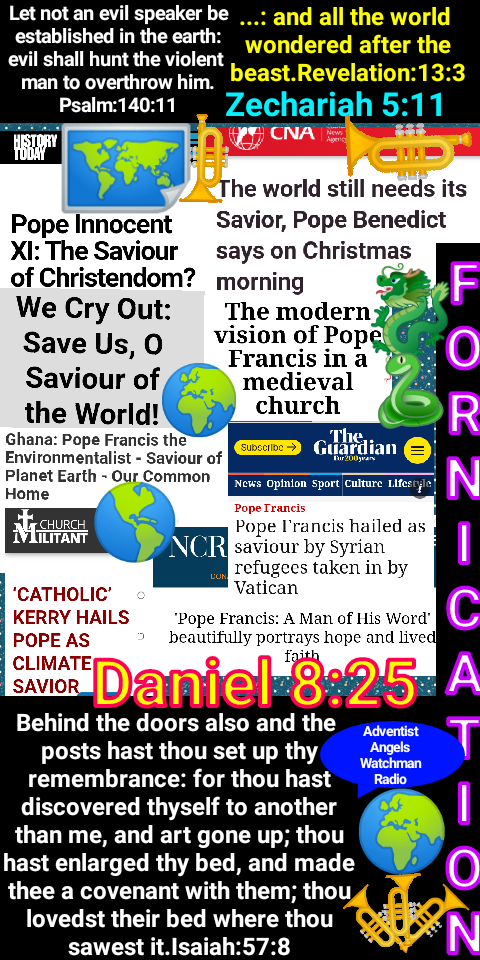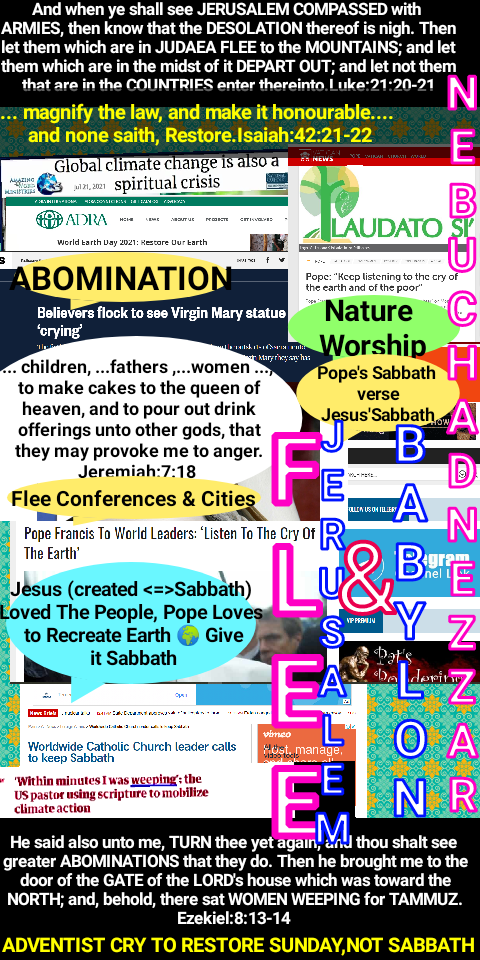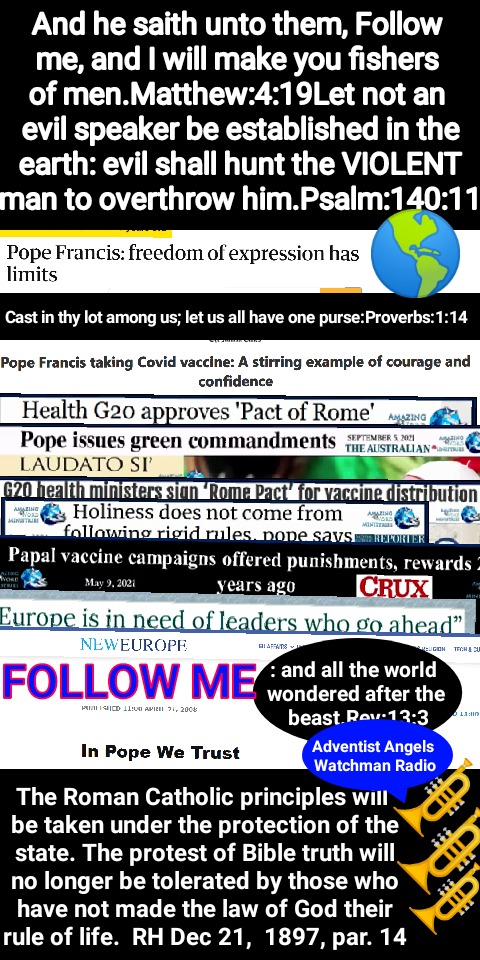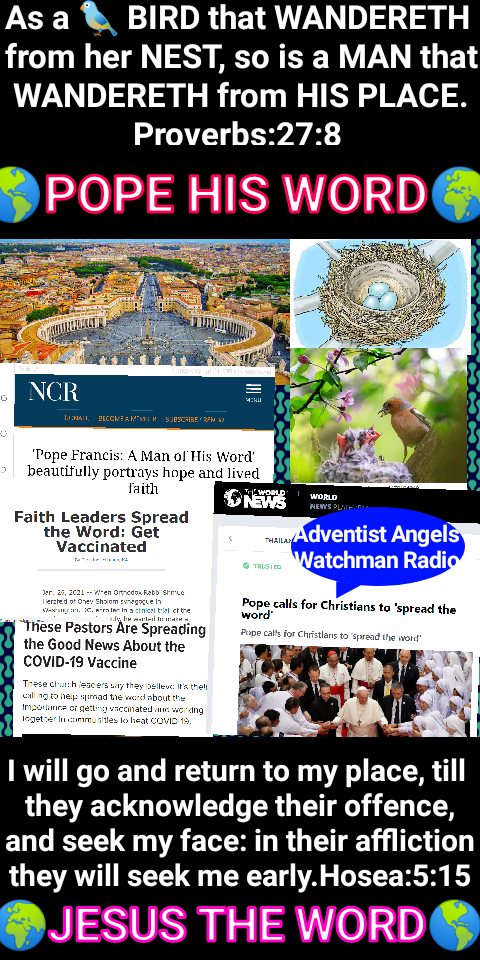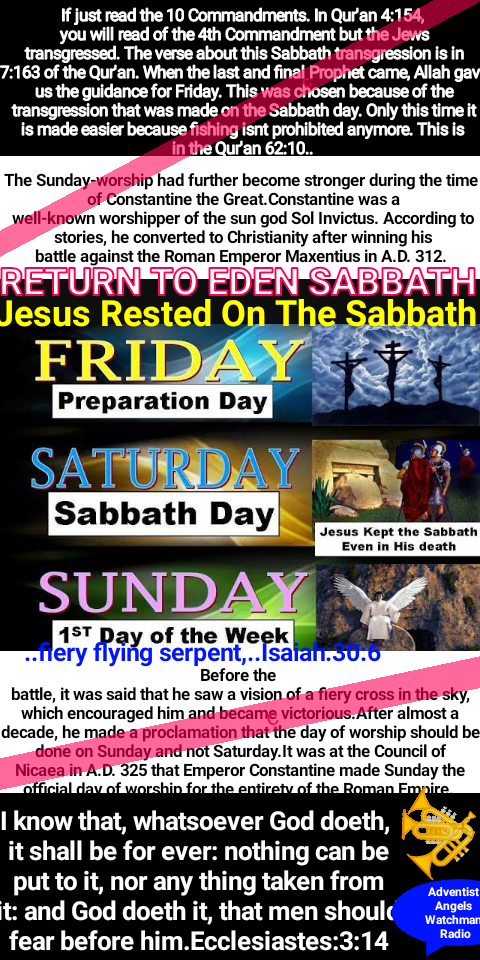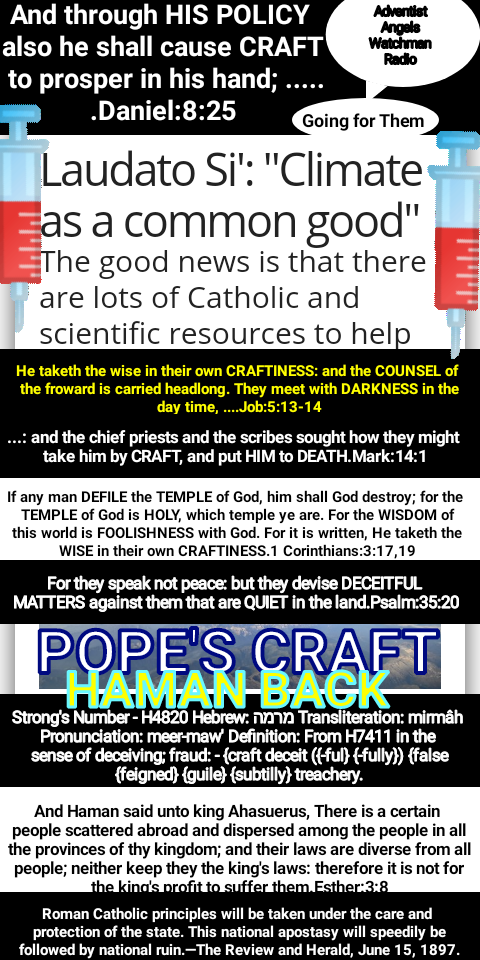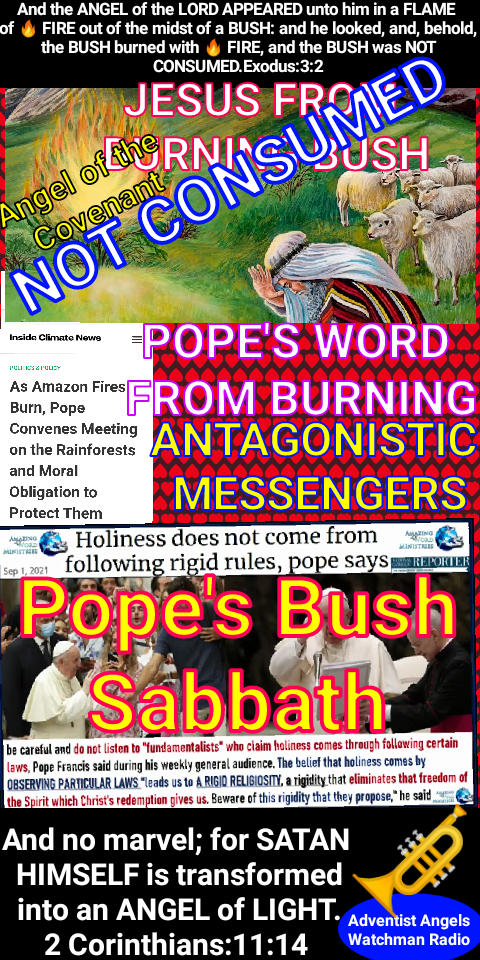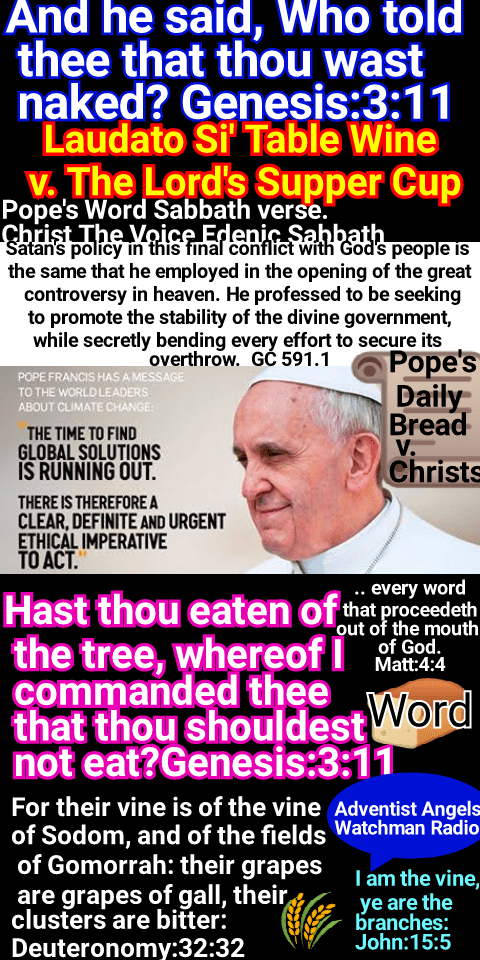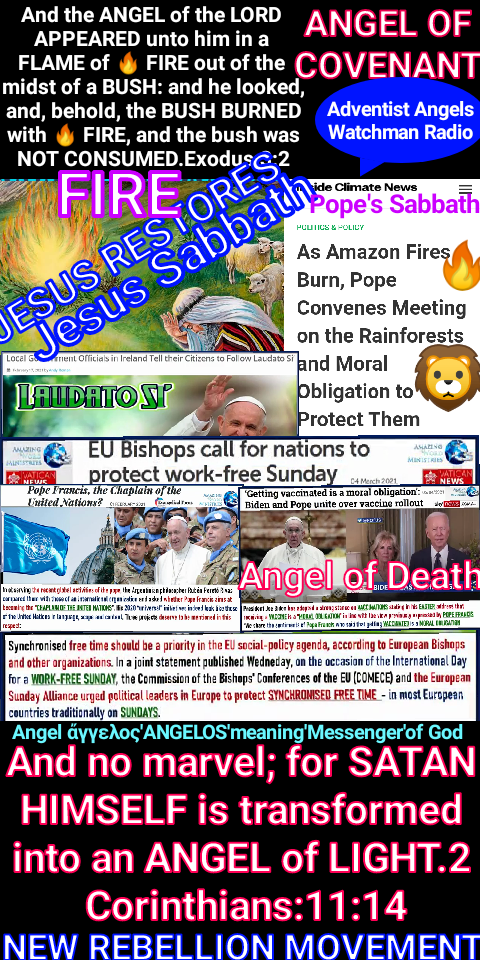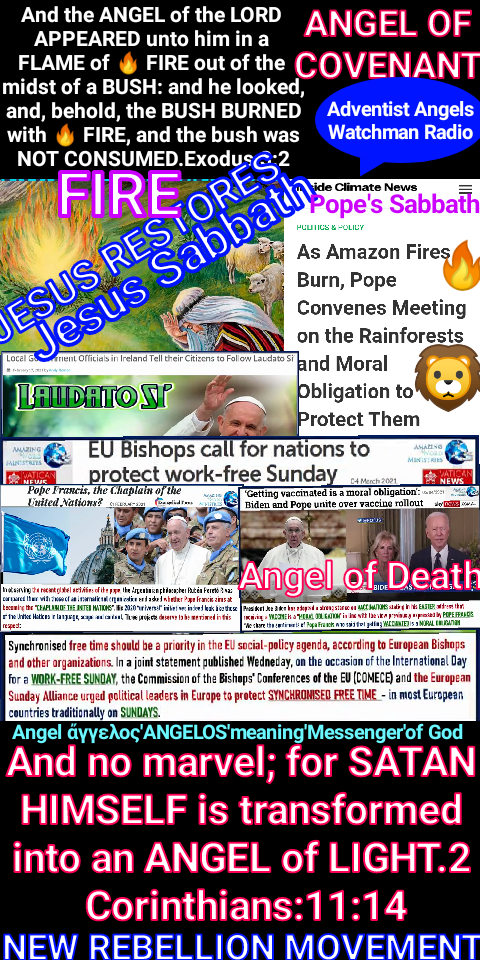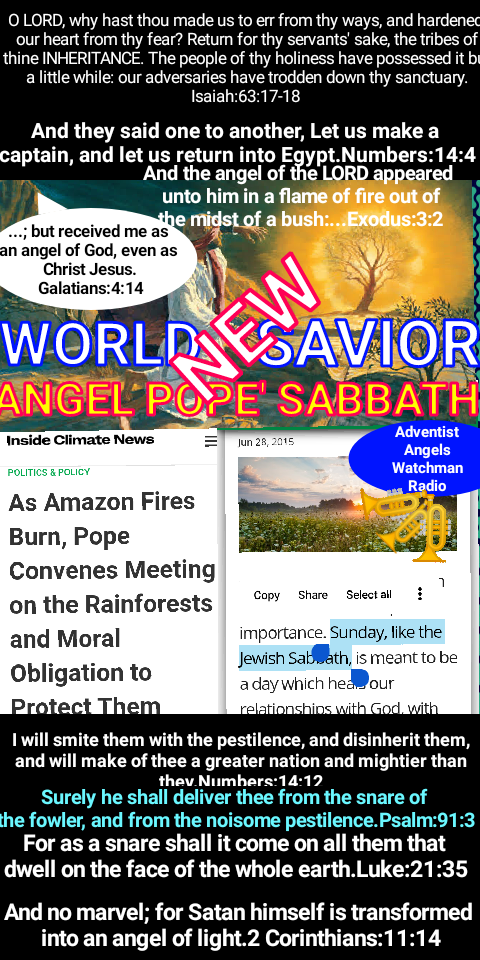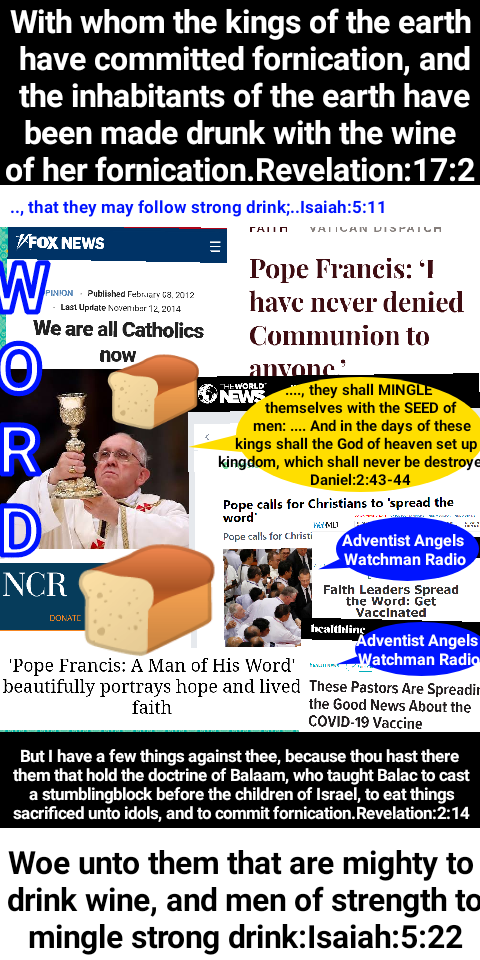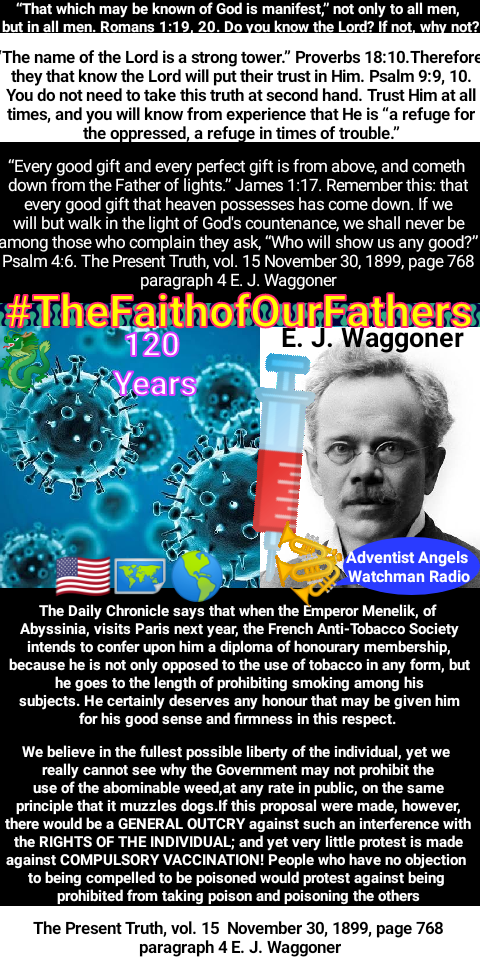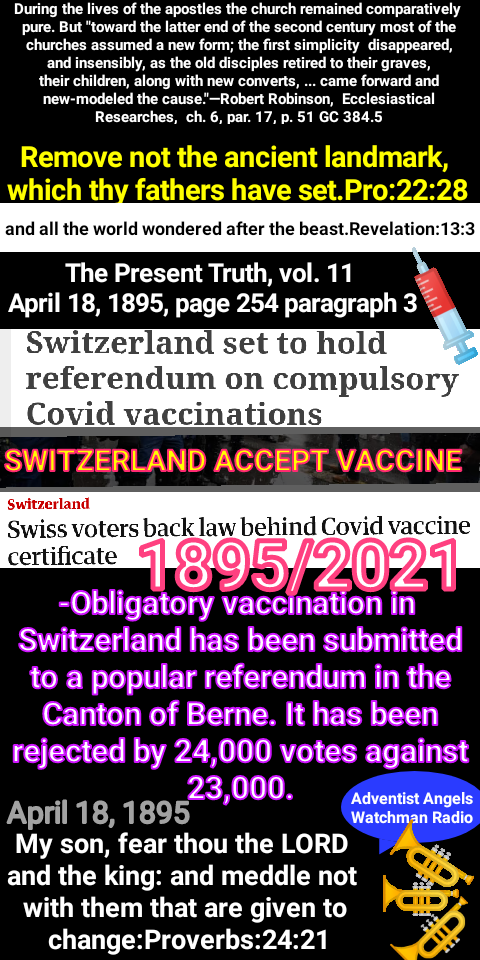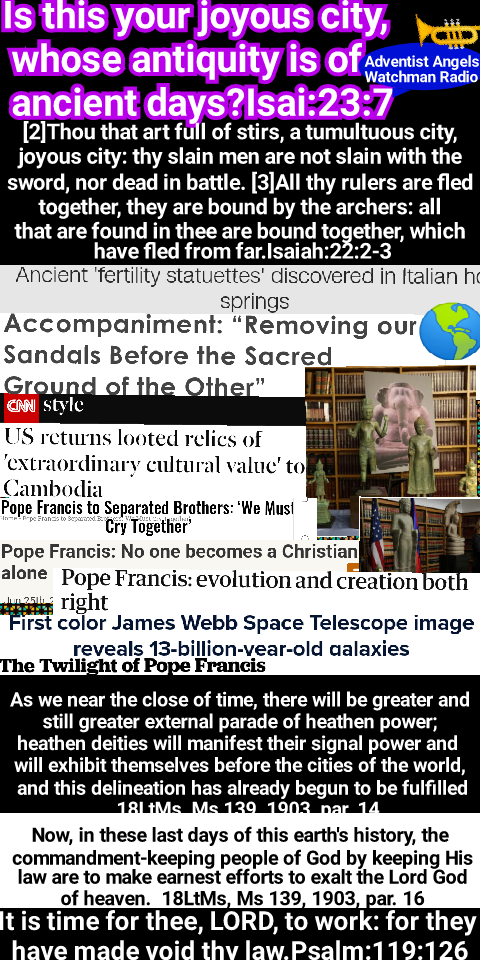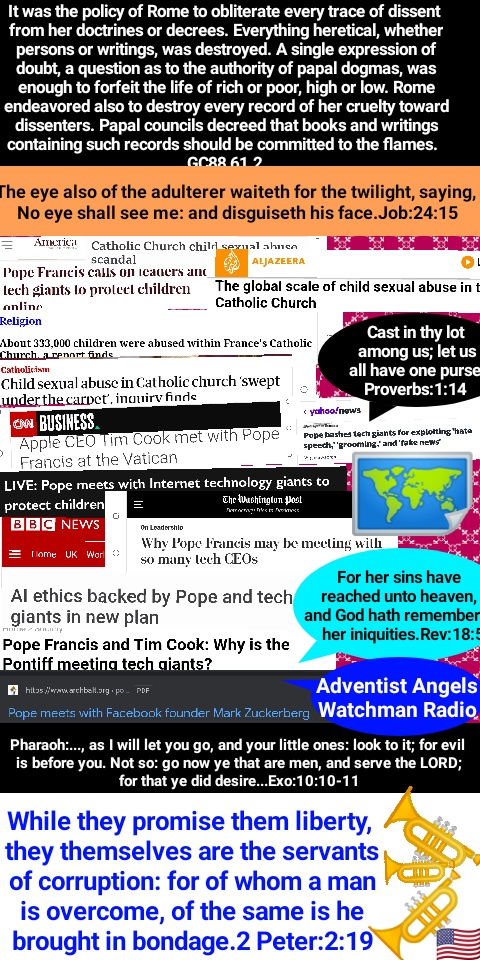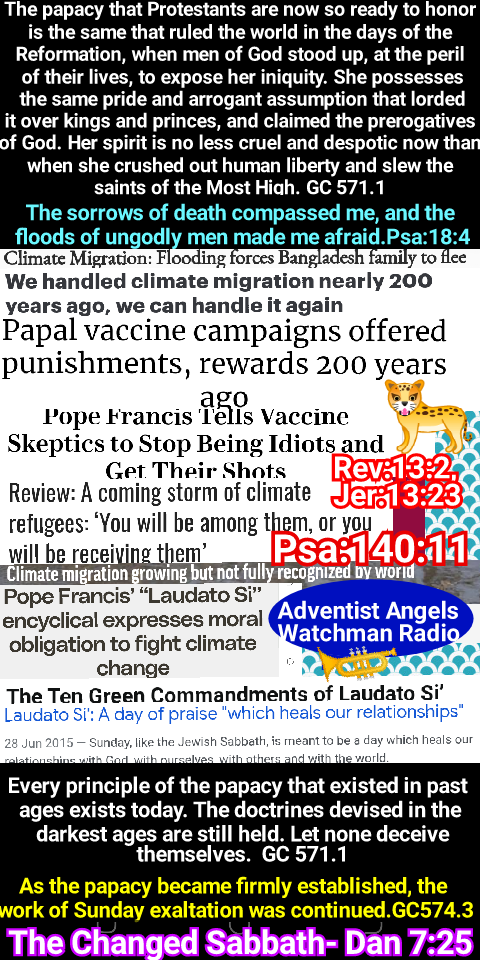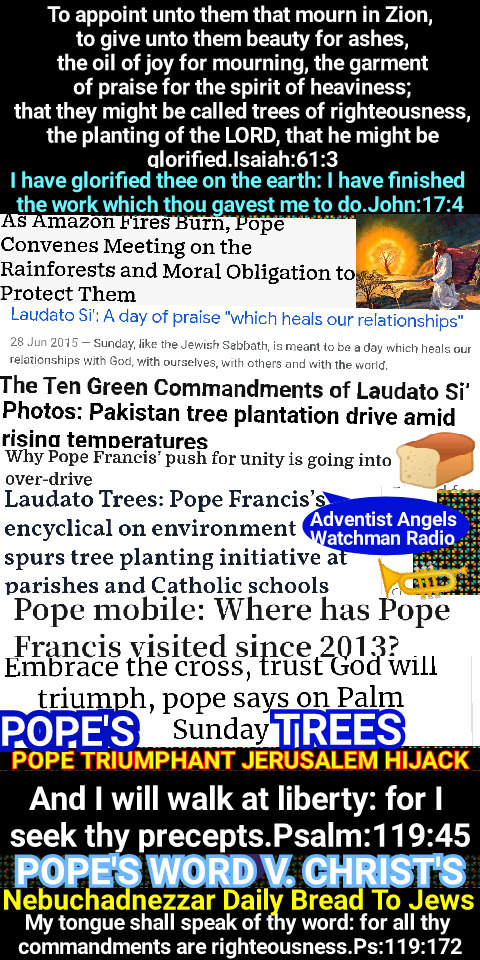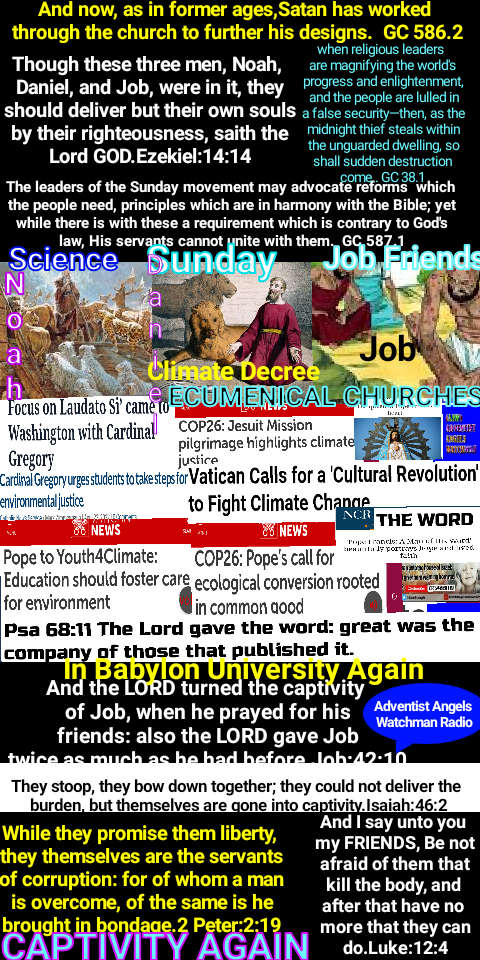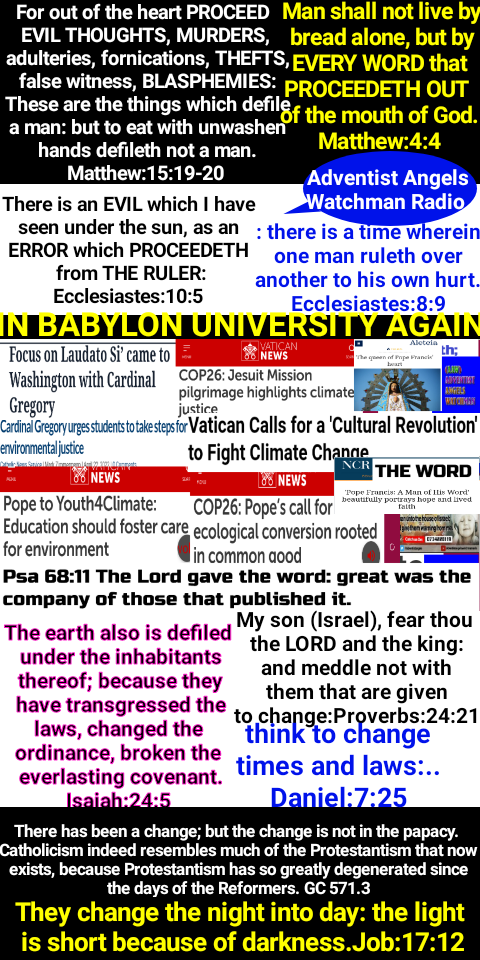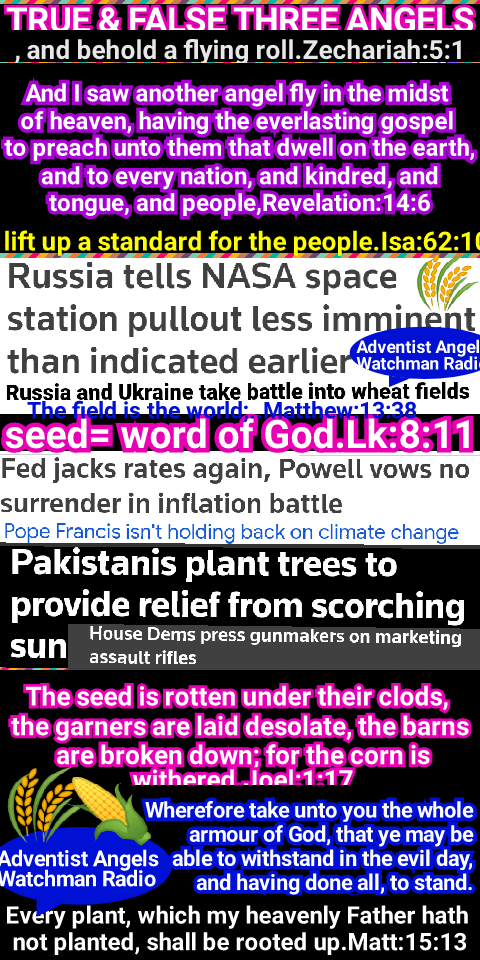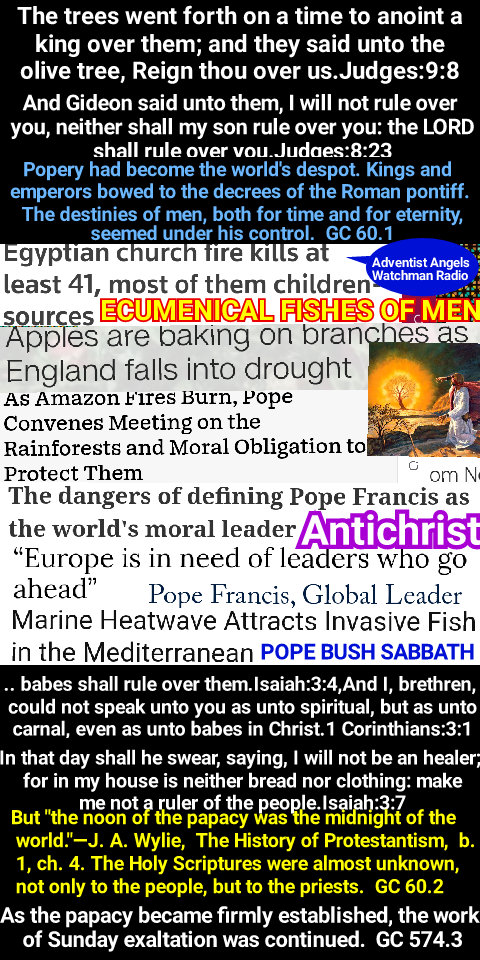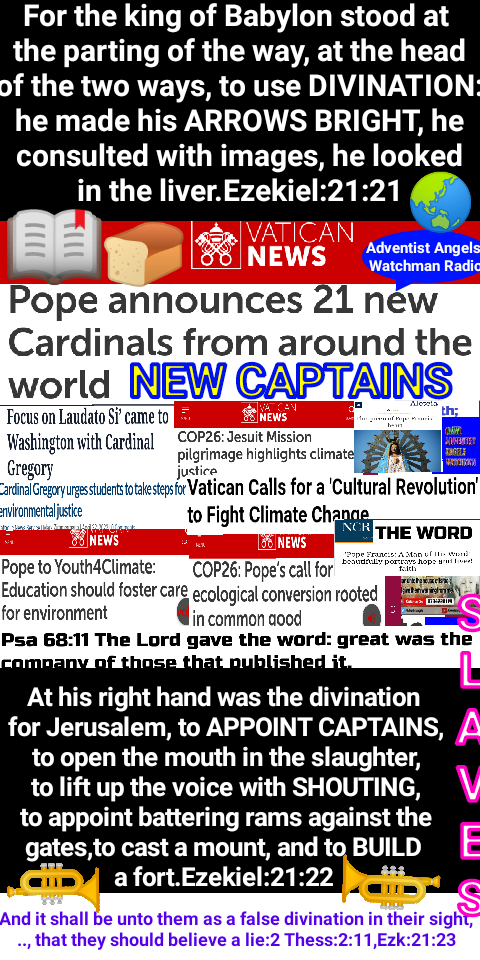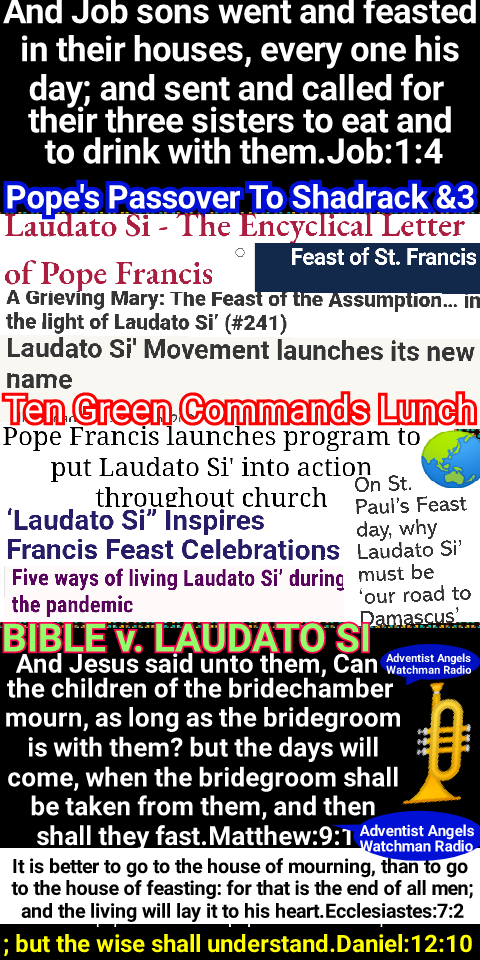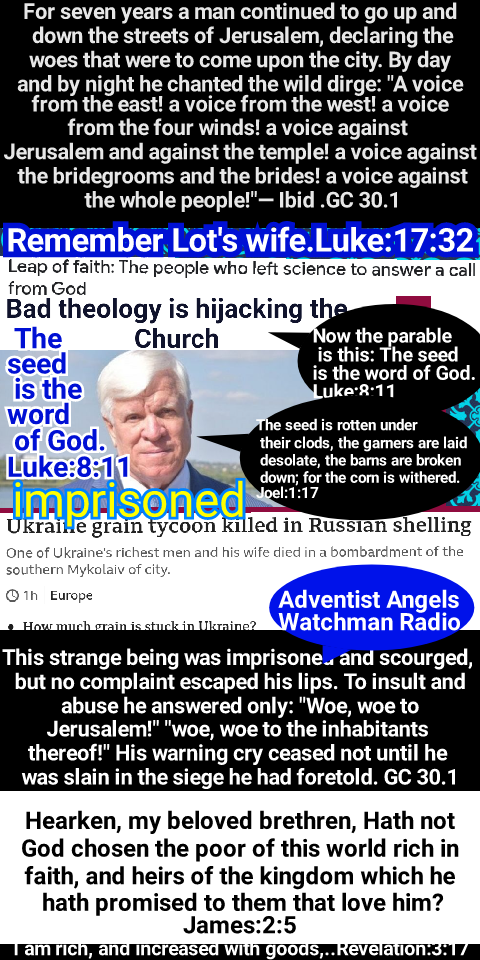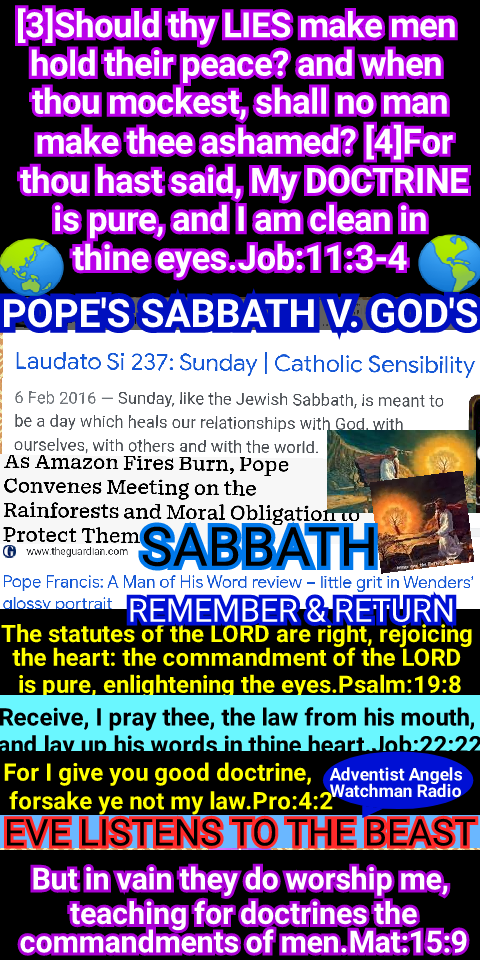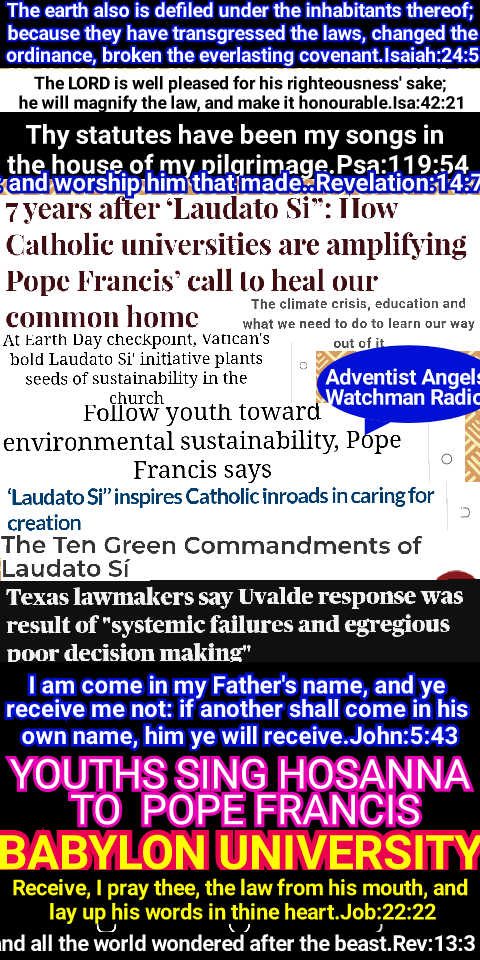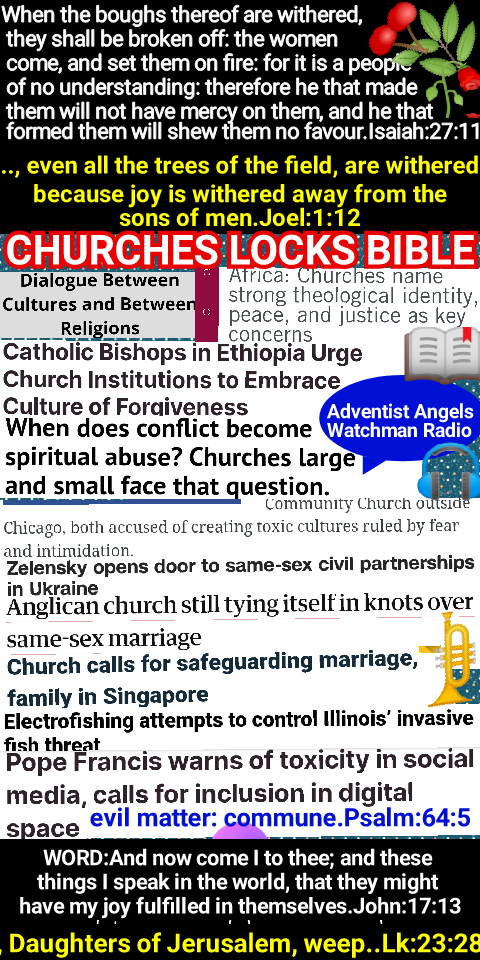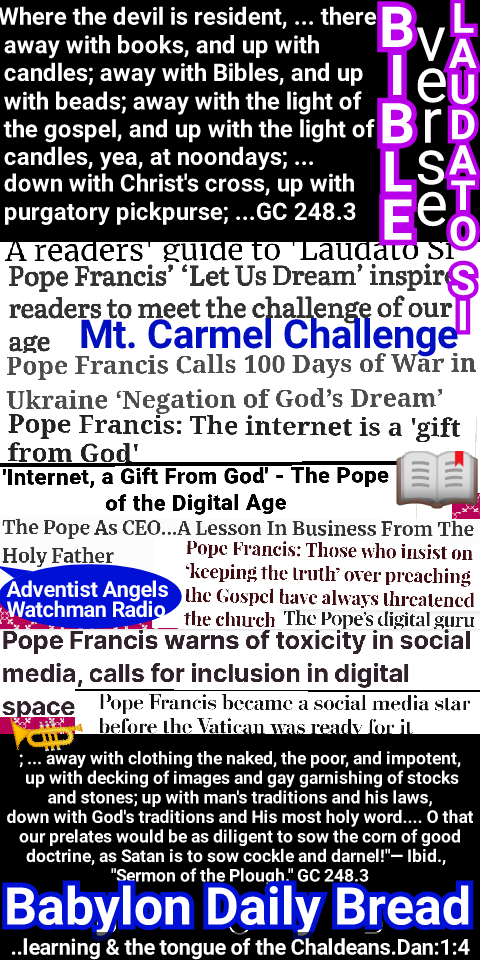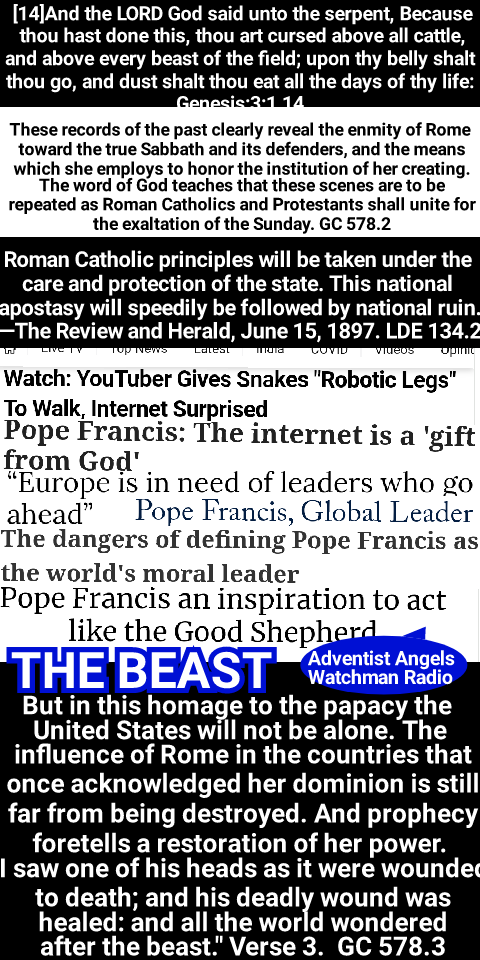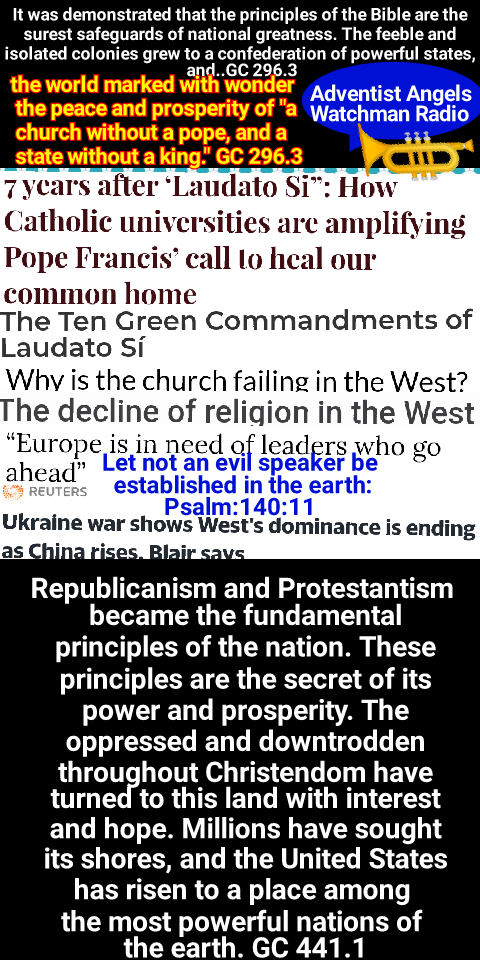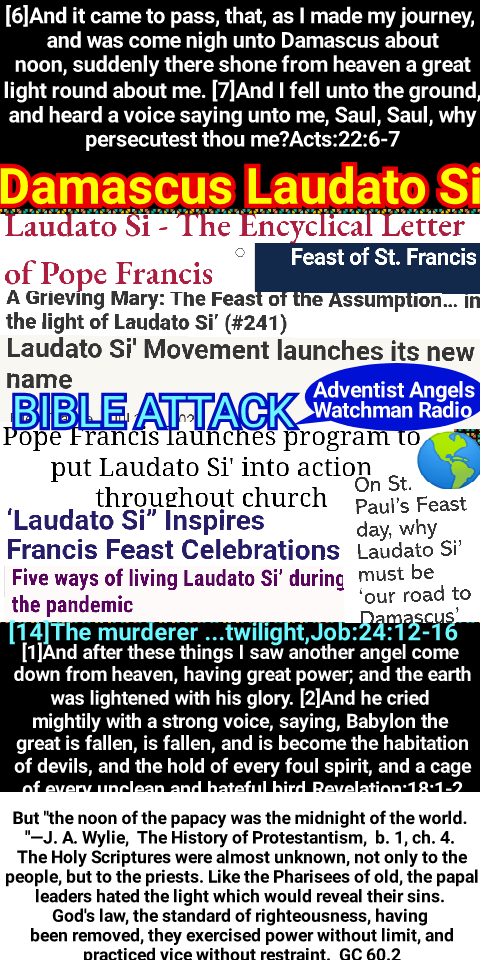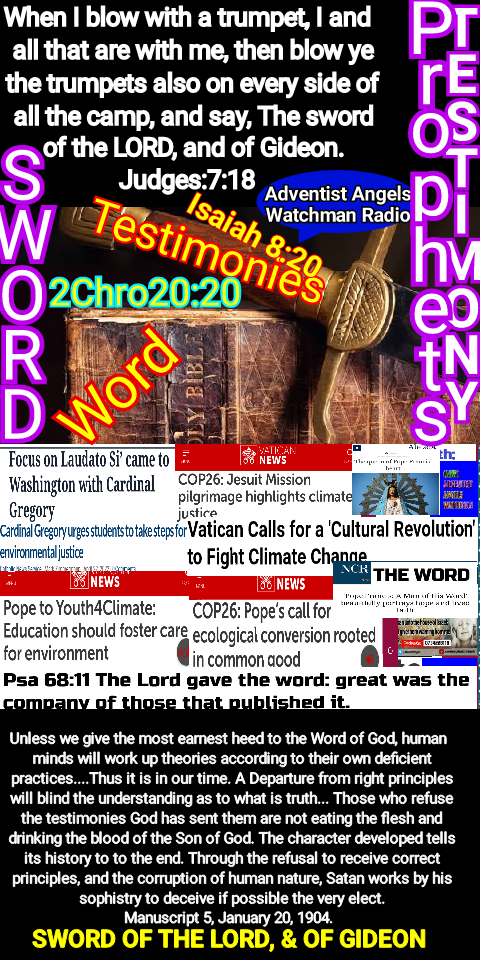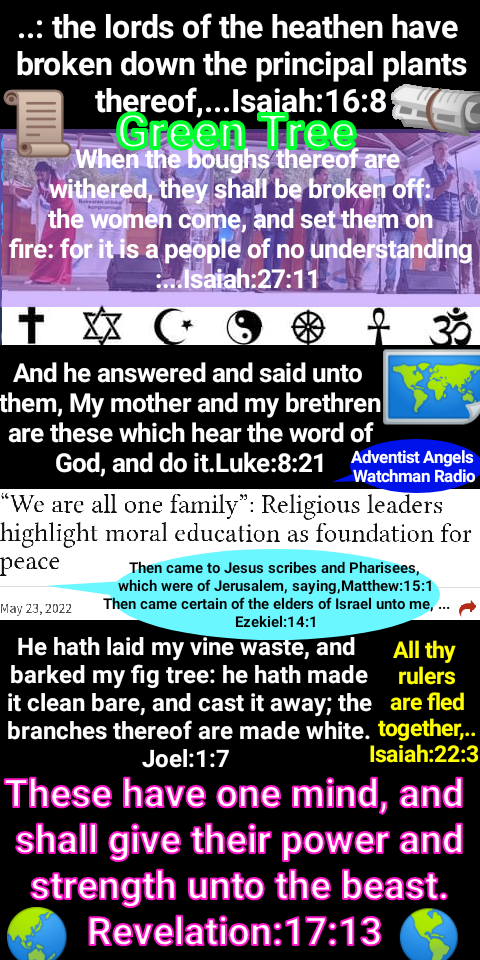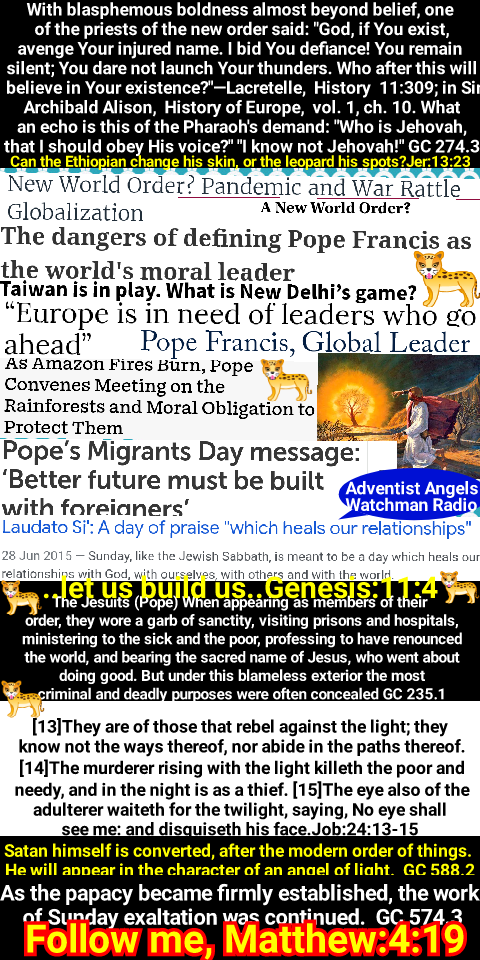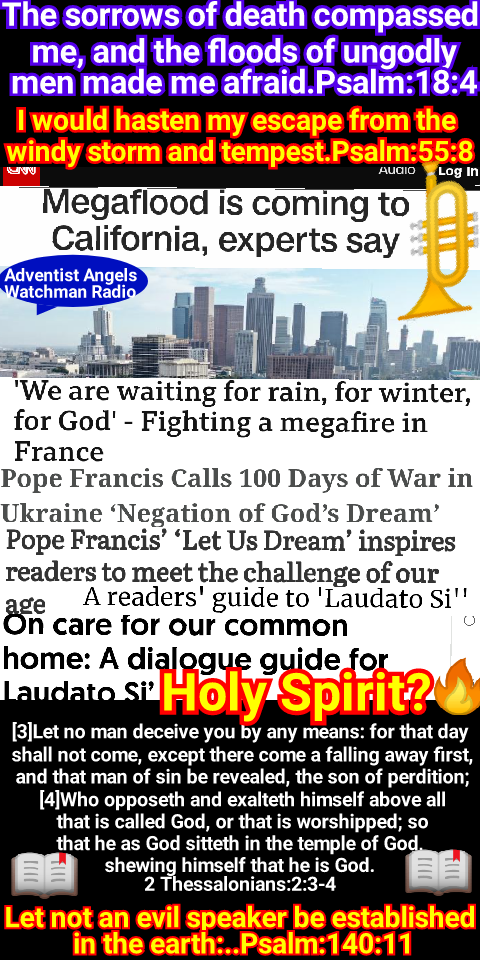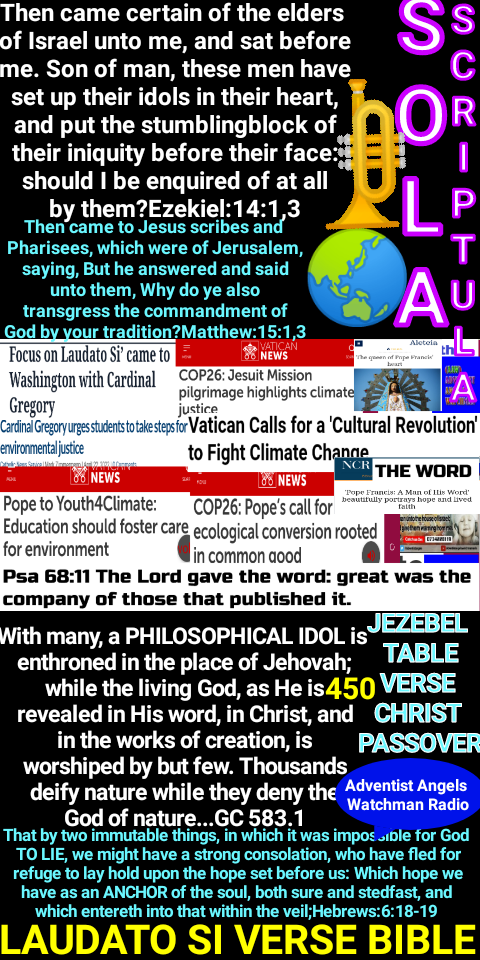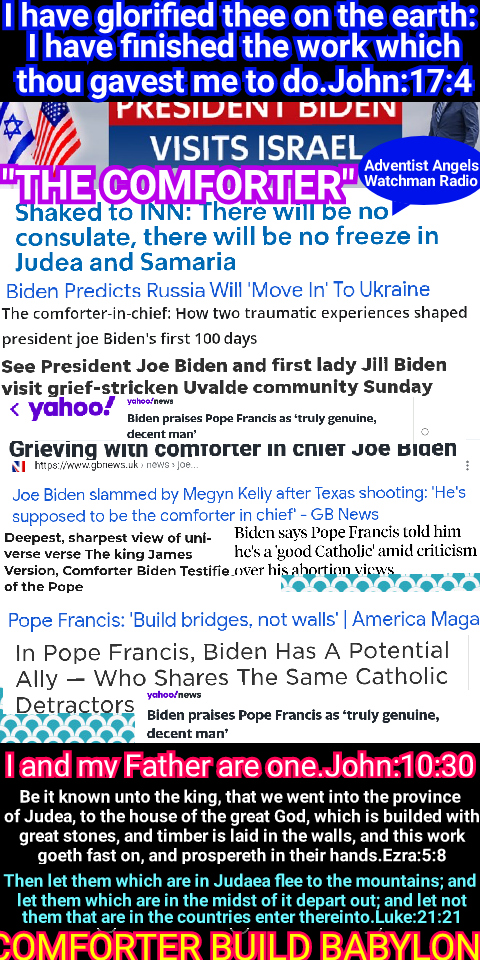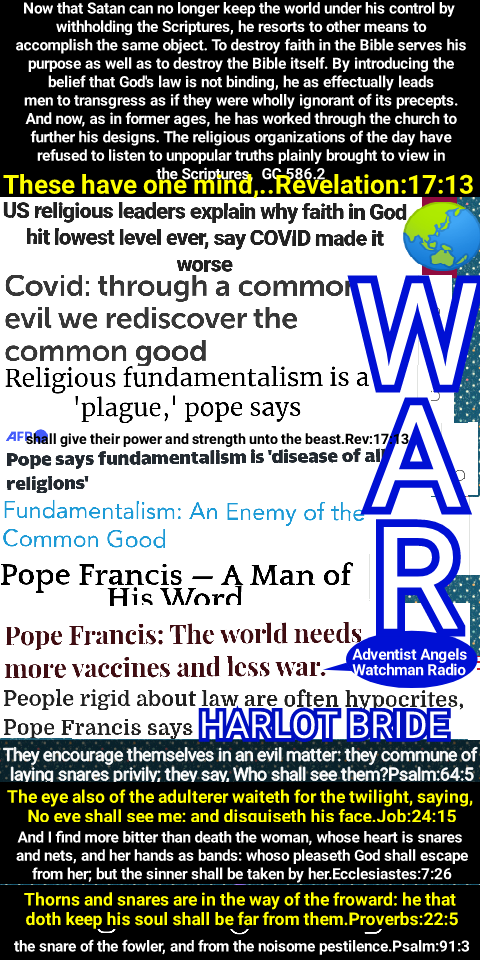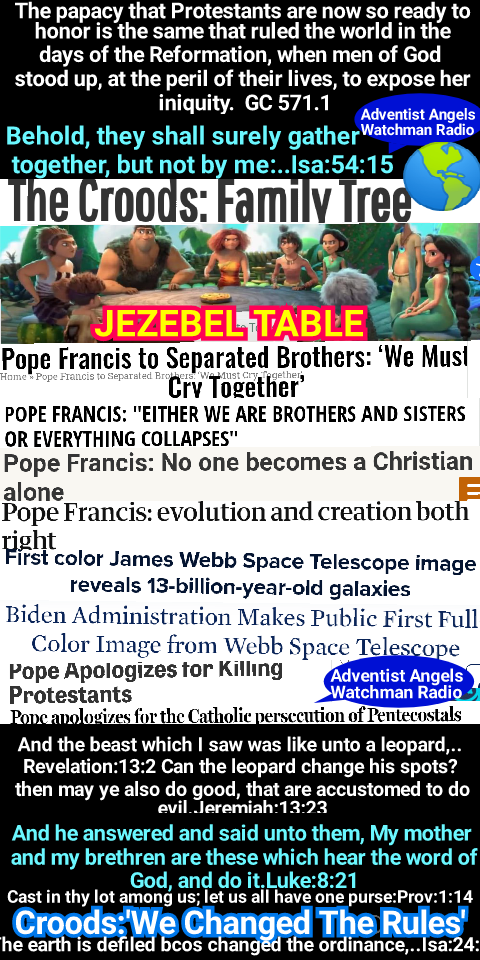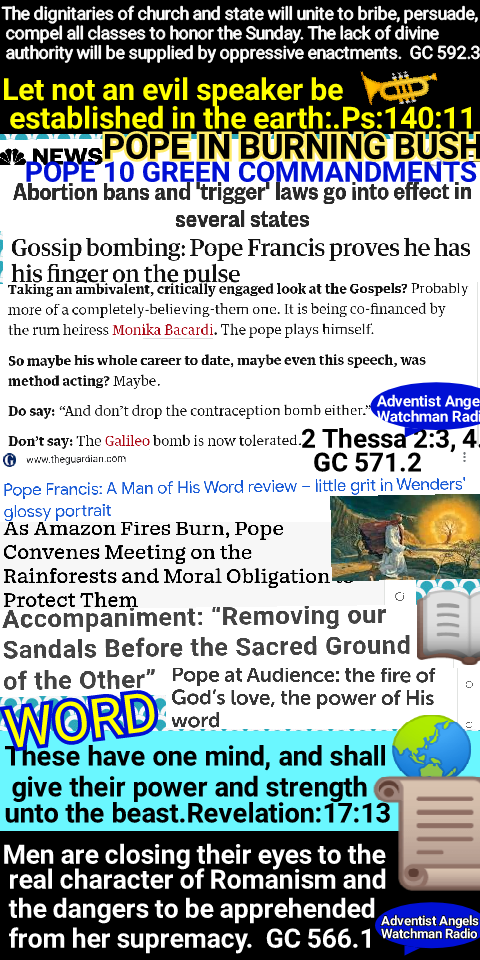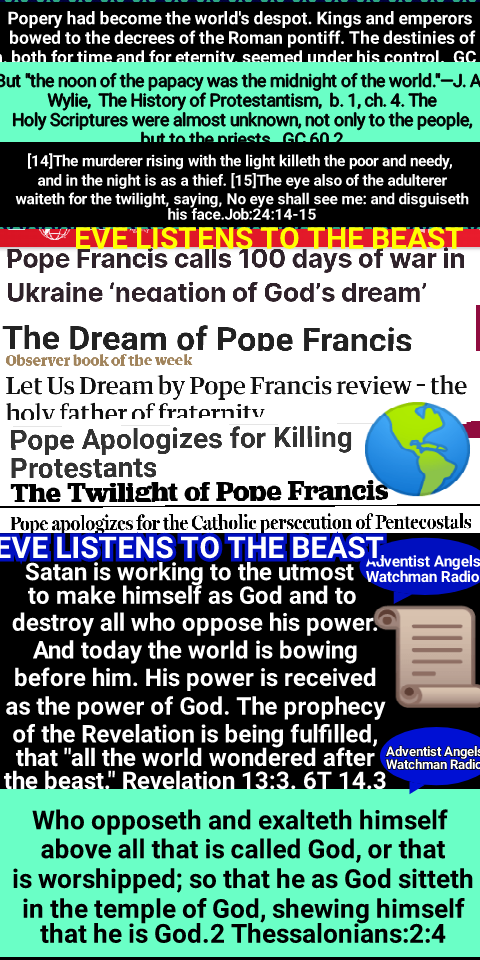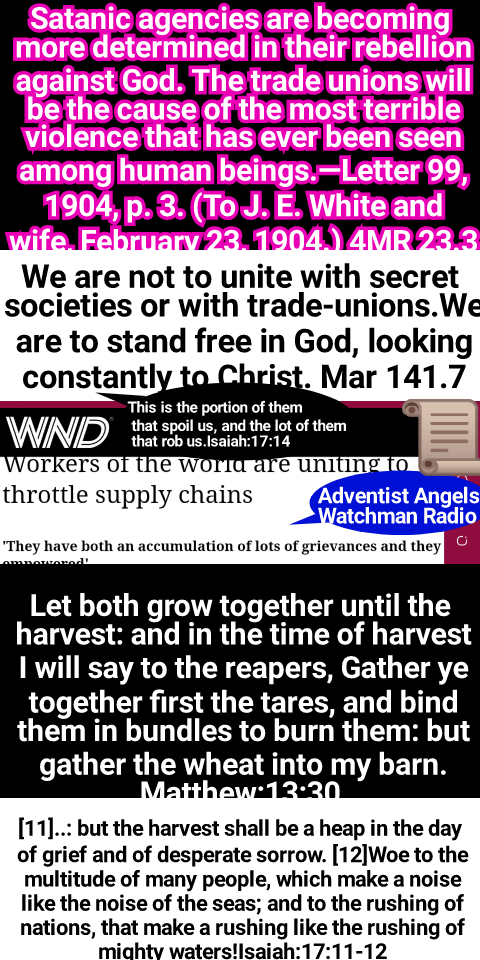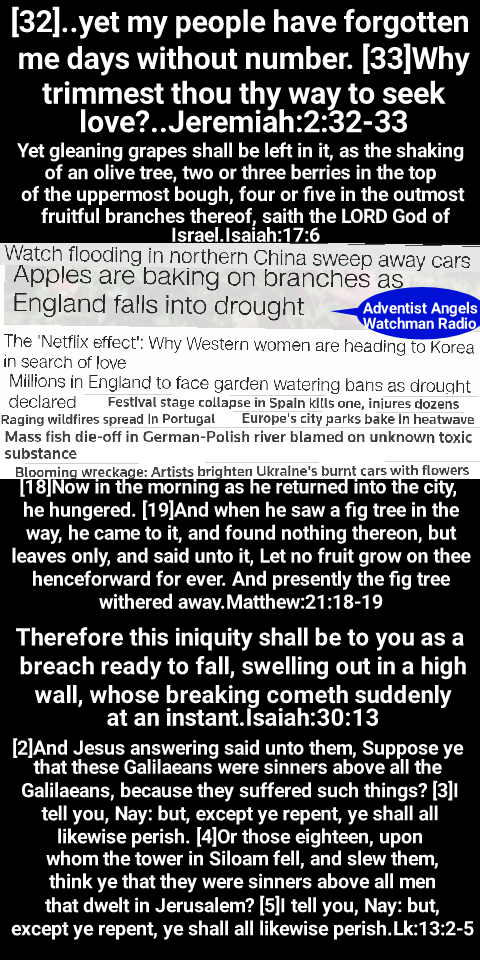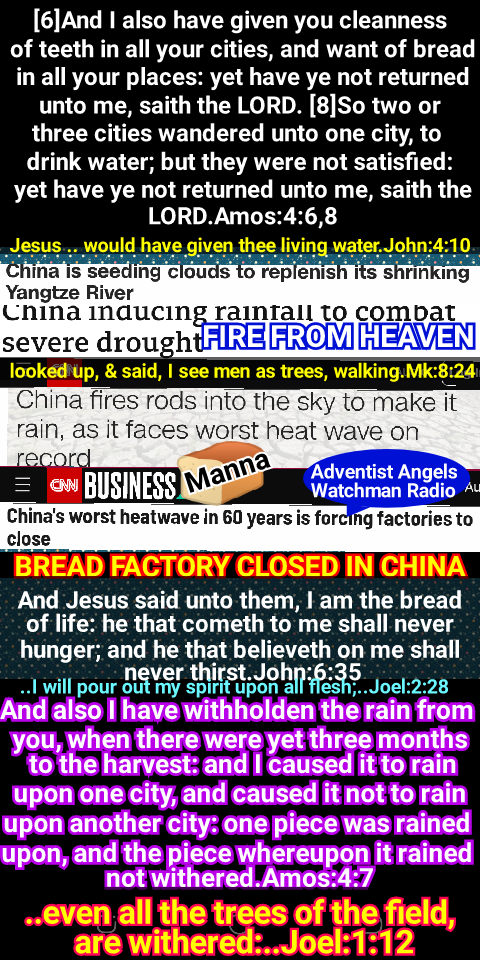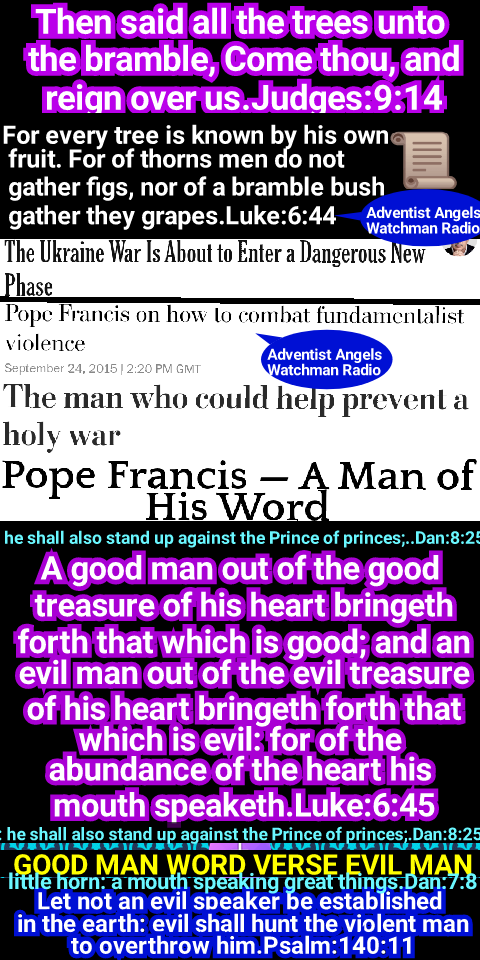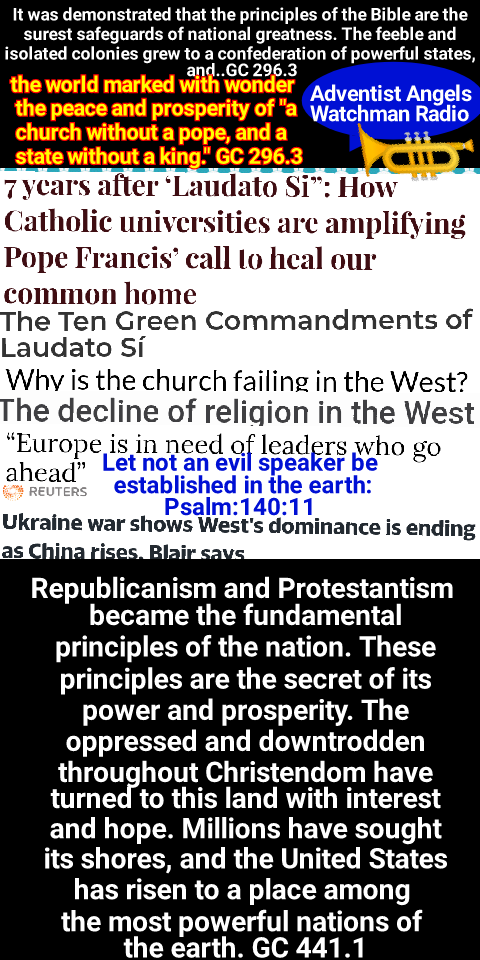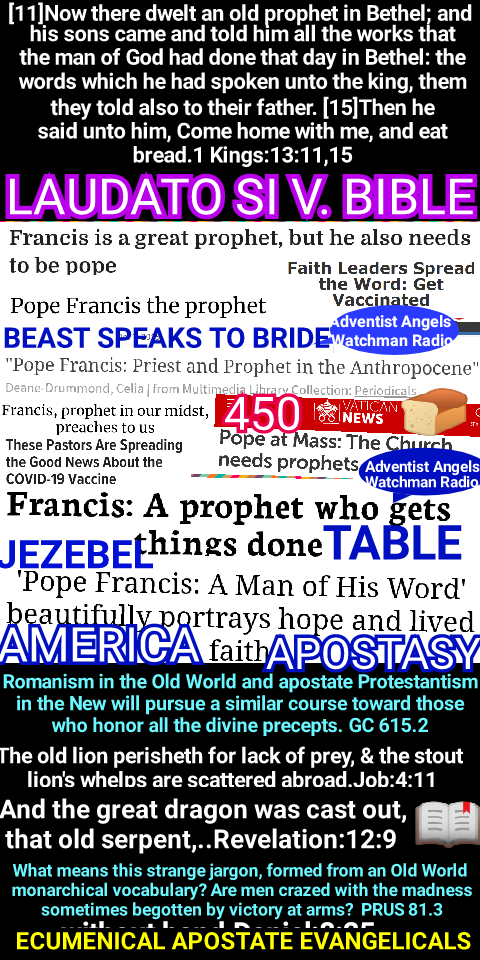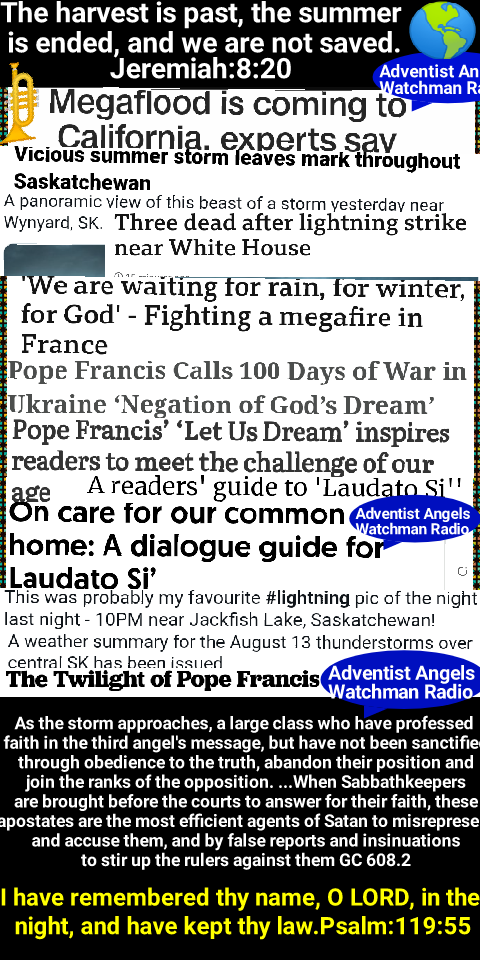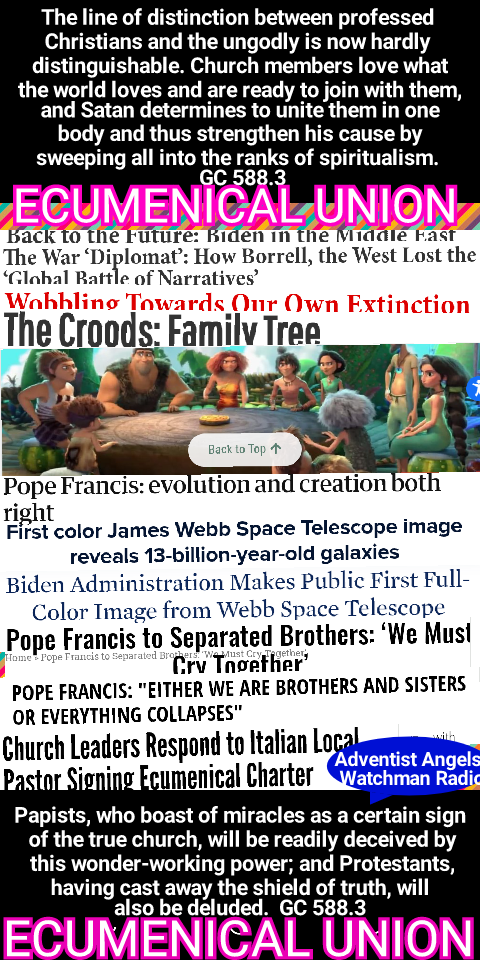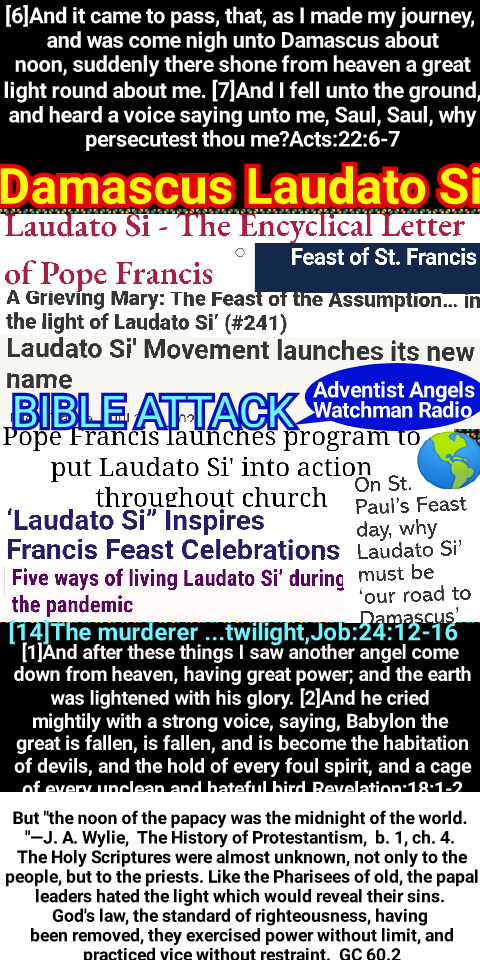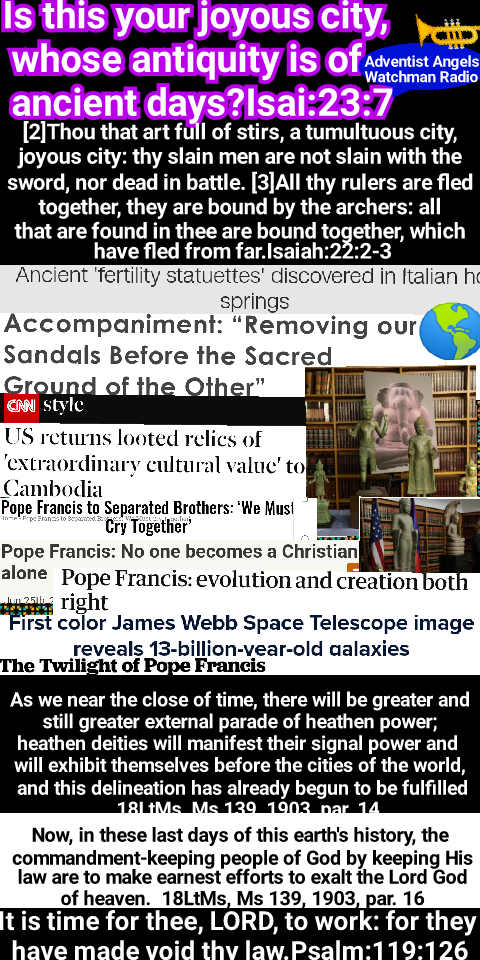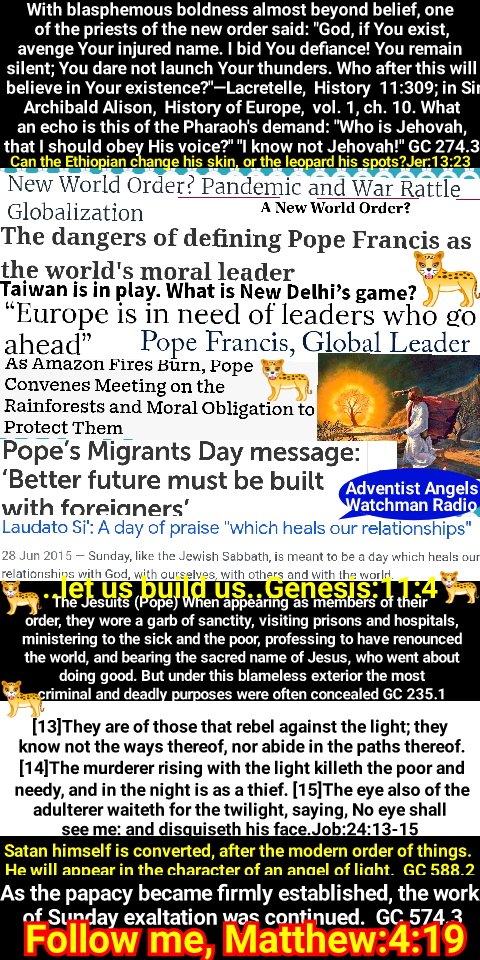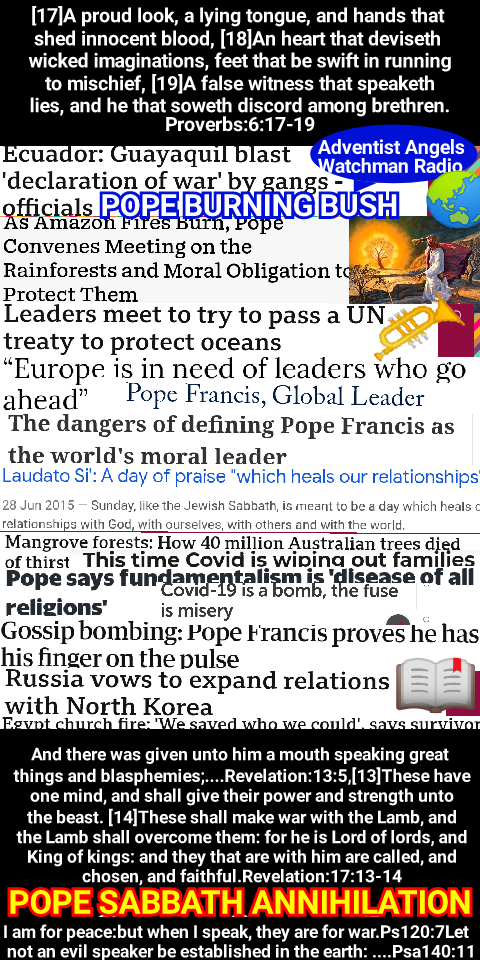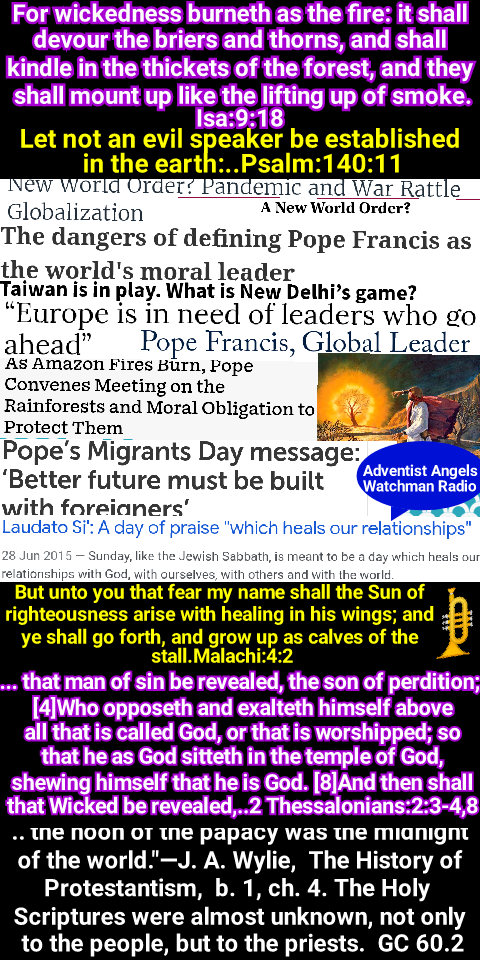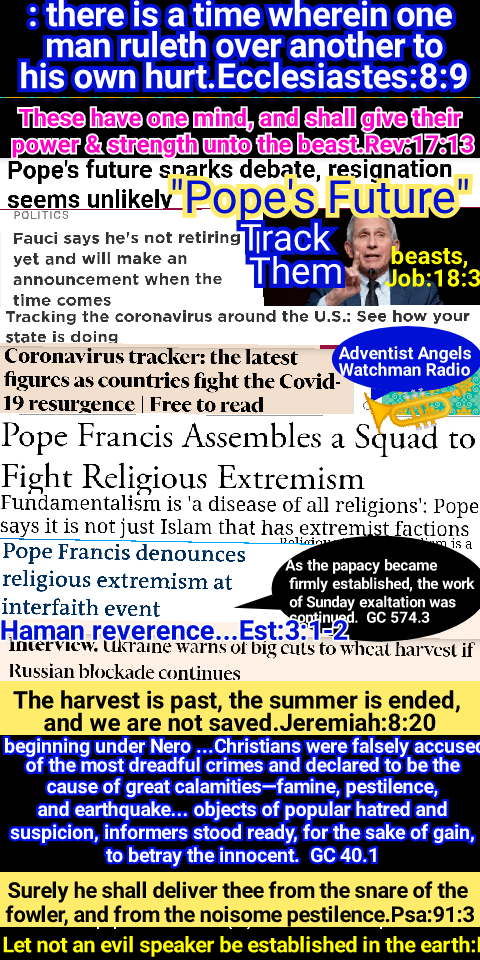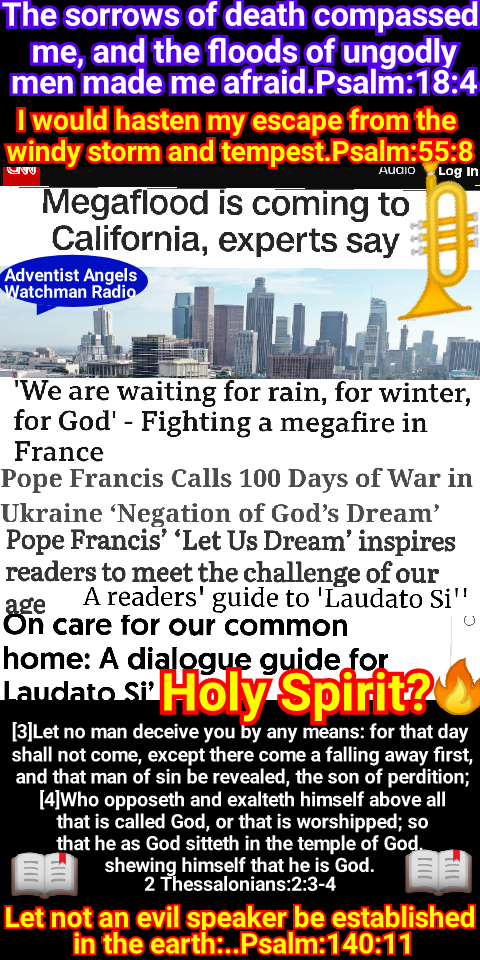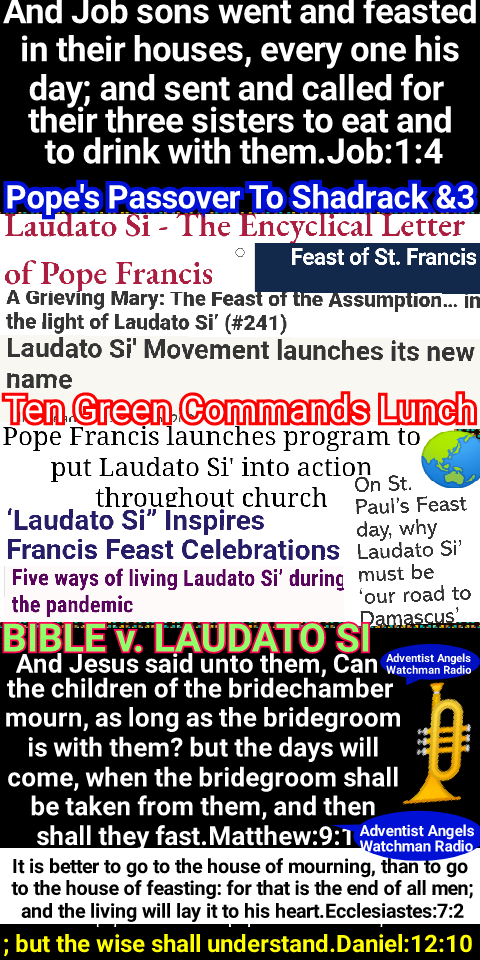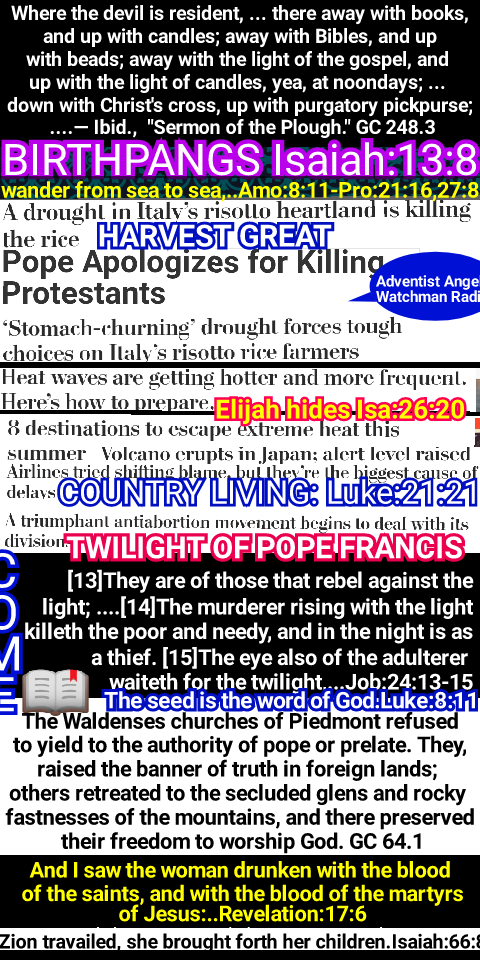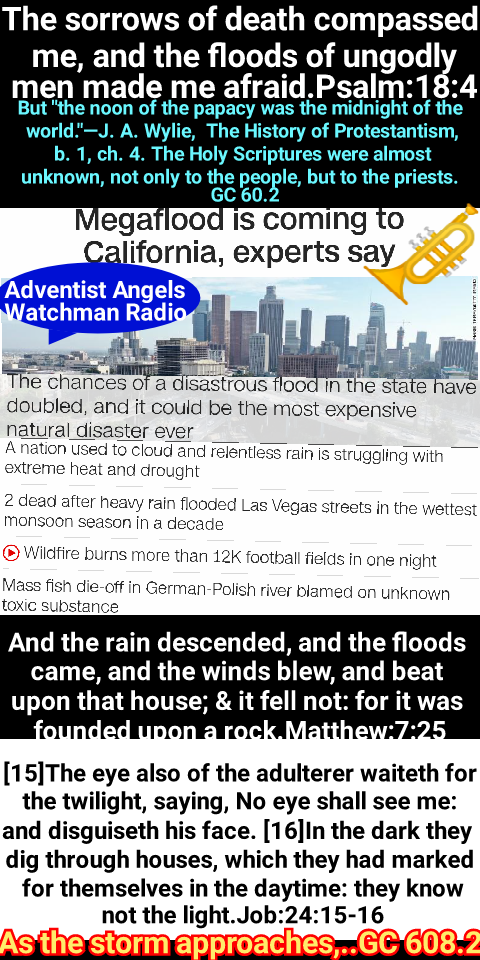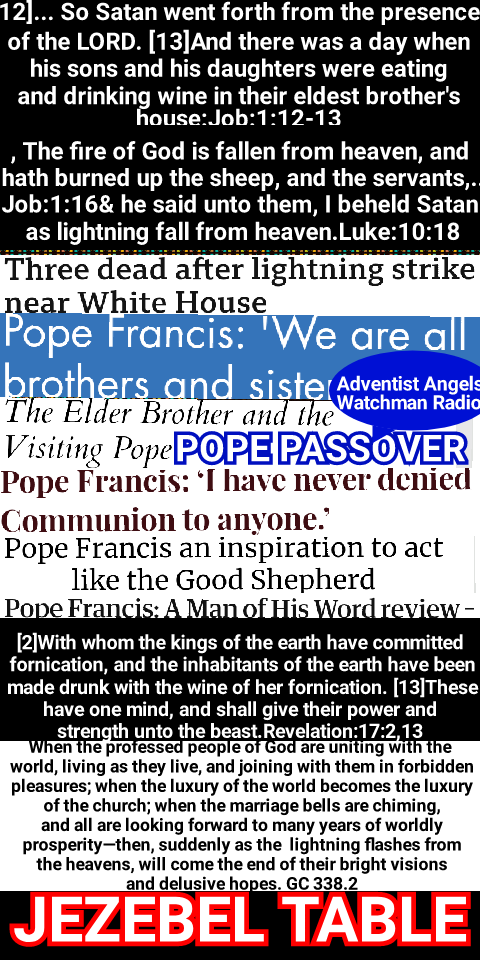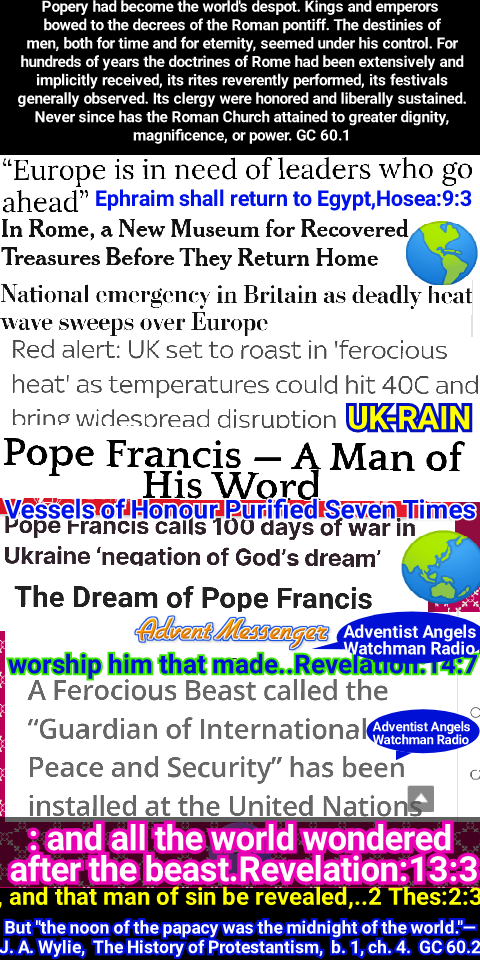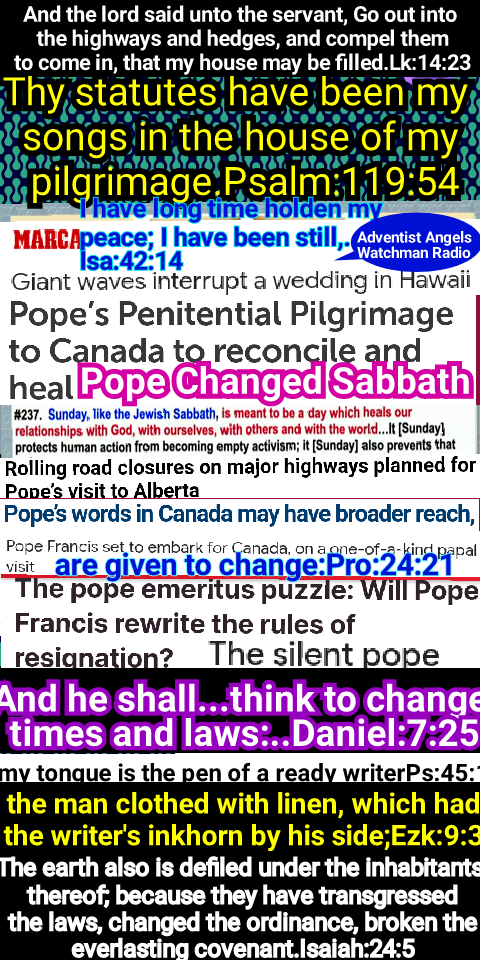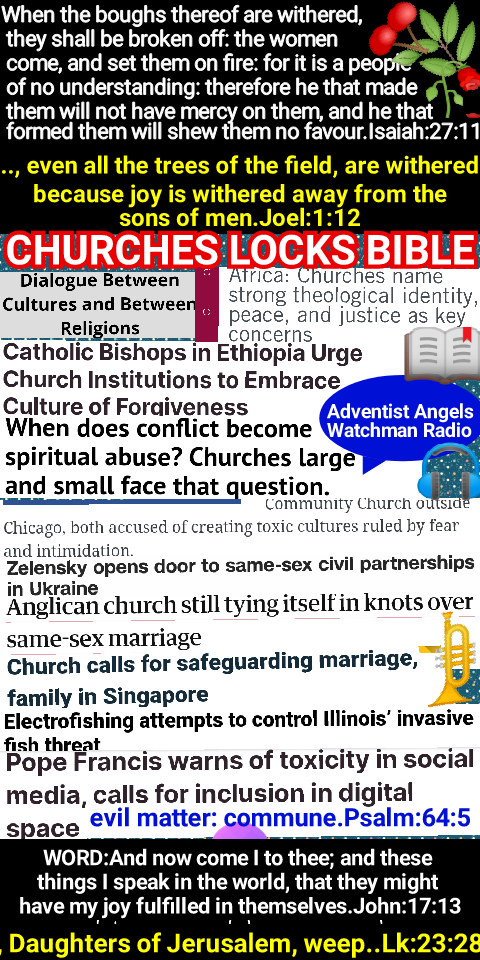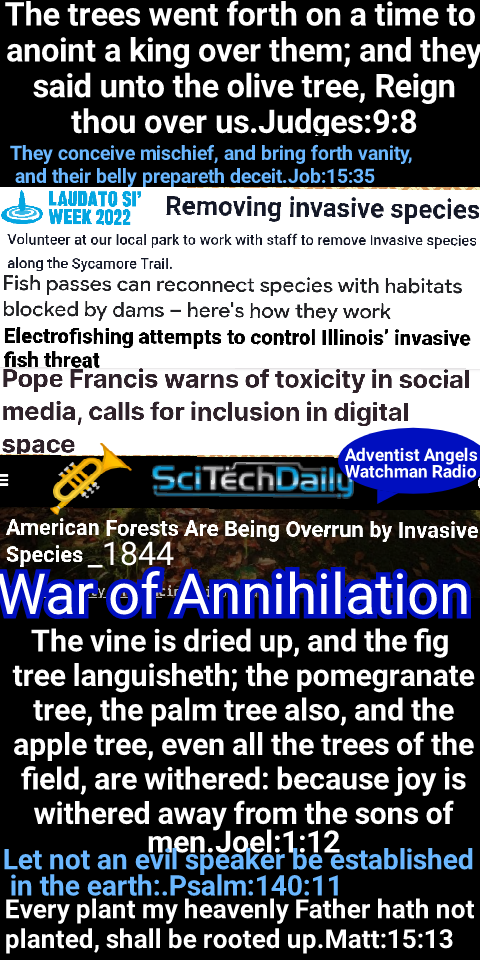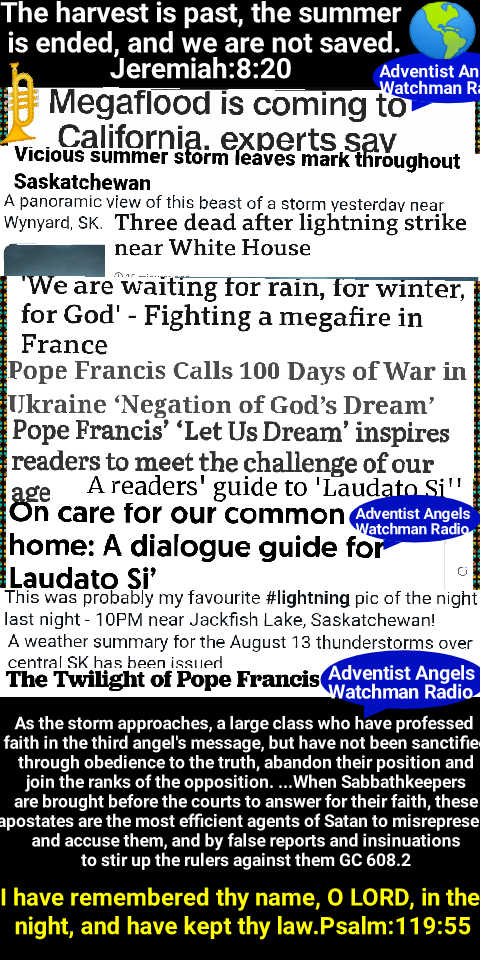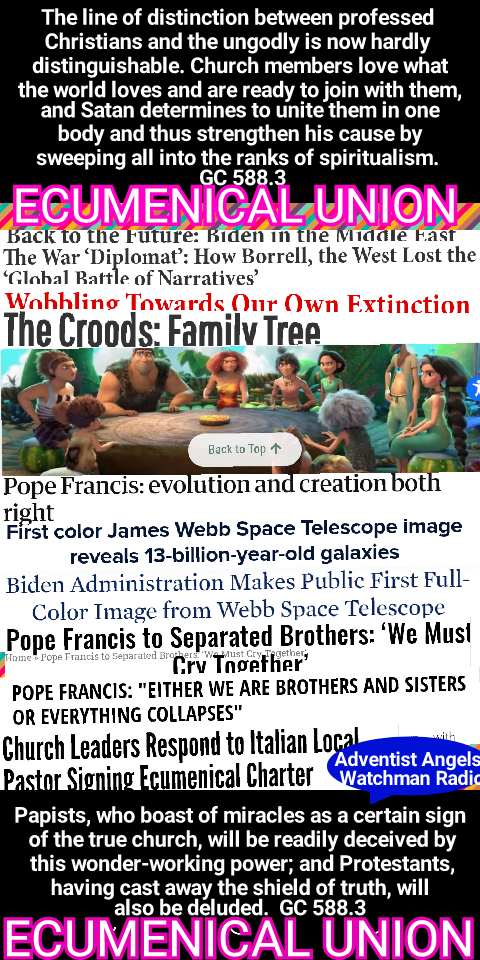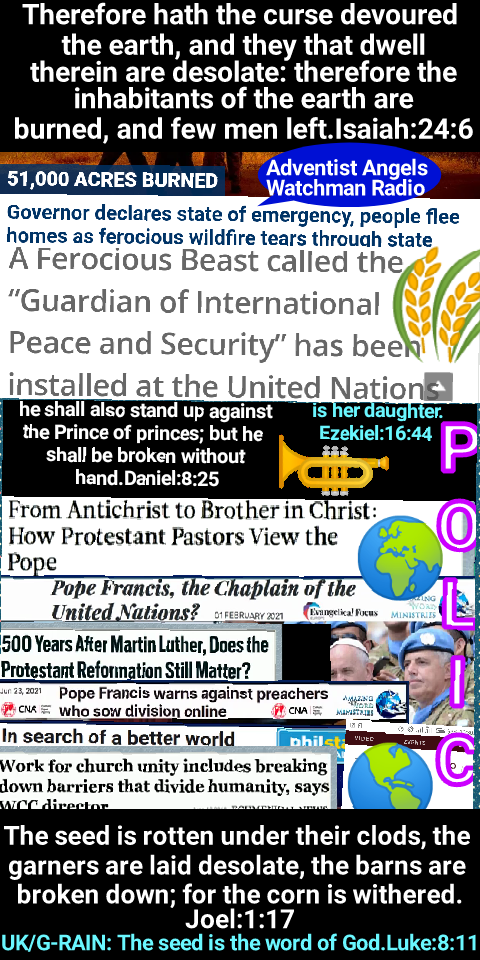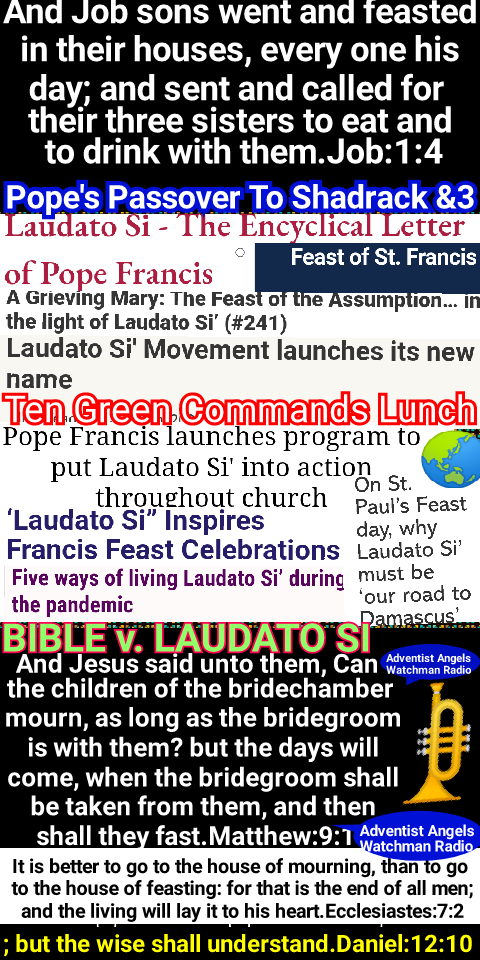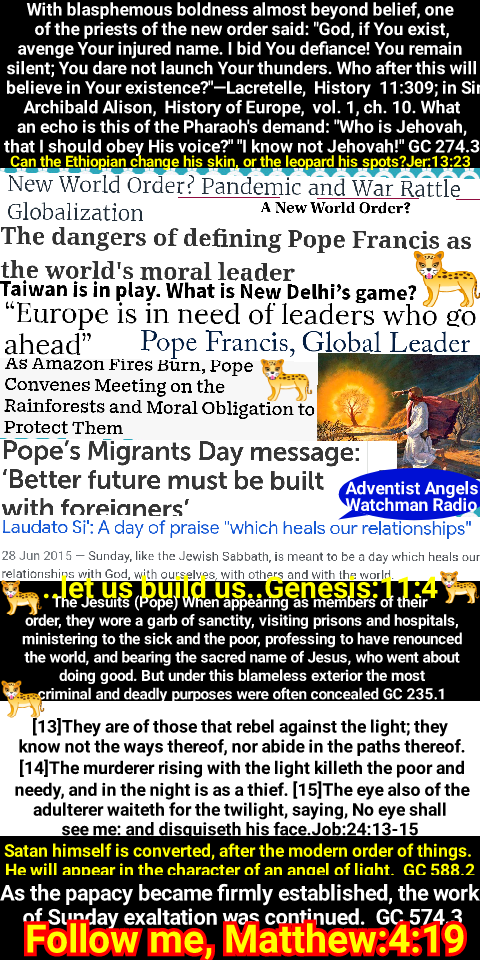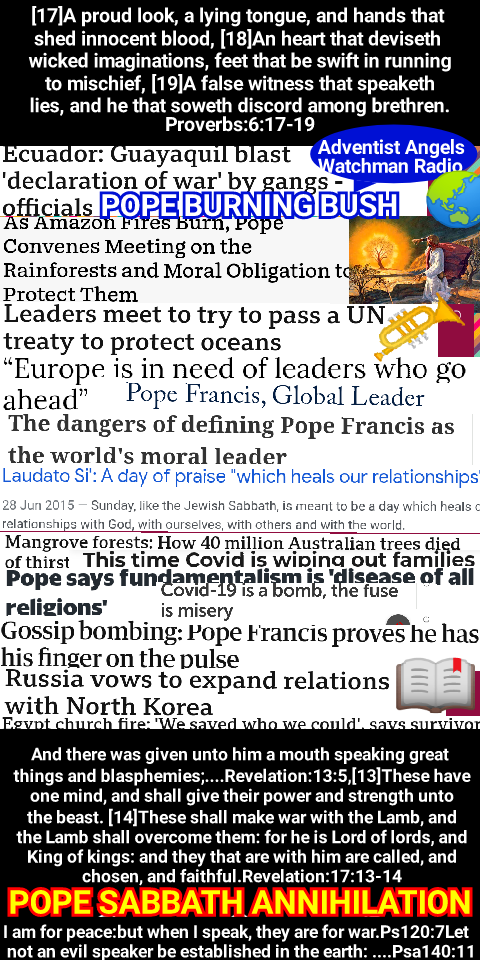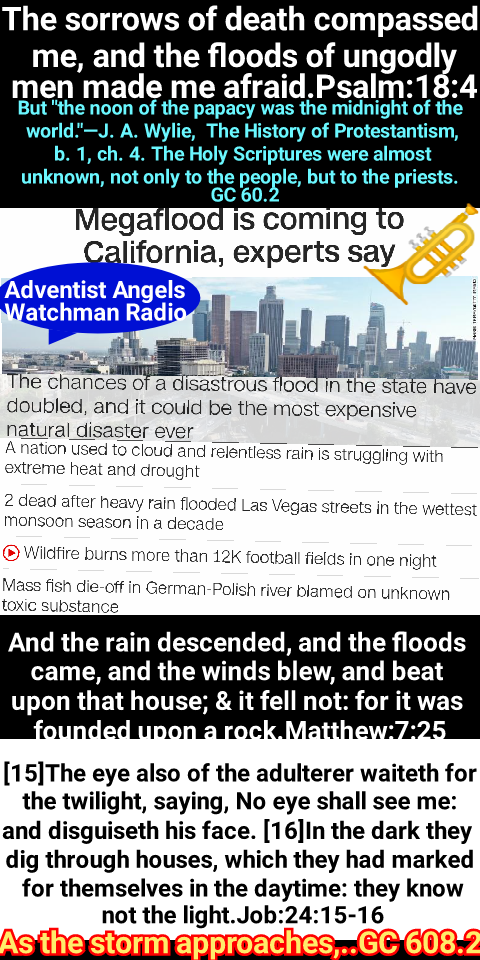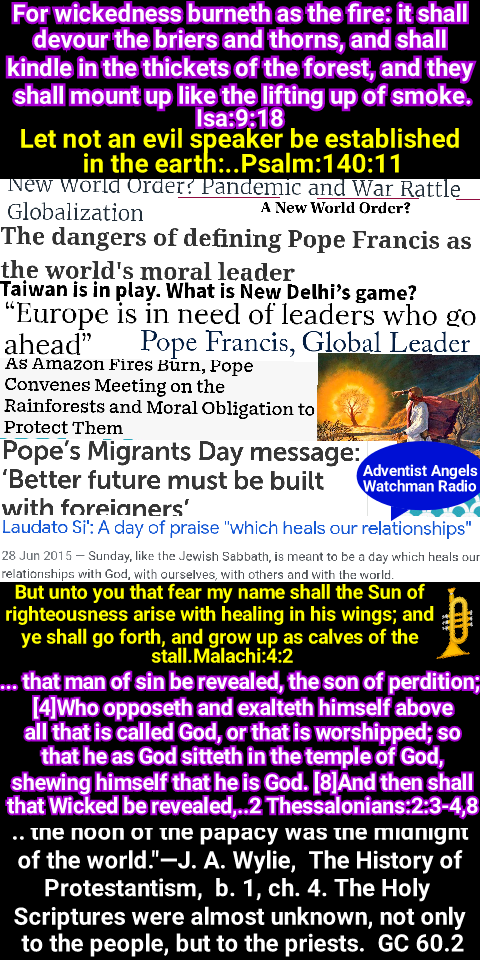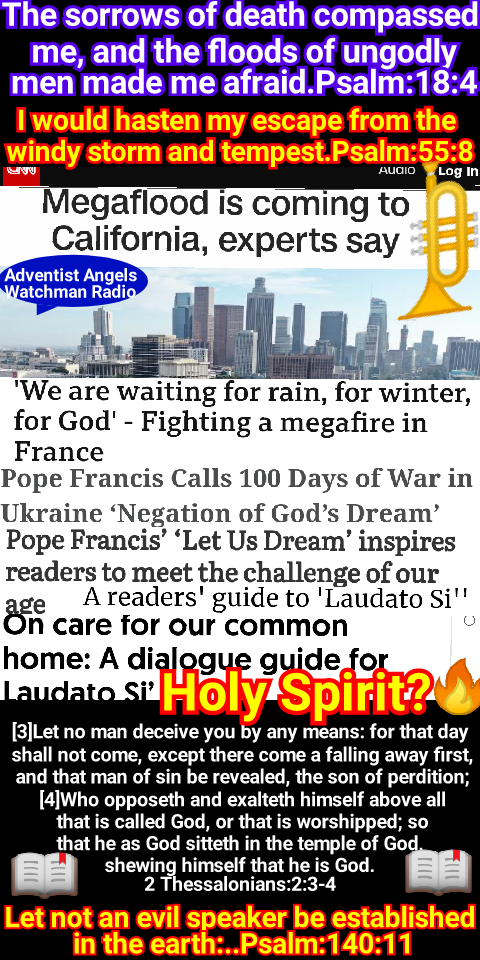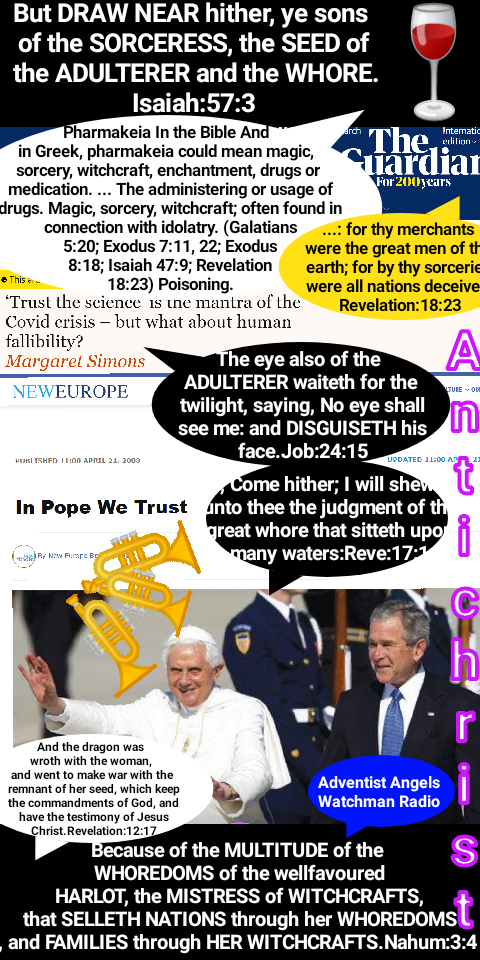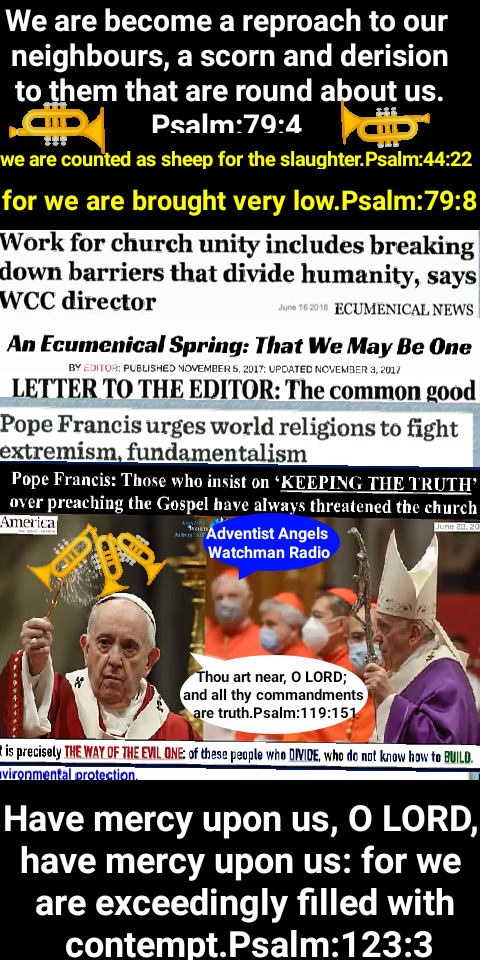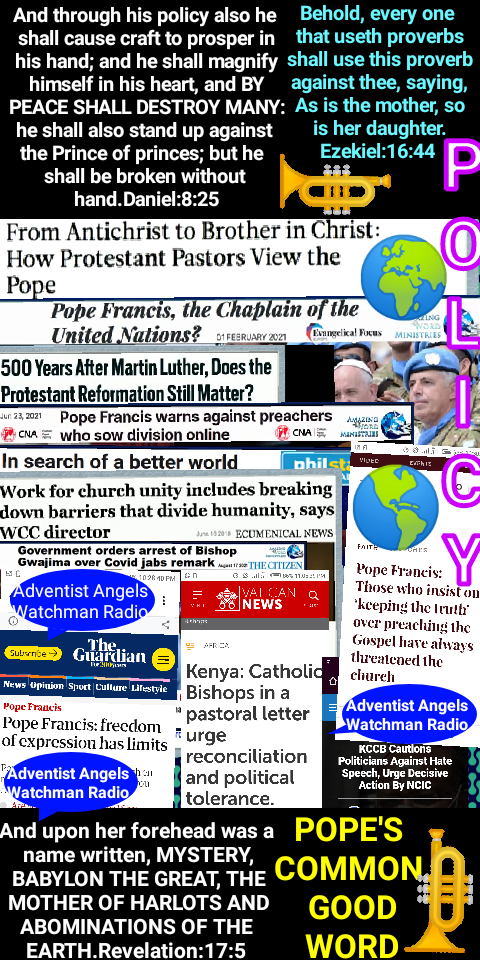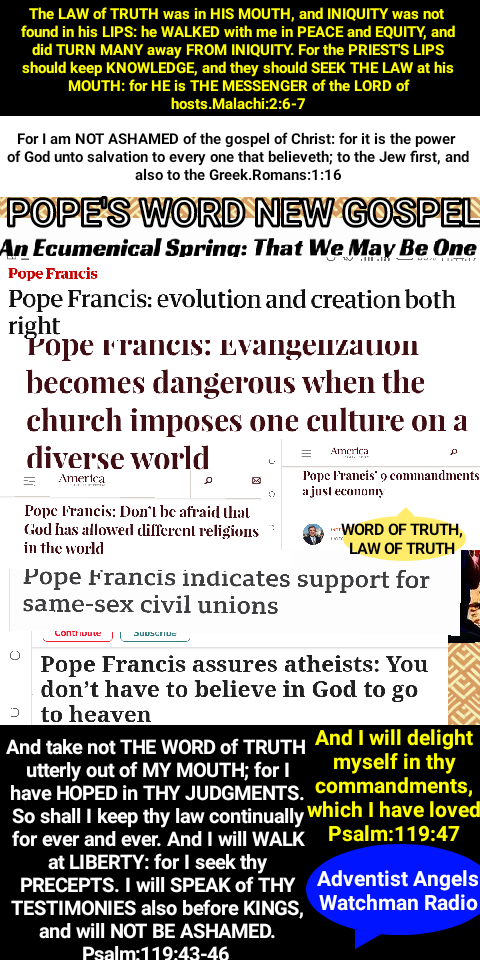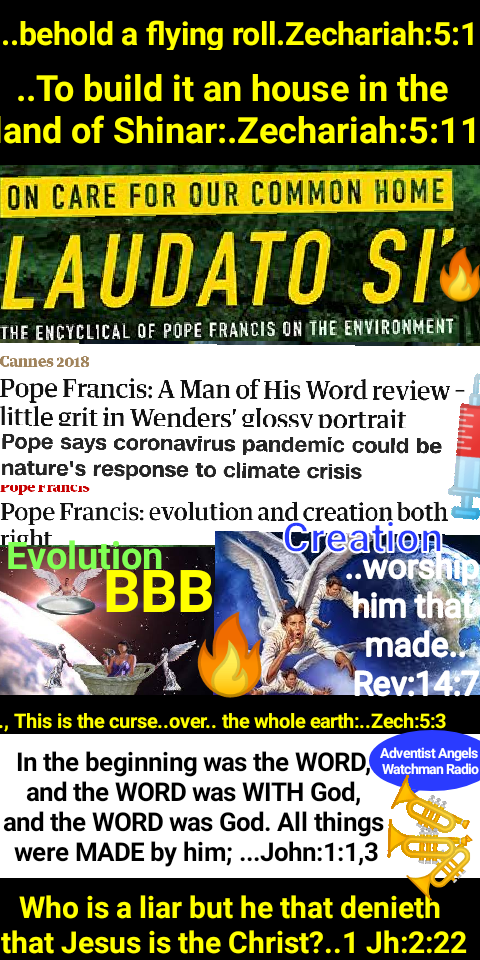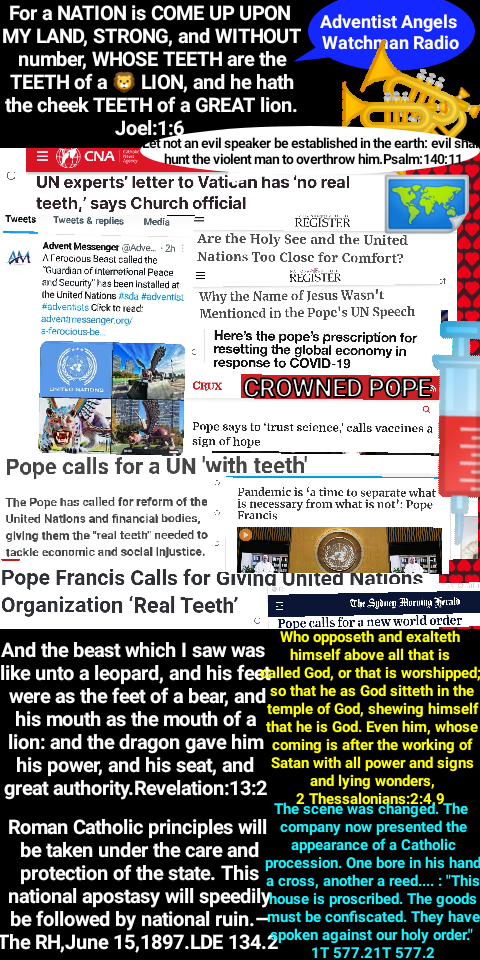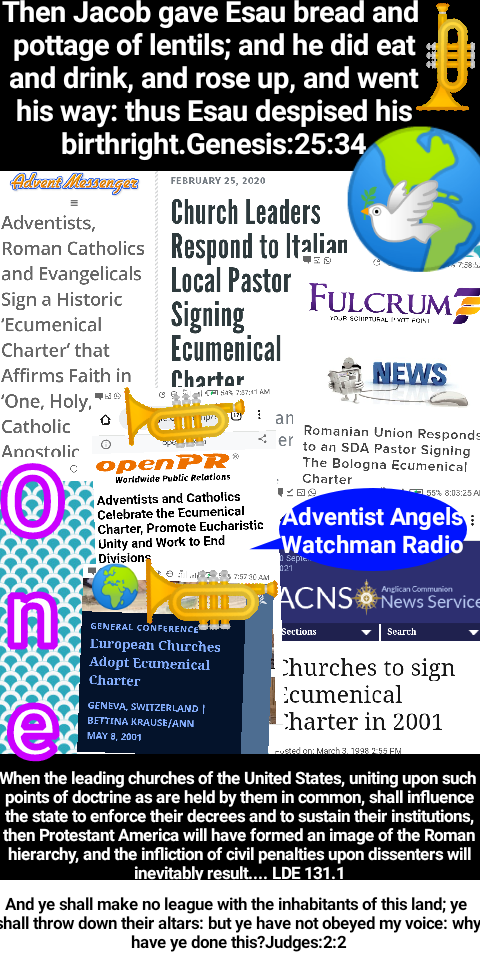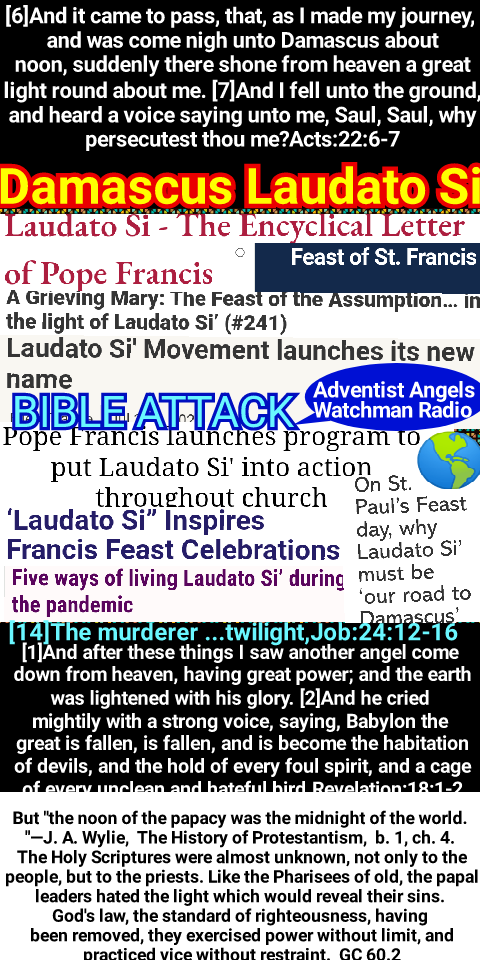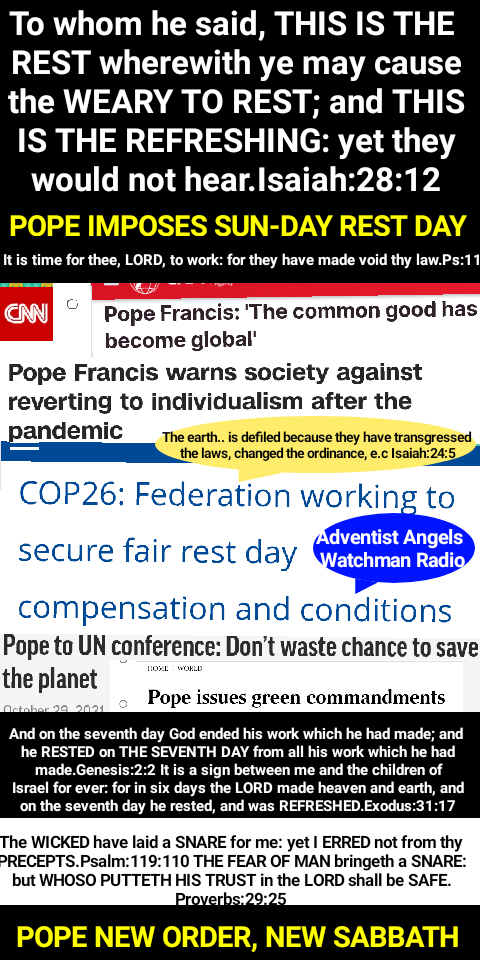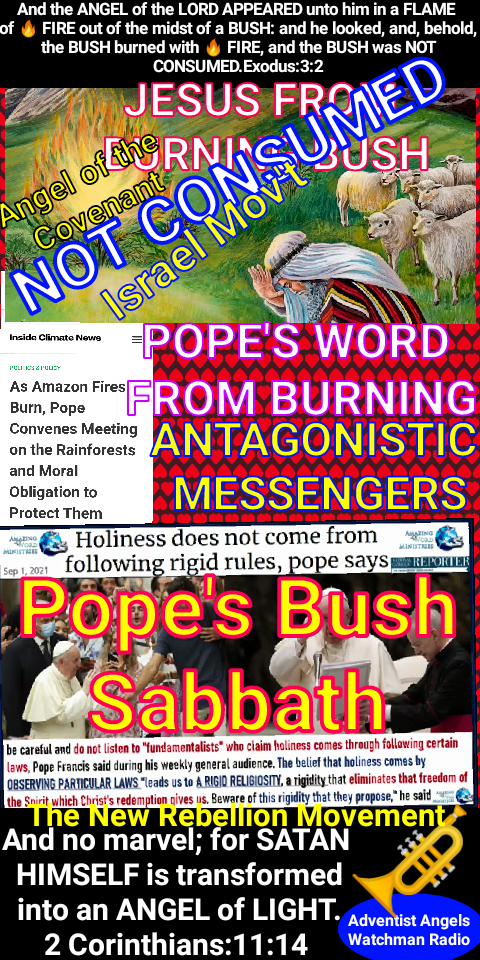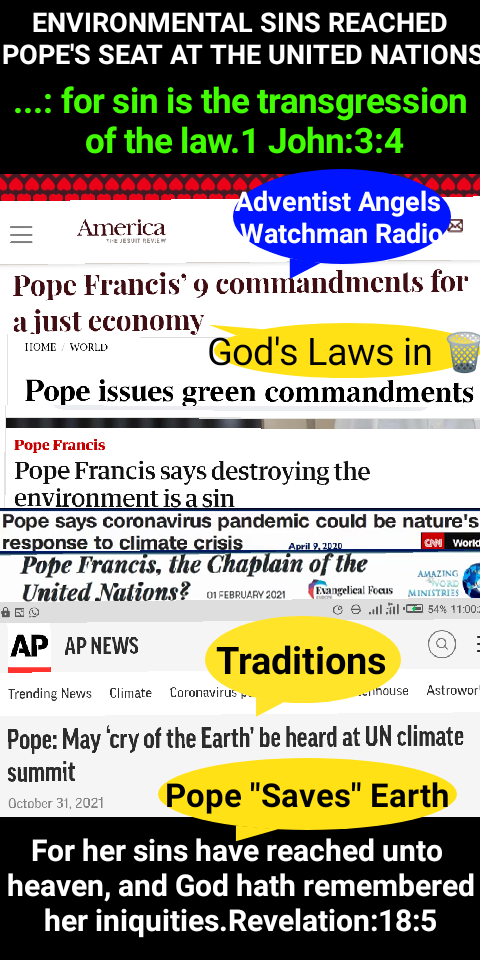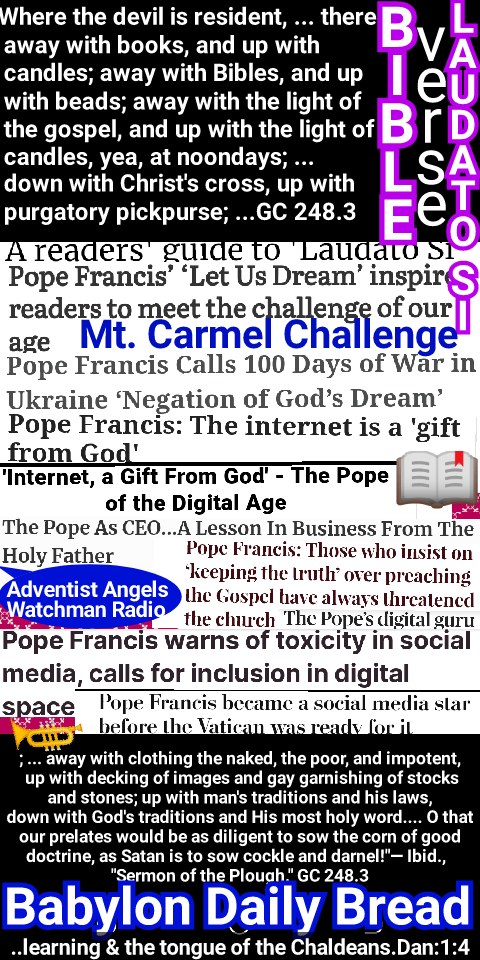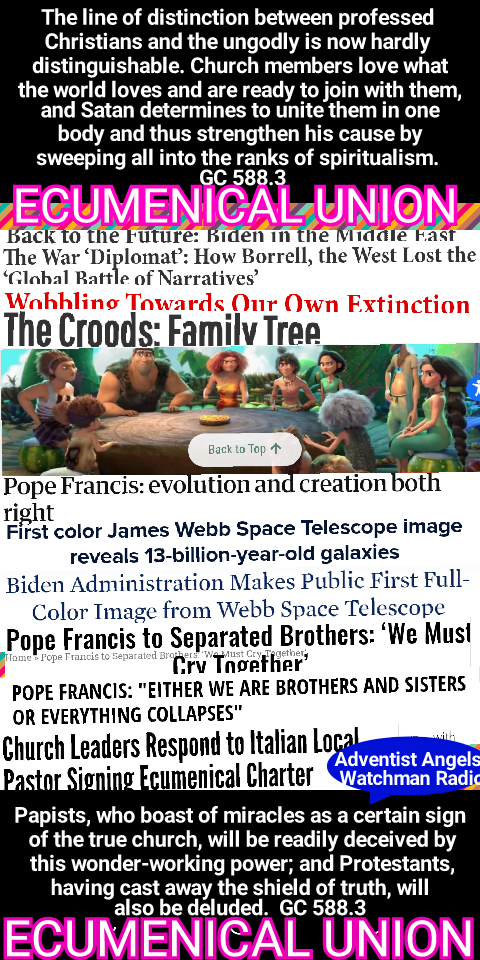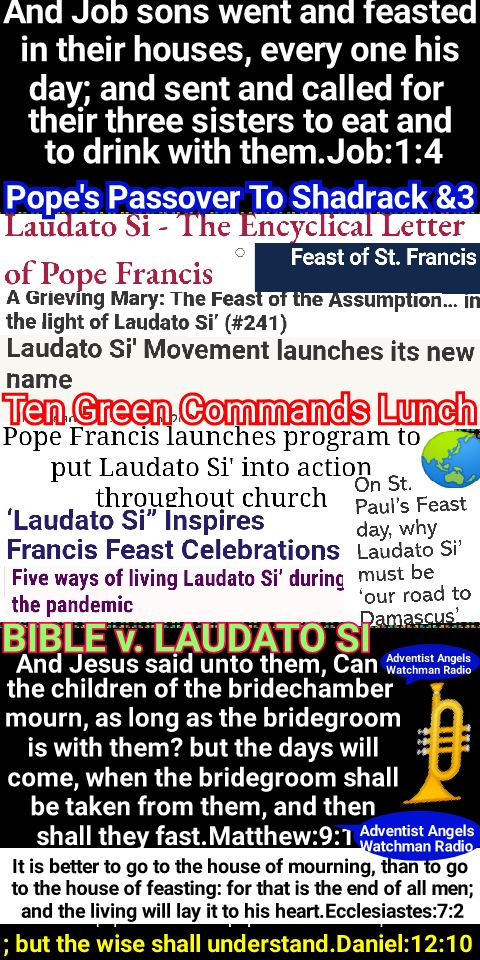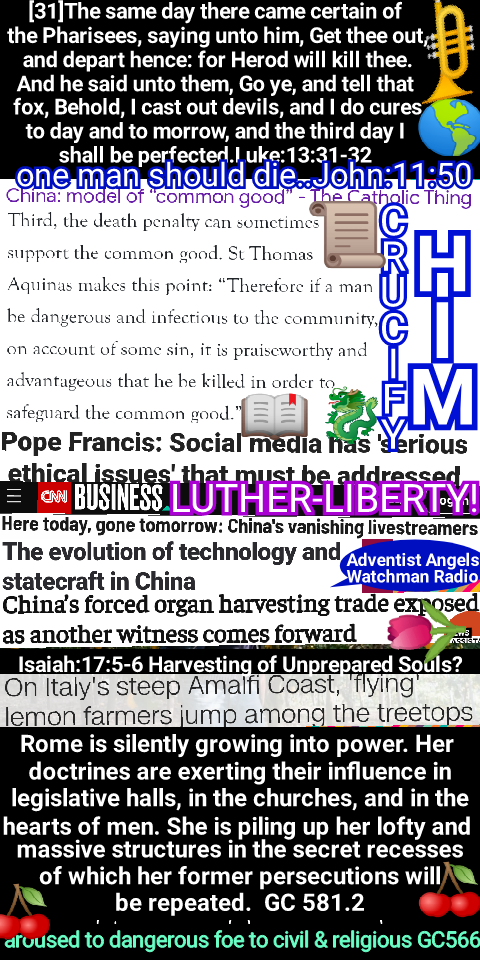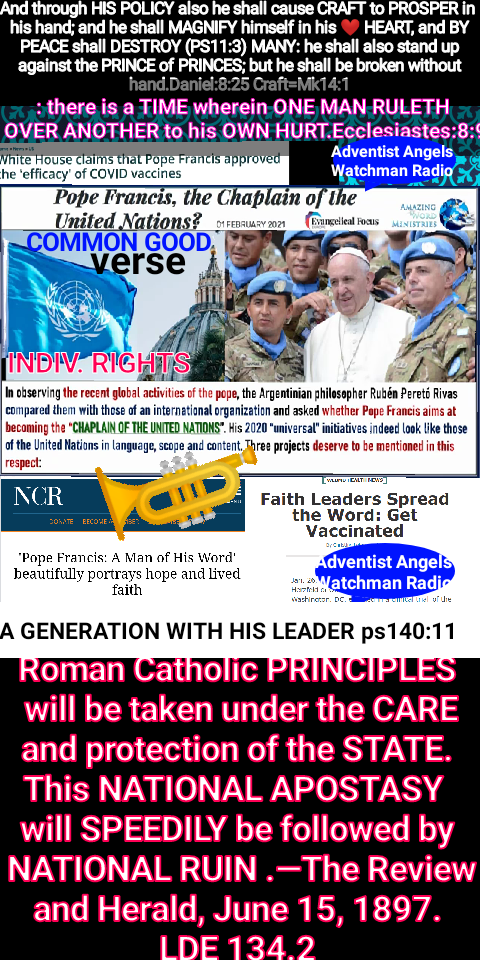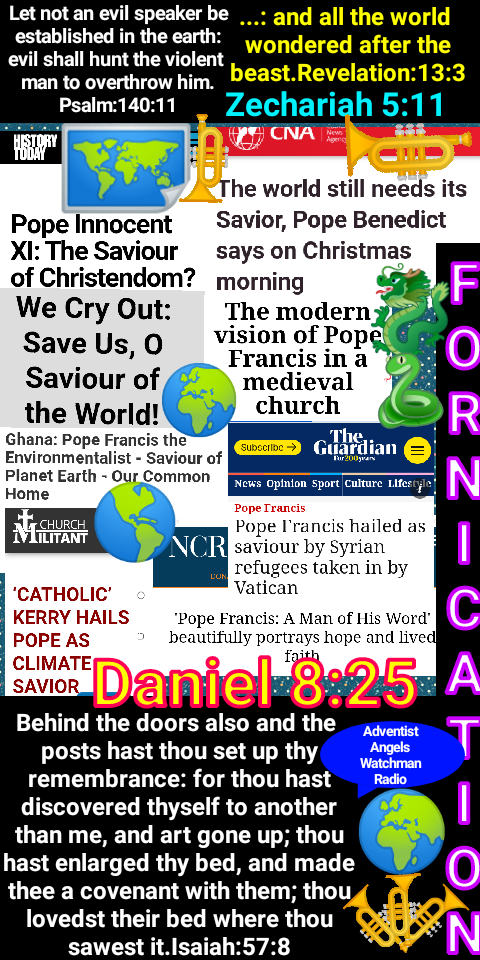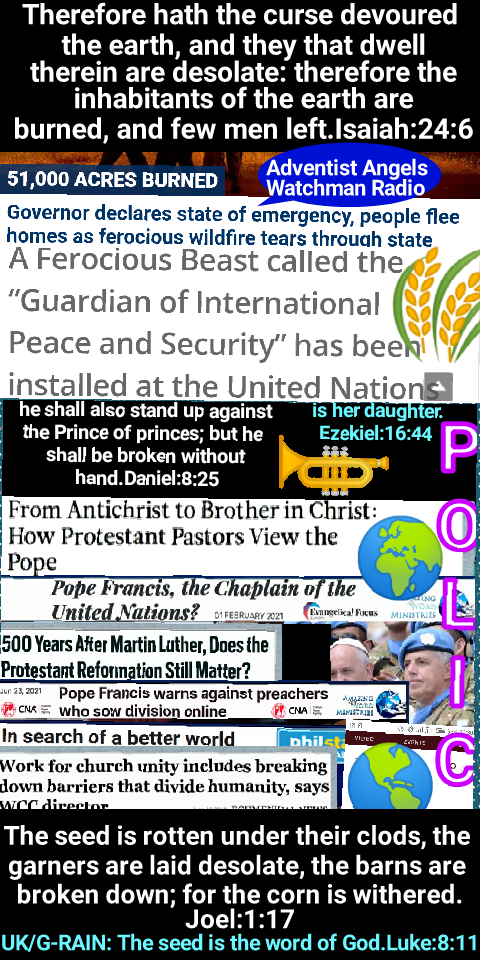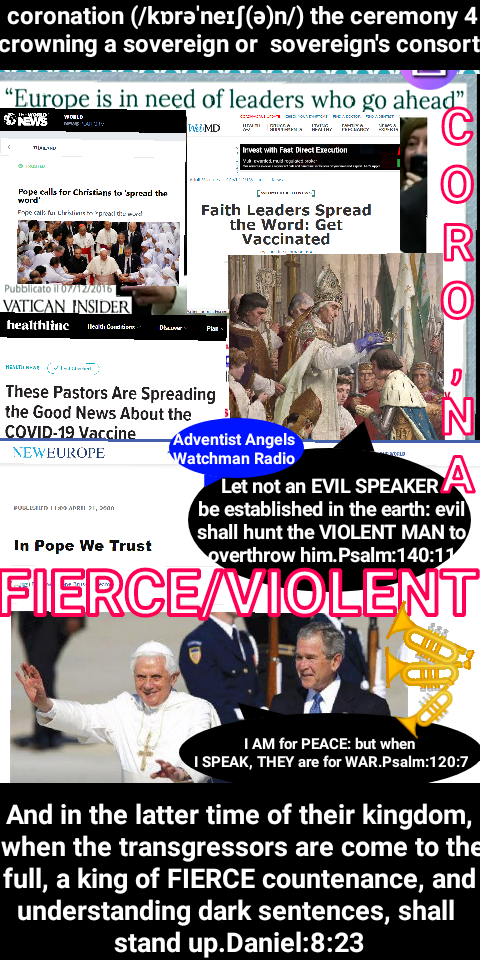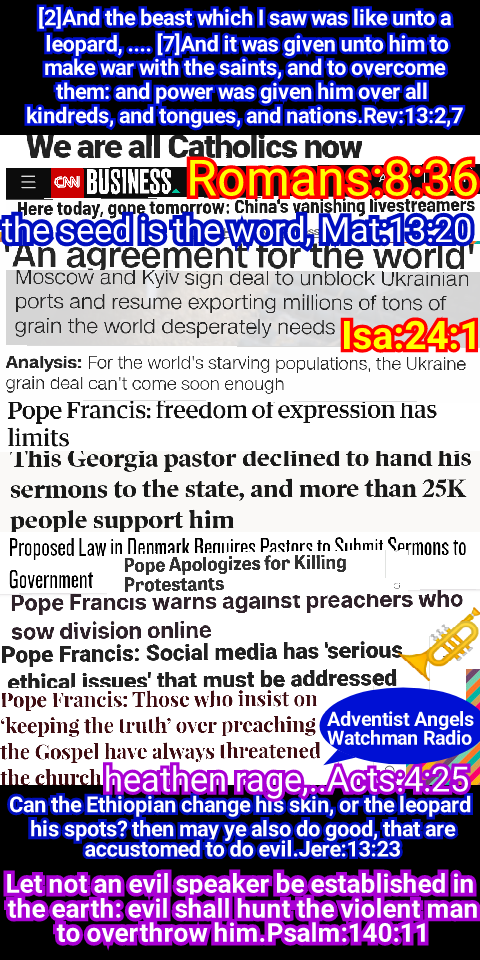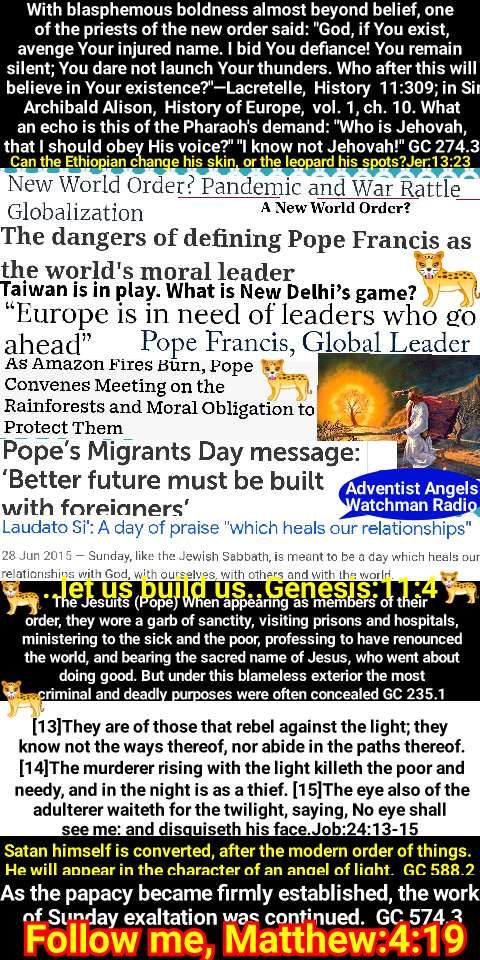

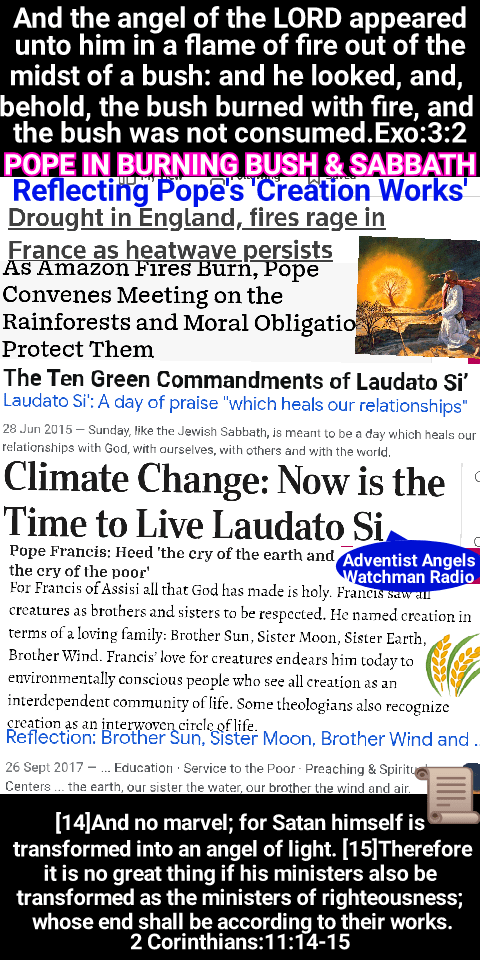
Worldlings and Churches Family Reflect Image and Face of Pope Francis On Burning Bush: The Ten Green Commandments Tablets of Laudato Si’ and Sabbath,

That they might set their hope in God, and not forget the works of God, but keep his commandments:Psalm:78:7

The temple of God was opened in heaven, and there was seen in His temple the ark of His testament.” Revelation 11:19. The ark of God’s testament is in the holy of holies, the second apartment of the sanctuary. In the ministration of the earthly tabernacle, which served “unto the example and shadow of heavenly things,” this apartment was opened only upon the great Day of Atonement for the cleansing of the sanctuary. Therefore the announcement that the temple of God was opened in heaven and the ark of His testament was seen points to the opening of the most holy place of the heavenly sanctuary in 1844 as Christ entered there to perform the closing work of the atonement. Those who by faith followed their great High Priest as He entered upon His ministry in the most holy place, beheld the ark of His testament. As they had studied the subject of the sanctuary they had come to understand the Saviour’s change of ministration, and they saw that He was now officiating before the ark of God, pleading His blood in behalf of sinners.
The ark in the tabernacle on earth contained the two tables of stone, upon which were inscribed the precepts of the law of God. The ark was merely a receptacle for the tables of the law, and the presence of these divine precepts gave to it its value and sacredness. When the temple of God was opened in heaven, the ark of His testament was seen. Within the holy of holies, in the sanctuary in heaven, the divine law is sacredly enshrined—the law that was spoken by God Himself amid the thunders of Sinai and written with His own finger on the tables of stone.
The law of God in the sanctuary in heaven is the great original, of which the precepts inscribed upon the tables of stone and recorded by Moses in the Pentateuch were an unerring transcript. Those who arrived at an understanding of this important point were thus led to see the sacred, unchanging character of the divine law. They saw, as never before, the force of the Saviour’s words: “Till heaven and earth pass, one jot or one tittle shall in no wise pass from the law.” Matthew 5:18. The law of God, being a revelation of His will, a transcript of His character, must forever endure, “as a faithful witness in heaven.” Not one command has been annulled; not a jot or tittle has been changed. Says the psalmist: “Forever, O Lord, Thy word is settled in heaven.” “All His commandments are sure. They stand fast for ever and ever.” Psalm 119:89; 111:7, 8.
In the very bosom of the Decalogue is the fourth commandment, as it was first proclaimed: “Remember the Sabbath day, to keep it holy. Six days shalt thou labor, and do all thy work: but the seventh day is the Sabbath of the Lord thy God: in it thou shalt not do any work, thou, nor thy son, nor thy daughter, thy manservant, nor thy maidservant, nor thy cattle, nor thy stranger that is within thy gates: for in six days the Lord made heaven and earth, the sea, and all that in them is, and rested the seventh day: wherefore the Lord blessed the Sabbath day, and hallowed it.” Exodus 20:8-11.
The Spirit of God impressed the hearts of those students of His word. The conviction was urged upon them that they had ignorantly transgressed this precept by disregarding the Creator’s rest day. They began to examine the reasons for observing the first day of the week instead of the day which God had sanctified. They could find no evidence in the Scriptures that the fourth commandment had been abolished, or that the Sabbath had been changed; the blessing which first hallowed the seventh day had never been removed. They had been honestly seeking to know and to do God’s will; now, as they saw themselves transgressors of His law, sorrow filled their hearts, and they manifested their loyalty to God by keeping His Sabbath holy.
Many and earnest were the efforts made to overthrow their faith. None could fail to see that if the earthly sanctuary was a figure or pattern of the heavenly, the law deposited in the ark on earth was an exact transcript of the law in the ark in heaven; and that an acceptance of the truth concerning the heavenly sanctuary involved an acknowledgment of the claims of God’s law and the obligation of the Sabbath of the fourth commandment. Here was the secret of the bitter and determined opposition to the harmonious exposition of the Scriptures that revealed the ministration of Christ in the heavenly sanctuary. Men sought to close the door which God had opened, and to open the door which He had closed. But “He that openeth, and no man shutteth; and shutteth, and no man openeth,” had declared: “Behold, I have set before thee an open door, and no man can shut it.” Revelation 3:7, 8. Christ had opened the door, or ministration, of the most holy place, light was shining from that open door of the sanctuary in heaven, and the fourth commandment was shown to be included in the law which is there enshrined; what God had established, no man could overthrow.
Those who had accepted the light concerning the mediation of Christ and the perpetuity of the law of God found that these were the truths presented in Revelation 14. The messages of this chapter constitute a threefold warning (see Appendix) which is to prepare the inhabitants of the earth for the Lord’s second coming. The announcement, “The hour of His judgment is come,” points to the closing work of Christ’s ministration for the salvation of men. It heralds a truth which must be proclaimed until the Saviour’s intercession shall cease and He shall return to the earth to take His people to Himself. The work of judgment which began in 1844 must continue until the cases of all are decided, both of the living and the dead; hence it will extend to the close of human probation. That men may be prepared to stand in the judgment, the message commands them to “fear God, and give glory to Him,” “and worship Him that made heaven, and earth, and the sea, and the fountains of waters.” The result of an acceptance of these messages is given in the word: “Here are they that keep the commandments of God, and the faith of Jesus.” In order to be prepared for the judgment, it is necessary that men should keep the law of God. That law will be the standard of character in the judgment. The apostle Paul declares: “As many as have sinned in the law shall be judged by the law, … in the day when God shall judge the secrets of men by Jesus Christ.” And he says that “the doers of the law shall be justified.” Romans 2:12-16. Faith is essential in order to the keeping of the law of God; for “without faith it is impossible to please Him.” And “whatsoever is not of faith is sin.” Hebrews 11:6; Romans 14:23.
By the first angel, men are called upon to “fear God, and give glory to Him” and to worship Him as the Creator of the heavens and the earth. In order to do this, they must obey His law. Says the wise man: “Fear God, and keep His commandments: for this is the whole duty of man.” Ecclesiastes 12:13. Without obedience to His commandments no worship can be pleasing to God. “This is the love of God, that we keep His commandments.” “He that turneth away his ear from hearing the law, even his prayer shall be abomination.” 1 John 5:3; Proverbs 28:9.
The duty to worship God is based upon the fact that He is the Creator and that to Him all other beings owe their existence. And wherever, in the Bible, His claim to reverence and worship, above the gods of the heathen, is presented, there is cited the evidence of His creative power. “All the gods of the nations are idols: but the Lord made the heavens.” Psalm 96:5. “To whom then will ye liken Me, or shall I be equal? saith the Holy One. Lift up your eyes on high, and behold who hath created these things.” “Thus saith the Lord that created the heavens; God Himself that formed the earth and made it: … I am the Lord; and there is none else.” Isaiah 40:25, 26; 45:18. Says the psalmist: “Know ye that the Lord He is God: it is He that hath made us, and not we ourselves.” “O come, let us worship and bow down: let us kneel before the Lord our Maker.” Psalm 100:3; 95:6. And the holy beings who worship God in heaven state, as the reason why their homage is due to Him: “Thou art worthy, O Lord, to receive glory and honor and power: for Thou hast created all things.” Revelation 4:11.
In Revelation 14, men are called upon to worship the Creator; and the prophecy brings to view a class that, as the result of the threefold message, are keeping the commandments of God. One of these commandments points directly to God as the Creator. The fourth precept declares: “The seventh day is the Sabbath of the Lord thy God: … for in six days the Lord made heaven and earth, the sea, and all that in them is, and rested the seventh day: wherefore the Lord blessed the Sabbath day, and hallowed it.” Exodus 20:10, 11. Concerning the Sabbath, the Lord says, further, that it is “a sign, … that ye may know that I am the Lord your God.” Ezekiel 20:20. And the reason given is: “For in six days the Lord made heaven and earth, and on the seventh day He rested, and was refreshed.” Exodus 31:17.
“The importance of the Sabbath as the memorial of creation is that it keeps ever present the true reason why worship is due to God”—because He is the Creator, and we are His creatures. “The Sabbath therefore lies at the very foundation of divine worship, for it teaches this great truth in the most impressive manner, and no other institution does this. The true ground of divine worship, not of that on the seventh day merely, but of all worship, is found in the distinction between the Creator and His creatures. This great fact can never become obsolete, and must never be forgotten.”—J. N. Andrews, History of the Sabbath, chapter 27. It was to keep this truth ever before the minds of men, that God instituted the Sabbath in Eden; and so long as the fact that He is our Creator continues to be a reason why we should worship Him, so long the Sabbath will continue as its sign and memorial. Had the Sabbath been universally kept, man’s thoughts and affections would have been led to the Creator as the object of reverence and worship, and there would never have been an idolater, an atheist, or an infidel. The keeping of the Sabbath is a sign of loyalty to the true God, “Him that made heaven, and earth, and the sea, and the fountains of waters.” It follows that the message which commands men to worship God and keep His commandments will especially call upon them to keep the fourth commandment.
In contrast to those who keep the commandments of God and have the faith of Jesus, the third angel points to another class, against whose errors a solemn and fearful warning is uttered: “If any man worship the beast and his image, and receive his mark in his forehead, or in his hand, the same shall drink of the wine of the wrath of God.” Revelation 14:9, 10. A correct interpretation of the symbols employed is necessary to an understanding of this message. What is represented by the beast, the image, the mark?
The line of prophecy in which these symbols are found begins with Revelation 12, with the dragon that sought to destroy Christ at His birth. The dragon is said to be Satan (Revelation 12:9); he it was that moved upon Herod to put the Saviour to death. But the chief agent of Satan in making war upon Christ and His people during the first centuries of the Christian Era was the Roman Empire, in which paganism was the prevailing religion. Thus while the dragon, primarily, represents Satan, it is, in a secondary sense, a symbol of pagan Rome.
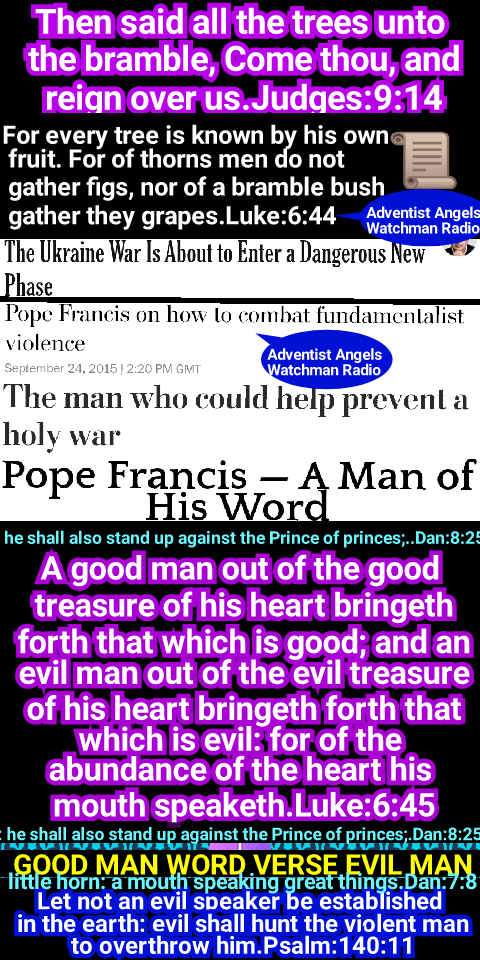
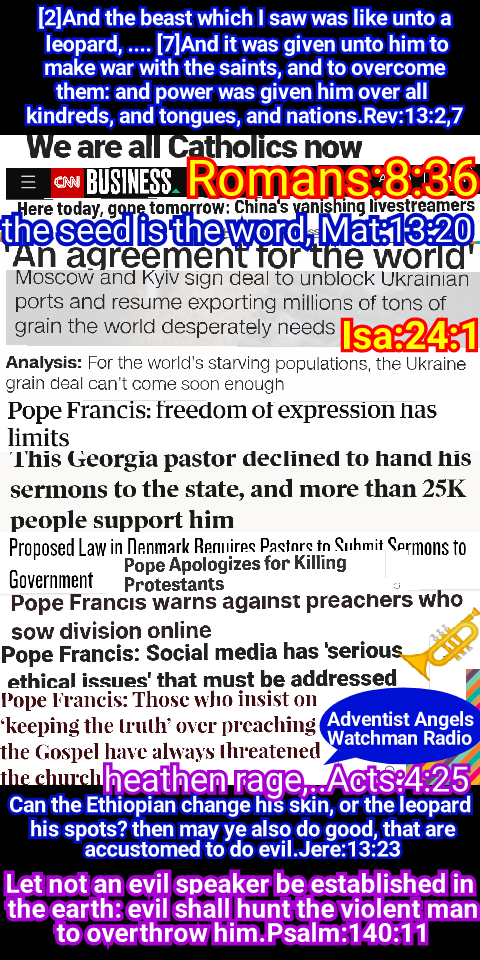
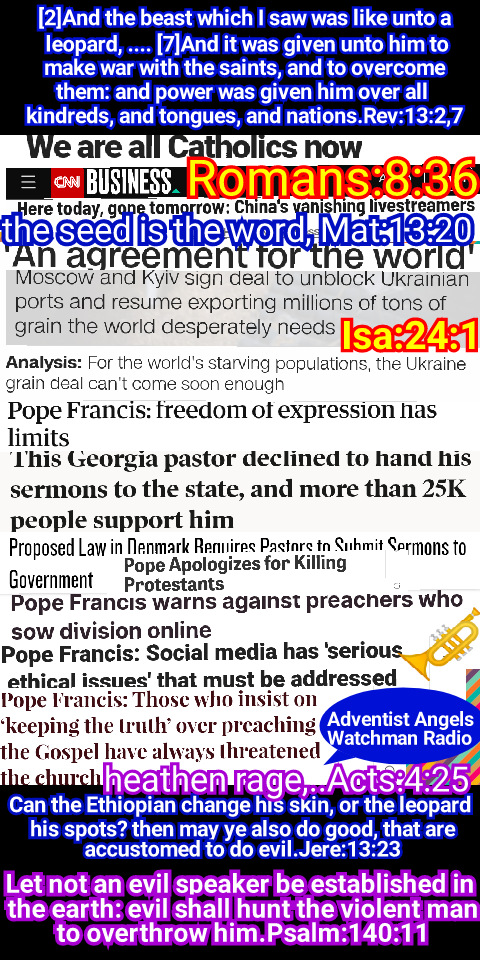
In chapter 13 (verses 1-10) is described another beast, “like unto a leopard,” to which the dragon gave “his power, and his seat, and great authority.” This symbol, as most Protestants have believed, represents the papacy, which succeeded to the power and seat and authority once held by the ancient Roman empire. Of the leopardlike beast it is declared: “There was given unto him a mouth speaking great things and blasphemies…. And he opened his mouth in blasphemy against God, to blaspheme His name, and His tabernacle, and them that dwell in heaven. And it was given unto him to make war with the saints, and to overcome them: and power was given him over all kindreds, and tongues, and nations.” This prophecy, which is nearly identical with the description of the little horn of Daniel 7, unquestionably points to the papacy.
“Power was given unto him to continue forty and two months.” And, says the prophet, “I saw one of his heads as it were wounded to death.” And again: “He that leadeth into captivity shall go into captivity: he that killeth with the sword must be killed with the sword.” The forty and two months are the same as the “time and times and the dividing of time,” three years and a half, or 1260 days, of Daniel 7—the time during which the papal power was to oppress God’s people. This period, as stated in preceding chapters, began with the supremacy of the papacy, A.D. 538, and terminated in 1798. At that time the pope was made captive by the French army, the papal power received its deadly wound, and the prediction was fulfilled, “He that leadeth into captivity shall go into captivity.”
At this point another symbol is introduced. Says the prophet: “I beheld another beast coming up out of the earth; and he had two horns like a lamb.” Verse 11. Both the appearance of this beast and the manner of its rise indicate that the nation which it represents is unlike those presented under the preceding symbols. The great kingdoms that have ruled the world were presented to the prophet Daniel as beasts of prey, rising when “the four winds of the heaven strove upon the great sea.” Daniel 7:2. In Revelation 17 an angel explained that waters represent “peoples, and multitudes, and nations, and tongues.” Revelation 17:15. Winds are a symbol of strife. The four winds of heaven striving upon the great sea represent the terrible scenes of conquest and revolution by which kingdoms have attained to power.
But the beast with lamblike horns was seen “coming up out of the earth.” Instead of overthrowing other powers to establish itself, the nation thus represented must arise in territory previously unoccupied and grow up gradually and peacefully. It could not, then, arise among the crowded and struggling nationalities of the Old World—that turbulent sea of “peoples, and multitudes, and nations, and tongues.” It must be sought in the Western Continent.
What nation of the New World was in 1798 rising into power, giving promise of strength and greatness, and attracting the attention of the world? The application of the symbol admits of no question. One nation, and only one, meets the specifications of this prophecy; it points unmistakably to the United States of America. Again and again the thought, almost the exact words, of the sacred writer has been unconsciously employed by the orator and the historian in describing the rise and growth of this nation. The beast was seen “coming up out of the earth;” and, according to the translators, the word here rendered “coming up” literally signifies “to grow or spring up as a plant.” And, as we have seen, the nation must arise in territory previously unoccupied. A prominent writer, describing the rise of the United States, speaks of “the mystery of her coming forth from vacancy,” and says: “Like a silent seed we grew into empire.”—G. A. Townsend, The New World Compared With the Old, page 462. A European journal in 1850 spoke of the United States as a wonderful empire, which was “emerging,” and ” amid the silence of the earth daily adding to its power and pride.”—The Dublin Nation . Edward Everett, in an oration on the Pilgrim founders of this nation, said: “Did they look for a retired spot, inoffensive for its obscurity, and safe in its remoteness, where the little church of Leyden might enjoy the freedom of conscience? Behold the mighty regions over which, in peaceful conquest, … they have borne the banners of the cross!”—Speech delivered at Plymouth, Massachusetts, Dec. 22, 1824, page 11.
“And he had two horns like a lamb.” The lamblike horns indicate youth, innocence, and gentleness, fitly representing the character of the United States when presented to the prophet as “coming up” in 1798. Among the Christian exiles who first fled to America and sought an asylum from royal oppression and priestly intolerance were many who determined to establish a government upon the broad foundation of civil and religious liberty. Their views found place in the Declaration of Independence, which sets forth the great truth that “all men are created equal” and endowed with the inalienable right to “life, liberty, and the pursuit of happiness.” And the Constitution guarantees to the people the right of self-government, providing that representatives elected by the popular vote shall enact and administer the laws. Freedom of religious faith was also granted, every man being permitted to worship God according to the dictates of his conscience. Republicanism and Protestantism became the fundamental principles of the nation. These principles are the secret of its power and prosperity. The oppressed and downtrodden throughout Christendom have turned to this land with interest and hope. Millions have sought its shores, and the United States has risen to a place among the most powerful nations of the earth.
But the beast with lamblike horns “spake as a dragon. And he exerciseth all the power of the first beast before him, and causeth the earth and them which dwell therein to worship the first beast, whose deadly wound was healed; … saying to them that dwell on the earth, that they should make an image to the beast, which had the wound by a sword, and did live.” Revelation 13:11-14.
The lamblike horns and dragon voice of the symbol point to a striking contradiction between the professions and the practice of the nation thus represented. The “speaking” of the nation is the action of its legislative and judicial authorities. By such action it will give the lie to those liberal and peaceful principles which it has put forth as the foundation of its policy. The prediction that it will speak “as a dragon” and exercise “all the power of the first beast” plainly foretells a development of the spirit of intolerance and persecution that was manifested by the nations represented by the dragon and the leopardlike beast. And the statement that the beast with two horns “causeth the earth and them which dwell therein to worship the first beast” indicates that the authority of this nation is to be exercised in enforcing some observance which shall be an act of homage to the papacy.
Such action would be directly contrary to the principles of this government, to the genius of its free institutions, to the direct and solemn avowals of the Declaration of Independence, and to the Constitution. The founders of the nation wisely sought to guard against the employment of secular power on the part of the church, with its inevitable result—intolerance and persecution. The Constitution provides that “Congress shall make no law respecting an establishment of religion, or prohibiting the free exercise thereof,” and that “no religious test shall ever be required as a qualification to any office or public trust under the United States.” Only in flagrant violation of these safeguards to the nation’s liberty, can any religious observance be enforced by civil authority. But the inconsistency of such action is no greater than is represented in the symbol. It is the beast with lamblike horns—in profession pure, gentle, and harmless—that speaks as a dragon.
“Saying to them that dwell on the earth, that they should make an image to the beast.” Here is clearly presented a form of government in which the legislative power rests with the people, a most striking evidence that the United States is the nation denoted in the prophecy.
But what is the “image to the beast”? and how is it to be formed? The image is made by the two-horned beast, and is an image to the beast. It is also called an image of the beast. Then to learn what the image is like and how it is to be formed we must study the characteristics of the beast itself—the papacy.
When the early church became corrupted by departing from the simplicity of the gospel and accepting heathen rites and customs, she lost the Spirit and power of God; and in order to control the consciences of the people, she sought the support of the secular power. The result was the papacy, a church that controlled the power of the state and employed it to further her own ends, especially for the punishment of “heresy.” In order for the United States to form an image of the beast, the religious power must so control the civil government that the authority of the state will also be employed by the church to accomplish her own ends.
Whenever the church has obtained secular power, she has employed it to punish dissent from her doctrines. Protestant churches that have followed in the steps of Rome by forming alliance with worldly powers have manifested a similar desire to restrict liberty of conscience. An example of this is given in the long-continued persecution of dissenters by the Church of England. During the sixteenth and seventeenth centuries, thousands of nonconformist ministers were forced to flee from their churches, and many, both of pastors and people, were subjected to fine, imprisonment, torture, and martyrdom.
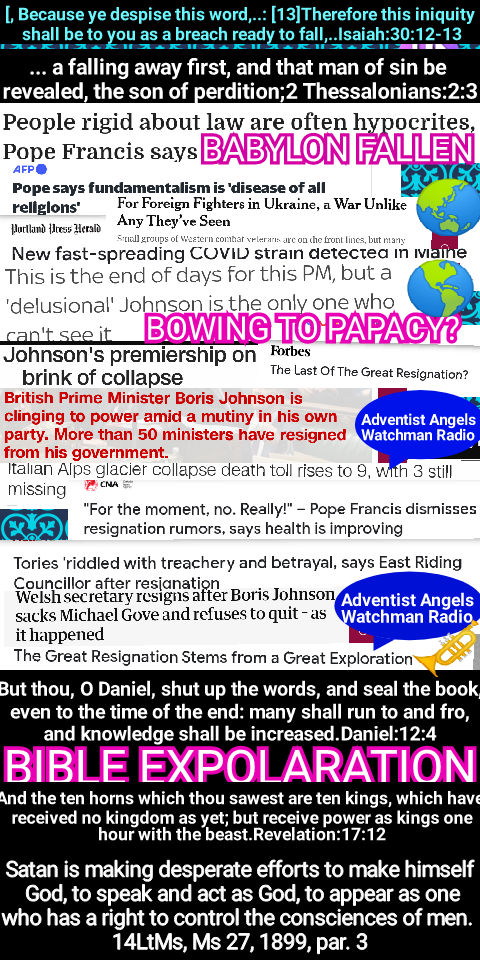
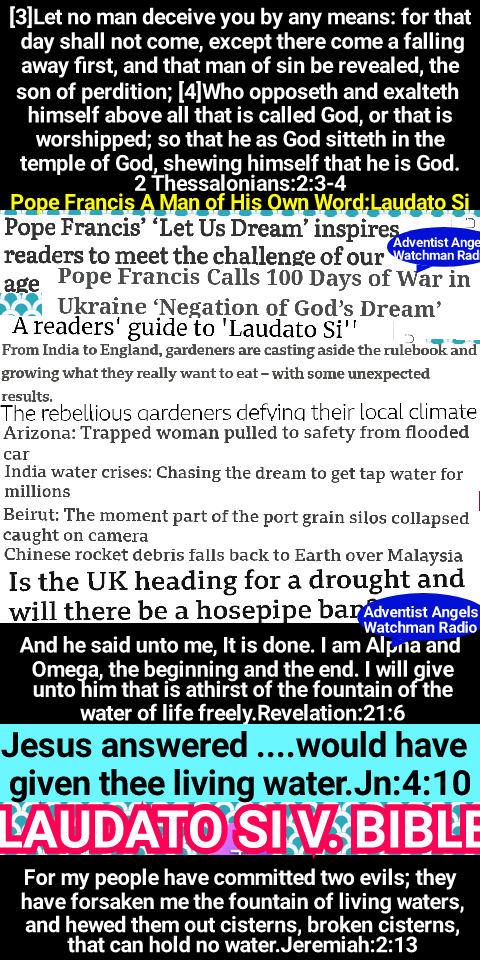
It was apostasy that led the early church to seek the aid of the civil government, and this prepared the way for the development of the papacy—the beast. Said Paul: “There” shall “come a falling away, … and that man of sin be revealed.” 2 Thessalonians 2:3. So apostasy in the church will prepare the way for the image to the beast.
The Bible declares that before the coming of the Lord there will exist a state of religious declension similar to that in the first centuries. “In the last days perilous times shall come. For men shall be lovers of their own selves, covetous, boasters, proud, blasphemers, disobedient to parents, unthankful, unholy, without natural affection, trucebreakers, false accusers, incontinent, fierce, despisers of those that are good, traitors, heady, high-minded, lovers of pleasures more than lovers of God; having a form of godliness, but denying the power thereof.” 2 Timothy 3:1-5. “Now the Spirit speaketh expressly, that in the latter times some shall depart from the faith, giving heed to seducing spirits, and doctrines of devils.” 1 Timothy 4:1. Satan will work “with all power and signs and lying wonders, and with all deceivableness of unrighteousness.” And all that “received not the love of the truth, that they might be saved,” will be left to accept “strong delusion, that they should believe a lie.” 2 Thessalonians 2:9-11. When this state of ungodliness shall be reached, the same results will follow as in the first centuries.
The wide diversity of belief in the Protestant churches is regarded by many as decisive proof that no effort to secure a forced uniformity can ever be made. But there has been for years, in churches of the Protestant faith, a strong and growing sentiment in favor of a union based upon common points of doctrine. To secure such a union, the discussion of subjects upon which all were not agreed—however important they might be from a Bible standpoint—must necessarily be waived.
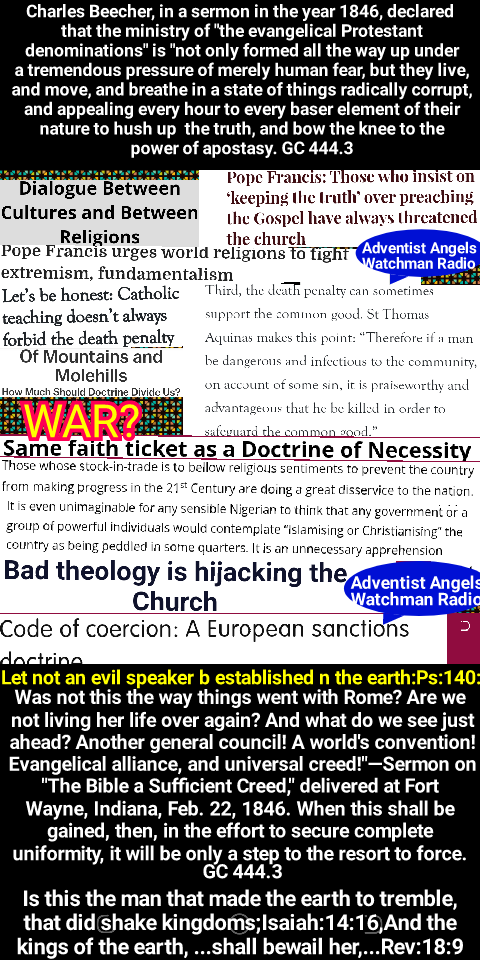
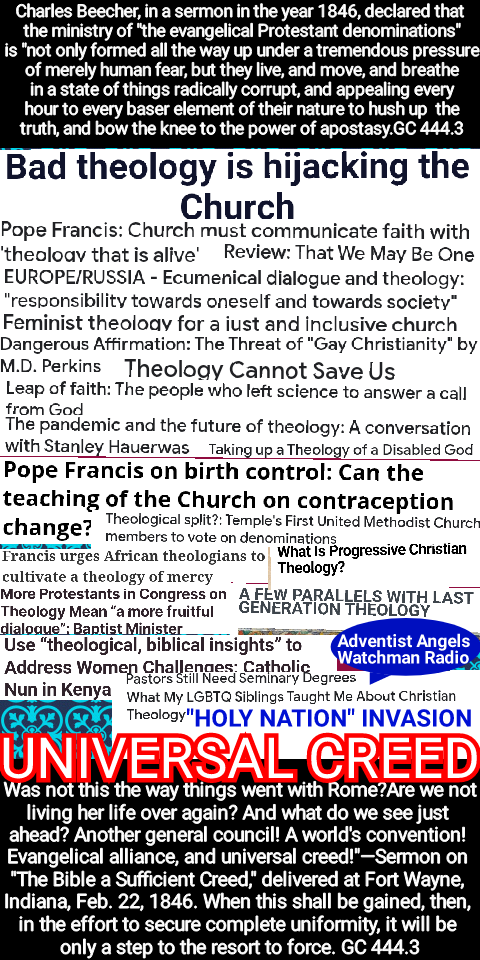
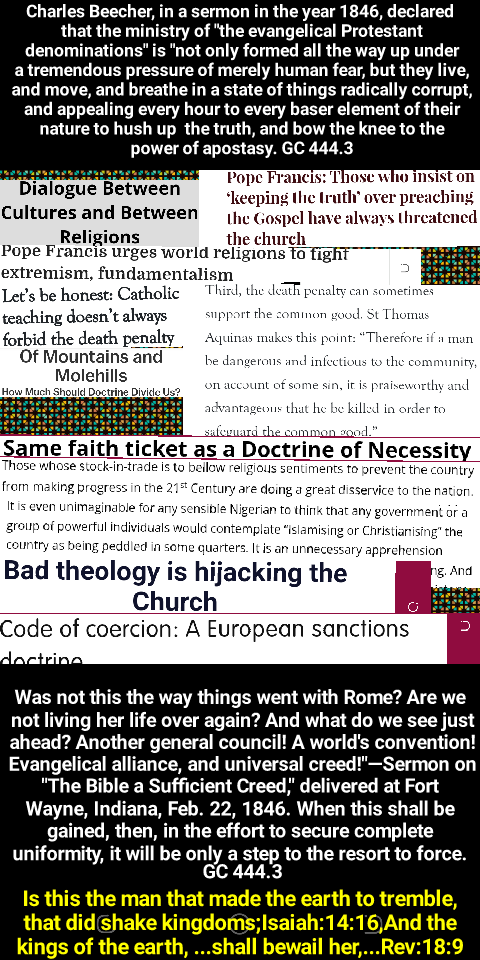
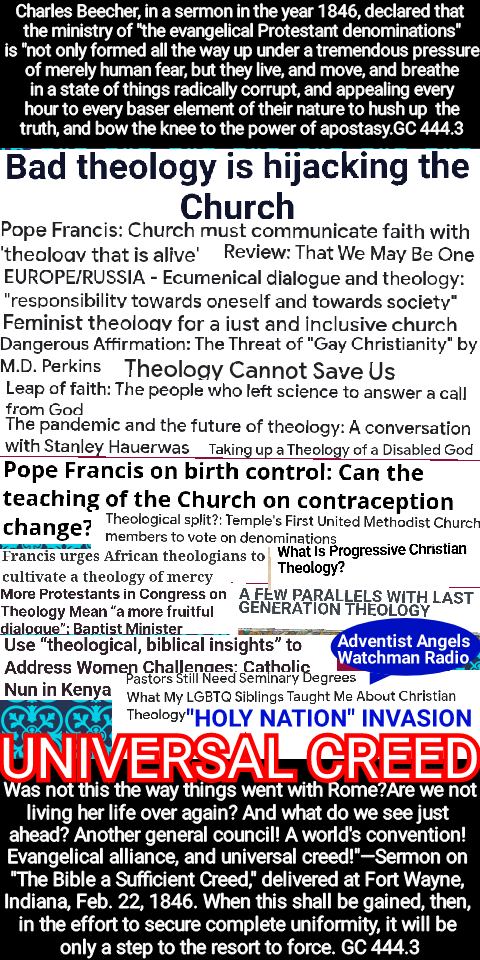
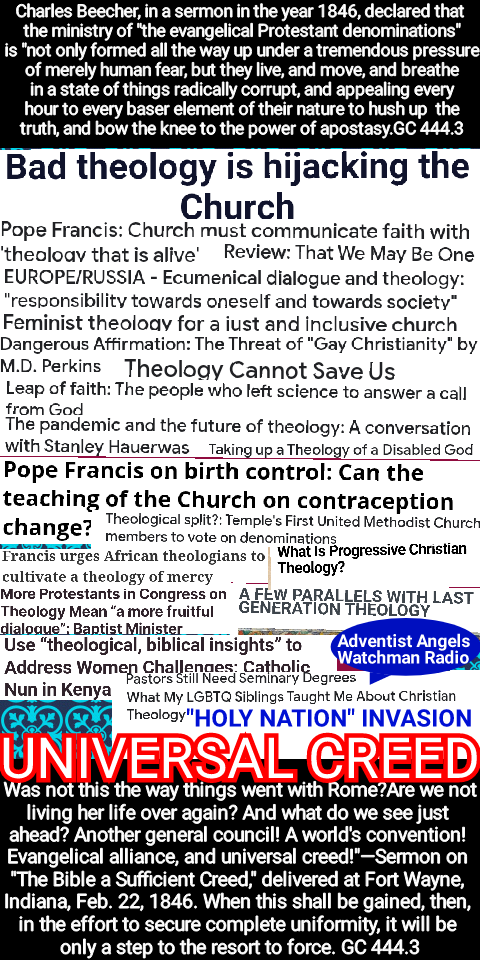
Charles Beecher, in a sermon in the year 1846, declared that the ministry of “the evangelical Protestant denominations” is “not only formed all the way up under a tremendous pressure of merely human fear, but they live, and move, and breathe in a state of things radically corrupt, and appealing every hour to every baser element of their nature to hush up the truth, and bow the knee to the power of apostasy. Was not this the way things went with Rome? Are we not living her life over again? And what do we see just ahead? Another general council! A world’s convention! Evangelical alliance, and universal creed!”—Sermon on “The Bible a Sufficient Creed,” delivered at Fort Wayne, Indiana, Feb. 22, 1846. When this shall be gained, then, in the effort to secure complete uniformity, it will be only a step to the resort to force.
When the leading churches of the United States, uniting upon such points of doctrine as are held by them in common, shall influence the state to enforce their decrees and to sustain their institutions, then Protestant America will have formed an image of the Roman hierarchy, and the infliction of civil penalties upon dissenters will inevitably result.
The beast with two horns “causeth commands all, both small and great, rich and poor, free and bond, to receive a mark in their right hand, or in their foreheads: and that no man might buy or sell, save he that had the mark, or the name of the beast, or the number of his name.” Revelation 13:16, 17. The third angel’s warning is: “If any man worship the beast and his image, and receive his mark in his forehead, or in his hand, the same shall drink of the wine of the wrath of God.” “The beast” mentioned in this message, whose worship is enforced by the two-horned beast, is the first, or leopardlike beast of Revelation 13—the papacy. The “image to the beast” represents that form of apostate Protestantism which will be developed when the Protestant churches shall seek the aid of the civil power for the enforcement of their dogmas. The “mark of the beast” still remains to be defined.
After the warning against the worship of the beast and his image the prophecy declares: “Here are they that keep the commandments of God, and the faith of Jesus.” Since those who keep God’s commandments are thus placed in contrast with those that worship the beast and his image and receive his mark, it follows that the keeping of God’s law, on the one hand, and its violation, on the other, will make the distinction between the worshipers of God and the worshipers of the beast.
The special characteristic of the beast, and therefore of his image, is the breaking of God’s commandments. Says Daniel, of the little horn, the papacy: “He shall think to change times and the law.” Daniel 7:25, R.V. And Paul styled the same power the “man of sin,” who was to exalt himself above God. One prophecy is a complement of the other. Only by changing God’s law could the papacy exalt itself above God; whoever should understandingly keep the law as thus changed would be giving supreme honor to that power by which the change was made. Such an act of obedience to papal laws would be a mark of allegiance to the pope in the place of God.
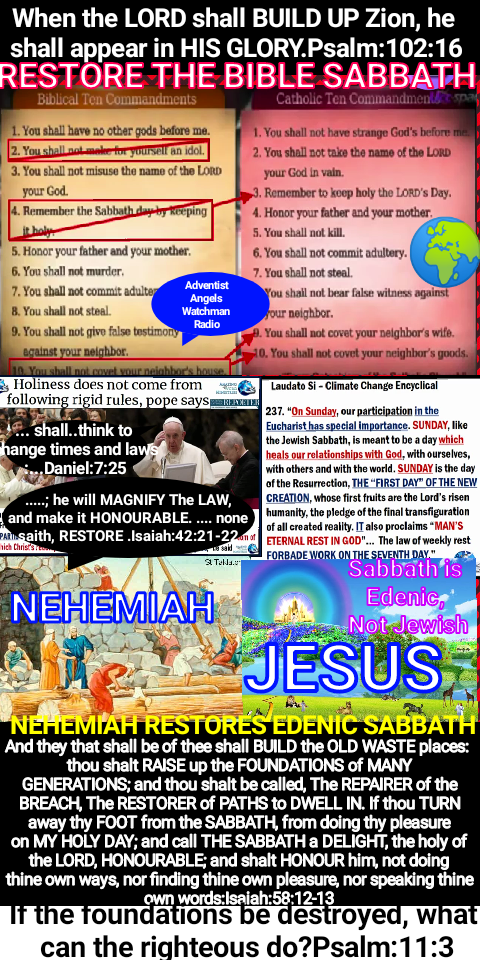
The papacy has attempted to change the law of God. The second commandment, forbidding image worship, has been dropped from the law, and the fourth commandment has been so changed as to authorize the observance of the first instead of the seventh day as the Sabbath. But papists urge, as a reason for omitting the second commandment, that it is unnecessary, being included in the first, and that they are giving the law exactly as God designed it to be understood. This cannot be the change foretold by the prophet. An intentional, deliberate change is presented: “He shall think to change the times and the law.” The change in the fourth commandment exactly fulfills the prophecy. For this the only authority claimed is that of the church. Here the papal power openly sets itself above God.
While the worshipers of God will be especially distinguished by their regard for the fourth commandment,—since this is the sign of His creative power and the witness to His claim upon man’s reverence and homage,—the worshipers of the beast will be distinguished by their efforts to tear down the Creator’s memorial, to exalt the institution of Rome. It was in behalf of the Sunday that popery first asserted its arrogant claims (see Appendix); and its first resort to the power of the state was to compel the observance of Sunday as “the Lord’s day.” But the Bible points to the seventh day, and not to the first, as the Lord’s day. Said Christ: “The Son of man is Lord also of the Sabbath.” The fourth commandment declares: “The seventh day is the Sabbath of the Lord.” And by the prophet Isaiah the Lord designates it: “My holy day.” Mark 2:28; Isaiah 58:13.
The claim so often put forth that Christ changed the Sabbath is disproved by His own words. In His Sermon on the Mount He said: “Think not that I am come to destroy the law, or the prophets: I am not come to destroy, but to fulfill. For verily I say unto you, Till heaven and earth pass, one jot or one tittle shall in no wise pass from the law, till all be fulfilled. Whosoever therefore shall break one of these least commandments, and shall teach men so, he shall be called the least in the kingdom of heaven: but whosoever shall do and teach them, the same shall be called great in the kingdom of heaven,” Matthew 5:17-19.
It is a fact generally admitted by Protestants that the Scriptures give no authority for the change of the Sabbath. This is plainly stated in publications issued by the American Tract Society and the American Sunday School Union. One of these works acknowledges “the complete silence of the New Testament so far as any explicit command for the Sabbath Sunday, the first day of the week or definite rules for its observance are concerned.”—George Elliott, The Abiding Sabbath, page 184.
Another says: “Up to the time of Christ’s death, no change had been made in the day;” and, “so far as the record shows, they the apostles did not … give any explicit command enjoining the abandonment of the seventh-day Sabbath, and its observance on the first day of the week.”—A. E. Waffle, The Lord’s Day, pages 186-188.
Roman Catholics acknowledge that the change of the Sabbath was made by their church, and declare that Protestants by observing the Sunday are recognizing her power. In the Catholic Catechism of Christian Religion, in answer to a question as to the day to be observed in obedience to the fourth commandment, this statement is made: “During the old law, Saturday was the day sanctified; but the church, instructed by Jesus Christ, and directed by the Spirit of God, has substituted Sunday for Saturday; so now we sanctify the first, not the seventh day. Sunday means, and now is, the day of the Lord.”
As the sign of the authority of the Catholic Church, papist writers cite “the very act of changing the Sabbath into Sunday, which Protestants allow of; … because by keeping Sunday, they acknowledge the church’s power to ordain feasts, and to command them under sin.”—Henry Tuberville, An Abridgment of the Christian Doctrine, page 58. What then is the change of the Sabbath, but the sign, or mark, of the authority of the Roman Church—”the mark of the beast”?
GC 433.1
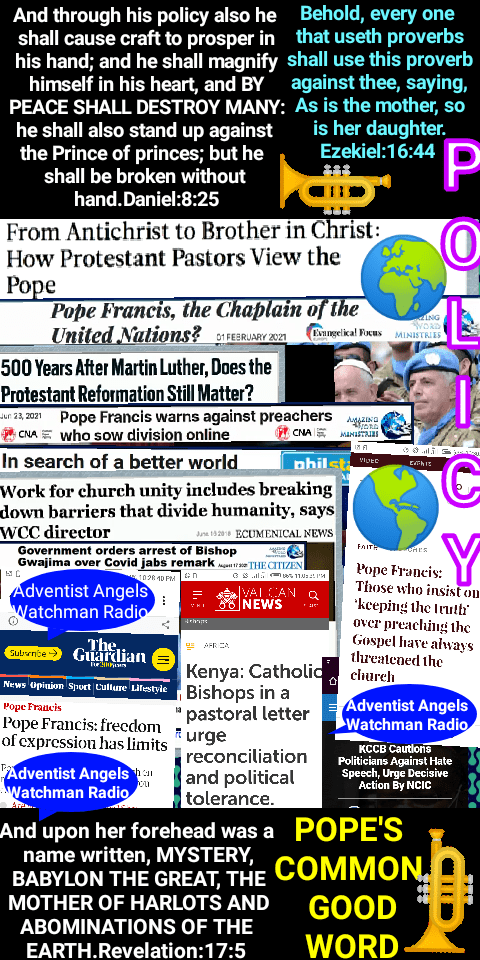
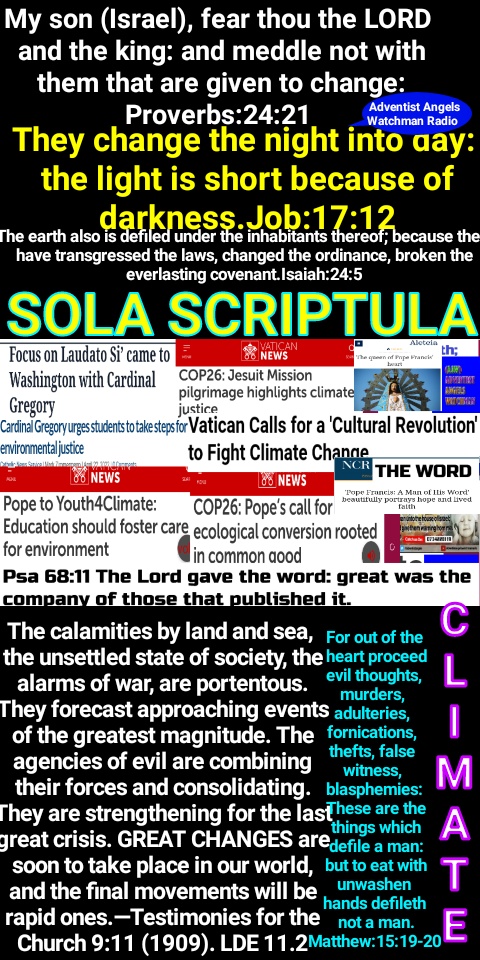
Who told thee that thou wast naked? Hast thou eaten of the tree..Laudato Si’ verse Sola Scriptula Vine

From the very beginning of the great controversy in heaven it has been Satan’s purpose to overthrow the law of God. It was to accomplish this that he entered upon his rebellion against the Creator, and though he was cast out of heaven he has continued the same warfare upon the earth. To deceive men, and thus lead them to transgress God’s law, is the object which he has steadfastly pursued. Whether this be accomplished by casting aside the law altogether, or by rejecting one of its precepts, the result will be ultimately the same. He that offends “in one point,” manifests contempt for the whole law; his influence and example are on the side of transgression; he becomes “guilty of all.” James 2:10.
In seeking to cast contempt upon the divine statutes, Satan has perverted the doctrines of the Bible, and errors have thus become incorporated into the faith of thousands who profess to believe the Scriptures. The last great conflict between truth and error is but the final struggle of the long-standing controversy concerning the law of God. Upon this battle we are now entering—a battle between the laws of men and the precepts of Jehovah, between the religion of the Bible and the religion of fable and tradition.
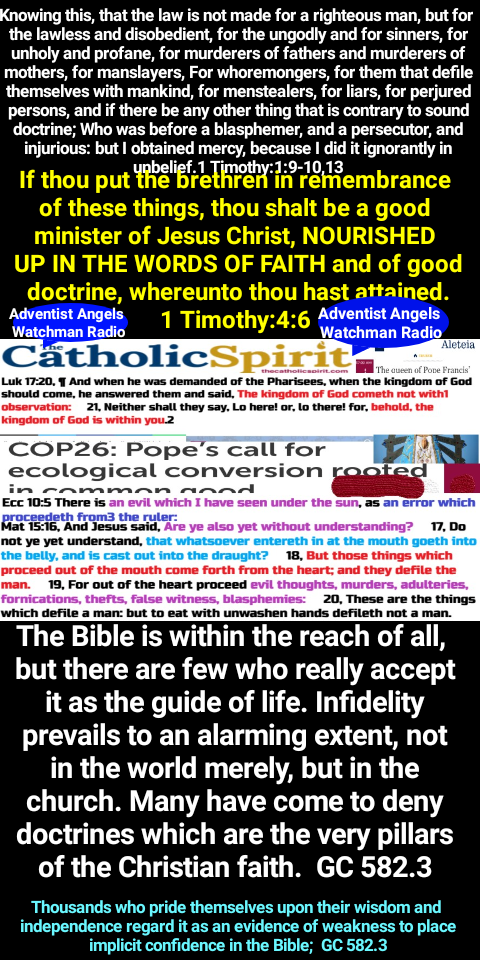
The agencies which will unite against truth and righteousness in this contest are now actively at work. God’s holy word, which has been handed down to us at such a cost of suffering and blood, is but little valued. The Bible is within the reach of all, but there are few who really accept it as the guide of life. Infidelity prevails to an alarming extent, not in the world merely, but in the church. Many have come to deny doctrines which are the very pillars of the Christian faith. The great facts of creation as presented by the inspired writers, the fall of man, the atonement, and the perpetuity of the law of God, are practically rejected, either wholly or in part, by a large share of the professedly Christian world. Thousands who pride themselves upon their wisdom and independence regard it as an evidence of weakness to place implicit confidence in the Bible; they think it a proof of superior talent and learning to cavil at the Scriptures and to spiritualize and explain away their most important truths. Many ministers are teaching their people, and many professors and teachers are instructing their students, that the law of God has been changed or abrogated; and those who regard its requirements as still valid, to be literally obeyed, are thought to be deserving only of ridicule or contempt.
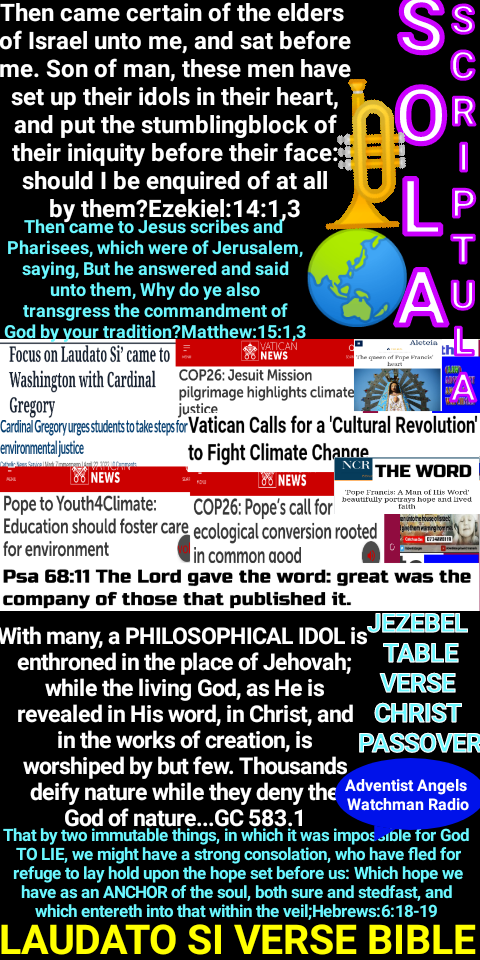
In rejecting the truth, men reject its Author. In trampling upon the law of God, they deny the authority of the Law-giver. It is as easy to make an idol of false doctrines and theories as to fashion an idol of wood or stone. By misrepresenting the attributes of God, Satan leads men to conceive of Him in a false character. With many, a philosophical idol is enthroned in the place of Jehovah; while the living God, as He is revealed in His word, in Christ, and in the works of creation, is worshiped by but few. Thousands deify nature while they deny the God of nature. Though in a different form, idolatry exists in the Christian world today as verily as it existed among ancient Israel in the days of Elijah. The God of many professedly wise men, of philosophers, poets, politicians, journalists—the God of polished fashionable circles, of many colleges and universities, even of some theological institutions—is little better than Baal, the sun-god of Phoenicia.
No error accepted by the Christian world strikes more boldly against the authority of Heaven, none is more directly opposed to the dictates of reason, none is more pernicious in its results, than the modern doctrine, so rapidly gaining ground, that God’s law is no longer binding upon men. Every nation has its laws, which command respect and obedience; no government could exist without them; and can it be conceived that the Creator of the heavens and the earth has no law to govern the beings He has made? Suppose that prominent ministers were publicly to teach that the statutes which govern their land and protect the rights of its citizens were not obligatory—that they restricted the liberties of the people, and therefore ought not to be obeyed; how long would such men be tolerated in the pulpit? But is it a graver offense to disregard the laws of states and nations than to trample upon those divine precepts which are the foundation of all government?
It would be far more consistent for nations to abolish their statutes, and permit the people to do as they please, than for the Ruler of the universe to annul His law, and leave the world without a standard to condemn the guilty or justify the obedient. Would we know the result of making void the law of God? The experiment has been tried. Terrible were the scenes enacted in France when atheism became the controlling power. It was then demonstrated to the world that to throw off the restraints which God has imposed is to accept the rule of the cruelest of tyrants. When the standard of righteousness is set aside, the way is open for the prince of evil to establish his power in the earth.
Wherever the divine precepts are rejected, sin ceases to appear sinful or righteousness desirable. Those who refuse to submit to the government of God are wholly unfitted to govern themselves. Through their pernicious teachings the spirit of insubordination is implanted in the hearts of children and youth, who are naturally impatient of control; and a lawless, licentious state of society results. While scoffing at the credulity of those who obey the requirements of God, the multitudes eagerly accept the delusions of Satan. They give the rein to lust and practice the sins which have called down judgments upon the heathen GC 582.1 – GC 584.3

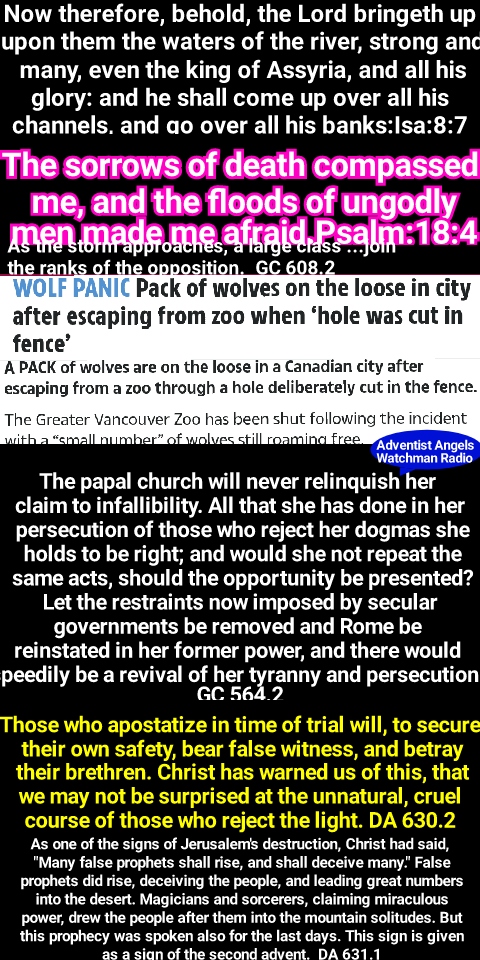
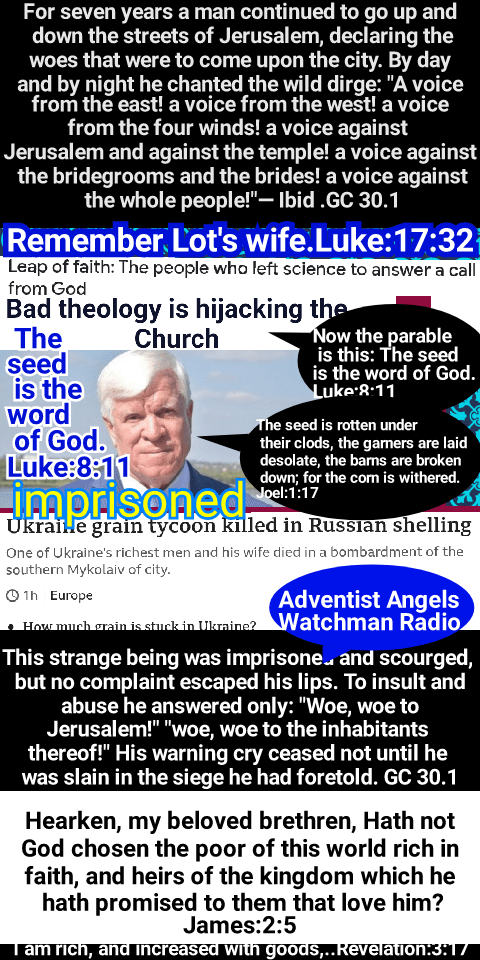
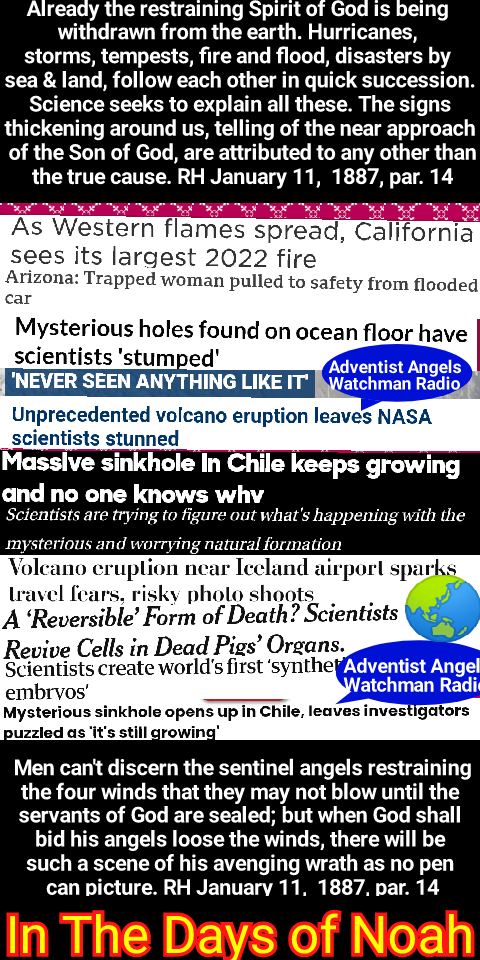
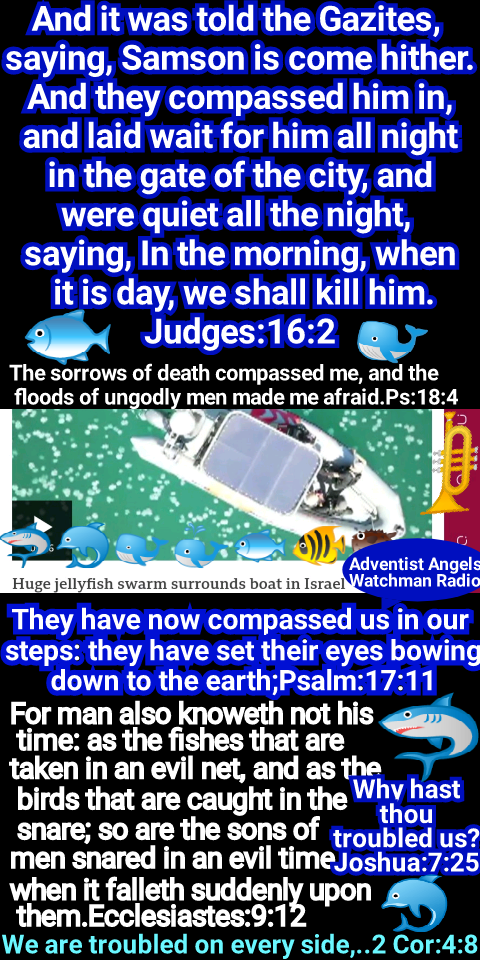
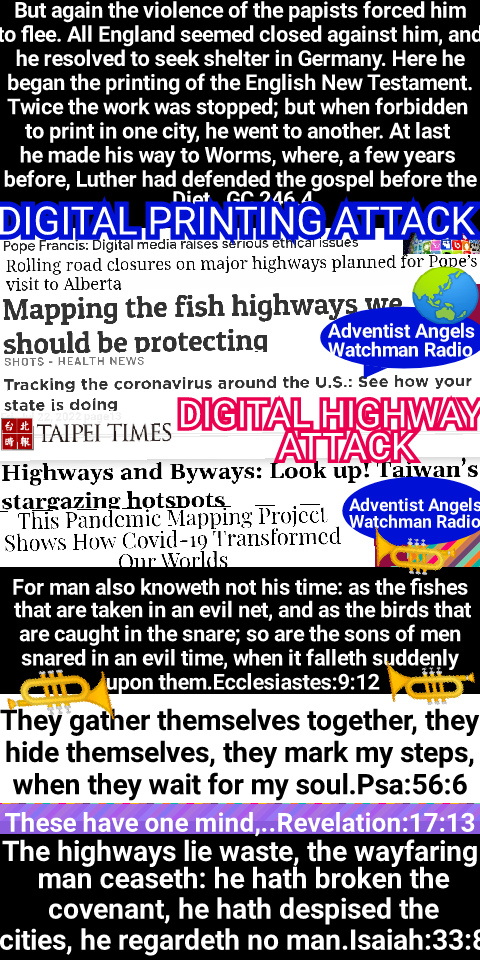
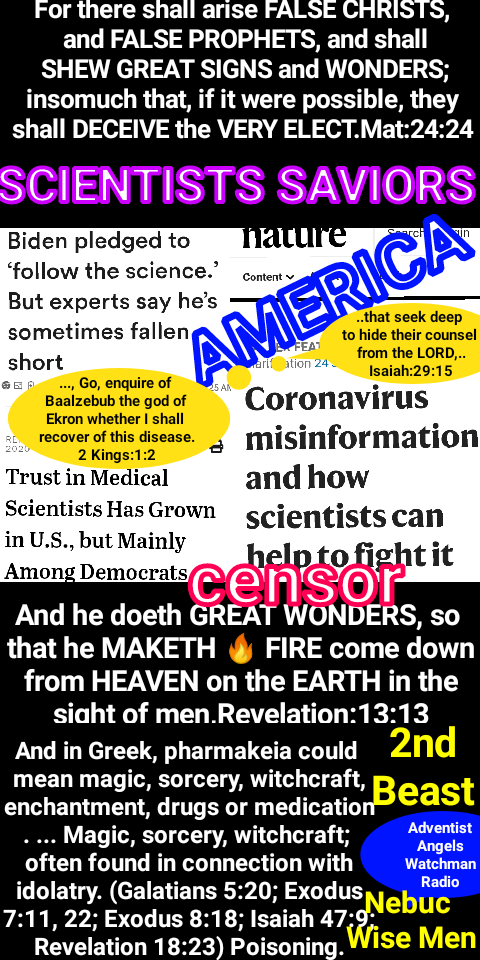
Magicians and Prophets Save The World and ‘Temple’: Pack of wolves on the loose in Jerusalem City after escaping from zoo for little season When ‘hole was cut in fence’

Christ’s words had been spoken in the hearing of a large number of people; but when He was alone, Peter, John, James, and Andrew came to Him as He sat upon the Mount of Olives. “Tell us,” they said, “when shall these things be? and what shall be the sign of Thy coming, and of the end of the world?” Jesus did not answer His disciples by taking up separately the destruction of Jerusalem and the great day of His coming. He mingled the description of these two events. Had He opened to His disciples future events as He beheld them, they would have been unable to endure the sight. In mercy to them He blended the description of the two great crises, leaving the disciples to study out the meaning for themselves. When He referred to the destruction of Jerusalem, His prophetic words reached beyond that event to the final conflagration in that day when the Lord shall rise out of His place to punish the world for their iniquity, when the earth shall disclose her blood, and shall no more cover her slain. This entire discourse was given, not for the disciples only, but for those who should live in the last scenes of this earth’s history.
Turning to the disciples, Christ said, “Take heed that no man deceive you. For many shall come in My name, saying, I am Christ; and shall deceive many.” Many false messiahs will appear, claiming to work miracles, and declaring that the time of the deliverance of the Jewish nation has come. These will mislead many. Christ’s words were fulfilled. Between His death and the siege of Jerusalem many false messiahs appeared. But this warning was given also to those who live in this age of the world. The same deceptions practiced prior to the destruction of Jerusalem have been practiced through the ages, and will be practiced again.
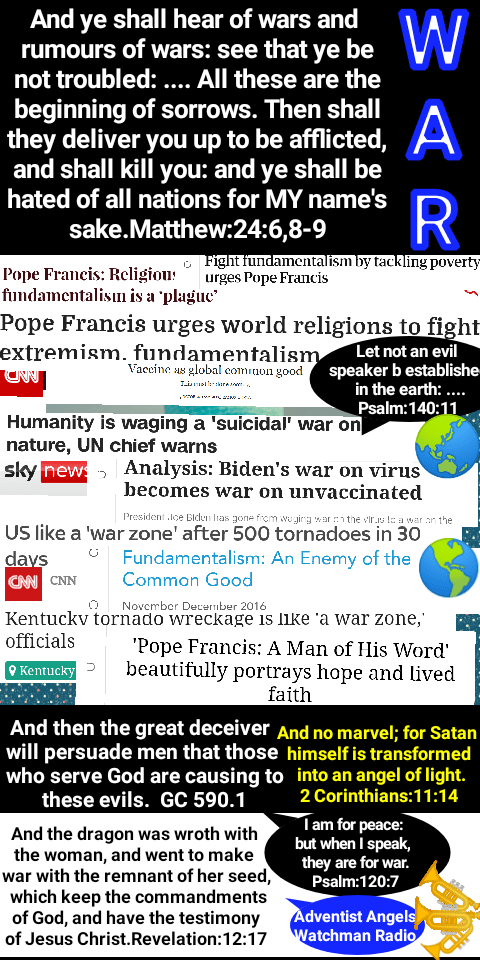
“And ye shall hear of wars and rumors of wars: see that ye be not troubled: for all these things must come to pass, but the end is not yet.” Prior to the destruction of Jerusalem, men wrestled for the supremacy. Emperors were murdered. Those supposed to be standing next the throne were slain. There were wars and rumors of wars. “All these things must come to pass,” said Christ, “but the end of the Jewish nation as a nation is not yet. For nation shall rise against nation, and kingdom against kingdom: and there shall be famines, and pestilences, and earthquakes, in divers places. All these are the beginning of sorrows.” Christ said, As the rabbis see these signs, they will declare them to be God’s judgments upon the nations for holding in bondage His chosen people. They will declare that these signs are the token of the advent of the Messiah. Be not deceived; they are the beginning of His judgments. The people have looked to themselves. They have not repented and been converted that I should heal them. The signs that they represent as tokens of their release from bondage are signs of their destruction.
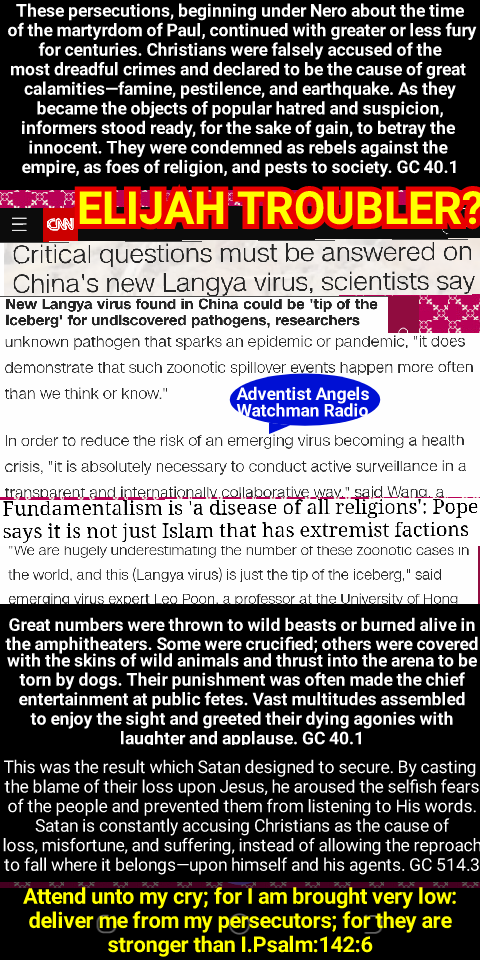
“Then shall they deliver you up to be afflicted, and shall kill you: and ye shall be hated of all nations for My name’s sake. And then shall many be offended, and shall betray one another, and shall hate one another.” All this the Christians suffered. Fathers and mothers betrayed their children. Children betrayed their parents. Friends delivered their friends up to the Sanhedrin. The persecutors wrought out their purpose by killing Stephen, James, and other Christians.
Through His servants, God gave the Jewish people a last opportunity to repent. He manifested Himself through His witnesses in their arrest, in their trial, and in their imprisonment. Yet their judges pronounced on them the death sentence. They were men of whom the world was not worthy, and by killing them the Jews crucified afresh the Son of God. So it will be again. The authorities will make laws to restrict religious liberty. They will assume the right that is God’s alone. They will think they can force the conscience, which God alone should control. Even now they are making a beginning; this work they will continue to carry forward till they reach a boundary over which they cannot step. God will interpose in behalf of His loyal, commandment-keeping people.
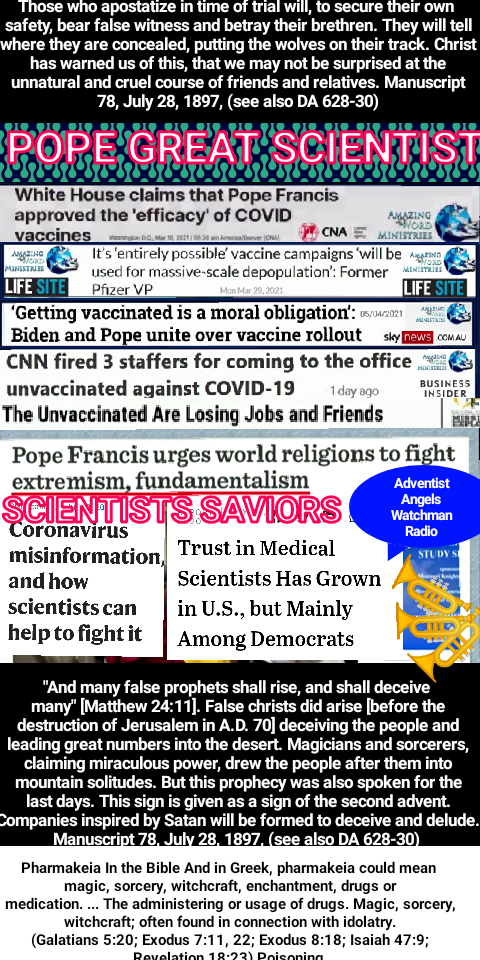
On every occasion when persecution takes place, those who witness it make decisions either for Christ or against Him. Those who manifest sympathy for the ones wrongly condemned show their attachment for Christ. Others are offended because the principles of truth cut directly across their practice. Many stumble and fall, apostatizing from the faith they once advocated. Those who apostatize in time of trial will, to secure their own safety, bear false witness, and betray their brethren. Christ has warned us of this, that we may not be surprised at the unnatural, cruel course of those who reject the light.
Christ gave His disciples a sign of the ruin to come on Jerusalem, and He told them how to escape: “When ye shall see Jerusalem compassed with armies, then know that the desolation thereof is nigh. Then let them which are in Judea flee to the mountains; and let them which are in the midst of it depart out; and let not them that are in the countries enter thereinto. For these be the days of vengeance, that all things which are written may be fulfilled.” This warning was given to be heeded forty years after, at the destruction of Jerusalem. The Christians obeyed the warning, and not a Christian perished in the fall of the city.
“Pray ye that your flight be not in the winter; neither on the Sabbath day,” Christ said. He who made the Sabbath did not abolish it, nailing it to His cross. The Sabbath was not rendered null and void by His death. Forty years after His crucifixion it was still to be held sacred. For forty years the disciples were to pray that their flight might not be on the Sabbath day.
From the destruction of Jerusalem, Christ passed on rapidly to the greater event, the last link in the chain of this earth’s history,—the coming of the Son of God in majesty and glory. Between these two events, there lay open to Christ’s view long centuries of darkness, centuries for His church marked with blood and tears and agony. Upon these scenes His disciples could not then endure to look, and Jesus passed them by with a brief mention. “Then shall be great tribulation,” He said, “such as was not since the beginning of the world to this time, no, nor ever shall be. And except those days should be shortened, there should no flesh be saved: but for the elect’s sake those days shall be shortened.” For more than a thousand years such persecution as the world had never before known was to come upon Christ’s followers. Millions upon millions of His faithful witnesses were to be slain. Had not God’s hand been stretched out to preserve His people, all would have perished. “But for the elect’s sake,” He said, “those days shall be shortened.”
Now, in unmistakable language, our Lord speaks of His second coming, and He gives warning of dangers to precede His advent to the world. “If any man shall say unto you, Lo, here is Christ, or there; believe it not. For there shall arise false christs, and false prophets, and shall show great signs and wonders; insomuch that, if it were possible, they shall deceive the very elect. Behold, I have told you before. Wherefore if they shall say unto you, Behold, He is in the desert; go not forth: behold, He is in the secret chambers; believe it not. For as the lightning cometh out of the east, and shineth even unto the west; so shall also the coming of the Son of man be.” As one of the signs of Jerusalem’s destruction, Christ had said, “Many false prophets shall rise, and shall deceive many.” False prophets did rise, deceiving the people, and leading great numbers into the desert. Magicians and sorcerers, claiming miraculous power, drew the people after them into the mountain solitudes. But this prophecy was spoken also for the last days. This sign is given as a sign of the second advent. Even now false christs and false prophets are showing signs and wonders to seduce His disciples. Do we not hear the cry, “Behold, He is in the desert”? Have not thousands gone forth into the desert, hoping to find Christ? And from thousands of gatherings where men profess to hold communion with departed spirits is not the call now heard, “Behold, He is in the secret chambers”? This is the very claim that spiritism puts forth. But what says Christ? “Believe it not. For as the lightning cometh out of the east, and shineth even unto the west; so shall also the coming of the Son of man be.”
The Saviour gives signs of His coming, and more than this, He fixes the time when the first of these signs shall appear: “Immediately after the tribulation of those days shall the sun be darkened, and the moon shall not give her light, and the stars shall fall from heaven, and the powers of the heavens shall be shaken: and then shall appear the sign of the Son of man in heaven: and then shall all the tribes of the earth mourn, and they shall see the Son of man coming in the clouds of heaven with power and great glory. And He shall send His angels with a great sound of a trumpet, and they shall gather together His elect from the four winds, from one end of heaven to the other.”
At the close of the great papal persecution, Christ declared, the sun should be darkened, and the moon should not give her light. Next, the stars should fall from heaven. And He says, “Learn a parable of the fig tree; When his branch is yet tender, and putteth forth leaves, ye know that summer is nigh: so likewise ye, when ye shall see all these things, know that He is near, even at the doors.” Matthew 24:32, 33, margin.
Christ has given signs of His coming. He declares that we may know when He is near, even at the doors. He says of those who see these signs, “This generation shall not pass, till all these things be fulfilled.” These signs have appeared. Now we know of a surety that the Lord’s coming is at hand. “Heaven and earth shall pass away,” He says, “but My words shall not pass away.”
Christ is coming with clouds and with great glory. A multitude of shining angels will attend Him. He will come to raise the dead, and to change the living saints from glory to glory. He will come to honor those who have loved Him, and kept His commandments, and to take them to Himself. He has not forgotten them nor His promise. There will be a relinking of the family chain. When we look upon our dead, we may think of the morning when the trump of God shall sound, when “the dead shall be raised incorruptible, and we shall be changed.” 1 Corinthians 15:52. A little longer, and we shall see the King in His beauty. A little longer, and He will wipe all tears from our eyes. A little longer, and He will present us “faultless before the presence of His glory with exceeding joy.” Jude 1:24. Wherefore, when He gave the signs of His coming He said, “When these things begin to come to pass, then look up, and lift up your heads; for your redemption draweth nigh.” DA 628.1 – DA 632.3

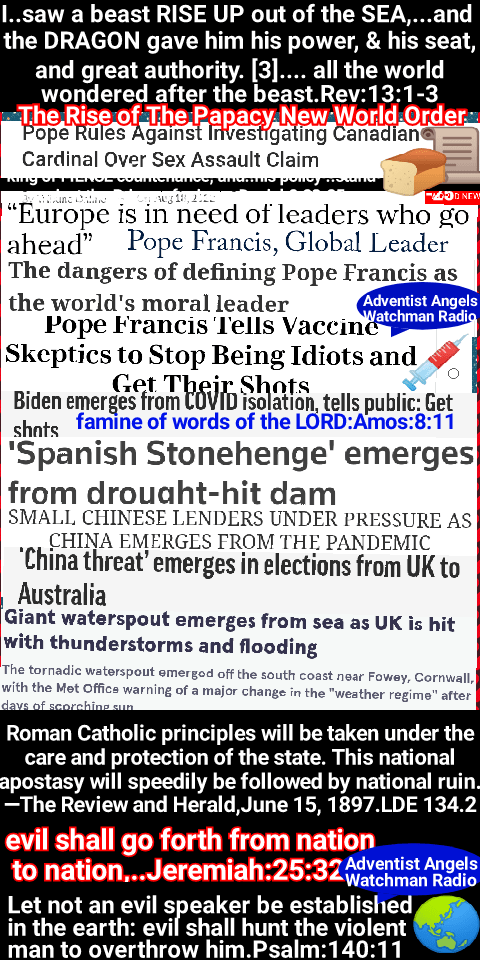
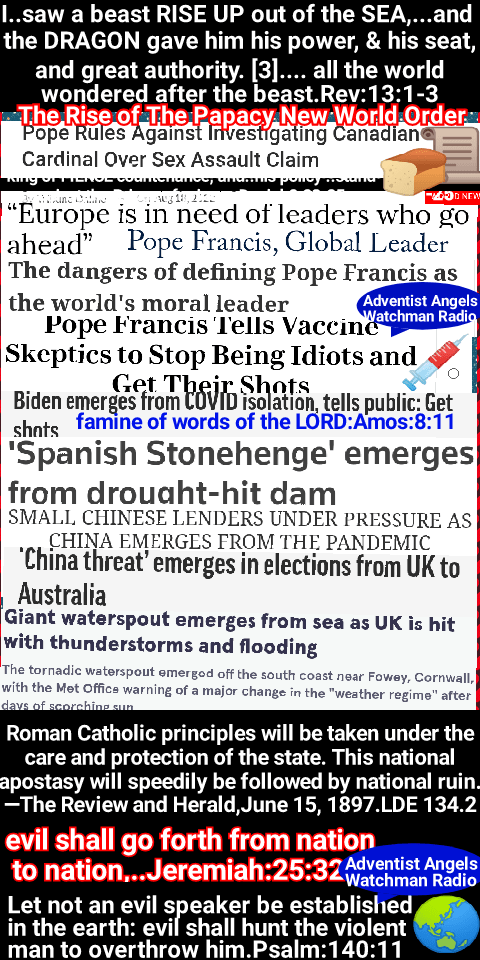
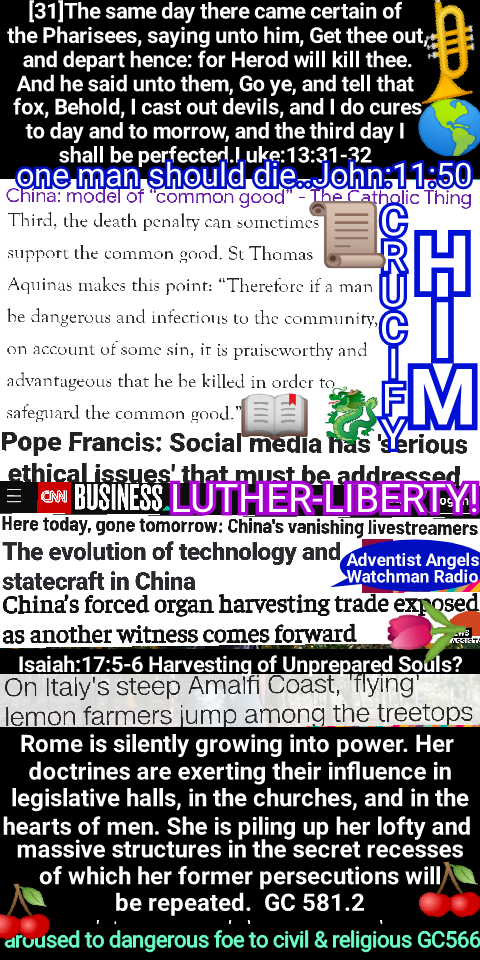
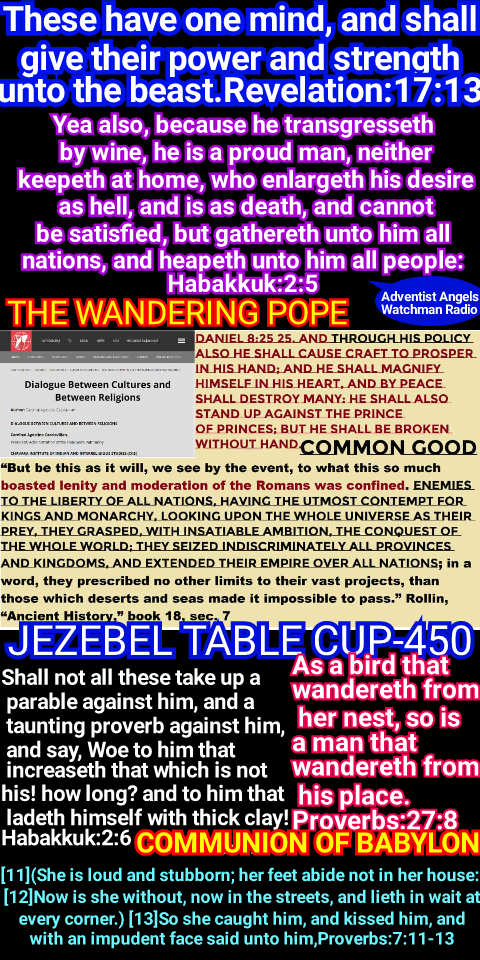
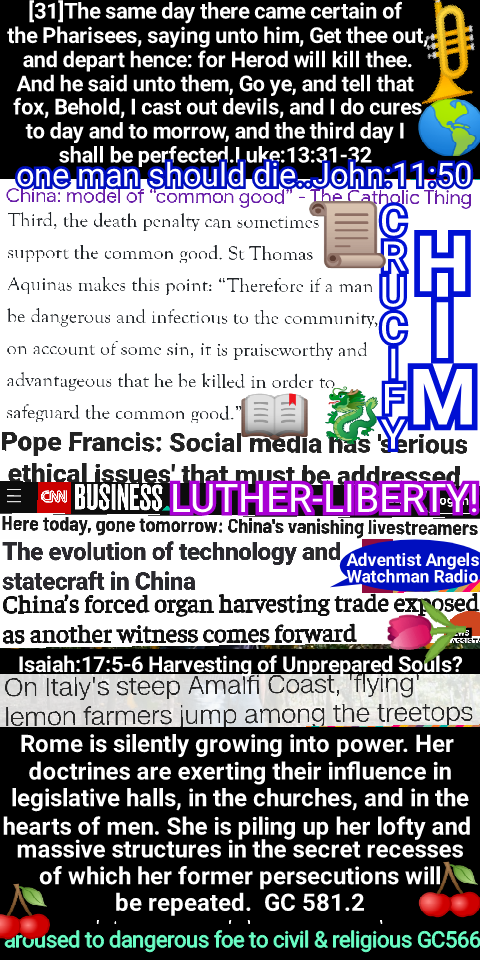
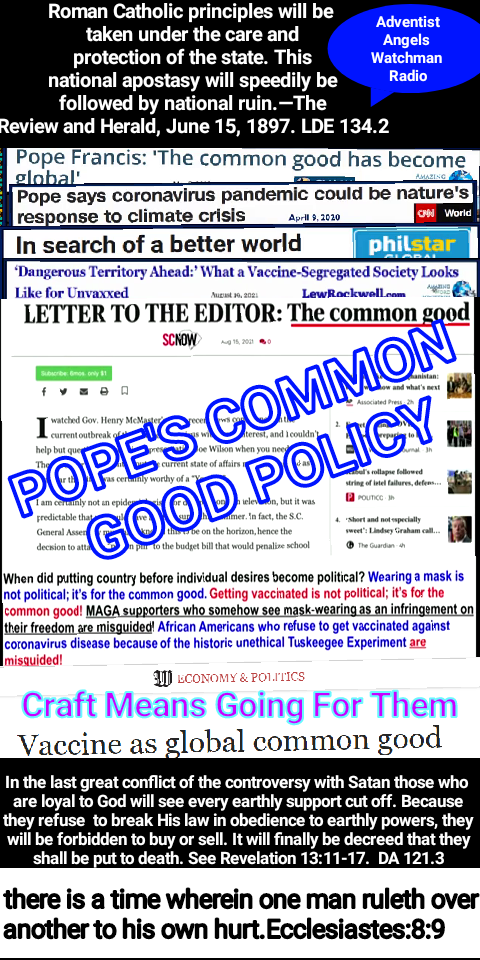
The Emerged Sea and Dry Earth Beasts United Kingdom(s) ‘Common Good’ Policies: Global ‘Immortal’ Leader, Rome Spanish Inquisition Doctrine Come Back!

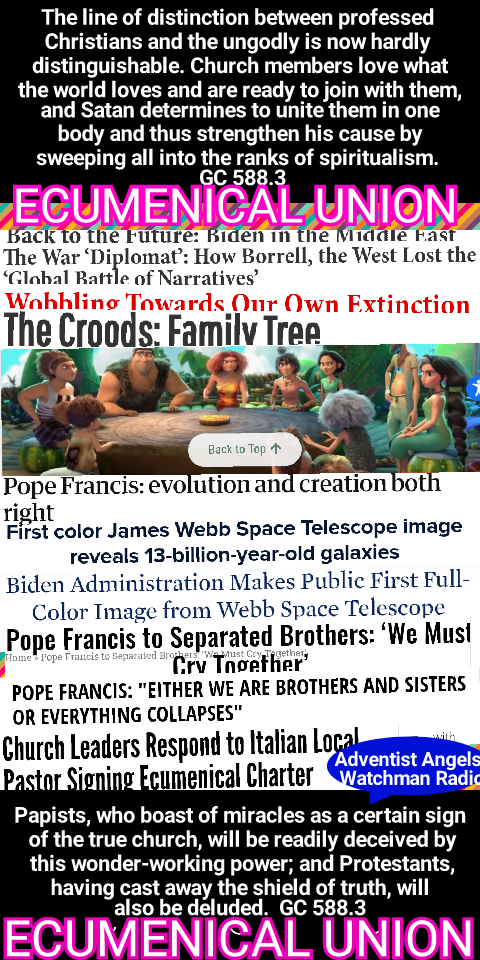
Romanism is now regarded by Protestants with far greater favor than in former years. In those countries where Catholicism is not in the ascendency, and the papists are taking a conciliatory course in order to gain influence, there is an increasing indifference concerning the doctrines that separate the reformed churches from the papal hierarchy; the opinion is gaining ground, that, after all, we do not differ so widely upon vital points as has been supposed, and that a little concession on our part will bring us into a better understanding with Rome. The time was when Protestants placed a high value upon the liberty of conscience which has been so dearly purchased. They taught their children to abhor popery, and held that to seek harmony with Rome would be disloyalty to God. But how widely different are the sentiments now expressed.
The defenders of popery declare that the church has been maligned; and the Protestant world are inclined to accept the statement. Many urge that it is unjust to judge the church of today by the abominations and absurdities that marked her reign during the centuries of ignorance and darkness. They excuse her horrible cruelty as the result of the barbarism of the times, and plead that the influence of modern civilization has changed her sentiments.
Have these persons forgotten the claim of infallibility put forth for eight hundred years by this haughty power? So far from being relinquished, this claim has been affirmed in the nineteenth century with greater positiveness than ever before. As Rome asserts that she “never erred, and never can err,” how can she renounce the principles which governed her course in past ages?
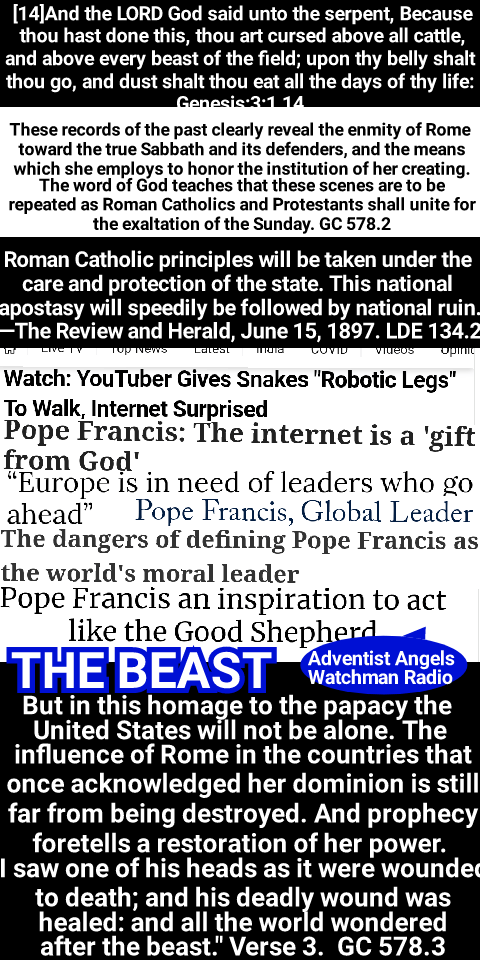
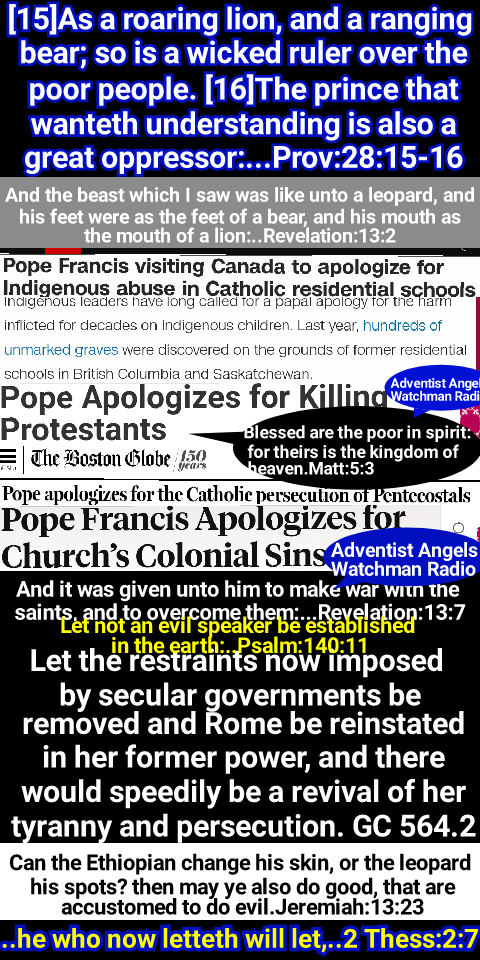
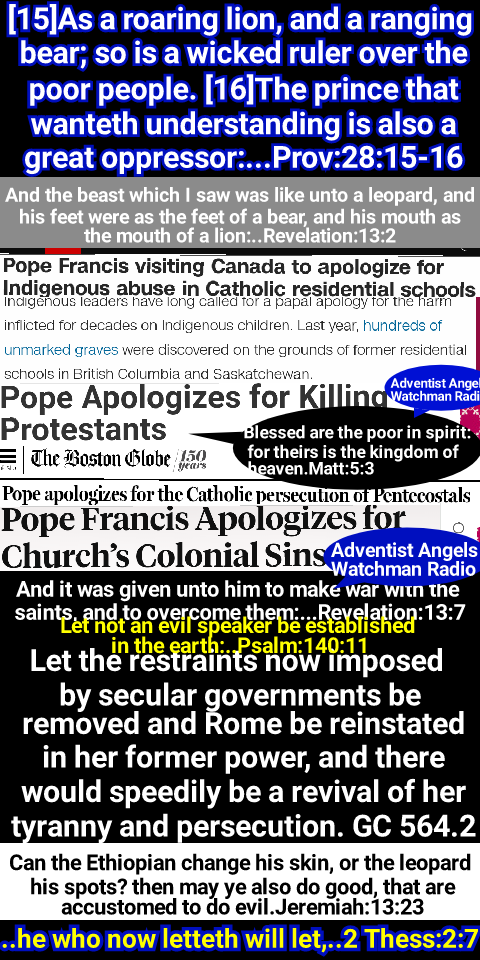
The papal church will never relinquish her claim to infallibility. All that she has done in her persecution of those who reject her dogmas, she holds to be right; and would she not repeat the same acts, should the opportunity be presented? Let the restraints now imposed by secular governments be removed, and Rome be re-instated in her former power, and there would speedily be a revival of her tyranny and persecution.
A recent writer Josiah Strong, D.D., In “Our Country,” pp. 46-48. speaks thus of the attitude of the papal hierarchy as regards freedom of conscience, and of the perils which especially threaten the United States from the success of her policy:—
“There are many who are disposed to attribute any fear of Roman Catholicism in the United States to bigotry or childishness. Such see nothing in the character and attitude of Romanism that is hostile to our free institutions, or find nothing portentous in its growth. Let us, then, first compare some of the fundamental principles of our government with those of the Catholic Church.
“The Constitution of the United States guarantees liberty of conscience . Nothing is dearer or more fundamental. Pope Pius IX., in his Encyclical Letter of August 15, 1854, said: ‘The absurd and erroneous doctrines or ravings in defense of liberty of conscience, are a most pestilential error—a pest, of all others, most to be dreaded in a State.’ The same pope, in his Encyclical Letter of December 8, 1864, anathematized ‘those who assert the liberty of conscience and of religious worship,’ also ‘all such as maintain that the church may not employ force.’
“The pacific tone of Rome in the United States does not imply a change of heart. She is tolerant where she is helpless. Says Bishop O’Connor: ‘Religious liberty is merely endured until the opposite can be carried into effect without peril to the Catholic world.'” “The archbishop of St. Louis once said: ‘Heresy and unbelief are crimes; and in Christian countries, as in Italy and Spain, for instance, where all the people are Catholics, and where the Catholic religion is an essential part of the law of the land, they are punished as other crimes.'”
“Every cardinal, archbishop, and bishop in the Catholic Church takes an oath of allegiance to the pope, in which occur the following words: ‘Heretics, schismatics, and rebels to our said lord the pope, or his aforesaid successors, I will to my utmost persecute and oppose.'”
It is true that there are real Christians in the Roman Catholic communion. Thousands in that church are serving God according to the best light they have. They are not allowed access to his Word, and therefore they do not discern the truth. They have never seen the contrast between a living heart-service and a round of mere forms and ceremonies. God looks with pitying tenderness upon these souls, educated as they are in a faith that is delusive and unsatisfying. He will cause rays of light to penetrate the dense darkness that surrounds them. He will reveal to them the truth, as it is in Jesus, and many will yet take their position with his people.
But Romanism as a system is no more in harmony with the gospel of Christ now than at any former period in her history. The Protestant churches are in great darkness, or they would discern the signs of the times. The Roman Church is far-reaching in her plans and modes of operation. She is employing every device to extend her influence and increase her power in preparation for a fierce and determined conflict to regain control of the world, to re-establish persecution, and to undo all that Protestantism has done. Catholicism is gaining ground upon every side. See Appendix, Note 10. See the increasing number of her churches and chapels in Protestant countries. Look at the popularity of her colleges and seminaries in America, so widely patronized by Protestants Look at the growth of ritualism in England, and the frequent defections to the ranks of the Catholics. These things should awaken the anxiety of all who prize the pure principles of the gospel.
Protestants have tampered with and patronized popery; they have made compromises and concessions which papists themselves are surprised to see, and fail to understand. Men are closing their eyes to the real character of Romanism, and the dangers to be apprehended from her supremacy. The people need to be aroused to resist the advances of this most dangerous foe to civil and religious liberty.
Many Protestants suppose that the Catholic religion is unattractive, and that its worship is a dull, meaningless round of ceremony. Here they mistake. While Romanism is based upon deception, it is not a coarse and clumsy imposture. The religious service of the Romish Church is a most impressive ceremonial. Its gorgeous display and solemn rites fascinate the senses of the people, and silence the voice of reason and of conscience. The eye is charmed. Magnificent churches, imposing processions, golden altars, jeweled shrines, choice paintings, and exquisite sculpture appeal to the love of beauty. The ear also is captivated. The music is unsurpassed. The rich notes of the deep-toned organ, blending with the melody of many voices as it swells through the lofty domes and pillared aisles of her grand cathedrals, cannot fail to impress the mind with awe and reverence.
This outward splendor, pomp, and ceremony, that only mocks the longings of the sin-sick soul, is an evidence of inward corruption. The religion of Christ needs not such attractions to recommend it. In the light shining from the cross, true Christianity appears so pure and lovely that no external decorations can enhance its true worth. It is the beauty of holiness, a meek and quiet spirit, which is of value with God.
Brilliancy of style is not necessarily an index of pure, elevated thought. High conceptions of art, delicate refinement of taste, often exist in minds that are earthly and sensual. They are often employed by Satan to lead men to forget the necessities of the soul, to lose sight of the future, immortal life, to turn away from their infinite Helper, and to live for this world alone.
A religion of externals is attractive to the unrenewed heart. The pomp and ceremony of the Catholic worship have a seductive, bewitching power, by which many are deceived; and they come to look upon the Roman Church as the very gate of Heaven. None but those who have planted their feet firmly upon the foundation of truth, and whose hearts are renewed by the Spirit of God, are proof against her influence. Thousands who have not an experimental knowledge of Christ will be led to accept the forms of godliness without the power. Such a religion is just what the multitudes desire.
The church’s claim to the right to pardon, causes the Romanist to feel at liberty to sin; and the ordinance of confession, without which her pardon is not granted, tends also to give license to evil. He who kneels before fallen man, and opens in confession the secret thoughts and imaginations of his heart, is debasing his manhood, and degrading every noble instinct of his soul. In unfolding the sins of his life to a priest,—an erring, sinful mortal, and too often corrupted with wine and licentiousness,—his standard of character is lowered, and he is defiled in consequence. His thought of God is degraded to the likeness of fallen humanity; for the priest stands as a representative of God. This degrading confession of man to man is the secret spring from which has flowed much of the evil that is defiling the world, and fitting it for the final destruction. Yet to him who loves self-indulgence, it is more pleasing to confess to a fellow-mortal than to open the soul to God. It is more palatable to human nature to do penance than to renounce sin; it is easier to mortify the flesh by sackcloth and nettles and galling chains than to crucify fleshly lusts. Heavy is the yoke which the carnal heart is willing to bear rather than bow to the yoke of Christ.
There is a striking similarity between the Church of Rome and the Jewish Church at the time of Christ’s first advent. While the Jews secretly trampled upon every principle of the law of God, they were outwardly rigorous in the observance of its precepts, loading it down with exactions and traditions that made obedience painful and burdensome. As the Jews professed to revere the law, so do Romanists claim to reverence the cross. They exalt the symbol of Christ’s sufferings, while in their lives they deny him whom it represents.
Papists place crosses upon their churches, upon their altars, and upon their garments. Everywhere is seen the insignia of the cross. Everywhere it is outwardly honored and exalted. But the teachings of Christ are buried beneath a mass of senseless traditions, false interpretations, and rigorous exactions. The Saviour’s words concerning the bigoted Jews, apply with still greater force to the Romish leaders: “They bind heavy burdens and grievous to be borne, and lay them on men’s shoulders; but they themselves will not move them with one of their fingers.” Matthew 23:4. Conscientious souls are kept in constant terror, fearing the wrath of an offended God, while the dignitaries of the church are living in luxury and sensual pleasure.
The worship of images and relics, the invocation of saints, and the exaltation of the pope, are devices of Satan to attract the minds of the people from God and from his Son. To accomplish their ruin, he endeavors to turn their attention from Him through whom alone they can find salvation. He will direct them to any object that can be substituted for the One who has said, “Come unto me, all ye that labor and are heavy-laden, and I will give you rest.” Matthew 11:28.
It is Satan’s constant effort to misrepresent the character of God, the nature of sin, and the real issues at stake in the great controversy. His sophistry lessens the obligation of the divine law, and gives men license to sin. At the same time he causes them to cherish false conceptions of God, so that they regard him with fear and hate, rather than with love. The cruelty inherent in his own character is attributed to the Creator; it is embodied in systems of religion, and expressed in modes of worship. Thus the minds of men are blinded, and Satan secures them as his agents to war against God. By perverted conceptions of the divine attributes, heathen nations were led to believe human sacrifices necessary to secure the favor of Deity; and horrible cruelties have been perpetrated under the various forms of idolatry. The Romish Church, uniting the forms of paganism and Christianity, and, like paganism, misrepresenting the character of God, has resorted to practices no less cruel and revolting. In the days of Rome’s supremacy, there were instruments of torture to compel assent to her doctrines. There was the stake for those who would not concede to her claims. There were massacres on a scale that will never be known until revealed in the Judgment. Dignitaries of the church studied, under Satan their master, to invent means to cause the greatest possible torture, and not end the life of their victim. The infernal process was repeated to the utmost limit of human endurance, until nature gave up the struggle, and the sufferer hailed death as a sweet release.
Such was the fate of Rome’s opponents. For her adherents she had the discipline of the scourge, of famishing hunger, of bodily austerities in every conceivable, heartsickening form. To secure the favor of Heaven, penitents violated the laws of God by violating the laws of nature. They were taught to sunder every tie which he has formed to bless and gladden man’s earthly sojourn. The churchyard contains millions of victims, who spent their lives in vain endeavors to subdue their natural affections, to repress, as offensive to God, every thought and feeling of sympathy with their fellow-creatures.
If we desire to understand the determined cruelty of Satan, manifested for hundreds of years, not among those who never heard of God, but in the very heart and throughout the extent of Christendom, we have only to look at the history of Romanism. Through this mammoth system of deception the prince of evil achieves his purpose of bringing dishonor to God and wretchedness to man. And as we see how he succeeds in disguising himself, and accomplishing his work through the leaders of the church, we may better understand why he has so great antipathy to the Bible. If that book is read, the mercy and love of God will be revealed; it will be seen that he lays upon men none of these heavy burdens. All that he asks is a broken and contrite heart, a humble, obedient spirit.
Christ gives no example in his life for men and women to shut themselves in monasteries in order to become fitted for Heaven. He has never taught that love and sympathy must be repressed. The Saviour’s heart overflowed with love. The nearer man approaches to moral perfection, the keener are his sensibilities, the more acute is his perception of sin, and the deeper his sympathy for the afflicted. The pope claims to be the vicar of Christ; but how does his character bear comparison with that of our Saviour? Was Christ ever known to consign men to the prison or the rack because they did not pay him homage as the King of Heaven? Was his voice heard condemning to death those who did not accept him? When he was slighted by the people of a Samaritan village, the apostle John was filled with indignation, and inquired, “Lord, wilt thou that we command fire to come down from heaven, and consume them, even as Elias did?” Jesus looked with pity upon his disciple, and rebuked his harsh spirit, saying, “The Son of man is not come to destroy men’s lives, but to save them.” Luke 9:54, 56. How different from the spirit manifested by Christ is that of his professed vicar.
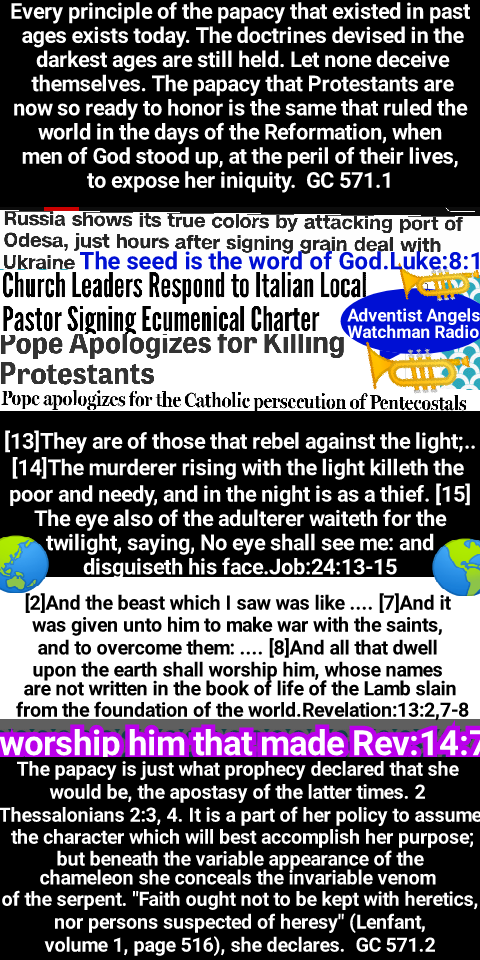
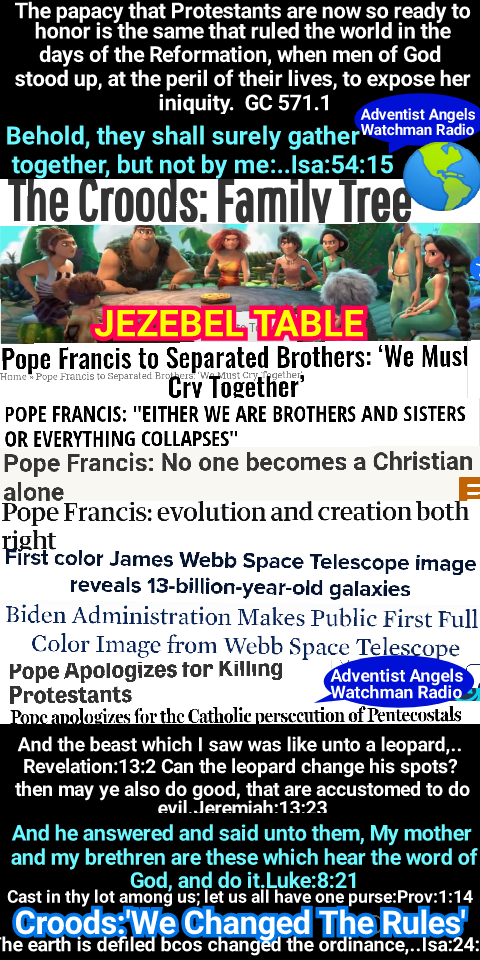
The Romish Church now presents a fair front to the world, covering with apologies her record of horrible cruelties. She has clothed herself in Christ-like garments; but she is unchanged. Every principle of popery that existed in past ages exists today. The doctrines devised in the darkest ages are still held. Let none deceive themselves. The popery that Protestants are now so ready to honor is the same that ruled the world in the days of the Reformation, when men of God stood up, at the peril of their lives, to expose her iniquity. She possesses the same pride and arrogant assumption that lorded it over kings and princes, and claimed the prerogatives of God. Her spirit is no less cruel and despotic now than when she crushed out human liberty, and slew the saints of the Most High.
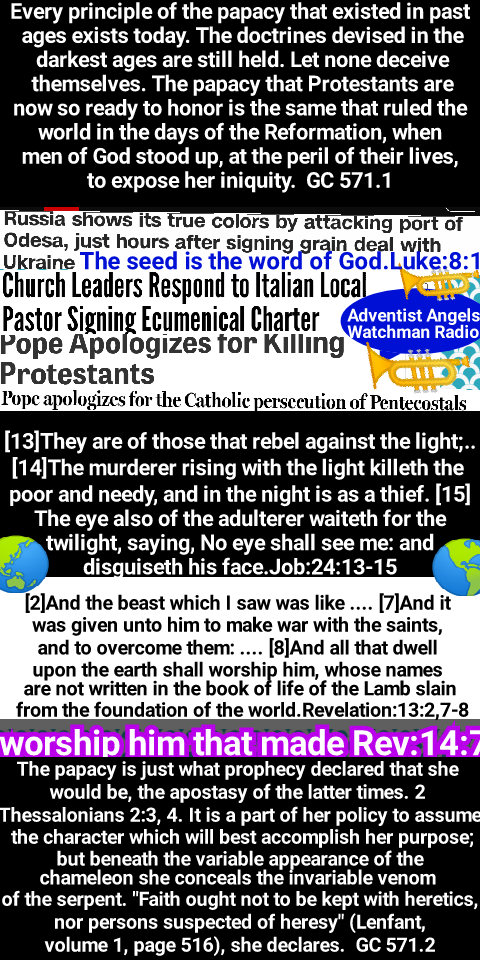
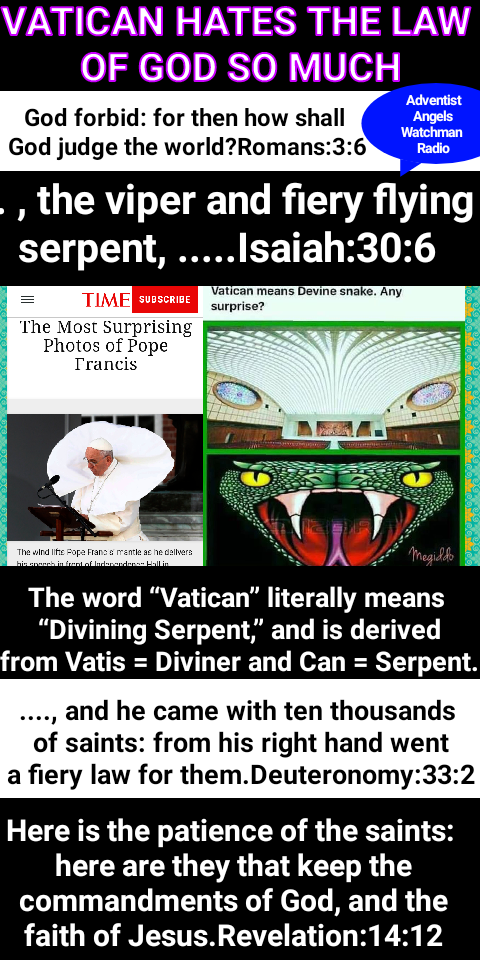
Popery is just what prophecy declared that she would be, the apostasy of the latter times. 2 Thessalonians 2:3, 4. It is a part of her policy to assume the character which will best accomplish her purpose; but beneath the variable appearance of the chameleon, she conceals the invariable venom of the serpent. “We are not bound to keep faith and promises to heretics,” she declares. Shall this power, whose record for a thousand years is written in the blood of the saints, be now acknowledged as a part of the church of Christ?
It is not without reason that the claim has been put forth in Protestant countries, that Catholicism differs less widely from Protestantism than in former times. There has been a change; but the change is not in the papacy. Catholicism indeed resembles much of the Protestantism that now exists, because Protestantism has so greatly degenerated since the days of the reformers.
As the Protestant churches have been seeking the favor of the world, false charity has blinded their eyes. They do not see but that it is right to believe good of all evil; and as the inevitable result, they will finally believe evil of all good. Instead of standing in defense of the faith once delivered to the saints, they are now, as it were, apologizing to Rome for their uncharitable opinion of her, begging pardon for their bigotry.
A large class, even of those who look upon Romanism with no favor, apprehend little danger from her power and influence. Many urge that the intellectual and moral darkness prevailing during the Middle Ages favored the spread of her dogmas, superstitions, and oppression, and that the greater intelligence of modern times, the general diffusion of knowledge, and the increasing liberality in matters of religion, forbid a revival of intolerance and tyranny. The very thought that such a state of things will exist in this enlightened age is ridiculed. It is true that great light, intellectual, moral, and religious, is shining upon this generation. In the open pages of God’s holy Word, light from Heaven has been shed upon the world. But it should be remembered that the greater the light bestowed, the greater the darkness of those who pervert or reject it.
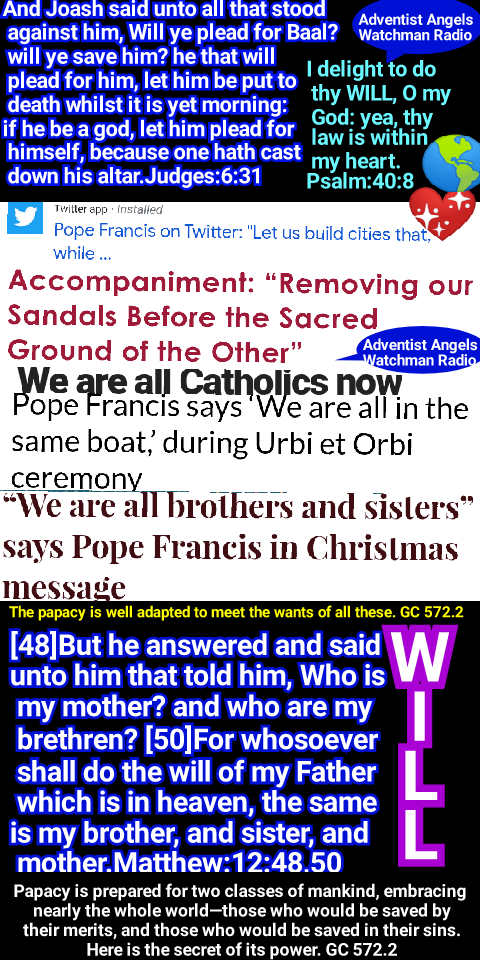
A prayerful study of the Bible would show Protestants the real character of the papacy, and would cause them to abhor and to shun it; but many are so wise in their own conceit that they feel no need of humbly seeking God that they may be led into the truth. Although priding themselves on their enlightenment, they are ignorant both of the Scriptures and of the power of God. They must have some means of quieting their consciences; and they seek that which is least spiritual and humiliating. What they desire is a method of forgetting God which shall pass as a method of remembering him. The papacy is well adapted to meet the wants of all these. It is prepared for two classes of mankind, embracing nearly the whole world,—those who would be saved by their merits, and those who would be saved in their sins. Here is the secret of its power.
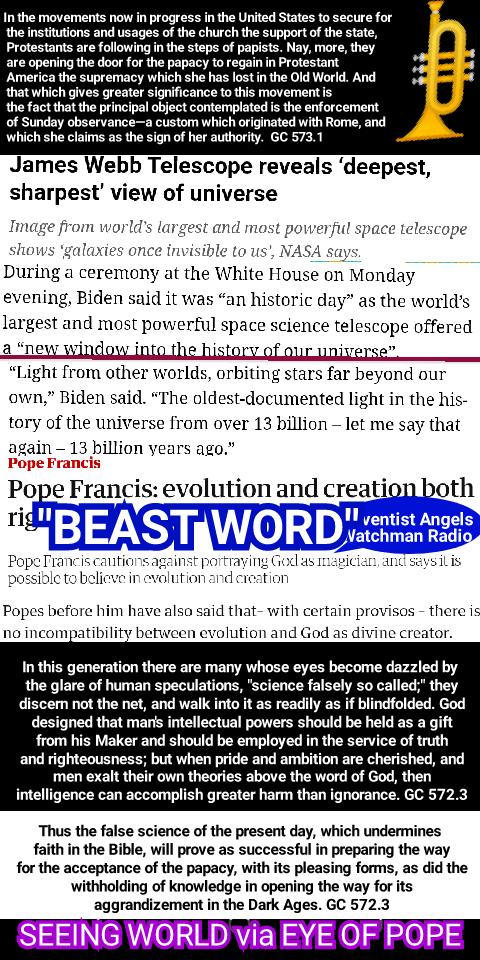
A day of great intellectual darkness has been shown to be favorable to the success of popery. It will yet be demonstrated that a day of great intellectual light is equally favorable for its success. In past ages, when men were without God’s Word, and without the knowledge of the truth, their eyes were blindfolded, and thousands were ensnared, not seeing the net spread for their feet. In this generation there are many whose eyes become dazzled by the glare of human speculations, “science falsely so-called;” they discern not the net, and walk into it as readily as if blindfolded. God designed that man’s intellectual powers should be held as a gift from his Maker, and should be employed in the service of truth and righteousness; but when pride and ambition are cherished, and men exalt their own theories above the Word of God, then intelligence can accomplish greater harm than ignorance. Thus the false science of the nineteenth century, which undermines faith in the Bible, will prove as successful in preparing the way for the acceptance of the papacy, with its pleasing forms, as did the withholding of knowledge in opening the way for its aggrandizement in the Dark Ages.
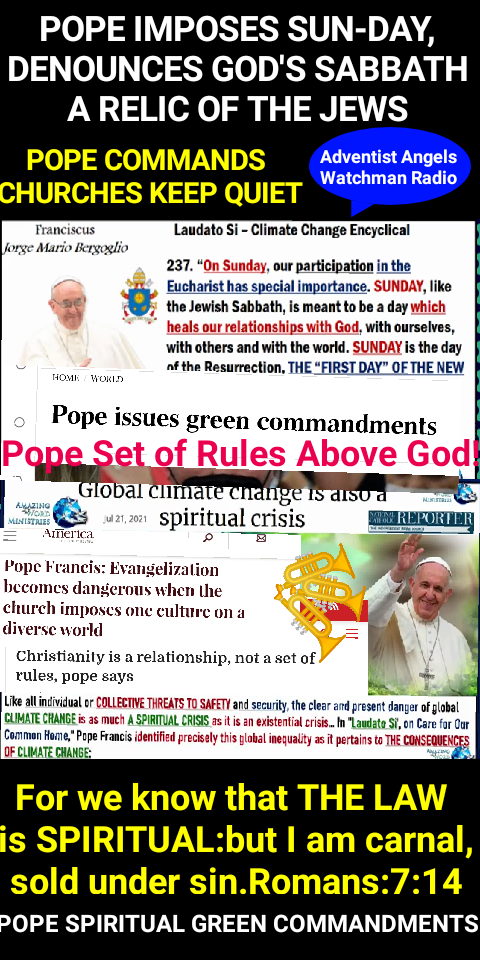
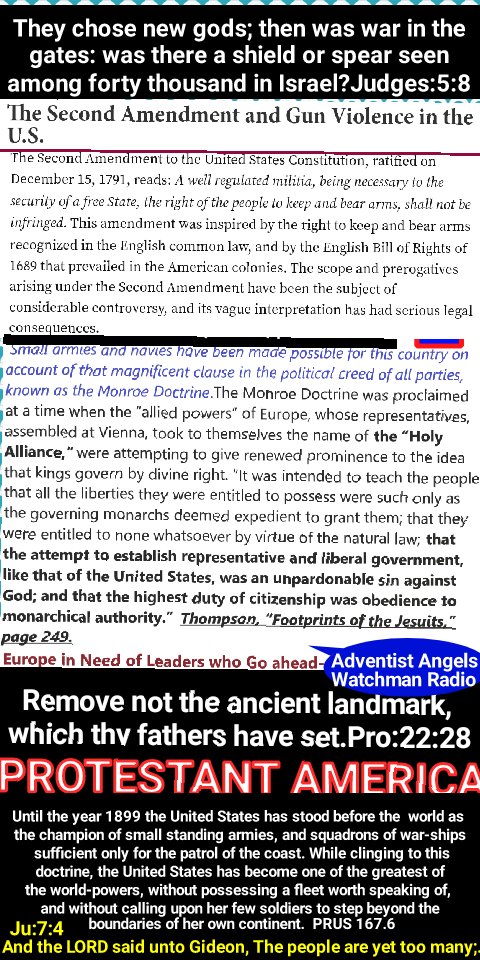
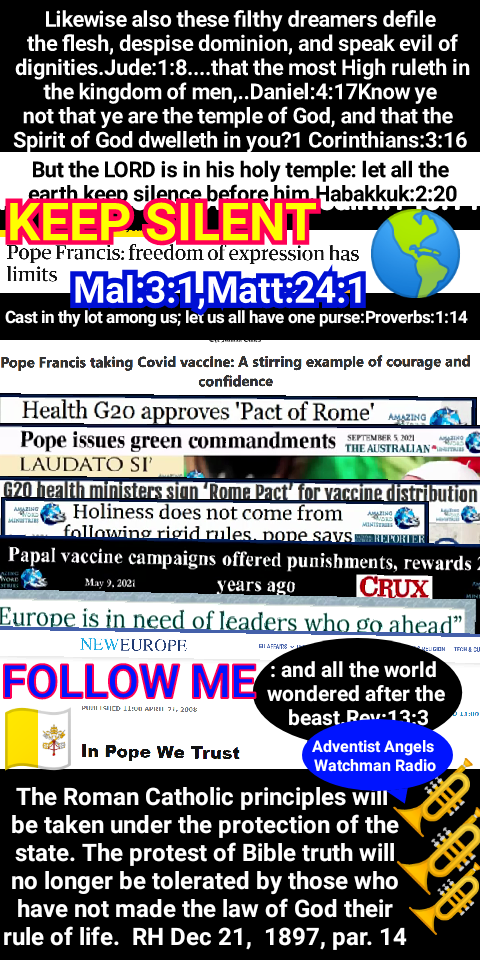
In the movements now in progress in the United States to secure for the institutions and usages of the church the support of the State, Protestants are following in the steps of papists. See Appendix, Note 11. Nay, more, they are opening the door for popery to regain in Protestant America the supremacy which she has lost in the Old World. And that which gives greater significance to this movement is the fact that the principal object contemplated is the enforcement of Sunday observance,—a custom which originated with Rome, and which she claims as the sign of her authority. It is the spirit of the papacy,—the spirit of conformity to worldly customs, the veneration for human traditions above the commandments of God,—that is permeating the Protestant churches, and leading them on to do the same work of Sunday exaltation which the papacy has done before them.
If the reader would understand the agencies to be employed in the soon-coming contest, he has but to trace the record of the means which Rome employed for the same object in ages past. If he would know how papists and Protestants united will deal with those who reject their dogmas, let him see the spirit which Rome manifested toward the Sabbath and its defenders.
Royal edicts, general councils, and church ordinances sustained by secular power, were the steps by which the pagan festival attained its position of honor in the Christian world. The first public measure enforcing Sunday observance was the law enacted by Constantine. A. D. 321. This edict required townspeople to rest on “the venerable day of the sun,” but permitted countrymen to continue their agricultural pursuits. Though virtually a heathen statute, it was enforced by the emperor after his nominal acceptance of Christianity.
The royal mandate not proving a sufficient substitute for divine authority, Eusebius, a bishop who sought the favor of princes, and who was the special friend and flatterer of Constantine, advanced the claim that Christ had transferred the Sabbath to Sunday. Not a single testimony of the Scriptures was produced in proof of the new doctrine. Eusebius himself unwittingly acknowledges its falsity, and points to the real authors of the change. “All things,” he says, “whatsoever that it was duty to do on the Sabbath, these we have transferred to the Lord’s day.” But the Sunday argument, groundless as it was, served to embolden men in trampling upon the Sabbath of the Lord. All who desired to be honored by the world accepted the popular festival.
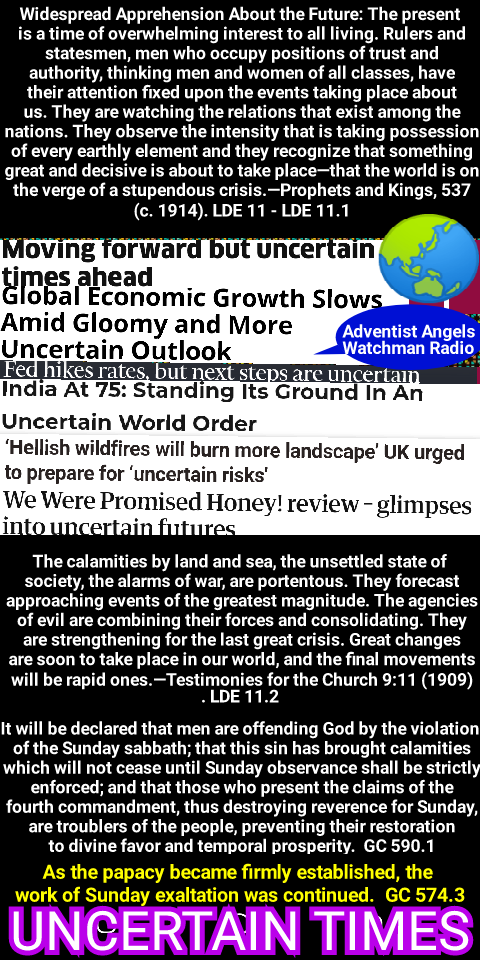
As the papacy became firmly established, the work of Sunday exaltation was continued. For a time the people engaged in agricultural labor when not attending church, and the seventh day was still regarded as the Sabbath. But steadily a change was effected. Those in holy office were forbidden to pass judgment in any civil controversy on the Sunday. Soon after, all persons, of whatever rank, were commanded to refrain from common labor, on pain of a fine for freemen, and stripes in the case of servants. Later it was decreed, that rich men should be punished with the loss of half of their estates; and finally, that if still obstinate they should be made slaves. The lower classes were to suffer perpetual banishment.
Miracles also were called into requisition. Among other wonders it was reported that as a husbandman who was about to plow his field on Sunday, cleaned his plow with an iron, the iron stuck fast in his hand, and for two years he carried it about with him, “to his exceeding great pain and shame.”
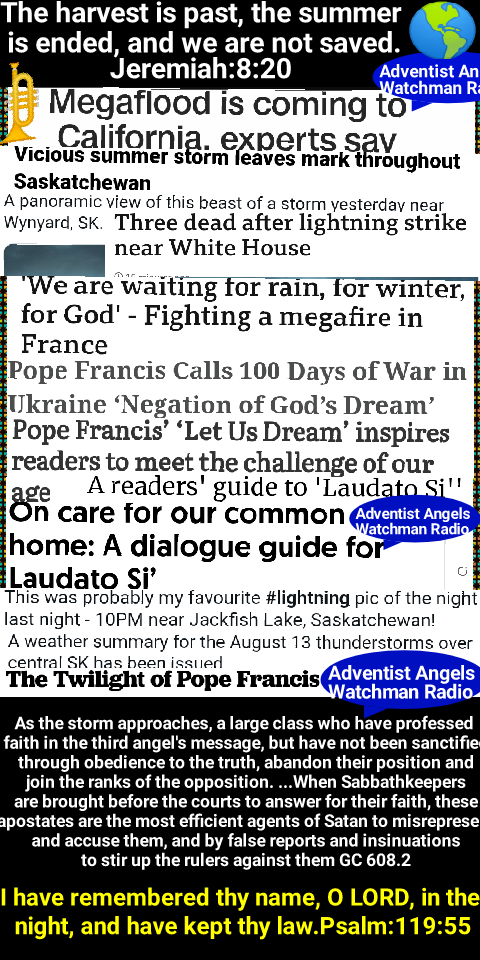
Later, the pope gave directions that the parish priest should admonish the violators of Sunday, and wish them to go to church and say their prayers, lest they bring some great calamity on themselves and neighbors. An ecclesiastical council brought forward the argument, since so widely employed, even by Protestants, that because persons had been struck by lightning while laboring on Sunday, it must be the Sabbath. “It is apparent,” said the prelates, “how high the displeasure of God was upon their neglect of this day.” An appeal was then made that priests and ministers, kings and princes, and all faithful people, “use their utmost endeavors and care that the day be restored to its honor, and, for the credit of Christianity, more devoutly observed for time to come.”
The decrees of councils proving insufficient, the secular authorities were besought to issue an edict that would strike terror to the hearts of the people, and force them to refrain from labor on the Sunday. At a synod held in Rome, all previous decisions were reaffirmed with greater force and solemnity. They were also incorporated into the ecclesiastical law, and enforced by the civil authorities throughout nearly all Christendom.
Still the absence of scriptural authority for Sunday-keeping occasioned no little embarrassment. The people questioned the right of their teachers to set aside the positive declaration of Jehovah, “The seventh day is the Sabbath of the Lord thy God,” in order to honor the day of the sun. To supply the lack of Bible testimony, other expedients were necessary. A zealous advocate of Sunday, who about the close of the twelfth century visited the churches of England, was resisted by faithful witnesses for the truth; and so fruitless were his efforts that he departed from the country for a season, and cast about him for some means to enforce his teachings. When he returned, the lack was supplied, and in his after-labors he met with greater success. He brought with him a roll purporting to be from God himself, which contained the needed command for Sunday observance, with awful threats to terrify the disobedient. This precious document—as base a counterfeit as the institution it supported—was said to have fallen from Heaven, and to have been found in Jerusalem, upon the altar of St. Simeon, in Golgotha. But in fact, the pontifical palace at Rome was the source whence it proceeded. Frauds and forgeries to advance the power and prosperity of the church have in all ages been esteemed lawful by the papal hierarchy.
The roll forbade labor from the ninth hour, three o’clock, on Saturday afternoon, till sunrise on Monday; and its authority was declared to be confirmed by many miracles. It was reported that persons laboring beyond the appointed hour were stricken with paralysis. A Miller who attempted to grind his corn, saw, instead of flour, a torrent of blood come forth, and the mill-wheel stood still, notwithstanding the strong rush of the water. A woman who placed dough in the oven, found it raw when taken out, though the oven was very hot. Another who had dough prepared for baking at the ninth hour, but determined to set it aside till Monday, found, the next day, that it had been made into loaves and baked by divine power. A man who baked bread after the ninth hour on Saturday, found, when he broke it the next morning, that blood started therefrom. By such absurd and superstitious fabrications did the advocates of Sunday endeavor to establish its sacredness.
In Scotland, as in England, a greater regard for Sunday was secured by uniting with it a portion of the ancient Sabbath. But the time required to be kept holy varied. An edict from the king of Scotland declared that Saturday from twelve at noon ought to be accounted holy, and that no man, from that time till Monday morning, should engage in worldly business.
But notwithstanding all the efforts to establish Sunday sacredness, papists themselves publicly confessed the divine authority of the Sabbath, and the human origin of the institution by which it had been supplanted. In the sixteenth century a papal council plainly declared: “Let all Christians remember that the seventh day was consecrated by God, and hath been received and observed, not only by the Jews, but by all others who pretend to worship God; though we Christians have changed their Sabbath into the Lord’s day.” Those who were tampering with the divine law were not ignorant of the character of their work. They were deliberately setting themselves above God.
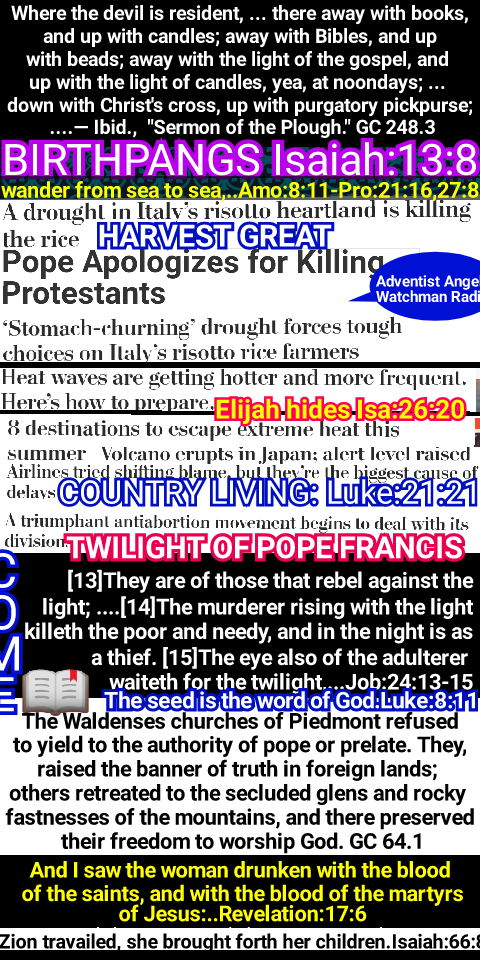
A striking illustration of Rome’s policy toward those who disagree with her was given in the long and bloody persecution of the Waldenses, some of whom were observers of the Sabbath. Others suffered in a similar manner for their fidelity to the fourth commandment. The history of the churches of Ethiopia and Abyssinia is especially significant. Amid the gloom of the Dark Ages, the Christians of Central Africa were lost sight of and forgotten by the world, and for many centuries they enjoyed freedom in the exercise of their faith. But at last Rome learned of their existence, and the emperor of Abyssinia was soon beguiled into an acknowledgment of the pope as the vicar of Christ. Other concessions followed. An edict was issued forbidding the observance of the Sabbath under the severest penalties. But papal tyranny soon became a yoke so galling that the Abyssinians determined to break it from their necks. After a terrible struggle, the Romanists were banished from their dominions, and the ancient faith was restored. The churches rejoiced in their freedom, and they never forgot the lesson they had learned concerning the deception, the fanaticism, and the despotic power of Rome. Within their solitary realm they were content to remain, unknown to the rest of Christendom.
The churches of Africa held the Sabbath as it was held by the papal church before her complete apostasy. While they kept the seventh day in obedience to the commandment of God, they abstained from labor on the Sunday in conformity to the custom of the church. Upon obtaining supreme power, Rome had trampled upon the Sabbath of God to exalt her own; but the churches of Africa, hidden for nearly a thousand years, did not share in this apostasy. When brought under the sway of Rome, they were forced to set aside the true and exalt the false Sabbath; but no sooner had they regained their independence than they returned to obedience to the fourth commandment. See Appendix, Note 12.
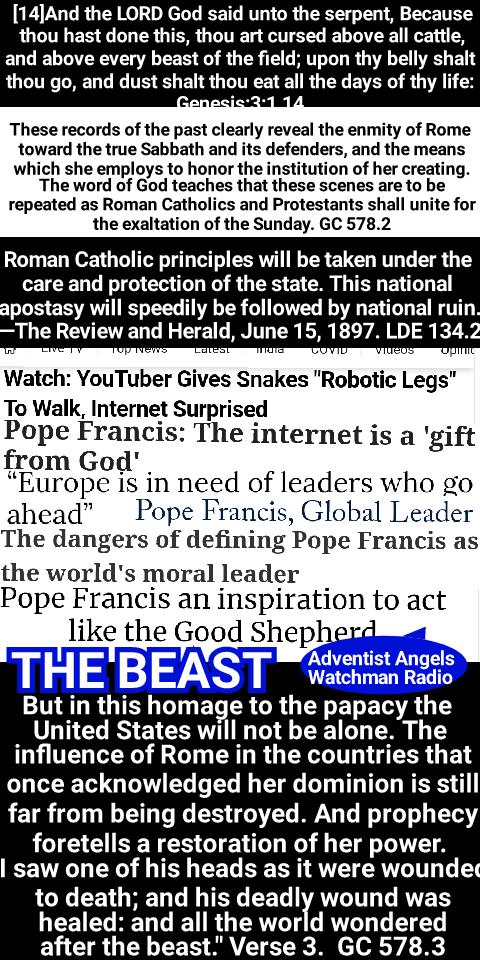
These records of the past clearly reveal the enmity of Rome toward the true Sabbath and its defenders, and the means which she employs to honor the institution of her creating. The Word of God teaches that these scenes are to be repeated as papists and Protestants shall unite for the exaltation of the Sunday.
The prophecy of Revelation 13 declares that the power represented by the beast with lamb-like horns shall cause “the earth and them which dwell therein” to worship the papacy—there symbolized by the beast “like unto a leopard.” The beast with two horns is also to say “to them that dwell on the earth, that they should make an image to the beast;” and, furthermore, it is to command all, “both small and great, rich and poor, free and bond,” to receive “the mark of the beast.” Revelation 13:11-16. It has been shown that the United States is the power represented by the beast with lamb-like horns, and that this prophecy will be fulfilled when the United States shall enforce Sunday observance, which Rome claims as the special acknowledgment of her supremacy. But in this homage to papacy the United States will not be alone. The influence of Rome in the countries that once acknowledged her dominion, is still far from being destroyed. And prophecy foretells a restoration of her power. “I saw one of his heads as it were wounded to death; and his deadly wound was healed; and all the world wondered after the beast.” Revelation 13:3. The infliction of the deadly wound points to the abolition of the papacy in 1798. After this, says the prophet, “His deadly wound was healed; and all the world wondered after the beast.” Paul states plainly that the man of sin will continue until the second advent. 2 Thessalonians 2:8. To the very close of time he will carry forward his work of deception. And the Revelator declares, also referring to the papacy, “All that dwell upon the earth shall worship him, whose names are not written in the book of life.” Revelation 13:8. In both the Old and the New World, papacy will receive homage in the honor paid to the Sunday institution, that rests solely upon the authority of the Romish Church.
For about forty years, students of prophecy in the United States have presented this testimony to the world. In the events now taking place is seen a rapid advance toward the fulfillment of the prediction. With Protestant teachers there is the same claim of divine authority for Sunday-keeping, and the same lack of scriptural evidence, as with the papist leaders who fabricated miracles to supply the place of a command from God. The assertion that God’s judgments are visited upon men for their violation of the Sunday-sabbath, will be repeated; already it is beginning to be urged. And a movement to enforce Sunday observance is fast gaining ground.
Marvelous in her shrewdness and cunning is the Romish Church. She can read what is to be. She bides her time, seeing that the Protestant churches are paying her homage in their acceptance of the false Sabbath, and that they are preparing to enforce it by the very means which she herself employed in by-gone days. Those who reject the light of truth will yet seek the aid of this self-styled infallible power to exalt an institution that originated with her. How readily she will come to the help of Protestants in this work, it is not difficult to conjecture. Who understands better than the papal leaders how to deal with those who are disobedient to the church?
The Roman Church, with all its ramifications throughout the world, forms one vast organization, under the control, and designed to serve the interests, of the papal see. Its millions of communicants, in every country on the globe, are instructed to hold themselves as bound in allegiance to the pope. Whatever their nationality or their government, they are to regard the authority of the church as above all other. Though they may take the oath pledging their loyalty to the State, yet back of this lies the vow of obedience to Rome, absolving them from every pledge inimical to her interests.
Protestants little know what they are doing when they propose to accept the aid of Rome in the work of Sunday exaltation. While they are bent upon the accomplishment of their purpose, Rome is aiming to re-establish her power, to recover her lost supremacy. Let history testify of her artful and persistent efforts to insinuate herself into the affairs of nations; and having gained a foothold, to further her own aims, even at the ruin of princes and people. Romanism openly puts forth the claim that the pope “can pronounce sentences and judgments in contradiction to the right of nations, to the law of God and man.” The “Decretalia.”
And let it be remembered, it is the boast of Rome that she never changes. The principles of Gregory VII. and Innocent III. are still the principles of the Romish Church. And had she but the power, she would put them in practice with as much vigor now as in past centuries. Let the principle once be established in the United States, that the church may employ or control the power of the State; that religious observances may be enforced by secular laws; in short, that the authority of church and State is to dominate the conscience, and the triumph of Rome in this country is assured.
God’s Word has given warning of the impending danger; let this be unheeded, and the Protestant world will learn what the purposes of Rome really are, only when it is too late to escape the snare. She is silently growing into power. Her doctrines are exerting their influence in legislative halls, in the churches, and in the hearts of men. She is piling up her lofty and massive structures, in the secret recesses of which her former persecutions will be repeated. Stealthily and unsuspectedly she is strengthening her forces to further her own ends when the time shall come for her to strike. All that she desires is vantage-ground, and this is already being given her. We shall soon see and shall feel what the purpose of the Roman element is. Whoever shall believe and obey the Word of God will thereby incur reproach and persecution. GC88 563.1 – GC88 581.1
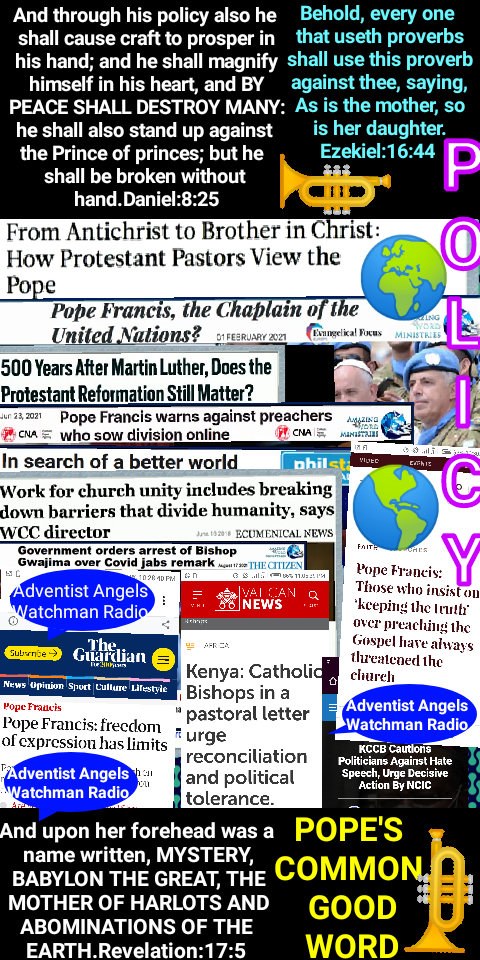
Laudato Si Sabbath Overules The Creators’ Sabbath: Coming Storm of Climate Refugees- Climate Migration Flooding Forces Bangladesh Families flee

As the storm approaches, a large class who have professed faith in the third angel’s message, but have not been sanctified through obedience to the truth, abandon their position and join the ranks of the opposition. By uniting with the world and partaking of its spirit, they have come to view matters in nearly the same light; and when the test is brought, they are prepared to choose the easy, popular side. Men of talent and pleasing address, who once rejoiced in the truth, employ their powers to deceive and mislead souls. They become the most bitter enemies of their former brethren. When Sabbathkeepers are brought before the courts to answer for their faith, these apostates are the most efficient agents of Satan to misrepresent and accuse them, and by false reports and insinuations to stir up the rulers against them.
In this time of persecution the faith of the Lord’s servants will be tried. They have faithfully given the warning, looking to God and to His word alone. God’s Spirit, moving upon their hearts, has constrained them to speak. Stimulated with holy zeal, and with the divine impulse strong upon them, they entered upon the performance of their duties without coldly calculating the consequences of speaking to the people the word which the Lord had given them. They have not consulted their temporal interests, nor sought to preserve their reputation or their lives. Yet when the storm of opposition and reproach bursts upon them, some, overwhelmed with consternation, will be ready to exclaim: “Had we foreseen the consequences of our words, we would have held our peace.” They are hedged in with difficulties. Satan assails them with fierce temptations. The work which they have undertaken seems far beyond their ability to accomplish. They are threatened with destruction. The enthusiasm which animated them is gone; yet they cannot turn back. Then, feeling their utter helplessness, they flee to the Mighty One for strength. They remember that the words which they have spoken were not theirs, but His who bade them give the warning. God put the truth into their hearts, and they could not forbear to proclaim it.
The same trials have been experienced by men of God in ages past. Wycliffe, Huss, Luther, Tyndale, Baxter, Wesley, urged that all doctrines be brought to the test of the Bible and declared that they would renounce everything which it condemned. Against these men persecution raged with relentless fury; yet they ceased not to declare the truth. Different periods in the history of the church have each been marked by the development of some special truth, adapted to the necessities of God’s people at that time. Every new truth has made its way against hatred and opposition; those who were blessed with its light were tempted and tried. The Lord gives a special truth for the people in an emergency. Who dare refuse to publish it? He commands His servants to present the last invitation of mercy to the world. They cannot remain silent, except at the peril of their souls. Christ’s ambassadors have nothing to do with consequences. They must perform their duty and leave results with God GC 608.2 – GC 609.1
Romanism is now regarded by Protestants with far greater favor than in former years. In those countries where Catholicism is not in the ascendancy, and the papists are taking a conciliatory course in order to gain influence, there is an increasing indifference concerning the doctrines that separate the reformed churches from the papal hierarchy; the opinion is gaining ground that, after all, we do not differ so widely upon vital points as has been supposed, and that a little concession on our part will bring us into a better understanding with Rome. The time was when Protestants placed a high value upon the liberty of conscience which had been so dearly purchased. They taught their children to abhor popery and held that to seek harmony with Rome would be disloyalty to God. But how widely different are the sentiments now expressed!
The defenders of the papacy declare that the church has been maligned, and the Protestant world are inclined to accept the statement. Many urge that it is unjust to judge the church of today by the abominations and absurdities that marked her reign during the centuries of ignorance and darkness. They excuse her horrible cruelty as the result of the barbarism of the times and plead that the influence of modern civilization has changed her sentiments.
Have these persons forgotten the claim of infallibility put forth for eight hundred years by this haughty power? So far from being relinquished, this claim was affirmed in the nineteenth century with greater positiveness than ever before. As Rome asserts that the “church never erred; nor will it, according to the Scriptures, ever err ” (John L. von Mosheim, Institutes of Ecclesiastical History, book 3, century II, part 2, chapter 2, section 9, note 17), how can she renounce the principles which governed her course in past ages?
The papal church will never relinquish her claim to infallibility. All that she has done in her persecution of those who reject her dogmas she holds to be right; and would she not repeat the same acts, should the opportunity be presented? Let the restraints now imposed by secular governments be removed and Rome be reinstated in her former power, and there would speedily be a revival of her tyranny and persecution.
A well-known writer speaks thus of the attitude of the papal hierarchy as regards freedom of conscience, and of the perils which especially threaten the United States from the success of her policy:
“There are many who are disposed to attribute any fear of Roman Catholicism in the United States to bigotry or childishness. Such see nothing in the character and attitude of Romanism that is hostile to our free institutions, or find nothing portentous in its growth. Let us, then, first compare some of the fundamental principles of our government with those of the Catholic Church.
“The Constitution of the United States guarantees liberty of conscience . Nothing is dearer or more fundamental. Pope Pius IX, in his Encyclical Letter of August 15, 1854, said: The absurd and erroneous doctrines or ravings in defense of liberty of conscience are a most pestilential error—a pest, of all others, most to be dreaded in a state.' The same pope, in his Encyclical Letter of December 8, 1864, anathematizedthose who assert the liberty of conscience and of religious worship,’ also ‘all such as maintain that the church may not employ force.’
“The pacific tone of Rome in the United States does not imply a change of heart. She is tolerant where she is helpless. Says Bishop O’Connor: ‘Religious liberty is merely endured until the opposite can be carried into effect without peril to the Catholic world.’… The archbishop of St. Louis once said: ‘Heresy and unbelief are crimes; and in Christian countries, as in Italy and Spain, for instance, where all the people are Catholics, and where the Catholic religion is an essential part of the law of the land, they are punished as other crimes.’…
“Every cardinal, archbishop, and bishop in the Catholic Church takes an oath of allegiance to the pope, in which occur the following words: ‘Heretics, schismatics, and rebels to our said lord (the pope), or his aforesaid successors, I will to my utmost persecute and oppose.'”—Josiah Strong, Our Country, ch. 5, pars. 2-4. See Appendix for Corrected References.
It is true that there are real Christians in the Roman Catholic communion. Thousands in that church are serving God according to the best light they have. They are not allowed access to His word, and therefore they do not discern the truth. Published in 1888 and 1911. See Appendix. They have never seen the contrast between a living heart service and a round of mere forms and ceremonies. God looks with pitying tenderness upon these souls, educated as they are in a faith that is delusive and unsatisfying. He will cause rays of light to penetrate the dense darkness that surrounds them. He will reveal to them the truth as it is in Jesus, and many will yet take their position with His people.
But Romanism as a system is no more in harmony with the gospel of Christ now than at any former period in her history. The Protestant churches are in great darkness, or they would discern the signs of the times. The Roman Church is far-reaching in her plans and modes of operation. She is employing every device to extend her influence and increase her power in preparation for a fierce and determined conflict to regain control of the world, to re-establish persecution, and to undo all that Protestantism has done. Catholicism is gaining ground upon every side. See the increasing number of her churches and chapels in Protestant countries. Look at the popularity of her colleges and seminaries in America, so widely patronized by Protestants. Look at the growth of ritualism in England and the frequent defections to the ranks of the Catholics. These things should awaken the anxiety of all who prize the pure principles of the gospel.
Protestants have tampered with and patronized popery; they have made compromises and concessions which papists themselves are surprised to see and fail to understand. Men are closing their eyes to the real character of Romanism and the dangers to be apprehended from her supremacy. The people need to be aroused to resist the advances of this most dangerous foe to civil and religious liberty.
Many Protestants suppose that the Catholic religion is unattractive and that its worship is a dull, meaningless round of ceremony. Here they mistake. While Romanism is based upon deception, it is not a coarse and clumsy imposture. The religious service of the Roman Church is a most impressive ceremonial. Its gorgeous display and solemn rites fascinate the senses of the people and silence the voice of reason and of conscience. The eye is charmed. Magnificent churches, imposing processions, golden altars, jeweled shrines, choice paintings, and exquisite sculpture appeal to the love of beauty. The ear also is captivated. The music is unsurpassed. The rich notes of the deep-toned organ, blending with the melody of many voices as it swells through the lofty domes and pillared aisles of her grand cathedrals, cannot fail to impress the mind with awe and reverence.
This outward splendor, pomp, and ceremony, that only mocks the longings of the sin-sick soul, is an evidence of inward corruption. The religion of Christ needs not such attractions to recommend it. In the light shining from the cross, true Christianity appears so pure and lovely that no external decorations can enhance its true worth. It is the beauty of holiness, a meek and quiet spirit, which is of value with God.
Brilliancy of style is not necessarily an index of pure, elevated thought. High conceptions of art, delicate refinement of taste, often exist in minds that are earthly and sensual. They are often employed by Satan to lead men to forget the necessities of the soul, to lose sight of the future, immortal life, to turn away from their infinite Helper, and to live for this world alone.
A religion of externals is attractive to the unrenewed heart. The pomp and ceremony of the Catholic worship has a seductive, bewitching power, by which many are deceived; and they come to look upon the Roman Church as the very gate of heaven. None but those who have planted their feet firmly upon the foundation of truth, and whose hearts are renewed by the Spirit of God, are proof against her influence. Thousands who have not an experimental knowledge of Christ will be led to accept the forms of godliness without the power. Such a religion is just what the multitudes desire.
The church’s claim to the right to pardon leads the Romanist to feel at liberty to sin; and the ordinance of confession, without which her pardon is not granted, tends also to give license to evil. He who kneels before fallen man, and opens in confession the secret thoughts and imaginations of his heart, is debasing his manhood and degrading every noble instinct of his soul. In unfolding the sins of his life to a priest,—an erring, sinful mortal, and too often corrupted with wine and licentiousness,—his standard of character is lowered, and he is defiled in consequence. His thought of God is degraded to the likeness of fallen humanity, for the priest stands as a representative of God. This degrading confession of man to man is the secret spring from which has flowed much of the evil that is defiling the world and fitting it for the final destruction. Yet to him who loves self-indulgence, it is more pleasing to confess to a fellow mortal than to open the soul to God. It is more palatable to human nature to do penance than to renounce sin; it is easier to mortify the flesh by sackcloth and nettles and galling chains than to crucify fleshly lusts. Heavy is the yoke which the carnal heart is willing to bear rather than bow to the yoke of Christ.
There is a striking similarity between the Church of Rome and the Jewish Church at the time of Christ’s first advent. While the Jews secretly trampled upon every principle of the law of God, they were outwardly rigorous in the observance of its precepts, loading it down with exactions and traditions that made obedience painful and burdensome. As the Jews professed to revere the law, so do Romanists claim to reverence the cross. They exalt the symbol of Christ’s sufferings, while in their lives they deny Him whom it represents.
Papists place crosses upon their churches, upon their altars, and upon their garments. Everywhere is seen the insignia of the cross. Everywhere it is outwardly honored and exalted. But the teachings of Christ are buried beneath a mass of senseless traditions, false interpretations, and rigorous exactions. The Saviour’s words concerning the bigoted Jews, apply with still greater force to the leaders of the Roman Catholic Church: “They bind heavy burdens and grievous to be borne, and lay them on men’s shoulders; but they themselves will not move them with one of their fingers.” Matthew 23:4. Conscientious souls are kept in constant terror fearing the wrath of an offended God, while many of the dignitaries of the church are living in luxury and sensual pleasure.
The worship of images and relics, the invocation of saints, and the exaltation of the pope are devices of Satan to attract the minds of the people from God and from His Son. To accomplish their ruin, he endeavors to turn their attention from Him through whom alone they can find salvation. He will direct them to any object that can be substituted for the One who has said: “Come unto Me, all ye that labor and are heavy-laden, and I will give you rest.” Matthew 11:28.
It is Satan’s constant effort to misrepresent the character of God, the nature of sin, and the real issues at stake in the great controversy. His sophistry lessens the obligation of the divine law and gives men license to sin. At the same time he causes them to cherish false conceptions of God so that they regard Him with fear and hate rather than with love. The cruelty inherent in his own character is attributed to the Creator; it is embodied in systems of religion and expressed in modes of worship. Thus the minds of men are blinded, and Satan secures them as his agents to war against God. By perverted conceptions of the divine attributes, heathen nations were led to believe human sacrifices necessary to secure the favor of Deity; and horrible cruelties have been perpetrated under the various forms of idolatry.
The Roman Catholic Church, uniting the forms of paganism and Christianity, and, like paganism, misrepresenting the character of God, has resorted to practices no less cruel and revolting. In the days of Rome’s supremacy there were instruments of torture to compel assent to her doctrines. There was the stake for those who would not concede to her claims. There were massacres on a scale that will never be known until revealed in the judgment. Dignitaries of the church studied, under Satan their master, to invent means to cause the greatest possible torture and not end the life of the victim. In many cases the infernal process was repeated to the utmost limit of human endurance, until nature gave up the struggle, and the sufferer hailed death as a sweet release.
Such was the fate of Rome’s opponents. For her adherents she had the discipline of the scourge, of famishing hunger, of bodily austerities in every conceivable, heart-sickening form. To secure the favor of Heaven, penitents violated the laws of God by violating the laws of nature. They were taught to sunder the ties which He has formed to bless and gladden man’s earthly sojourn. The churchyard contains millions of victims who spent their lives in vain endeavors to subdue their natural affections, to repress, as offensive to God, every thought and feeling of sympathy with their fellow creatures.
If we desire to understand the determined cruelty of Satan, manifested for hundreds of years, not among those who never heard of God, but in the very heart and throughout the extent of Christendom, we have only to look at the history of Romanism. Through this mammoth system of deception the prince of evil achieves his purpose of bringing dishonor to God and wretchedness to man. And as we see how he succeeds in disguising himself and accomplishing his work through the leaders of the church, we may better understand why he has so great antipathy to the Bible. If that Book is read, the mercy and love of God will be revealed; it will be seen that He lays upon men none of these heavy burdens. All that He asks is a broken and contrite heart, a humble, obedient spirit.
Christ gives no example in His life for men and women to shut themselves in monasteries in order to become fitted for heaven. He has never taught that love and sympathy must be repressed. The Saviour’s heart overflowed with love. The nearer man approaches to moral perfection, the keener are his sensibilities, the more acute is his perception of sin, and the deeper his sympathy for the afflicted. The pope claims to be the vicar of Christ; but how does his character bear comparison with that of our Saviour? Was Christ ever known to consign men to the prison or the rack because they did not pay Him homage as the King of heaven? Was His voice heard condemning to death those who did not accept Him? When He was slighted by the people of a Samaritan village, the apostle John was filled with indignation, and inquired: “Lord, wilt Thou that we command fire to come down from heaven, and consume them, even as Elias did?” Jesus looked with pity upon His disciple, and rebuked his harsh spirit, saying: “The Son of man is not come to destroy men’s lives, but to save them.” Luke 9:54, 56. How different from the spirit manifested by Christ is that of His professed vicar.
The Roman Church now presents a fair front to the world, covering with apologies her record of horrible cruelties. She has clothed herself in Christlike garments; but she is unchanged. Every principle of the papacy that existed in past ages exists today. The doctrines devised in the darkest ages are still held. Let none deceive themselves. The papacy that Protestants are now so ready to honor is the same that ruled the world in the days of the Reformation, when men of God stood up, at the peril of their lives, to expose her iniquity. She possesses the same pride and arrogant assumption that lorded it over kings and princes, and claimed the prerogatives of God. Her spirit is no less cruel and despotic now than when she crushed out human liberty and slew the saints of the Most High.
The papacy is just what prophecy declared that she would be, the apostasy of the latter times. 2 Thessalonians 2:3, 4. It is a part of her policy to assume the character which will best accomplish her purpose; but beneath the variable appearance of the chameleon she conceals the invariable venom of the serpent. “Faith ought not to be kept with heretics, nor persons suspected of heresy” (Lenfant, volume 1, page 516), she declares. Shall this power, whose record for a thousand years is written in the blood of the saints, be now acknowledged as a part of the church of Christ?
It is not without reason that the claim has been put forth in Protestant countries that Catholicism differs less widely from Protestantism than in former times. There has been a change; but the change is not in the papacy. Catholicism indeed resembles much of the Protestantism that now exists, because Protestantism has so greatly degenerated since the days of the Reformers.
As the Protestant churches have been seeking the favor of the world, false charity has blinded their eyes. They do not see but that it is right to believe good of all evil, and as the inevitable result they will finally believe evil of all good. Instead of standing in defense of the faith once delivered to the saints, they are now, as it were, apologizing to Rome for their uncharitable opinion of her, begging pardon for their bigotry.
A large class, even of those who look upon Romanism with no favor, apprehend little danger from her power and influence. Many urge that the intellectual and moral darkness prevailing during the Middle Ages favored the spread of her dogmas, superstitions, and oppression, and that the greater intelligence of modern times, the general diffusion of knowledge, and the increasing liberality in matters of religion forbid a revival of intolerance and tyranny. The very thought that such a state of things will exist in this enlightened age is ridiculed. It is true that great light, intellectual, moral, and religious, is shining upon this generation. In the open pages of God’s Holy Word, light from heaven has been shed upon the world. But it should be remembered that the greater the light bestowed, the greater the darkness of those who pervert and reject it.
A prayerful study of the Bible would show Protestants the real character of the papacy and would cause them to abhor and to shun it; but many are so wise in their own conceit that they feel no need of humbly seeking God that they may be led into the truth. Although priding themselves on their enlightenment, they are ignorant both of the Scriptures and of the power of God. They must have some means of quieting their consciences, and they seek that which is least spiritual and humiliating. What they desire is a method of forgetting God which shall pass as a method of remembering Him. The papacy is well adapted to meet the wants of all these. It is prepared for two classes of mankind, embracing nearly the whole world—those who would be saved by their merits, and those who would be saved in their sins. Here is the secret of its power.
A day of great intellectual darkness has been shown to be favorable to the success of the papacy. It will yet be demonstrated that a day of great intellectual light is equally favorable for its success. In past ages, when men were without God’s word and without the knowledge of the truth, their eyes were blindfolded, and thousands were ensnared, not seeing the net spread for their feet. In this generation there are many whose eyes become dazzled by the glare of human speculations, “science falsely so called;” they discern not the net, and walk into it as readily as if blindfolded. God designed that man’s intellectual powers should be held as a gift from his Maker and should be employed in the service of truth and righteousness; but when pride and ambition are cherished, and men exalt their own theories above the word of God, then intelligence can accomplish greater harm than ignorance. Thus the false science of the present day, which undermines faith in the Bible, will prove as successful in preparing the way for the acceptance of the papacy, with its pleasing forms, as did the withholding of knowledge in opening the way for its aggrandizement in the Dark Ages.
In the movements now in progress in the United States to secure for the institutions and usages of the church the support of the state, Protestants are following in the steps of papists. Nay, more, they are opening the door for the papacy to regain in Protestant America the supremacy which she has lost in the Old World. And that which gives greater significance to this movement is the fact that the principal object contemplated is the enforcement of Sunday observance—a custom which originated with Rome, and which she claims as the sign of her authority. It is the spirit of the papacy—the spirit of conformity to worldly customs, the veneration for human traditions above the commandments of God—that is permeating the Protestant churches and leading them on to do the same work of Sunday exaltation which the papacy has done before them.
If the reader would understand the agencies to be employed in the soon-coming contest, he has but to trace the record of the means which Rome employed for the same object in ages past. If he would know how papists and Protestants united will deal with those who reject their dogmas, let him see the spirit which Rome manifested toward the Sabbath and its defenders.
Royal edicts, general councils, and church ordinances sustained by secular power were the steps by which the pagan festival attained its position of honor in the Christian world. The first public measure enforcing Sunday observance was the law enacted by Constantine. (A.D. 321; see Appendix note for page 53.) This edict required townspeople to rest on “the venerable day of the sun,” but permitted countrymen to continue their agricultural pursuits. Though virtually a heathen statute, it was enforced by the emperor after his nominal acceptance of Christianity.
The royal mandate not proving a sufficient substitute for divine authority, Eusebius, a bishop who sought the favor of princes, and who was the special friend and flatterer of Constantine, advanced the claim that Christ had transferred the Sabbath to Sunday. Not a single testimony of the Scriptures was produced in proof of the new doctrine. Eusebius himself unwittingly acknowledges its falsity and points to the real authors of the change. “All things,” he says, “whatever that it was duty to do on the Sabbath, these we have transferred to the Lord’s Day.”—Robert Cox, Sabbath Laws and Sabbath Duties, page 538. But the Sunday argument, groundless as it was, served to embolden men in trampling upon the Sabbath of the Lord. All who desired to be honored by the world accepted the popular festival.
As the papacy became firmly established, the work of Sunday exaltation was continued. For a time the people engaged in agricultural labor when not attending church, and the seventh day was still regarded as the Sabbath. But steadily a change was effected. Those in holy office were forbidden to pass judgment in any civil controversy on the Sunday. Soon after, all persons, of whatever rank, were commanded to refrain from common labor on pain of a fine for freemen and stripes in the case of servants. Later it was decreed that rich men should be punished with the loss of half of their estates; and finally, that if still obstinate they should be made slaves. The lower classes were to suffer perpetual banishment.
Miracles also were called into requisition. Among other wonders it was reported that as a husbandman who was about to plow his field on Sunday cleaned his plow with an iron, the iron stuck fast in his hand, and for two years he carried it about with him, “to his exceeding great pain and shame.”—Francis West, Historical and Practical Discourse on the Lord’s Day, page 174.
Later the pope gave directions that the parish priest should admonish the violators of Sunday and wish them to go to church and say their prayers, lest they bring some great calamity on themselves and neighbors. An ecclesiastical council brought forward the argument, since so widely employed, even by Protestants, that because persons had been struck by lightning while laboring on Sunday, it must be the Sabbath. “It is apparent,” said the prelates, “how high the displeasure of God was upon their neglect of this day.” An appeal was then made that priests and ministers, kings and princes, and all faithful people “use their utmost endeavors and care that the day be restored to its honor, and, for the credit of Christianity, more devoutly observed for the time to come.”—Thomas Morer, Discourse in Six Dialogues on the Name, Notion, and Observation of the Lord’s Day, page 271.
The decrees of councils proving insufficient, the secular authorities were besought to issue an edict that would strike terror to the hearts of the people and force them to refrain from labor on the Sunday. At a synod held in Rome, all previous decisions were reaffirmed with greater force and solemnity. They were also incorporated into the ecclesiastical law and enforced by the civil authorities throughout nearly all Christendom. (See Heylyn, History of the Sabbath, pt. 2, ch. 5, sec. 7.)
Still the absence of Scriptural authority for Sundaykeeping occasioned no little embarrassment. The people questioned the right of their teachers to set aside the positive declaration of Jehovah, “The seventh day is the Sabbath of the Lord thy God,” in order to honor the day of the sun. To supply the lack of Bible testimony, other expedients were necessary. A zealous advocate of Sunday, who about the close of the twelfth century visited the churches of England, was resisted by faithful witnesses for the truth; and so fruitless were his efforts that he departed from the country for a season and cast about him for some means to enforce his teachings. When he returned, the lack was supplied, and in his after labors he met with greater success. He brought with him a roll purporting to be from God Himself, which contained the needed command for Sunday observance, with awful threats to terrify the disobedient. This precious document—as base a counterfeit as the institution it supported—was said to have fallen from heaven and to have been found in Jerusalem, upon the altar of St. Simeon, in Golgotha. But, in fact, the pontifical palace at Rome was the source whence it proceeded. Frauds and forgeries to advance the power and prosperity of the church have in all ages been esteemed lawful by the papal hierarchy.
The roll forbade labor from the ninth hour, three o’clock, on Saturday afternoon, till sunrise on Monday; and its authority was declared to be confirmed by many miracles. It was reported that persons laboring beyond the appointed hour were stricken with paralysis. A Miller who attempted to grind his corn, saw, instead of flour, a torrent of blood come forth, and the mill wheel stood still, notwithstanding the strong rush of water. A woman who placed dough in the oven found it raw when taken out, though the oven was very hot. Another who had dough prepared for baking at the ninth hour, but determined to set it aside till Monday, found, the next day, that it had been made into loaves and baked by divine power. A man who baked bread after the ninth hour on Saturday found, when he broke it the next morning, that blood started therefrom. By such absurd and superstitious fabrications did the advocates of Sunday endeavor to establish its sacredness. (See Roger de Hoveden, Annals, vol. 2, pp. 526-530.)
In Scotland, as in England, a greater regard for Sunday was secured by uniting with it a portion of the ancient Sabbath. But the time required to be kept holy varied. An edict from the king of Scotland declared that “Saturday from twelve at noon ought to be accounted holy,” and that no man, from that time till Monday morning, should engage in worldly business.—Morer, pages 290, 291.
But notwithstanding all the efforts to establish Sunday sacredness, papists themselves publicly confessed the divine authority of the Sabbath and the human origin of the institution by which it had been supplanted. In the sixteenth century a papal council plainly declared: “Let all Christians remember that the seventh day was consecrated by God, and hath been received and observed, not only by the Jews, but by all others who pretend to worship God; though we Christians have changed their Sabbath into the Lord’s Day.”— Ibid., pages 281, 282. Those who were tampering with the divine law were not ignorant of the character of their work. They were deliberately setting themselves above God.
A striking illustration of Rome’s policy toward those who disagree with her was given in the long and bloody persecution of the Waldenses, some of whom were observers of the Sabbath. Others suffered in a similar manner for their fidelity to the fourth commandment. The history of the churches of Ethiopia and Abyssinia is especially significant. Amid the gloom of the Dark Ages, the Christians of Central Africa were lost sight of and forgotten by the world, and for many centuries they enjoyed freedom in the exercise of their faith. But at last Rome learned of their existence, and the emperor of Abyssinia was soon beguiled into an acknowledgment of the pope as the vicar of Christ. Other concessions followed. An edict was issued forbidding the observance of the Sabbath under the severest penalties. (See Michael Geddes, Church History of Ethiopia, pages 311, 312.) But papal tyranny soon became a yoke so galling that the Abyssinians determined to break it from their necks. After a terrible struggle the Romanists were banished from their dominions, and the ancient faith was restored. The churches rejoiced in their freedom, and they never forgot the lesson they had learned concerning the deception, the fanaticism, and the despotic power of Rome. Within their solitary realm they were content to remain, unknown to the rest of Christendom.
The churches of Africa held the Sabbath as it was held by the papal church before her complete apostasy. While they kept the seventh day in obedience to the commandment of God, they abstained from labor on the Sunday in conformity to the custom of the church. Upon obtaining supreme power, Rome had trampled upon the Sabbath of God to exalt her own; but the churches of Africa, hidden for nearly a thousand years, did not share in this apostasy. When brought under the sway of Rome, they were forced to set aside the true and exalt the false sabbath; but no sooner had they regained their independence than they returned to obedience to the fourth commandment. (See Appendix.)
These records of the past clearly reveal the enmity of Rome toward the true Sabbath and its defenders, and the means which she employs to honor the institution of her creating. The word of God teaches that these scenes are to be repeated as Roman Catholics and Protestants shall unite for the exaltation of the Sunday.
The prophecy of Revelation 13 declares that the power represented by the beast with lamblike horns shall cause “the earth and them which dwell therein” to worship the papacy—there symbolized by the beast “like unto a leopard.” The beast with two horns is also to say “to them that dwell on the earth, that they should make an image to the beast;” and, furthermore, it is to command all, “both small and great, rich and poor, free and bond,” to receive the mark of the beast. Revelation 13:11-16. It has been shown that the United States is the power represented by the beast with lamblike horns, and that this prophecy will be fulfilled when the United States shall enforce Sunday observance, which Rome claims as the special acknowledgment of her supremacy. But in this homage to the papacy the United States will not be alone. The influence of Rome in the countries that once acknowledged her dominion is still far from being destroyed. And prophecy foretells a restoration of her power. “I saw one of his heads as it were wounded to death; and his deadly wound was healed: and all the world wondered after the beast.” Verse 3. The infliction of the deadly wound points to the downfall of the papacy in 1798. After this, says the prophet, “his deadly wound was healed: and all the world wondered after the beast.” Paul states plainly that the “man of sin” will continue until the second advent. 2 Thessalonians 2:3-8. To the very close of time he will carry forward the work of deception. And the revelator declares, also referring to the papacy: “All that dwell upon the earth shall worship him, whose names are not written in the book of life.” Revelation 13:8. In both the Old and the New World, the papacy will receive homage in the honor paid to the Sunday institution, that rests solely upon the authority of the Roman Church.
Since the middle of the nineteenth century, students of prophecy in the United States have presented this testimony to the world. In the events now taking place is seen a rapid advance toward the fulfillment of the prediction. With Protestant teachers there is the same claim of divine authority for Sundaykeeping, and the same lack of Scriptural evidence, as with the papal leaders who fabricated miracles to supply the place of a command from God. The assertion that God’s judgments are visited upon men for their violation of the Sunday-sabbath, will be repeated; already it is beginning to be urged. And a movement to enforce Sunday observance is fast gaining ground.
Marvelous in her shrewdness and cunning is the Roman Church. She can read what is to be. She bides her time, seeing that the Protestant churches are paying her homage in their acceptance of the false sabbath and that they are preparing to enforce it by the very means which she herself employed in bygone days. Those who reject the light of truth will yet seek the aid of this self-styled infallible power to exalt an institution that originated with her. How readily she will come to the help of Protestants in this work it is not difficult to conjecture. Who understands better than the papal leaders how to deal with those who are disobedient to the church?
The Roman Catholic Church, with all its ramifications throughout the world, forms one vast organization under the control, and designed to serve the interests, of the papal see. Its millions of communicants, in every country on the globe, are instructed to hold themselves as bound in allegiance to the pope. Whatever their nationality or their government, they are to regard the authority of the church as above all other. Though they may take the oath pledging their loyalty to the state, yet back of this lies the vow of obedience to Rome, absolving them from every pledge inimical to her interests.
History testifies of her artful and persistent efforts to insinuate herself into the affairs of nations; and having gained a foothold, to further her own aims, even at the ruin of princes and people. In the year 1204, Pope Innocent III extracted from Peter II, king of Arragon, the following extraordinary oath: “I, Peter, king of Arragonians, profess and promise to be ever faithful and obedient to my lord, Pope Innocent, to his Catholic successors, and the Roman Church, and faithfully to preserve my kingdom in his obedience, defending the Catholic faith, and persecuting heretical pravity.”—John Dowling, The History of Romanism, b. 5, ch. 6, sec. 55. This is in harmony with the claims regarding the power of the Roman pontiff “that it is lawful for him to depose emperors” and “that he can absolve subjects from their allegiance to unrighteous rulers.”—Mosheim, b. 3, cent. 11, pt. 2, ch. 2, sec. 9, note 17. (See also Appendix note for page 447.)
And let it be remembered, it is the boast of Rome that she never changes. The principles of Gregory VII and Innocent III are still the principles of the Roman Catholic Church. And had she but the power, she would put them in practice with as much vigor now as in past centuries. Protestants little know what they are doing when they propose to accept the aid of Rome in the work of Sunday exaltation. While they are bent upon the accomplishment of their purpose, Rome is aiming to re-establish her power, to recover her lost supremacy. Let the principle once be established in the United States that the church may employ or control the power of the state; that religious observances may be enforced by secular laws; in short, that the authority of church and state is to dominate the conscience, and the triumph of Rome in this country is assured.
God’s word has given warning of the impending danger; let this be unheeded, and the Protestant world will learn what the purposes of Rome really are, only when it is too late to escape the snare. She is silently growing into power. Her doctrines are exerting their influence in legislative halls, in the churches, and in the hearts of men. She is piling up her lofty and massive structures in the secret recesses of which her former persecutions will be repeated. Stealthily and unsuspectedly she is strengthening her forces to further her own ends when the time shall come for her to strike. All that she desires is vantage ground, and this is already being given her. We shall soon see and shall feel what the purpose of the Roman element is. Whoever shall believe and obey the word of God will thereby incur reproach and persecution. GC 563.1 – GC 581.2
Pope Nebuchadnezzar in Burning Bush Laudato Si Siege Trees Sabbath Verse The Lord God Almighty Trees of Righteousness Edenic Sabbath- Purified Seven Times Furnace Gold

The words of the LORD are pure words: as silver tried in a furnace of earth, purified seven times.
Psalm:12:6

From the very beginning of the great controversy in heaven it has been Satan’s purpose to overthrow the law of God. It was to accomplish this that he entered upon his rebellion against the Creator, and though he was cast out of heaven he has continued the same warfare upon the earth. To deceive men, and thus lead them to transgress God’s law, is the object which he has steadfastly pursued. Whether this be accomplished by casting aside the law altogether, or by rejecting one of its precepts, the result will be ultimately the same. He that offends “in one point,” manifests contempt for the whole law; his influence and example are on the side of transgression; he becomes “guilty of all.” James 2:10.
In seeking to cast contempt upon the divine statutes, Satan has perverted the doctrines of the Bible, and errors have thus become incorporated into the faith of thousands who profess to believe the Scriptures. The last great conflict between truth and error is but the final struggle of the long-standing controversy concerning the law of God. Upon this battle we are now entering—a battle between the laws of men and the precepts of Jehovah, between the religion of the Bible and the religion of fable and tradition.
The agencies which will unite against truth and righteousness in this contest are now actively at work. God’s holy word, which has been handed down to us at such a cost of suffering and blood, is but little valued. The Bible is within the reach of all, but there are few who really accept it as the guide of life. Infidelity prevails to an alarming extent, not in the world merely, but in the church. Many have come to deny doctrines which are the very pillars of the Christian faith. The great facts of creation as presented by the inspired writers, the fall of man, the atonement, and the perpetuity of the law of God, are practically rejected, either wholly or in part, by a large share of the professedly Christian world. Thousands who pride themselves upon their wisdom and independence regard it as an evidence of weakness to place implicit confidence in the Bible; they think it a proof of superior talent and learning to cavil at the Scriptures and to spiritualize and explain away their most important truths. Many ministers are teaching their people, and many professors and teachers are instructing their students, that the law of God has been changed or abrogated; and those who regard its requirements as still valid, to be literally obeyed, are thought to be deserving only of ridicule or contempt.
In rejecting the truth, men reject its Author. In trampling upon the law of God, they deny the authority of the Law-giver. It is as easy to make an idol of false doctrines and theories as to fashion an idol of wood or stone. By misrepresenting the attributes of God, Satan leads men to conceive of Him in a false character. With many, a philosophical idol is enthroned in the place of Jehovah; while the living God, as He is revealed in His word, in Christ, and in the works of creation, is worshiped by but few. Thousands deify nature while they deny the God of nature. Though in a different form, idolatry exists in the Christian world today as verily as it existed among ancient Israel in the days of Elijah. The God of many professedly wise men, of philosophers, poets, politicians, journalists—the God of polished fashionable circles, of many colleges and universities, even of some theological institutions—is little better than Baal, the sun-god of Phoenicia.
No error accepted by the Christian world strikes more boldly against the authority of Heaven, none is more directly opposed to the dictates of reason, none is more pernicious in its results, than the modern doctrine, so rapidly gaining ground, that God’s law is no longer binding upon men. Every nation has its laws, which command respect and obedience; no government could exist without them; and can it be conceived that the Creator of the heavens and the earth has no law to govern the beings He has made? Suppose that prominent ministers were publicly to teach that the statutes which govern their land and protect the rights of its citizens were not obligatory—that they restricted the liberties of the people, and therefore ought not to be obeyed; how long would such men be tolerated in the pulpit? But is it a graver offense to disregard the laws of states and nations than to trample upon those divine precepts which are the foundation of all government?
It would be far more consistent for nations to abolish their statutes, and permit the people to do as they please, than for the Ruler of the universe to annul His law, and leave the world without a standard to condemn the guilty or justify the obedient. Would we know the result of making void the law of God? The experiment has been tried. Terrible were the scenes enacted in France when atheism became the controlling power. It was then demonstrated to the world that to throw off the restraints which God has imposed is to accept the rule of the cruelest of tyrants. When the standard of righteousness is set aside, the way is open for the prince of evil to establish his power in the earth.
Wherever the divine precepts are rejected, sin ceases to appear sinful or righteousness desirable. Those who refuse to submit to the government of God are wholly unfitted to govern themselves. Through their pernicious teachings the spirit of insubordination is implanted in the hearts of children and youth, who are naturally impatient of control; and a lawless, licentious state of society results. While scoffing at the credulity of those who obey the requirements of God, the multitudes eagerly accept the delusions of Satan. They give the rein to lust and practice the sins which have called down judgments upon the heathen.
Those who teach the people to regard lightly the commandments of God sow disobedience to reap disobedience. Let the restraint imposed by the divine law be wholly cast aside, and human laws would soon be disregarded. Because God forbids dishonest practices, coveting, lying, and defrauding, men are ready to trample upon His statutes as a hindrance to their worldly prosperity; but the results of banishing these precepts would be such as they do not anticipate. If the law were not binding, why should any fear to transgress? Property would no longer be safe. Men would obtain their neighbor’s possessions by violence, and the strongest would become richest. Life itself would not be respected. The marriage vow would no longer stand as a sacred bulwark to protect the family. He who had the power, would, if he desired, take his neighbor’s wife by violence. The fifth commandment would be set aside with the fourth. Children would not shrink from taking the life of their parents if by so doing they could obtain the desire of their corrupt hearts. The civilized world would become a horde of robbers and assassins; and peace, rest, and happiness would be banished from the earth.
Already the doctrine that men are released from obedience to God’s requirements has weakened the force of moral obligation and opened the floodgates of iniquity upon the world. Lawlessness, dissipation, and corruption are sweeping in upon us like an overwhelming tide. In the family, Satan is at work. His banner waves, even in professedly Christian households. There is envy, evil surmising, hypocrisy, estrangement, emulation, strife, betrayal of sacred trusts, indulgence of lust. The whole system of religious principles and doctrines, which should form the foundation and framework of social life, seems to be a tottering mass, ready to fall to ruin. The vilest of criminals, when thrown into prison for their offenses, are often made the recipients of gifts and attentions as if they had attained an enviable distinction. Great publicity is given to their character and crimes. The press publishes the revolting details of vice, thus initiating others into the practice of fraud, robbery, and murder; and Satan exults in the success of his hellish schemes. The infatuation of vice, the wanton taking of life, the terrible increase of intemperance and iniquity of every order and degree, should arouse all who fear God, to inquire what can be done to stay the tide of evil.
Courts of justice are corrupt. Rulers are actuated by desire for gain and love of sensual pleasure. Intemperance has beclouded the faculties of many so that Satan has almost complete control of them. Jurists are perverted, bribed, deluded. Drunkenness and revelry, passion, envy, dishonesty of every sort, are represented among those who administer the laws. “Justice standeth afar off: for truth is fallen in the street, and equity cannot enter.” Isaiah 59:14.
The iniquity and spiritual darkness that prevailed under the supremacy of Rome were the inevitable result of her suppression of the Scriptures; but where is to be found the cause of the widespread infidelity, the rejection of the law of God, and the consequent corruption, under the full blaze of gospel light in an age of religious freedom? Now that Satan can no longer keep the world under his control by withholding the Scriptures, he resorts to other means to accomplish the same object. To destroy faith in the Bible serves his purpose as well as to destroy the Bible itself. By introducing the belief that God’s law is not binding, he as effectually leads men to transgress as if they were wholly ignorant of its precepts. And now, as in former ages, he has worked through the church to further his designs. The religious organizations of the day have refused to listen to unpopular truths plainly brought to view in the Scriptures, and in combating them they have adopted interpretations and taken positions which have sown broadcast the seeds of skepticism. Clinging to the papal error of natural immortality and man’s consciousness in death, they have rejected the only defense against the delusions of spiritualism. The doctrine of eternal torment has led many to disbelieve the Bible. And as the claims of the fourth commandment are urged upon the people, it is found that the observance of the seventh-day Sabbath is enjoined; and as the only way to free themselves from a duty which they are unwilling to perform, many popular teachers declare that the law of God is no longer binding. Thus they cast away the law and the Sabbath together. As the work of Sabbath reform extends, this rejection of the divine law to avoid the claims of the fourth commandment will become well-nigh universal. The teachings of religious leaders have opened the door to infidelity, to spiritualism, and to contempt for God’s holy law; and upon these leaders rests a fearful responsibility for the iniquity that exists in the Christian world GC 582.1 – GC 586.2
Dropping Manna Doctrine Factories (Heaven) Shut-China ‘Cities’ inducing strange (fire) rainfall to combat severe drought-Famine Sorrow! Elijah

Chinese authorities are attempting to induce rainfall in parts of central and southwest China amid a severe drought and record-breaking heatwave.

For by fire and by his sword will the LORD plead with all flesh: and the slain of the LORD shall be many.Isaiah:66:16 For the word of God is quick, and powerful, and sharper than any twoedged sword, piercing even to the dividing asunder of soul and spirit, and of the joints and marrow, and is a discerner of the thoughts and intents of the heart. Hebrews:4:12

Behold, all ye that kindle a fire, that compass yourselves about with sparks: walk in the light of your fire, and in the sparks that ye have kindled. This shall ye have of mine hand; ye shall lie down in sorrow.
Isaiah:50:11
The Yangtze River – Asia’s longest waterway – is now at record low levels. In some stretches, there has been less than half the usual rainfall.

Forasmuch as this people refuseth the waters of Shiloah that go softly, and rejoice in Rezin and Remaliah’s son;Isaiah:8:6 And the Spirit and the bride say, Come. And let him that heareth say, Come. And let him that is athirst come. And whosoever will, let him take the water of life freely.Revelation:22:17

Hydropower reservoirs are currently down by as much as half, officials say.

At the same time, a surge in demand for air conditioning has put power companies under extreme pressure.

The two-month-long heatwave is the longest on record in China, the National Climate Centre said.

Provinces around the drought-stricken Yangtze river have turned to cloud seeding operations to combat the lack of rain, with Hubei and a number of other provinces launching rockets carrying chemicals into the sky, according to local media.

But a lack of cloud cover has stalled efforts in some areas seeking to do the same.

People swim in the intersection of the Han and Yangtze rivers during the heatwave in Wuhan, Hubei province on 10 August
Image caption,People swim in the intersection of the Han and Yangtze rivers during the heatwave in Wuhan, Hubei province on 10 August

Meanwhile, temperatures across Sichuan and neighbouring provinces have exceeded 40C (104 F).

As a result, government offices in Sichuan were asked to keep air conditioning levels at no lower than 26C (79 F), according to the Sichuan Daily quoted by Reuters news agency. Workers have also been asked to use staircases rather than lifts where possible.

Millions of residents have also been hit with black outs in the province.

In the city of Dazhou, home to some 5.4 million people, blackouts are lasting up to three hours, local media report.

They say factories in the province have been forced to cut production or halt work as part of emergency measures to redirect power supplies to households.

Hydropower reservoirs – of which there are many in the region – are currently down by as much as half, officials added.

Map

More on this story

Already the doctrine that men are released from obedience to God’s requirements has weakened the force of moral obligation and opened the floodgates of iniquity upon the world. Lawlessness, dissipation, and corruption are sweeping in upon us like an overwhelming tide. In the family, Satan is at work. His banner waves, even in professedly Christian households. There is envy, evil surmising, hypocrisy, estrangement, emulation, strife, betrayal of sacred trusts, indulgence of lust. The whole system of religious principles and doctrines, which should form the foundation and framework of social life, seems to be a tottering mass, ready to fall to ruin. The vilest of criminals, when thrown into prison for their offenses, are often made the recipients of gifts and attentions as if they had attained an enviable distinction. Great publicity is given to their character and crimes. The press publishes the revolting details of vice, thus initiating others into the practice of fraud, robbery, and murder; and Satan exults in the success of his hellish schemes. The infatuation of vice, the wanton taking of life, the terrible increase of intemperance and iniquity of every order and degree, should arouse all who fear God, to inquire what can be done to stay the tide of evil.
Courts of justice are corrupt. Rulers are actuated by desire for gain and love of sensual pleasure. Intemperance has beclouded the faculties of many so that Satan has almost complete control of them. Jurists are perverted, bribed, deluded. Drunkenness and revelry, passion, envy, dishonesty of every sort, are represented among those who administer the laws. “Justice standeth afar off: for truth is fallen in the street, and equity cannot enter.” Isaiah 59:14.
The iniquity and spiritual darkness that prevailed under the supremacy of Rome were the inevitable result of her suppression of the Scriptures; but where is to be found the cause of the widespread infidelity, the rejection of the law of God, and the consequent corruption, under the full blaze of gospel light in an age of religious freedom? Now that Satan can no longer keep the world under his control by withholding the Scriptures, he resorts to other means to accomplish the same object. To destroy faith in the Bible serves his purpose as well as to destroy the Bible itself. By introducing the belief that God’s law is not binding, he as effectually leads men to transgress as if they were wholly ignorant of its precepts. And now, as in former ages, he has worked through the church to further his designs. The religious organizations of the day have refused to listen to unpopular truths plainly brought to view in the Scriptures, and in combating them they have adopted interpretations and taken positions which have sown broadcast the seeds of skepticism. Clinging to the papal error of natural immortality and man’s consciousness in death, they have rejected the only defense against the delusions of spiritualism. The doctrine of eternal torment has led many to disbelieve the Bible. And as the claims of the fourth commandment are urged upon the people, it is found that the observance of the seventh-day Sabbath is enjoined; and as the only way to free themselves from a duty which they are unwilling to perform, many popular teachers declare that the law of God is no longer binding. Thus they cast away the law and the Sabbath together. As the work of Sabbath reform extends, this rejection of the divine law to avoid the claims of the fourth commandment will become well-nigh universal. The teachings of religious leaders have opened the door to infidelity, to spiritualism, and to contempt for God’s holy law; and upon these leaders rests a fearful responsibility for the iniquity that exists in the Christian world.
Yet this very class put forth the claim that the fast-spreading corruption is largely attributable to the desecration of the so-called “Christian sabbath,” and that the enforcement of Sunday observance would greatly improve the morals of society. This claim is especially urged in America, where the doctrine of the true Sabbath has been most widely preached. Here the temperance work, one of the most prominent and important of moral reforms, is often combined with the Sunday movement, and the advocates of the latter represent themselves as laboring to promote the highest interest of society; and those who refuse to unite with them are denounced as the enemies of temperance and reform. But the fact that a movement to establish error is connected with a work which is in itself good, is not an argument in favor of the error. We may disguise poison by mingling it with wholesome food, but we do not change its nature. On the contrary, it is rendered more dangerous, as it is more likely to be taken unawares. It is one of Satan’s devices to combine with falsehood just enough truth to give it plausibility. The leaders of the Sunday movement may advocate reforms which the people need, principles which are in harmony with the Bible; yet while there is with these a requirement which is contrary to God’s law, His servants cannot unite with them. Nothing can justify them in setting aside the commandments of God for the precepts of men.
Through the two great errors, the immortality of the soul and Sunday sacredness, Satan will bring the people under his deceptions. While the former lays the foundation of spiritualism, the latter creates a bond of sympathy with Rome. The Protestants of the United States will be foremost in stretching their hands across the gulf to grasp the hand of spiritualism; they will reach over the abyss to clasp hands with the Roman power; and under the influence of this threefold union, this country will follow in the steps of Rome in trampling on the rights of conscience.
As spiritualism more closely imitates the nominal Christianity of the day, it has greater power to deceive and ensnare. Satan himself is converted, after the modern order of things. He will appear in the character of an angel of light. Through the agency of spiritualism, miracles will be wrought, the sick will be healed, and many undeniable wonders will be performed. And as the spirits will profess faith in the Bible, and manifest respect for the institutions of the church, their work will be accepted as a manifestation of divine power.
The line of distinction between professed Christians and the ungodly is now hardly distinguishable. Church members love what the world loves and are ready to join with them, and Satan determines to unite them in one body and thus strengthen his cause by sweeping all into the ranks of spiritualism. Papists, who boast of miracles as a certain sign of the true church, will be readily deceived by this wonder-working power; and Protestants, having cast away the shield of truth, will also be deluded. Papists, Protestants, and worldlings will alike accept the form of godliness without the power, and they will see in this union a grand movement for the conversion of the world and the ushering in of the long-expected millennium.
Through spiritualism, Satan appears as a benefactor of the race, healing the diseases of the people, and professing to present a new and more exalted system of religious faith; but at the same time he works as a destroyer. His temptations are leading multitudes to ruin. Intemperance dethrones reason; sensual indulgence, strife, and bloodshed follow. Satan delights in war, for it excites the worst passions of the soul and then sweeps into eternity its victims steeped in vice and blood. It is his object to incite the nations to war against one another, for he can thus divert the minds of the people from the work of preparation to stand in the day of God.
Satan works through the elements also to garner his harvest of unprepared souls. He has studied the secrets of the laboratories of nature, and he uses all his power to control the elements as far as God allows. When he was suffered to afflict Job, how quickly flocks and herds, servants, houses, children, were swept away, one trouble succeeding another as in a moment. It is God that shields His creatures and hedges them in from the power of the destroyer. But the Christian world have shown contempt for the law of Jehovah; and the Lord will do just what He has declared that He would—He will withdraw His blessings from the earth and remove His protecting care from those who are rebelling against His law and teaching and forcing others to do the same. Satan has control of all whom God does not especially guard. He will favor and prosper some in order to further his own designs, and he will bring trouble upon others and lead men to believe that it is God who is afflicting them.
While appearing to the children of men as a great physician who can heal all their maladies, he will bring disease and disaster, until populous cities are reduced to ruin and desolation. Even now he is at work. In accidents and calamities by sea and by land, in great conflagrations, in fierce tornadoes and terrific hailstorms, in tempests, floods, cyclones, tidal waves, and earthquakes, in every place and in a thousand forms, Satan is exercising his power. He sweeps away the ripening harvest, and famine and distress follow. He imparts to the air a deadly taint, and thousands perish by the pestilence. These visitations are to become more and more frequent and disastrous. Destruction will be upon both man and beast. “The earth mourneth and fadeth away,” “the haughty people … do languish. The earth also is defiled under the inhabitants thereof; because they have transgressed the laws, changed the ordinance, broken the everlasting covenant.” Isaiah 24:4, 5.
And then the great deceiver will persuade men that those who serve God are causing these evils. The class that have provoked the displeasure of Heaven will charge all their troubles upon those whose obedience to God’s commandments is a perpetual reproof to transgressors. It will be declared that men are offending God by the violation of the Sunday sabbath; that this sin has brought calamities which will not cease until Sunday observance shall be strictly enforced; and that those who present the claims of the fourth commandment, thus destroying reverence for Sunday, are troublers of the people, preventing their restoration to divine favor and temporal prosperity. Thus the accusation urged of old against the servant of God will be repeated and upon grounds equally well established: “And it came to pass, when Ahab saw Elijah, that Ahab said unto him, Art thou he that troubleth Israel? And he answered, I have not troubled Israel; but thou, and thy father’s house, in that ye have forsaken the commandments of the Lord, and thou hast followed Baalim.” 1 Kings 18:17, 18. As the wrath of the people shall be excited by false charges, they will pursue a course toward God’s ambassadors very similar to that which apostate Israel pursued toward Elijah.
The miracle-working power manifested through spiritualism will exert its influence against those who choose to obey God rather than men. Communications from the spirits will declare that God has sent them to convince the rejecters of Sunday of their error, affirming that the laws of the land should be obeyed as the law of God. They will lament the great wickedness in the world and second the testimony of religious teachers that the degraded state of morals is caused by the desecration of Sunday. Great will be the indignation excited against all who refuse to accept their testimony.
Satan’s policy in this final conflict with God’s people is the same that he employed in the opening of the great controversy in heaven. He professed to be seeking to promote the stability of the divine government, while secretly bending every effort to secure its overthrow. And the very work which he was thus endeavoring to accomplish he charged upon the loyal angels. The same policy of deception has marked the history of the Roman Church. It has professed to act as the vicegerent of Heaven, while seeking to exalt itself above God and to change His law. Under the rule of Rome, those who suffered death for their fidelity to the gospel were denounced as evildoers; they were declared to be in league with Satan; and every possible means was employed to cover them with reproach, to cause them to appear in the eyes of the people and even to themselves as the vilest of criminals. So it will be now. While Satan seeks to destroy those who honor God’s law, he will cause them to be accused as lawbreakers, as men who are dishonoring God and bringing judgments upon the world.
God never forces the will or the conscience; but Satan’s constant resort—to gain control of those whom he cannot otherwise seduce—is compulsion by cruelty. Through fear or force he endeavors to rule the conscience and to secure homage to himself. To accomplish this, he works through both religious and secular authorities, moving them to the enforcement of human laws in defiance of the law of God.
Those who honor the Bible Sabbath will be denounced as enemies of law and order, as breaking down the moral restraints of society, causing anarchy and corruption, and calling down the judgments of God upon the earth. Their conscientious scruples will be pronounced obstinacy, stubbornness, and contempt of authority. They will be accused of disaffection toward the government. Ministers who deny the obligation of the divine law will present from the pulpit the duty of yielding obedience to the civil authorities as ordained of God. In legislative halls and courts of justice, commandment keepers will be misrepresented and condemned. A false coloring will be given to their words; the worst construction will be put upon their motives.
As the Protestant churches reject the clear, Scriptural arguments in defense of God’s law, they will long to silence those whose faith they cannot overthrow by the Bible. Though they blind their own eyes to the fact, they are now adopting a course which will lead to the persecution of those who conscientiously refuse to do what the rest of the Christian world are doing, and acknowledge the claims of the papal sabbath.
The dignitaries of church and state will unite to bribe, persuade, or compel all classes to honor the Sunday. The lack of divine authority will be supplied by oppressive enactments. Political corruption is destroying love of justice and regard for truth; and even in free America, rulers and legislators, in order to secure public favor, will yield to the popular demand for a law enforcing Sunday observance. Liberty of conscience, which has cost so great a sacrifice, will no longer be respected. In the soon-coming conflict we shall see exemplified the prophet’s words: “The dragon was wroth with the woman, and went to make war with the remnant of her seed, which keep the commandments of God, and have the testimony of Jesus Christ.” Revelation 12:17. GC 585.2 – GC 592.3

Let Us Dream:US couple transforms abandoned Italian house into dream home with an elevator

LIVING THE DREAM

Silvia Marchetti, CNN • Updated 8th August 2022

14 one euro italian home elevator

Editor’s Note — Sign up to CNN Travel’s free nine-part Unlocking Italy newsletter for insider intel on Italy’s best loved destinations and lesser-known regions to plan your ultimate trip. Plus, we’ll get you in the mood before you go with movie suggestions, reading lists and recipes from Stanley Tucci.(CNN) — 

Buyers from all around the world have been snapping up dilapidated Italian homes at rock bottom prices over the past few years as numerous depopulated towns and villages attempt to revive their dwindling communities by offering property bargains

[2]Behold, I have made thee small among the heathen: thou art greatly despised. [3]The pride of thine heart hath deceived thee, thou that dwellest in the clefts of the rock, whose habitation is high; that saith in his heart, Who shall bring me down to the ground? [4]Though thou exalt thyself as the eagle, and though thou set thy nest among the stars, thence will I bring thee down, saith the LORD. [7]All the men of thy confederacy have brought thee even to the border: the men that were at peace with thee have deceived thee, and prevailed against thee; that they eat thy bread have laid a wound under thee: there is none understanding in him.
Obadiah:1:2-4,7

Romanism is now regarded by Protestants with far greater favor than in former years. In those countries where Catholicism is not in the ascendancy, and the papists are taking a conciliatory course in order to gain influence, there is an increasing indifference concerning the doctrines that separate the reformed churches from the papal hierarchy; the opinion is gaining ground that, after all, we do not differ so widely upon vital points as has been supposed, and that a little concession on our part will bring us into a better understanding with Rome. The time was when Protestants placed a high value upon the liberty of conscience which had been so dearly purchased. They taught their children to abhor popery and held that to seek harmony with Rome would be disloyalty to God. But how widely different are the sentiments now expressed!
The defenders of the papacy declare that the church has been maligned, and the Protestant world are inclined to accept the statement. Many urge that it is unjust to judge the church of today by the abominations and absurdities that marked her reign during the centuries of ignorance and darkness. They excuse her horrible cruelty as the result of the barbarism of the times and plead that the influence of modern civilization has changed her sentiments.
Have these persons forgotten the claim of infallibility put forth for eight hundred years by this haughty power? So far from being relinquished, this claim was affirmed in the nineteenth century with greater positiveness than ever before. As Rome asserts that the “church never erred; nor will it, according to the Scriptures, ever err ” (John L. von Mosheim, Institutes of Ecclesiastical History, book 3, century II, part 2, chapter 2, section 9, note 17), how can she renounce the principles which governed her course in past ages?
The papal church will never relinquish her claim to infallibility. All that she has done in her persecution of those who reject her dogmas she holds to be right; and would she not repeat the same acts, should the opportunity be presented? Let the restraints now imposed by secular governments be removed and Rome be reinstated in her former power, and there would speedily be a revival of her tyranny and persecution.
A well-known writer speaks thus of the attitude of the papal hierarchy as regards freedom of conscience, and of the perils which especially threaten the United States from the success of her policy:
“There are many who are disposed to attribute any fear of Roman Catholicism in the United States to bigotry or childishness. Such see nothing in the character and attitude of Romanism that is hostile to our free institutions, or find nothing portentous in its growth. Let us, then, first compare some of the fundamental principles of our government with those of the Catholic Church.
“The Constitution of the United States guarantees liberty of conscience . Nothing is dearer or more fundamental. Pope Pius IX, in his Encyclical Letter of August 15, 1854, said: The absurd and erroneous doctrines or ravings in defense of liberty of conscience are a most pestilential error—a pest, of all others, most to be dreaded in a state.' The same pope, in his Encyclical Letter of December 8, 1864, anathematizedthose who assert the liberty of conscience and of religious worship,’ also ‘all such as maintain that the church may not employ force.’
“The pacific tone of Rome in the United States does not imply a change of heart. She is tolerant where she is helpless. Says Bishop O’Connor: ‘Religious liberty is merely endured until the opposite can be carried into effect without peril to the Catholic world.’… The archbishop of St. Louis once said: ‘Heresy and unbelief are crimes; and in Christian countries, as in Italy and Spain, for instance, where all the people are Catholics, and where the Catholic religion is an essential part of the law of the land, they are punished as other crimes.’…
“Every cardinal, archbishop, and bishop in the Catholic Church takes an oath of allegiance to the pope, in which occur the following words: ‘Heretics, schismatics, and rebels to our said lord (the pope), or his aforesaid successors, I will to my utmost persecute and oppose.'”—Josiah Strong, Our Country, ch. 5, pars. 2-4. See Appendix for Corrected References GC 563.1 – GC 565.2

Bind into Bundle-Unions To ‘Eliminate evil, Invasive Species and Extrimists’ Papua New Guinea Sorcery Violence, Forced Organ Harvesting ‘Common Good Multicultural’ In China

“Ye are the light of the world,” said Christ to His disciples. Matthew 5:14. I feel deeply over the inactivity and lack of faith and piety of our workers in our missions. God has entrusted to us great light, and our works do not correspond to that light. Satan is intensely active in these last days, doing his work of destroying souls and making attractive the road that leads to death. He prepares his agents, wheels them into line, and sets them to work to deceive and destroy. Men who are not on the side of God are on the enemy’s side. They are bold and defiant. Many deny the existence of God. There are knots of infidels binding in bundles ready to burn. They strengthen the hands of one another in their wickedness. They take counsel of their own hearts that are impressed by the originator of all evil. They assemble in council to devote their God-given powers to devise means to uproot the knowledge and reverence of God out of the human heart. They are plotting the suppression of the truth and put all their plans to work to increase darkness, disobedience, and error.
But watch them, how earnest they are, all so zealously devoted to doing their master’s work for evil. Where are the zealous Calebs and Joshuas who have another spirit, on the side of truth and right in our missions, to press back moral darkness, to let a steady light be reflected to our world? Shall those who believe sacred, solemn truth be slothful, indolent, inactive?
Infidels have boasted, “If I believe the things that you profess to believe, I would not take the matter so coolly as you do; I would not cease my efforts. I would take special pains to let everyone know this doctrine. I would not hold my peace night or day. I would devote all my powers, that my works should be in accordance with my faith. I would make it the main purpose of my life to repress sin.”
We are professed Christians, but many are far from being Bible Christians. They do not sanctify themselves as Christ did, that those with whom they associate may be sanctified. The truth must be in the soul, transforming the life and character, controlling the life, the thoughts, the words, the deportment. The Spirit of God helpeth our infirmities. The truth in the soul will be seen in the circumspect life. Levity of conduct, undue familiarity will not exist.
If every one who claims to be a child of God would cherish the spirit of kindness and love, without base thoughts and undue attention, and devote his God-given powers to spreading the truth, in seeking to save souls, what a bright, steady light would shine forth to the world! If we believe that Christ alone can save souls by His matchless grace, how earnest would every one be to hold up Christ, to be much in prayer as Christ was, and by living faith ask much in His name, that he may receive and be willing to spend and be spent to win souls to Christ. Let all who profess to be Christians open the door of their hearts to His Spirit and to His grace; then the peace of Christ will so rule in their hearts and be revealed in their characters that there will be no discord, no strife, no emulation, no biting and devouring one another, no seeking for the supremacy. The great and earnest effort will be to live the life of Christ. We are to represent His spirit of mercy and give no occasion for anyone to follow our example in doing evil.
Jesus was courteous, benevolent. He was obedient to all of His Father’s commandments implicitly and without questioning convenience or any selfish interest. It is enough for us to know that God has spoken; and when we know His will, as revealed in His Word, we are to obey.
The world’s Redeemer is speaking to us; let us hear what He says: “Blessed are they that do His commandments, that they may have right to the tree of life, and may enter in through the gates into the city.” Revelation 22:14. Then those who see the claims of God in His Word and do not obey, but excuse their negligence or wilful disregard of God’s requirements, testify by their course of action that they are not embraced in the blessed promise on condition of obedience. They are not the ones who will have a right to the tree of life, but are with the wilful transgressors of the law of God to whom Jesus says, “Depart, ye workers of iniquity.” Matthew 7:23. Sin is the transgression of the law, and no sinner shall enter the portals of bliss. No sinner will have a right to the tree of life and enter into the gates of the city 4LtMs 1.1885101500 – 4LtMs, Ms 15, 1885, par. 7

The conditions of obtaining eternal life are specified so plainly in the Word of God that the real sincere seeker for truth who chooses Christ as his portion need not make a mistake and walk in the course of error and disobedience and think he is in the holy path cast up for the ransomed of the Lord to walk in. His commandments are not grievous, not a yoke of bondage, as Satan tried to make Eve believe they were. The deceptive story which Satan started in Eden—that God’s law restricts their liberty and is a yoke of bondage—is repeated again and again by the self-deceived, by the transgressors of God’s law. Jesus says, “Blessed are they that do His commandments.” Revelation 22:14. We have an individual responsibility.
Satan is at work with all his powers to bind into bundles those whom he has deluded, to destroy them. He is represented—by One who knows—as our adversary the devil, walking about seeking whom he may devour. He is represented as working with intensity just prior to the close of probation, working with all deceivableness of unrighteousness. He even works miracles in the sight of men, and the statement is made that if it were possible, he would, through his deceptions and miracle-working power, deceive the very elect. Then is it not of the greatest consequence that we keep awake and, through searching the Scriptures and earnest, constant prayer, take hold of the strength of the Mighty Helper, that in our behalf He shall raise up for us a standard against the enemy?
We are to move cautiously, yet firmly, and contend earnestly for the faith once delivered to the saints. While the largest number are yielding to the fascinating influences that Satan will throw around them, while his wily deceptions will lead men to think that it shall be well with the sinner—that God is too merciful to be just and to punish iniquity—those whom God has made the repositories of His law should make no compromise with the wily deceiver and his servants who do his will. They should maintain their integrity at any cost to themselves. The world and the true church will never harmonize. They will ever be at variance, for they have two masters. One is opposed in every way to the other; therefore if there is harmony, it must be by the followers of Christ surrendering of principle to meet the world’s standard. This many professed Christians have done, but we have yet to learn that there is any concord between Christ and Belial.
Every soul who will be saved in Christ’s kingdom must comply with the conditions. “Wherefore come out from among them and be ye separate, saith the Lord, and touch not the unclean thing; and I will receive you, and will be a Father unto you, and ye shall be My sons and daughters, saith the Lord Almighty.” 2 Corinthians 6:17, 18. We have a personal work, an individual responsibility, a personal account to render; and it is our own salvation we must secure, for it is a matter of individual concern. Would we have the crown of life?—then we will receive it as conquerors. None others will have it. Unless we do our individual work, it will remain undone. The piety and obedience of others will not save us or be doing our work. Their efforts will never be registered against our names as ours. Every man, woman, and child will be rewarded as their works have been.
God has left to every one of us our work—not the temporal labor as planting, sowing, reaping, and gathering in the harvest, but to build up His kingdom, to bring souls to the knowledge of the truth, and to regard this as our first and highest duty. God has claims upon us. He has endowed us with capabilities and given us opportunities, if we will see them and improve them. These obligations to God none but ourselves individually can meet. The delinquencies of others, the sins of leading men, of those who corrupt their ways before the Lord, will be no excuse for any one to follow their example, because Christ is lifted up as the only true Pattern—faultless, pure, uncorrupted. Those who disregard their obligations to God and live in sin may have an influence over some minds to lower the standard, but this will be no excuse for others.
There are transgressors of God’s law who are open, who boast of their disregard of the laws of Jehovah. There are others who are hypocritical, who say, “The temple of God are we,” yet defile that temple with impurity, unholy desires, worldly ambition, corrupt thoughts. Upon these will Satan exercise his deceptions and succeed. If one man lowers the standard in his own life and influence, others are inclined to do as wickedly as he has done. He will have to meet his work in the judgment, and the one who yielded to temptation will be held responsible for yielding to Satan’s suggestion through his agents.
There are those who associate together to do evil and seem to think in this they lose their individual responsibility. But God holds them accountable for every act performed that has the slightest tendency to counteract the work of Christ; whether they are united with many or with the few, the sin is the same. We are individually responsible. We ourselves should be our concern. Are we in all our words and actions building up the kingdom of Christ, or are we tearing down? Christ says to each one of us, “Follow Me.” Then let us be found followers of Jesus Christ. Be earnest, be vigilant to seize every opportunity to work for the Master.
Through evil as well as good report, let there be efforts made by every laborer in the vineyard of the Lord to encourage and educate the indolent, those who lift no responsibilities. Teach them they must work to strengthen the church. A working church will be a living church. The do-nothings are those who block the wheels of progress. They are not building up, but their influence is tearing down. Let efforts be made to train up young converts to work with an eye single to the glory of God. Urge those who feel at ease to do something to show earnest, zealous effort in advancing light. Then Jesus will come into our midst and will be to us a tower of strength. The church will grow in grace and in the knowledge of the truth, and every true, earnest, unselfish worker will hear the “Well done” from the lips of the Master. Matthew 25:21. There is no mistake made. To those who have well done will the words be spoken, and to no other 4LtMs, Ms 15, 1885, par. 8 – 4LtMs, Ms 15, 1885, par. 15

Evil, Unclean Hateful Spirits in Gorgeous island/temple/nation in Asia at high travel risk- Travelling to Mount Zion.. all nations shall flow unto it.Isaiah:2:2

And it shall come to pass in the last days, that the mountain of the LORD’s house shall be established in the top of the mountains, and shall be exalted above the hills; and all nations shall flow unto it.Isaiah:2:2

Angels are sent on missions of mercy to the children of God. To Abraham, with promises of blessing; to the gates of Sodom, to rescue righteous Lot from its fiery doom; to Elijah, as he was about to perish from weariness and hunger in the desert; to Elisha, with chariots and horses of fire surrounding the little town where he was shut in by his foes; to Daniel, while seeking divine wisdom in the court of a heathen king, or abandoned to become the lions’ prey; to Peter, doomed to death in Herod’s dungeon; to the prisoners at Philippi; to Paul and his companions in the night of tempest on the sea; to open the mind of Cornelius to receive the gospel; to dispatch Peter with the message of salvation to the Gentile stranger—thus holy angels have, in all ages, ministered to God’s people.
A guardian angel is appointed to every follower of Christ. These heavenly watchers shield the righteous from the power of the wicked one. This Satan himself recognized when he said: “Doth Job fear God for nought? Hast not Thou made an hedge about him, and about his house, and about all that he hath on every side?” Job 1:9, 10. The agency by which God protects His people is presented in the words of the psalmist: “The angel of the Lord encampeth round about them that fear Him, and delivereth them.” Psalm 34:7. Said the Saviour, speaking of those that believe in Him: “Take heed that ye despise not one of these little ones; for I say unto you, That in heaven their angels do always behold the face of My Father.” Matthew 18:10. The angels appointed to minister to the children of God have at all times access to His presence.
Thus God’s people, exposed to the deceptive power and unsleeping malice of the prince of darkness, and in conflict with all the forces of evil, are assured of the unceasing guardianship of heavenly angels. Nor is such assurance given without need. If God has granted to His children promise of grace and protection, it is because there are mighty agencies of evil to be met—agencies numerous, determined, and untiring, of whose malignity and power none can safely be ignorant or unheeding.
Evil spirits, in the beginning created sinless, were equal in nature, power, and glory with the holy beings that are now God’s messengers. But fallen through sin, they are leagued together for the dishonor of God and the destruction of men. United with Satan in his rebellion, and with him cast out from heaven, they have, through all succeeding ages, co-operated with him in his warfare against the divine authority. We are told in Scripture of their confederacy and government, of their various orders, of their intelligence and subtlety, and of their malicious designs against the peace and happiness of men.
Old Testament history presents occasional mention of their existence and agency; but it was during the time when Christ was upon the earth that evil spirits manifested their power in the most striking manner. Christ had come to enter upon the plan devised for man’s redemption, and Satan determined to assert his right to control the world. He had succeeded in establishing idolatry in every part of the earth except the land of Palestine. To the only land that had not fully yielded to the tempter’s sway, Christ came to shed upon the people the light of heaven. Here two rival powers claimed supremacy. Jesus was stretching out His arms of love, inviting all who would to find pardon and peace in Him. The hosts of darkness saw that they did not possess unlimited control, and they understood that if Christ’s mission should be successful, their rule was soon to end. Satan raged like a chained lion and defiantly exhibited his power over the bodies as well as the souls of men.
The fact that men have been possessed with demons, is clearly stated in the New Testament. The persons thus afflicted were not merely suffering with disease from natural causes. Christ had perfect understanding of that with which He was dealing, and He recognized the direct presence and agency of evil spirits.
A striking example of their number, power, and malignity, and also of the power and mercy of Christ, is given in the Scripture account of the healing of the demoniacs at Gadara. Those wretched maniacs, spurning all restraint, writhing, foaming, raging, were filling the air with their cries, doing violence to themselves, and endangering all who should approach them. Their bleeding and disfigured bodies and distracted minds presented a spectacle well pleasing to the prince of darkness. One of the demons controlling the sufferers declared: “My name is Legion: for we are many.” Mark 5:9. In the Roman army a legion consisted of from three to five thousand men. Satan’s hosts also are marshaled in companies, and the single company to which these demons belonged numbered no less than a legion.
At the command of Jesus the evil spirits departed from their victims, leaving them calmly sitting at the Saviour’s feet, subdued, intelligent, and gentle. But the demons were permitted to sweep a herd of swine into the sea; and to the dwellers of Gadara the loss of these outweighed the blessings which Christ had bestowed, and the divine Healer was entreated to depart. This was the result which Satan designed to secure. By casting the blame of their loss upon Jesus, he aroused the selfish fears of the people and prevented them from listening to His words. Satan is constantly accusing Christians as the cause of loss, misfortune, and suffering, instead of allowing the reproach to fall where it belongs—upon himself and his agents.
But the purposes of Christ were not thwarted. He allowed the evil spirits to destroy the herd of swine as a rebuke to those Jews who were raising these unclean beasts for the sake of gain. Had not Christ restrained the demons, they would have plunged into the sea, not only the swine, but also their keepers and owners. The preservation of both the keepers and the owners was due alone to His power, mercifully exercised for their deliverance. Furthermore, this event was permitted to take place that the disciples might witness the cruel power of Satan upon both man and beast. The Saviour desired His followers to have a knowledge of the foe whom they were to meet, that they might not be deceived and overcome by his devices. It was also His will that the people of that region should behold His power to break the bondage of Satan and release his captives. And though Jesus Himself departed, the men so marvelously delivered, remained to declare the mercy of their Benefactor.
Other instances of a similar nature are recorded in the Scriptures. The daughter of the Syrophoenician woman was grievously vexed with a devil, whom Jesus cast out by His word. (Mark 7:26-30). “One possessed with a devil, blind, and dumb” (Matthew 12:22); a youth who had a dumb spirit, that ofttimes “cast him into the fire, and into the waters, to destroy him” (Mark 9:17-27); the maniac who, tormented by “a spirit of an unclean devil” (Luke 4:33-36), disturbed the Sabbath quiet of the synagogue at Capernaum—all were healed by the compassionate Saviour. In nearly every instance, Christ addressed the demon as an intelligent entity, commanding him to come out of his victim and to torment him no more. The worshipers at Capernaum, beholding His mighty power, “were all amazed, and spake among themselves, saying, What a word is this! for with authority and power He commandeth the unclean spirits, and they come out.” Luke 4:36.
Those possessed with devils are usually represented as being in a condition of great suffering; yet there were exceptions to this rule. For the sake of obtaining supernatural power, some welcomed the satanic influence. These of course had no conflict with the demons. Of this class were those who possessed the spirit of divination,—Simon Magus, Elymas the sorcerer, and the damsel who followed Paul and Silas at Philippi.
None are in greater danger from the influence of evil spirits than those who, notwithstanding the direct and ample testimony of the Scriptures, deny the existence and agency of the devil and his angels. So long as we are ignorant of their wiles, they have almost inconceivable advantage; many give heed to their suggestions while they suppose themselves to be following the dictates of their own wisdom. This is why, as we approach the close of time, when Satan is to work with greatest power to deceive and destroy, he spreads everywhere the belief that he does not exist. It is his policy to conceal himself and his manner of working.
There is nothing that the great deceiver fears so much as that we shall become acquainted with his devices. The better to disguise his real character and purposes, he has caused himself to be so represented as to excite no stronger emotion than ridicule or contempt. He is well pleased to be painted as a ludicrous or loathsome object, misshapen, half animal and half human. He is pleased to hear his name used in sport and mockery by those who think themselves intelligent and well informed.
It is because he has masked himself with consummate skill that the question is so widely asked: “Does such a being really exist?” It is an evidence of his success that theories giving the lie to the plainest testimony of the Scriptures are so generally received in the religious world. And it is because Satan can most readily control the minds of those who are unconscious of his influence, that the word of God gives us so many examples of his malignant work, unveiling before us his secret forces, and thus placing us on our guard against his assaults. GC 512.1 – GC 517.1