

Foreign investors are ditching China. Russia’s war is the latest trigger

All Rights Reserved

Pehal News Logo

“Nothing could be more gentle and equitable than the conduct of the Romans in the beginning. They acted with the utmost moderation toward such states and nations as addressed them for protection; they succored them against their enemies, took the utmost pains in terminating their differences, and in suppressing all commotions which arose among them, and did not demand the least recompence from their allies for all these services. By this means their authority gained strength daily, and prepared the nations for entire subjection.

“And, indeed, upon pretense of offering them their good offices, of entering into their interests, and of reconciling them, they rendered themselves the sovereign arbiters of those whom they had restored to liberty, and whom they now considered, in some measure, as their freedmen. They used to depute commissioners to them, to inquire into their complaints, to weigh and examine the reasons on both sides, and to decide their quarrels; but when the articles were of such a nature that there was no possibility of reconciling them on the spot, they invited them to send their deputies to Rome. Afterward, they used, with plenary authority, to summon those who refused to be reconciled, obliged them to plead their cause before the senate, and even to appear in person there. From arbiters and mediators being become supreme judges, they soon assumed a magisterial tone, looked upon their decrees as irrevocable decisions, were greatly offended when the most implicit obedience was not paid to them, and gave the name of rebellion to a second resistance; thus there arose, in the Roman senate, a tribunal which judged all nations and kings, from which there was no appeal. This tribunal, at the end of every war, determined the rewards and punishments due to all parties. They dispossessed the vanquished nations of part of their territories, in order to bestow them on their allies, by which they did two things from which they reaped a double advantage; for they thereby engaged in the interest of Rome such kings as were in no way formidable to them, and from whom they had something to hope; and weakened others, whose friendship the Romans could not expect, and whose arms they had reason to dread.

“We shall hear one of the chief magistrates in the republic of the Achaians inveigh strongly in a public assembly against this unjust usurpation, and ask by what title the Romans are empowered to assume so haughty an ascendent over them; whether their republic was not as free and independent as that of Rome; by what right the latter pretended to force the Achaians to account for their conduct; whether they would be pleased, should the Achaians, in their turn, officially pretend to inquire into their affairs, and whether matters ought not to be on the same footing on both sides? All these reflections were very reasonable, just, and unanswerable; and the Romans had no advantage in the question but force.

Nothing could be more gentle and equitable than the conduct of the Romans in the beginning. They acted with the utmost moderation toward such states and nations as addressed them for protection; they succored them against their enemies, took the utmost pains in terminating their differences, and in suppressing all commotions which arose among them, and did not demand the least recompence from their allies for all these services. By this means their authority gained strength daily, and prepared the nations for entire subjection. PRUS 152.3

“And, indeed, upon pretense of offering them their good offices, of entering into their interests, and of reconciling them, they rendered themselves the sovereign arbiters of those whom they had restored to liberty, and whom they now considered, in some measure, as their freedmen. They used to depute commissioners to them, to inquire into their complaints, to weigh and examine the reasons on both sides, and to decide their quarrels; but when the articles were of such a nature that there was no possibility of reconciling them on the spot, they invited them to send their deputies to Rome. Afterward, they used, with plenary authority, to summon those who refused to be reconciled, obliged them to plead their cause before the senate, and even to appear in person there. From arbiters and mediators being become supreme judges, they soon assumed a magisterial tone, looked upon their decrees as irrevocable decisions, were greatly offended when the most implicit obedience was not paid to them, and gave the name of rebellion to a second resistance; thus there arose, in the Roman senate, a tribunal which judged all nations and kings, from which there was no appeal. This tribunal, at the end of every war, determined the rewards and punishments due to all parties. They dispossessed the vanquished nations of part of their territories, in order to bestow them on their allies, by which they did two things from which they reaped a double advantage; for they thereby engaged in the interest of Rome such kings as were in no way formidable to them, and from whom they had something to hope; and weakened others, whose friendship the Romans could not expect, and whose arms they had reason to dread. PRUS 152.4

“We shall hear one of the chief magistrates in the republic of the Achaians inveigh strongly in a public assembly against this unjust usurpation, and ask by what title the Romans are empowered to assume so haughty an ascendent over them; whether their republic was not as free and independent as that of Rome; by what right the latter pretended to force the Achaians to account for their conduct; whether they would be pleased, should the Achaians, in their turn, officially pretend to inquire into their affairs, and whether matters ought not to be on the same footing on both sides? All these reflections were very reasonable, just, and unanswerable; and the Romans had no advantage in the question but force

“But be this as it will, we see by the event, to what this so much boasted lenity and moderation of the Romans was confined. Enemies to the liberty of all nations, having the utmost contempt for kings and monarchy, looking upon the whole universe as their prey, they grasped, with insatiable ambition, the conquest of the whole world; they seized indiscriminately all provinces and kingdoms, and extended their empire over all nations; in a word, they prescribed no other limits to their vast projects, than those which deserts and seas made it impossible to pass.”

The expansion fever which laid such firm hold upon the people of the Roman republic has come upon the people of the republic of the United States. In both cases the game of the despoliation of nations and peoples has opened with a war “solely in the cause of humanity.” In the former instance, the Romans did declare the people of the small Greek republics free and independent. The United States has not yet even done this much. The republics of Greece never became free. The “war for humanity” never gave them their liberty. They soon found, and that to their bitter disappointment, that they had only exchanged masters, and that the little finger of Rome was thicker than the loins of Philip of Macedon, and that if the king had chastised them with whips, the republic chastised them with scorpions. They soon found to their intense sorrow that in the “war for humanity” there had been a transfer made, and that they had been the subject of barter. It did not take them long to discover that they had only acquired a slavery more abject and complete than that which they had endured under their previous ruler. It was as much more complete as Rome was more powerful than Macedon.

Adapted from the book the Perils of the Republic of the United States of America by Percy Magan Tilson,1899

https://m.egwwritings.org/en/book/1619.730#752

Foreign investors are ditching China. Russia's war is the latest trigger

China witnessed $17.5 billion value of portfolio outflows final month, an all-time excessive, based on most up-to-date information from the Institute of International Finance (IIF). The US-based commerce affiliation known as this capital flight by abroad investors “unprecedented,” particularly as there have been no comparable outflows from different rising markets throughout this era. The outflows included $11.2 billion in bonds, whereas the relaxation had been equities.

Data from the Chinese authorities additionally confirmed a file bond-market retreat by overseas investors in current months. Overseas investors offloaded a internet 35 billion yuan ($5.5 billion) of Chinese authorities bonds in February, the largest month-to-month discount on file, based on China Central Depository and Clearing. The sell-off accelerated in March, hitting a brand new excessive of 52 billion yuan ($8.1 billion).

“China’s support for the Russian invasion of Ukraine was clearly the catalyst for capital to leave China,” stated George Magnus, an affiliate at the China Centre at Oxford University and former chief economist for UBS.

China and Russia proclaimed in February that their friendship had “no limits.” That was earlier than Russia invaded Ukraine. Now, with Russia’s economic system being slammed with sanctions from throughout the world, Beijing has not rushed to assist out its northern neighbor, fearing that it too could get caught up in sanctions. But it has additionally refused to condemn Russia’s assault on Ukraine, searching for to portray itself as a neutral actor and blaming the situation on the United States.

“There is nervousness about China’s ambiguous, but Russia-leaning stance on the Ukraine conflict, which raises worries that China could be targeted by sanctions if it helps Russia,” stated Martin Chorzempa, a senior fellow at the Peterson Institute for International Economics, who has studied China’s economic system and US-China relations.

The war in Ukraine has additionally heightened concerns about the threat that China may improve its army drive towards Taiwan, triggering a massive flight of capital from the Asian island.

But geopolitical pressure is not the solely motive behind the exodus. The charge hike in the United States and China’s strict Covid-related lockdowns have additionally performed a task in scaring investors.

The US Federal Reserve is rising interest rates for the first time since 2018 to tame inflation, whereas the People’s Bank of China has entered an easing cycle to bolster its faltering economic system. That means China appears much less engaging to investors compared with the United States. Earlier this month, yields on China’s 10-year authorities bond fell beneath US Treasury yields for the first time in 12 years. And the yuan hit a six-month low towards the US greenback.

“The rise in interest rates, especially in the US, makes the nominal return associated with Chinese fixed income assets less attractive on a relative basis,” Chorzempa stated.

Furthermore, Beijing’s unwavering commitment to its zero Covid policy has taken a large financial toll, and elevated uncertainties about future progress.

“The economy is enfeebled and being made worse by government actions and by zero Covid policies,” stated Magnus.

China’s economic system slowed sharply in March — consumption slumped for the first time in additional than a yr, whereas unemployment in 31 main cities surged to a file excessive — as escalating Covid lockdowns in Shanghai and different main cities severely hit progress and provide chains.

Some economists are even speaking about the possibility of a recession this quarter, as Beijing appears decided to carry on to its zero Covid coverage regardless of the hefty value.

A lot of funding banks have slashed their forecasts for China’s full-year progress in the previous week. The International Monetary Fund on Tuesday minimize its progress forecast for China to 4.4%, down from 4.8%, citing dangers from Beijing’s strict zero Covid coverage. This is nicely beneath China’s official forecast of around 5.5%.

Confusion about the future

With these worries mounting, some fund managers and analysts have began questioning whether or not they need to put money into China in any respect.

“China is seeing deep foreign capital outflows as doubts increase regarding its basic investability,” stated Brock Silvers, managing director for Kaiyuan Capital, a personal fairness funding agency primarily based in Shanghai.

The pandemic is not the solely motive behind China’s slowdown. A number of the nation’s present financial ache could be traced again to the sweeping regulatory crackdown on the personal sector, which was unleashed by President Xi Jinping in 2020. There are fears that the authorities will proceed to clampdown on sectors starting from training to know-how this yr.

“Global investors don’t want to play regulatory guessing games or worry that tomorrow’s news may deplete another otherwise attractive company or business model,” Silvers stated.

The velocity and ferocity with which authorities have acted towards personal enterprise have startled even the closest China watchers.

A algorithm unveiled final July primarily shut down the $120 billion private tutoring industry, placing tens of 1000’s of corporations out of enterprise. Another determination by regulators to ban Didi — the nation’s largest ride-hailing app -— days after its US IPO shocked worldwide investors and cost them dearly. The crackdown resulted in a steep sell-off in Chinese stocks worldwide.

The Nasdaq Golden Dragon index, a preferred index that tracks greater than 90 US-listed Chinese corporations, misplaced 31% in the third quarter of 2021, the worst quarter on file. It then shed one other 14% in the remaining quarter of final yr. By comparability, the S&P 500 rose 0.2% and 11% respectively in the third and fourth quarters of final yr. The Nasdaq Composite additionally surged 8% in the remaining quarter of 2021.

Some of the cash flowing out of China might have gone into US greenback belongings, whereas there is additionally “a notable switch from China to India,” based on Qi Wang, chief funding officer for MegaTrust Investment in Hong Kong.

Shrinking urge for food

The crackdown on the personal sector has additionally impacted personal fairness funds that target China.

Funds that increase US {dollars} to put money into China solely attracted $1.4 billion in the first quarter of 2022, down 70% from the earlier quarter, based on Preqin, a London-based funding information agency.

A separate survey by Bain & Company confirmed that Greater China-focused personal fairness funds attracted $28 billion in new funding for the second half of final yr, down 54% from the first half, as world investors are more and more involved about political and financial uncertainty in the Chinese market.

“Looking ahead, about 55% of respondents expect the [fundraising] situation to be more challenging in next 12 months,” stated Kai Zhong, a supervisor on the China Private Equity staff at Bain & Company.

On the fence

However, whereas bond and fairness funds could also be slashing their publicity to China, there’s proof that world corporations are persevering with to put money into Chinese companies.

Foreign direct funding inflows to China hit a file excessive of $173 billion in 2021, up 20% from the earlier yr, based on information from China’s Ministry of Commerce.

Chorzempa famous that the file FDI got here although “the regulatory uncertainty and a darkening view among policymakers outside of China was already highly salient.”

“So it is not clear whether the data from the last two months represents a paradigm shift or more of a temporary recalibration to a still very strong investment relationship, especially with Europe,” he stated.

According to an annual survey performed by the European Union Chamber of Commerce in China final yr, solely 9% of almost 600 European corporations working in China deliberate on shifting any present or deliberate funding out of China, the lowest share on file.

Still, there are indicators that a few of them have turn out to be anxious about China’s zero Covid coverage.

Earlier this week, China’s commerce minister Wang Wentao met with a couple of overseas chambers to debate the affect of the nation’s zero Covid coverage.

Jens Hildebrandt, govt director of the German Chamber of Commerce in North China, advised CNN Business that the individuals raised some urgent points member corporations are dealing with associated to the Covid-containment technique, particularly in Shanghai.

An ongoing lockdown in Shanghai — a serious enterprise and manufacturing hub — has pressured most companies to close down for weeks, threatening to disrupt key provide chains for autos and electronics. It has additionally made port delays worse and compelled the suspension of many passenger flights, sending air freight charges hovering and placing much more stress on world provide chains.

“The current policy with lockdowns leading to productions stops, logistic and supply chain disruptions and restrictions on the movement of people do not only pose a short-term concern, but will leave their marks on the long run,” Hildebrandt stated in an emailed response to CNN Business.

“As foreign companies are suffering economically, we are looking for clear signals on how the Chinese government will help to ease the burden through relief programs,” he added.


Source link

Pehal News Team

NEXT”Tour Own Schools First”: Bhagwant Mann’s Delhi Visit Draws Criticism »

PREVIOUS« rahul gandhi: Rahul Gandhi calls CBSE ‘Central Board of Suppressing Education’ days after it modifies syllabus of classes 10, 12 | India News – Times of India

Leave a Comment

SHARE

PUBLISHED BY

Pehal News Team

TAGS:investingIs China still a good investment amid Covid and Russia’s war? – CNN

3 MINS AGO

RECENT POSTS

Over 30% firms in India, China vulnerable to risks of Russia-Ukraine conflict

NEW DELHI: More than 30% corporations throughout India, China, Korea and Indonesia have important threat… Read More

59 seconds ago

“Tour Own Schools First”: Bhagwant Mann’s Delhi Visit Draws Criticism

Bhagwant Mann (left) will tour Delhi colleges and hospitals with Arvind Kejriwal. (File)Chandigarh: Punjab Chief… Read More

2 mins ago

rahul gandhi: Rahul Gandhi calls CBSE ‘Central Board of Suppressing Education’ days after it modifies syllabus of classes 10, 12 | India News – Times of India

NEW DELHI: Days after the CBSE eliminated a number of chapters from the historical past… Read More

4 mins ago

Frozen pensions: Dunkirk veteran among those losing up to £5,600

Almost half 1,000,000 UK pensioners residing abroad shall be ignored of pocket by up to… Read More

5 mins ago

Oil joins tumbling commodities as China COVID spread triggers fresh demand worries

Oil costs tumbled on Monday, amid fresh worries that spreading COVID circumstances and extra lockdowns… Read More

6 mins ago

As much-hyped IT stocks bleed, here’s what analysts are thinking

NEW DELHI: Over the final couple of fiscal years, Indian inventory market buyers have been… Read More

8 mins ago

ABOUT US

Pehal News is a news portal which provides the latest news with transparency as fast as possible. Our team of persevering and committed members accumulate news, check their credibility before displaying them on our site for your utilization.

PAGES

All Rights ReservedView Non-AMP Version

line

The Two World Nations/ Churches: Christ verse Satan, Abel Verse Cain, Jews verse Babylon, Christ Verse Jews, Protestants verse Rome, Remnants verse 450 Apostate Evangelicals(Babylon Again)

And God said unto Noah, The end of all flesh is come before me; for the earth is filled with violence through them; and, behold, I will destroy them with the earth.
Genesis:6:13

O thou that art named the house of Jacob, is the spirit of the LORD straitened? are these his doings? do not my words do good to him that walketh uprightly? Even of late my people is risen up as an enemy: ye pull off the robe with the garment from them that pass by securely as men averse from war. Arise ye, and depart; for this is not your rest: because it is polluted, it shall destroy you, even with a sore destruction. If a man walking in the spirit and falsehood do lie, saying, I will prophesy unto thee of wine and of strong drink; he shall even be the prophet of this people.
Micah:2:7-8,10-11

I marvel that ye are so soon removed from him that called you into the grace of Christ unto another gospel:
Galatians:1:6

O LORD, how long shall I cry, and thou wilt not hear! even cry out unto thee of violence, and thou wilt not save! Why dost thou shew me iniquity, and cause me to behold grievance? for spoiling and violence are before me: and there are that raise up strife and contention. Therefore the law is slacked, and judgment doth never go forth: for the wicked doth compass about the righteous; therefore wrong judgment proceedeth. Behold ye among the heathen, and regard, and wonder marvelously: for I will work a work in your days which ye will not believe, though it be told you.
Habakkuk:1:2-5

And it shall come to pass in the day of the LORD’s sacrifice, that I will punish the princes, and the king’s children, and all such as are clothed with strange apparel. In the same day also will I punish all those that leap on the threshold, which fill their masters’ houses with violence and deceit.
Zephaniah:1:8-9

Her prophets are light and treacherous persons: her priests have polluted the sanctuary, they have done violence to the law.
Zephaniah:3:4

Ecumenism of Moab: Balak verse Balaam

Pt 1 1986 60 Religious Leaders Join Pontiff To Pray For Peace Ev King Osiemo

And the princes of Moab rose up, and they went unto Balak, and said, Balaam refuseth to come with us.
Numbers:22:14

For there shall arise false Christs, and false prophets, and shall shew great signs and wonders; insomuch that, if it were possible, they shall deceive the very elect. Behold, I have told you before. Wherefore if they shall say unto you, Behold, he is in the desert; go not forth: behold, he is in the secret chambers; believe it not.
Matthew:24:24-26

Wherefore come out from among them, and be ye separate, saith the Lord, and touch not the unclean thing; and I will receive you.
2 Corinthians:6:17

And I heard another voice from heaven, saying, Come out of her, my people, that ye be not partakers of her sins, and that ye receive not of her plagues. For her sins have reached unto heaven, and God hath remembered her iniquities.
Revelation:18:4-5

I shall see him, but not now: I shall behold him, but not nigh: there shall come a Star out of Jacob, and a Sceptre shall rise out of Israel, and shall smite the corners of Moab, and destroy all the children of Sheth.
Numbers:24:17

Hearken unto me, ye that know righteousness, the people in whose heart is my law; fear ye not the reproach of men, neither be ye afraid of their revilings. Awake, awake, put on strength, O arm of the LORD; awake, as in the ancient days, in the generations of old. Art thou not it that hath cut Rahab, and wounded the dragon? Art thou not it which hath dried the sea, the waters of the great deep; that hath made the depths of the sea a way for the ransomed to pass over?
Isaiah:51:7,9-10

I have heard the reproach of Moab, and the revilings of the children of Ammon, whereby they have reproached my people, and magnified themselves against their border. Therefore as I live, saith the LORD of hosts, the God of Israel, Surely Moab shall be as Sodom, and the children of Ammon as Gomorrah, even the breeding of nettles, and saltpits, and a perpetual desolation: the residue of my people shall spoil them, and the remnant of my people shall possess them. This shall they have for their pride, because they have reproached and magnified themselves against the people of the LORD of hosts. The LORD will be terrible unto them: for he will famish all the gods of the earth; and men shall worship him, every one from his place, even all the isles of the heathen.
Zephaniah:2:8-11

They chose new gods; then was war in the gates:..Judges:5:8

Nature Worship Ecclesiastical Spanish Inquisition Climate Carbon Taxes: Sabbath-Keepers On Mount Carmel, Jezebel “Table” Laudato Si Communion Social Teachings: https://kingosiemo.wordpress.com/2022/04/25/nature-worship-ecclesiastical-spanish-inquisition-climate-carbon-taxes-sabbath-keepers-on-mount-carmel-jezebel-table-laudato-si-communion-social-teachings/

Nature Worship Ecclesiastical Spanish Inquisition Climate Carbon Taxes: Sabbath-Keepers On Mount Carmel, Jezebel “Table” Laudato Si Communion Social Teachings:

In rejecting the truth, men reject its Author. In trampling upon the law of God, they deny the authority of the Law-giver. It is as easy to make an idol of false doctrines and theories as to fashion an idol of wood or stone. By misrepresenting the attributes of God, Satan leads men to conceive of Him in a false character. With many, a philosophical idol is enthroned in the place of Jehovah; while the living God, as He is revealed in His word, in Christ, and in the works of creation, is worshiped by but few. Thousands deify nature while they deny the God of nature. Though in a different form, idolatry exists in the Christian world today as verily as it existed among ancient Israel in the days of Elijah. The God of many professedly wise men, of philosophers, poets, politicians, journalists—the God of polished fashionable circles, of many colleges and universities, even of some theological institutions—is little better than Baal, the sun-god of Phoenicia. GC 583.1

Pt 1 1986 60 Religious Leaders Join Pontiff To Pray For Peace Ev King Osiemo

Those who teach the people to regard lightly the commandments of God sow disobedience to reap disobedience.  GC 585.1

Already the doctrine that men are released from obedience to God’s requirements has weakened the force of moral obligation and opened the floodGATES of iniquity upon the world.  GC 585.2

The iniquity and spiritual darkness that prevailed under the supremacy of Rome were the inevitable result of her suppression of the Scriptures; but where is to be found the cause of the widespread infidelity, the rejection of the law of God, and the consequent corruption, under the full blaze of gospel light in an age of religious freedom? Now that Satan can no longer keep the world under his control by withholding the Scriptures, he resorts to other means to accomplish the same object. To destroy faith in the Bible serves his purpose as well as to destroy the Bible itself. By introducing the belief that God’s law is not binding, he as effectually leads men to transgress as if they were wholly ignorant of its precepts. And now, as in former ages, he has worked through the church to further his designs. The religious organizations of the day have refused to listen to unpopular truths plainly brought to view in the Scriptures, and in combating them they have adopted interpretations and taken positions which have sown broadcast the seeds of skepticism. Clinging to the papal error of natural immortality and man’s  consciousness in death, they have rejected the only defense against the delusions of spiritualism. The doctrine of eternal torment has led many to disbelieve the Bible. And as the claims of the fourth commandment are urged upon the people, it is found that the observance of the seventh-day Sabbath is enjoined; and as the only way to free themselves from a duty which they are unwilling to perform, many popular teachers declare that the law of God is no longer binding. Thus they cast away the law and the Sabbath together. As the work of Sabbath reform extends, this rejection of the divine law to avoid the claims of the fourth commandment will become well-nigh universal. The teachings of religious leaders have opened the door to infidelity, to spiritualism, and to contempt for God’s holy law; and upon these leaders rests a fearful responsibility for the iniquity that exists in the Christian world.
Yet this very class put forth the claim that the fast-spreading corruption is largely attributable to the desecration of the so-called “Christian sabbath,” and that the enforcement of Sunday observance would greatly improve the morals of society. This claim is especially urged in America, where the doctrine of the true Sabbath has been most widely preached. Here the temperance work, one of the most prominent and important of moral reforms, is often combined with the Sunday movement, and the advocates of the latter represent themselves as laboring to promote the highest interest of society; and those who refuse to unite with them are denounced as the enemies of temperance and reform. But the fact that a movement to establish error is connected with a work which is in itself good, is not an argument in favor of the error. We may disguise poison by mingling it with wholesome food, but we do not change its nature. On the contrary, it is rendered more dangerous, as it is more likely to be taken unawares. It is one of Satan’s devices to combine with falsehood just enough truth to give it plausibility. The leaders of the Sunday movement may advocate reforms  which the people need, principles which are in harmony with the Bible; yet while there is with these a requirement which is contrary to God’s law, His servants cannot unite with them. Nothing can justify them in setting aside the commandments of God for the precepts of men.
Through the two great errors, the immortality of the soul and Sunday sacredness, Satan will bring the people under his deceptions. While the former lays the foundation of spiritualism, the latter creates a bond of sympathy with Rome. The Protestants of the United States will be foremost in stretching their hands across the gulf to grasp the hand of spiritualism; they will reach over the abyss to clasp hands with the Roman power; and under the influence of this threefold union, this country will follow in the steps of Rome in trampling on the rights of conscience.
As spiritualism more closely imitates the nominal Christianity of the day, it has greater power to deceive and ensnare. Satan himself is converted, after the modern order of things. He will appear in the character of an angel of light. Through the agency of spiritualism, miracles will be wrought, the sick will be healed, and many undeniable wonders will be performed. And as the spirits will profess faith in the Bible, and manifest respect for the institutions of the church, their work will be accepted as a manifestation of divine power.
The line of distinction between professed Christians and the ungodly is now hardly distinguishable. Church members love what the world loves and are ready to join with them, and Satan determines to unite them in one body and thus strengthen his cause by sweeping all into the ranks of spiritualism.  GC 586.2 – GC 588.3

Satan works through the elements also to garner his harvest of unprepared souls. He has studied the secrets of the laboratories of nature, and he uses all his power to control the elements as far as God allows. When he was suffered to afflict Job, how quickly flocks and herds, servants, houses, children, were swept away, one trouble succeeding another as in a moment. It is God that shields His creatures and hedges them in from the power of the destroyer. But the Christian world have shown contempt for the law of Jehovah; and the Lord will do just what He has declared that He would—He will withdraw His blessings from the earth and remove His protecting care from those who are rebelling against His law and teaching and forcing others to do the same.  GC 589.2

While appearing to the children of men as a great physician who can heal all their maladies, he will bring disease and disaster, until populous cities are reduced to ruin and desolation. Even now he is at work.  GC 589.3

broken the everlasting covenant.” Isaiah 24:4, 5.
And then the great deceiver will persuade men that those who serve God are causing these evils. The class that have provoked the displeasure of Heaven will charge all their troubles upon those whose obedience to God’s commandments is a perpetual reproof to transgressors. It will be declared that men are offending God by the violation of the Sunday sabbath; that this sin has brought calamities which will not cease until Sunday observance shall be strictly enforced; and that those who present the claims of the fourth commandment, thus destroying reverence for Sunday, are troublers of the people, preventing their restoration to divine favor and temporal prosperity. Thus the accusation urged of old against the servant of God will be repeated and upon grounds equally well established: “And it came to pass, when Ahab saw Elijah, that Ahab said unto him, Art thou he that troubleth Israel? And he answered, I have not troubled Israel; but thou, and thy father’s house, in that ye have forsaken the commandments of the Lord, and thou hast followed Baalim.” 1 Kings 18:17, 18. As the wrath of the people shall be excited by false charges, they will pursue a course toward God’s ambassadors very similar to that which apostate Israel pursued toward Elijah. GC 589.3 – GC 590.1

THE SPANISH INQUISITION: Before The Judgement Hall

This Work is adapted from the book the Perils of The Republic of The United States of America by Percy Magan Tilson 1899


The secret reason for the Inquisition-Everything based on the Bible-Treatment of the Albigenses-Stories circulated concerning the Jews-Position of Queen Isabella-Ideas of King Ferdinand-Evidences that a Jewish conversion was not sincere-The hall of torture-Modes of torture-Why the people of Cuba and the Philippine Islands rebelled against Spain

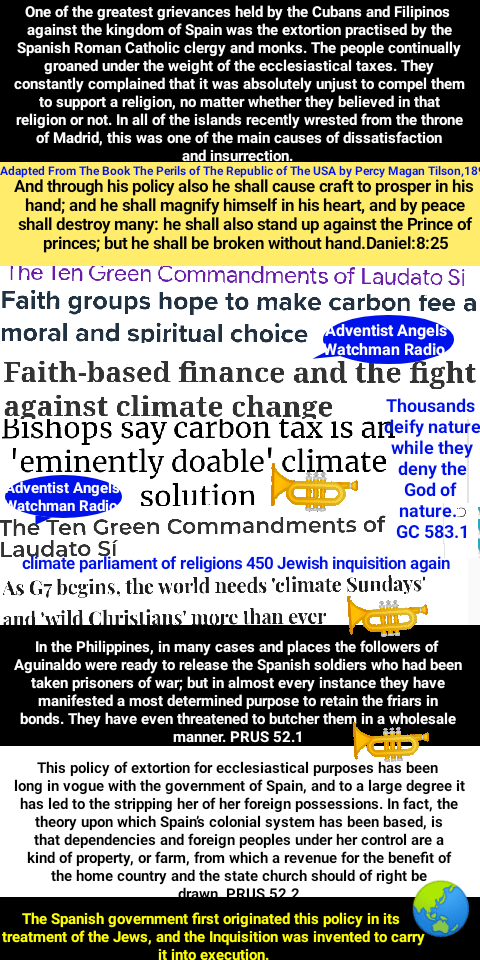
One of the greatest grievances held by the Cubans and Filipinos against the kingdom of Spain was the extortion practised by the Spanish Roman Catholic clergy and monks. The people continually groaned under the weight of the ecclesiastical taxes. They constantly complained that it was absolutely unjust to compel them to support a religion, no matter whether they believed in that religion or not. In all of the islands recently wrested from the throne of Madrid, this was one of the main causes of dissatisfaction and insurrection. In the Philippines, in many cases and places the followers of Aguinaldo were ready to release the Spanish soldiers who had been taken prisoners of war; but in almost every instance they have manifested a most determined purpose to retain the friars in bonds. They have even threatened to butcher them in a wholesale manner.

This policy of extortion for ecclesiastical purposes has been long in vogue with the government of Spain, and to a large degree it has led to the stripping her of her foreign possessions. In fact, the theory upon which Spain’s colonial system has been based, is that dependencies and foreign peoples under her control are a kind of property, or farm, from which a revenue for the benefit of the home country and the state church should of right be drawn.

The Spanish government first originated this policy in its treatment of the Jews, and the Inquisition was invented to carry it into execution. The story is intensely interesting, and well worthy of consideration here, as it marks the beginning of a piece of sowing from which Spain has just reaped the last instalment of the harvest of loss.

The kingdom and church of Spain have always professed to find in Holy Writ precedent for all their doctrines and practises. I do not say that Holy Writ contains precedent for their doctrines and practises; but simply aver that they think they find them there.

The Inquisition is one of the most diabolically gross abuses that ever disgraced the name of humanity. Nevertheless the Spanish writers rest the authority of this infamous tribunal upon the Word of God. PRUS 52.5

According to a well-known Roman Catholic historian, God himself was the first inquisitor-general. In the death penalty announced to Adam and Eve, “In the day that thou eatest thereof thou shalt surely die” (Genesis 2:17), precedent is found for inflicting capital punishment on heretics, because our first parents were heretics,-they had left the true faith. Again, the Lord turned them out of the garden of Eden; this was the confiscation of the property of heretics. Thirdly, the Almighty made them “coats of skins, and clothed them.” Genesis 3:21. This was the model of the san benito1 The san benitos were coarse woolen garments, in which the heretic was arrayed for the auto da fe, the name given to the ceremony accompanying the burning of the victims. These garments were brought close round the neck, and descended like a frock down to the knees. They were of a yellow color, embroidered with a cross, and well garnished with figures of devils and flames of fire, which, typical of the heretic’s destiny hereafter, served to make him more odious in the eyes of the superstitious multitude. In certain cases the garment was also adorned with the picture of the wearer, burning in flames, with several figures of dragons and devils in the act of fanning them. 2 

The Inquisition has existed in principle ever since the fourth century, when Christianity became the established religion of the Roman empire; but acts of intolerance do not seem to have flowed from any systematized plan of persecution until the papal authority had risen to a considerable height.

Inquisitorial missions were first sent out by Pope Innocent III, 1210-1215, against the Albigenses, who dwelt under the shadow of the lofty Pyrenees in southern France. They were a most peaceable and polished people, and the only national crime of which they had ever been guilty was that of rejecting with shrinking horror the doctrines and practises of the Roman Catholic Church, whose clergy was regarded with loathing and contempt. “Viler than a priest,“ and “I would as soon be a priest,” became proverbial expressions. “The papacy had lost all authority with all classes, from the great feudal princes down to the cultivators of the soil.” How beautiful their land, how elegant their manners, how advanced, for that barbarous age, their scientific research, how cruel their extermination, the pen of Lord Macaulay has perfectly delineated!

In the year 1480, during the reign of Ferdinand and Isabella, the holy office was established in Spain. It was inaugurated for the benefit of the Jews, not primarily because they were heretics, but because they were wealthy, and Rome and Spain needed money. This is a serious charge, but nevertheless a true one, and one which can be easily and clearly sustained. PRUS 54.1

These unfortunate members of the race of Israel were not only wealthy, but they had gradually risen in political eminence until they were the incumbents of the highest civil offices. They made great advancement in various departments of letters. The schools of Cordova, Toledo, Barcelona, and Grenada were crowded with students. It was the Jews and the Arabs who kept alive the flame of learning during the mythological gloom of the Middle Ages. They frequently resided at the courts of Catholic princes as ministers of finance, situations which they were eminently qualified to fill. PRUS 54.2

But royal patronage proved incompetent to save them from the bloody hand of the state church, when their “flourishing fortunes had risen to a sufficient height” to excite her envy. I quote from Prescott:— PRUS 54.3

“Stories were circulated of their contempt for the Catholic worship, their desecration of the most holy symbols, and of their crucifixion, or other sacrifice, of Christian children at the celebration of their own Passover…. At length toward the close of the fourteenth century the fanatical populace, stimulated in many instances by the no less fanatical clergy, and perhaps encouraged by the numerous class of debtors to the Jews, who found this a convenient mode of settling their accounts, made a fierce assault on this unfortunate people in Castile and Arragon, breaking into their houses, violating their most private sanctuaries, scattering their most costly collections and furniture, and consigning the wretched proprietors to indiscriminate massacre, without regard to sex or ago.” 3 PRUS 54.4

On account of this barbarous treatment many of the Spanish Jews feigned conversion to Christianity. Such was their spiritual condition when Ferdinand and Isabella assumed the reins of government. During their reign complaints against Jewish heresy became more and more frequent, and the throne was repeatedly beset with petitions to devise some means for its extirpation. The words of the curate of Los Palacios, who lived at this time, throw considerable light on “the real as well as pretended motives of the subsequent persecution“:— PRUS 55.1

“This accursed race were either unwilling to bring their children to be baptized, or, if they did, they washed away the stain on returning home. They dressed their stews and other dishes with oil instead of lard; abstained from pork; kept the Passover, ate meat in Lent; and sent oil to replenish the lamps in their synagogues, with many other abominable ceremonies of their religion…. They were an exceeding polite and ambitious people engrossing the most lucrative municipal offices.” 

No wonder Prescott remarks, after quoting the above:— PRUS 55.3

“It is easy to discern in this medley of credulity and superstition the secret envy entertained by the Castilians of the superior skill and industry of their Hebrew brethren, and of the superior riches which these qualities secured to them; and it is impossible not to suspect that the zeal of the most orthodox was considerably sharpened by worldly motives…. Ferdinand listened with complacency to a scheme which promised an ample source of revenue in the confiscations it involved. 4 PRUS 55.4

To Isabella’s honor be it spoken, frequent importunities on the part of the clergy were necessary before she yielded her consent to having the Inquisition established in her dominions. But at last she gave way. PRUS 55.5

“Sixtus the Fourth, who at that time filled the pontifical chair, easily discerning the sources of wealth and influence which this measure [the establishment of the Inquisition in Spain] opened to the court of Rome, readily complied with the petitions of the sovereigns, and expedited a bull, bearing date Nov. 1, 1478, authorizing them to appoint two or three ecclesiastics, inquisitors for the detection and suppression of heresy throughout their dominions.” 5 PRUS 55.6

Ferdinand and Isabella, in 1492, issued a decree expelling from Spain every Jew who did not deny his faith, so that the soil of Spain might be no longer polluted by the presence of unbelievers. To make them Christians, or failing in this, to exterminate them, was the business of the Inquisition. PRUS 56.1

Of course many of the Jews declared, when the terrible words which constituted the form of arrest, “Deliver yourself up a prisoner to the Inquisition!” were whispered in their ear, that they were not Jews, but Catholics. It then became necessary to prove that they were Jews. Here are some of the points by means of which the charge of Judaism was established among them:— PRUS 56.2

“It was considered good evidence of the fact if the prisoner wore better clothes or cleaner linen on the Jewish Sabbath than on any other day of the week; if he had no fire in his house the preceding evening; if he sat at table with Jews, or ate the meat of animals slaughtered by their hands, or drank a certain beverage held in much estimation by them; if he washed a corpse in warm water, or when dying turned his face to the wall; or, finally, if he gave Hebrew names to his children, a provision most whimsically cruel, since, by a law of Henry II he was prohibited under severe penalties from giving them Christian names. He must have found it difficult to have extricated himself from the horns of this dilemma. Such are a few of the circumstances, some of them purely accidental in their nature, others the result of early habit, which might well have continued after a sincere conversion to Christianity, and all of them trivial, on which capital accusations were to be alleged, and even satisfactorily established.” 6 PRUS 56.3

I give this quotation from Llorente, as he is a writer most competent to unveil the hidden mysteries of the Inquisition. He was secretary to that tribunal in Madrid from 1790-1792. He devoted several years to a thorough investigation of the records of the tribunals, as well as of other original documents contained in their archives. PRUS 56.4

It will therefore be now in place to relate some of those secret workings, and to relate how its victims were accused, condemned, and tortured. PRUS 56.5

To presume the innocence of the prisoner until his guilt has been established, is an axiom of justice accepted by all true jurists. The Inquisition, however, instead of granting to the prisoner the protection afforded by every other judicature, and especially demanded by his forlorn situation, acted upon the opposite principle, and used the most insidious arts to circumvent and surround all who came within its fearful grasp. Says Prescott:— PRUS 56.6

“The accused, … whose mysterious disappearance was perhaps the only public evidence of his arrest, was conveyed to the secret chambers of the Inquisition, where he was jealously excluded from intercourse with all, save a priest of the Romish Church, and his jailer, both of whom might be regarded as the spies of the tribunal. In this desolate condition the unfortunate man, cut off from external communication and all cheering sympathy and support, was kept for some time in ignorance even of the nature of the charges preferred against him; and at length, instead of the original process, was favored only with extracts from the deposition of the witnesses, so garbled as to conceal every possible clue to their name and quality. With still greater unfairness no mention whatever was made of such testimony as had arisen in the course of the examination in his own favor. Counsel was indeed allowed him from a list presented by his judges. But this privilege availed little, since the parties were not permitted to confer together, and the advocate was furnished with no other information than what had been granted to his client. To add to the injustice of these proceedings, every discrepancy in the statements of the witnesses was converted into a separate charge against the prisoner, who thus, instead of one crime, stood accused of several. This, taken in connection with the concealment of time, place, and circumstance in the accusations, created such embarrassment that, unless the accused was possessed of unusual acuteness and presence of mind, it was sure to involve him, in his attempt to explain, in inextricable contradiction. PRUS 57.1

“If the prisoner refused to confess his guilt, or, as was usual, was suspected of evasion, or an attempt to conceal the truth, he was subjected to torture. This, which was administered in the deepest vaults of the Inquisition, where the cries of the victim could fall on no ear save that of his tormentors, is admitted by the secretary of the holy office, who has furnished the most accurate report of its transactions, not to have been exaggerated in any of the numerous narratives which have dragged these subterranean horrors into light. If the intensity of pain extorted a confession from the sufferer, he was expected, if he should survive, to sustain it on the next day. Should he refuse to do this, his mutilated members were condemned to a repetition of the same sufferings, until his obstinacy (it should rather have been termed his heroism) might be vanquished.” 7 PRUS 57.2

“By a subsequent regulation of Philip II, the repetition of torture in the same process was strictly prohibited to the inquisitors. But they, making use of a sophism worthy of the arch-fiend himself, contrived to evade this law, by pretending after each new application of punishment, that they had only suspended and not terminated the torture.” 8 PRUS 58.1

“Should the rack, however, prove ineffectual to force a confession of his guilt, he was so far from being considered as having established his innocence that, with a barbarity unknown to any tribunal where torture has been admitted, and which of itself proves its utter incompetency to the end it proposes, he was not unfrequently convicted on the depositions of the witnesses. At the conclusion of his mock trial, the prisoner was again returned to his dungeon, where, without the blaze of a single faggot to dispel the cold or illuminate the darkness of the long winter night, he was left in unbroken silence to await the doom which was to consign him to an ignominious death, or a life scarcely less ignominious.” 9 PRUS 58.2

To add to the discomfiture of the victims, the three men who sat as judges in the inquisitorial courts were almost invariably chosen from the most ignorant. Says Puighblanch:— PRUS 58.3

“Even the common people, amidst the illusion in which they lived under the yoke of this tribunal, at length became sensible of the great ignorance which prevailed in its dark conclaves. This is proved by the following saying to be met in the mouths of every one:— PRUS 58.4

Question-What constituted the Inquisition? PRUS 58.5

Answer-One crucifix, two candlesticks, and three blockheads, alluding to the form and parade of its sittings, and the number of the Judges present thereat.” 10 PRUS 58.6

The culprit was obliged to declare his whole genealogy and descent, and to state whether any of his ancestors, in a direct or transversal line, or his brothers, wife, children, or, indeed, himself, had at any time previously been arraigned before the tribunal, and penanced by it. The real object of all this was to obtain possession of the property he might have inherited, by declaring the right of succession null and void. PRUS 59.1

There were three kinds of torture generally used by the Inquisition; viz., the pulley, the rack, and the fire. The apartment in which these were inflicted was underground, and was called the hall of torture. PRUS 59.2

The first of these three modes of punishment was inflicted by fastening a pulley, with a rope passed through it, to the roof. The executioners would then seize the culprit, shackle his feet together, and suspend weights of one hundred pounds to his ankles. His hands were bound behind his back, and the rope from the pulley fastened to his wrists. He was then raised about six feet from the ground, and twelve stripes were inflicted upon him. After this he was let down with a run, but checked just before either of his feet or the weights should touch the floor, in order to render the shock to his body greater. PRUS 59.3

The torture of the rack, also called that of water and ropes, was a common one. The victim, divested of his clothing, was stretched upon his back along a hollow bench with sticks across like a ladder, and prepared for the purpose. To this his head, hands, and feet were bound so tightly that he could not move. In this position he experienced eight strong contortions in his limbs; viz., two on the fleshy parts of the arm above the elbow, two below the elbow, two on the thighs, and two on the legs. Sometimes also his face was covered with a thin piece of linen, through which seven pints of water ran into his mouth and nostrils, preventing him from breathing. PRUS 59.4

But the torture by fire was the most revolting of all. The prisoner was placed with his legs naked in the stocks, the soles of his feet well greased with lard, and a blazing chafing-dish applied to them, by the heat of which they became perfectly fried 11 PRUS 59.5

Now all of these tortures and inhuman barbarities were committed in defense of those two theories that there should not be freedom of conscience, and that men are not equal before the law. They were committed for the purpose of wringing money from the inferior race (if inferior it can be termed) for the support of the superior. I can not believe that originally the Spaniards were more cruel or inhuman than the rest of mankind. It is certain that we are all of one blood, and all born in sin. But the manifestation of such awful cruelties by the Spaniards was brought about by following a wrong theory. PRUS 59.6

The people of Cuba and of the Philippine Islands were oppressed for precisely the same reasons that the Jews of Spain were oppressed so many years ago. As a result of the first persecutions, the Jews left, and were driven out of Spain. But as a result of the second, the Spanish were driven out of the Philippines, and out of Cuba; for in this latter time the cup of her iniquity was full and her punishment was decreed from above. PRUS 60.1

A CHAPTER IN CRIMINAL HISTORY: The Repeat of History, How Quick To Forget?

Ecumenicism: Making Them Christians? At first the Spaniards attempted to convert the Saracens to their own religion. Exhortations and arguments were the first weapons, but when these means failed, she had resource to other means; viz., she persecuted those whom she was unable to persuade. This method seemed to be more successful, since we are told by good authority that after the year 1526 “there was no Mohammedan in Spain who had not been converted to Christianity.” That is to say, in other language, that every Mohammedan in Spain professed to be a papist. PRUS 47.3

[4/23, 7:34 AM] Adventist Angels Watchman: Pt 2 The Besieged City,Sweden Koran Burn, Rome Statutes Universalism, USA Join ICC Moderation


[4/23, 7:35 AM] Adventist Angels Watchman: Pt 1 The Besieged City,Rome Statutes Lockdown of Russia, USA Give Up and Join Moderation

https://youtu.be/Fw9R-xqDR3M


[4/23, 7:38 AM] Adventist Angels Watchman: Pt 1 1986 60 Religious Leaders Join Pontiff To Pray For Peace Ev King Osiemo

https://youtu.be/ClMgspOZu6Q

Adapted from the book The Perils of The Republic of The United States of America by Percy Magan Tilson 1899


The beginnings of Spain-Visigoths become Roman Catholics-The Saracens arrive in Spain-Magnificent civilization of the Spanish Saracens-Their houses, gardens, and libraries, and contributions to science-Their learning contrasted with papistical learning-The Saracens conquered by the Spaniards-The Spaniards attempt to convert the Saracens-Odious persecutions-Expulsion of the Saracens from Spain-Degradation of Spain

Of the powers which rose upon the ashes of the empire of Rome, the kingdom of Spain was one. This people trace their lineage back to the woods of ancient Germania. In that vast cradle of nations they were known as the tribe of the Visigoths. Like all the other German tribes they were intensely fond of liberty, and knew far more of its true and governing principles than did the more highly educated and refined people of the Roman empire.

When Rome had filled her cup of tyranny and despotism to the full, Providence took these barbarous children of the North, and used them as an instrument in the hand of Heaven to wreak vengeance upon the guilty world-power. Under the leadership of the great chieftain, Alaric, the Visigoths everywhere defeated the Roman armies. By the year 436 a. d., they were established in the peninsula of Spain.

For a long time the Visigoths remained true to the Arian faith, to which they had been converted from heathenism. For years they maintained a sturdy and uncompromising warfare against the princes and prelates of the Roman Catholic Church, who left untried no strategy of war, or seductions of peace, to accomplish their conversion and submission to the see of Rome.

Had the Visigoths persevered in their stand, they might have become the liberators, instead of the oppressors, of mankind. Both natural traits and religious tenets had admirably fitted them for this position. But the nation of Visigoths, like many a man, allowed the golden opportunity to pass by; and the opportunity came but once. Neglecting to accept the high and lofty station offered them, they became instruments of the Roman Catholic Church. There is an ancient adage that a good slave always makes a good tyrant, and this has proved itself only too true in the case of the Spanish nation.

The bait of luxury, ease, and power held out by Rome was too tempting; and late in the sixth century they became orthodox, and joined the Latin communion. Then began an era in the history of Spain, continuing through centuries, at times victorious and triumphant, and at times repulsed and defeated, and whether in weal or in woe, ever and always criminal. The story of Spain, from first to last, is the record of a criminal case. Her history is naught but one prolonged crime. Forever has it been her boast that she has uncompromisingly denied freedom of conscience on the one hand, and equality before the law on the other.

In the year 711 a. d., the Mohammedans sailed from Africa, and landed at Gibraltar, which notable rock took its present name-Gebel-al-Tarik, the Rock of Tarik-from Tarik, a lieutenant of the emir. A desperate struggle ensued, and continued for nearly eight centuries. At first victory after victory in rapid succession crowned the arms of the worshipers of Allah. At one time it almost looked as if the Spanish Catholics would be blotted from the face of the earth. A large part of the peninsula fell under the rule of the Saracens. At length the tide of battle turned. Malaga was taken by the Spaniards in 1487, and Granada in 1492, and this, in a certain sense, re-established the old Spanish monarchy.

Christendom has never yet acknowledged her debt to the Saracens; but that much that is useful and artistic was acquired from them, can never be rightly contested nor successfully denied. During the time that they were masters of Spain they were lenient and merciful to their fallen foe. In the days of their power they accorded far more of civil and religious liberty and toleration than the orthodox church was wont to grant to those whom she subdued. To all who did not wish to turn to Mohammedanism, there was given the choice of paying a slight tribute and continuing as a devotee of their former faith. But few historians have correctly understood or estimated the real services of the Saracens of Spain to civilization and intellectual development. Only one has honestly accorded to them their just and well-won place. I refer to the impartial and ingenuous John W. Draper. He alone has graphically and truthfully described their splendid achievements in material things:— 

“Scarcely had the Arabs become firmly settled in Spain when they commenced a brilliant career. Adopting what had now become the established policy of the commanders of the faithful in Asia, the emirs of Cordova distinguished themselves as patrons of learning, and set an example of refinement strongly contrasting with the condition of the native European princes. Cordova under their administration, at its highest point of prosperity, boasted of more than two hundred thousand houses and more than a million inhabitants. After sunset, a man might walk through it in a straight line for ten miles by the light of the public lamps. Seven hundred years after this time there was not so much as one public lamp in London. Its streets were solidly paved. In Paris, centuries subsequently, whoever stepped over his threshold of a rainy day stepped up to his ankles in mud. Other cities, as Grenada, Seville, and Toledo considered themselves rivals with Cordova. The palaces of the khalifs were magnificently decorated. Those sovereigns might well look down with supercilious contempt on the dwellings of the rulers of Germany, France, and England, which were scarcely better than stables,-chimneyless, windowless, with a hole in the roof for the smoke to escape, like the wigwams of certain Indians. The Spanish Mohammedans had brought with them all the luxuries and prodigalities of Asia. Their residences stood forth against the clear blue sky, or were embosomed in the woods. They had polished marble balconies, overhanging orange-gardens; courts with cascades of water; shady retreats provocative of slumber in the heat of the day; retiring-rooms vaulted with stained glass, speckled with gold, over which streams of water were made to gush; the floors and walls were of exquisite mosaic. Here, a fountain of quicksilver shot up in a glistening spray, the glittering particles falling with a tranquil sound like fairy bells; there, apartments into which cool air was drawn from the flower gardens, in summer by means of ventilating towers, and in winter through earthen pipes, or caleducts, imbedded in the walls-the hypocaust, in the vaults below, breathing forth volumes of warmed and perfumed air through these hidden passages. The walls were not covered with wainscot, but adorned with arabesques, and paintings of agricultural scenes, and views of Paradise. From the ceilings, corniced with fretted gold, great chandeliers hung, one of which, it is said, was so large that it contained 1,804 lamps. Clusters of frail marble columns surprised the beholder with the vast weights they bore. In the boudoirs of the sultanas they were sometimes of verd antique and incrusted with lapis-lazuli. The furniture was of sandal and citron wood, inlaid with mother-of-pearl, ivory, silver, or relieved with gold and precious malachite. In orderly confusion were arranged vases of rock crystal, Chinese porcelains, and tables of exquisite mosaic. The winter apartments were hung with rich tapestry; the floors were covered with embroidered Persian carpets. Pillows and couches, of elegant forms, were scattered about the rooms, perfumed with frankincense…. Great care was taken to make due provision for the cleanliness and amusement of the inmates. Through pipes of metal, water, both warm and cold, to suit the season of the year, ran into baths of marble; in niches, where the current of air could be artificially directed, hung dripping alcarazzas. There were whispering-galleries for the amusement of the women; labyrinths and marble play-courts for the children; for the master himself, grand libraries. The Khalif Alhakem’s was so large that the catalogue alone filled forty volumes. PRUS 42.3

“No nation has ever excelled the Spanish Arabs in the beauty and costliness of their pleasure-gardens. To them we owe the introduction of very many of our most valuable cultivated fruits, such as the peach. Retaining the love of their ancestors for the cooling effect of water in a hot climate, they spared no pains in the superfluity of fountains, hydraulic works, and artificial lakes in which fish were raised for the table. Into such a lake, attached to the palace at Cordova, many loaves were cast each day to feed the fish. There were also menageries of foreign animals; aviaries of rare birds; manufactories in which skilled workmen displayed their art in textures of silk, cotton, linen, and all the miracles of the loom; in jewelry and filigree work, with which they ministered to the pride of the sultanas and concubines. Under the shade of cypresses, cascades disappeared; among flowering shrubs there were winding walks, bowers of roses, seats cut out of the rock, and crypt-like grottoes hewn in the living stone. Nowhere was ornamental gardening better understood; for not only did the artist try to please the eye as it wandered over the pleasant gradation of vegetable color and form, he also boasted his success in the gratification of sense and smell by the studied succession of perfumes from beds of flowers. PRUS 44.1

“To these Saracens we are indebted for many of our personal comforts. Religiously cleanly, it was not possible for them to clothe themselves according to the fashion of the natives of Europe, in a garment unchanged till it dropped to pieces of itself, a loathsome mass of vermin, stench, and rags. No Arab who had been a minister of state, or the associate or antagonist of a sovereign, would have offered such a spectacle as the corpse of Thomas à Becket when his haircloth shirt was removed. They taught us the use of the often-changed and often-washed undergarment of cotton or linen, which still passes among ladies under its old Arabic name. But to cleanliness they were not unwilling to add ornament. Especially among women of the higher classes was the love of finery a passion. Their outer garments were often of silk, embroidered and decorated with gems and woven gold. So fond were the Moorish women of gay colors and the luster of chrysolites, hyacinths, emeralds, and sapphires, that it was quaintly said that the interior of any public building in which they were permitted to appear, looked like a flower meadow in the spring besprinkled with rain. PRUS 44.2

“The khalifs of the West carried out the precepts of Ali, the fourth successor of Mohammed, in the patronage of literature. They established libraries in all their chief towns; it is said that not fewer than seventy were in existence. To every mosque was attached a public school, in which the children of the poor were taught to read and write, and instructed in the precepts of the Koran. For those in easier circumstances there were academies, usually arranged in twenty-five or thirty apartments, each catalogued for accommodating four students; the academy being presided over by a rector. In Cordova, Granada, and other great cities there were universities presided over by the Jews, the Mohammedan maxim being that the real learning of a man is of more public importance than any particular religious opinions he may entertain…. The Mohammedan liberality was in striking contrast with the intolerance of Europe…. In the universities some of the professors in polite literature gave lectures on Arabic classical works; others taught rhetoric or composition, or mathematics, or astronomy. From these institutions many of the practises observed in our colleges were derived. They held commencements, at which poems were read and orations delivered in presence of the public. They had also, in addition to these schools of general learning, professional ones, particularly for medicine…. PRUS 45.1

“The Saracens commenced the application of chemistry to the theory and practise of medicine, in the explanation of the functions of the human body, and in the cure of its diseases. Nor was their surgery behind their medicine. Albucasis, of Cordova, shrinks not from the performance of the most formidable operations in his own and in the obstetrical art; the actual cautery and the knife are used without hesitation. He has left us ample description of the surgical instruments then employed; and from him we learn that, in operations on females in which considerations of delicacy intervened, the services of properly instructed women were secured. How different was all this from the state of things in Europe; the Christian peasant, fever-stricken, or overtaken by accident, hied to the nearest saint-shrine, and expected a miracle; the Spanish Moor relied upon the prescription or lancet of his physician, or the bandage and knife of his surgeon. PRUS 45.2

“Our obligations to the Spanish Moors in the arts of life are even more marked than in the higher branches of science. They set an example of skilful agriculture, the practise of which was regulated by a code of laws. Not only did they attend to the cultivation of plants, introducing very many new ones, they likewise paid great attention to the breeding of cattle, especially the sheep and the horse. To them we owe the introduction of the great products, rice, sugar, cotton, and also, as we have previously observed, nearly all the fine garden and orchard fruits, together with many less important plants, as spinach and saffron. To them Spain owes the culture of silk; they gave to Xeres and Malaga their celebrity for wine. They introduced the Egyptian system of irrigation by flood-gates, wheels, pumps. They also promoted many important branches of industry; improved the manufacture of textile fabrics, earthenware, iron, and steel; the Toledo sword-blades were everywhere prized for the temper of their steel.” PRUS 46.1

Such were some of the splendid achievements of the Saracens of Spain. Many more of the material benefits which they conferred upon Christendom might be mentioned, but the above will suffice for this sketch, which is not designed to be exhaustive. These are the things with which the Saracens occupied themselves, while Christendom sat in squalor and superstition. While Rome was asserting the flatness of the earth, the Spanish Moors were teaching geography from globes. To say that the earth was globular in form was held to be heretical by monks and patristic teachers. They said in the words of Lactantius: “Is it possible that men can be so absurd as to believe that the crops and the trees, on the other side of the earth, hang downward, and that men have their feet higher than their heads?” They taught that the edge of the sea was protected by a wall of weeds in order to keep the ships from tumbling into space. While the Arab was studying physiology and the use of the lancet, in order that he might the better treat disease, the Christian of the West was prostrating himself before the shrine of some bleeding, sweating, winking image, with the hope and expectation that the doing of this would cause his bodily woes to vanish. If a pious Catholic could only kiss a lock of the hair of Saint Peter or a piece of a bone of Saint Paul, he would confidently expect that his diseases would disappear like frost before the morning sun. PRUS 46.2

But the learning of the Arabs really forced Christendom to cast aside its superstition, and to study in a rational way. The Arabian system was undoubtedly one of the chief causes of the Renaissance. And the lasting benefits which the Saracens conferred upon Europe can be clearly traced, even at the present time. PRUS 47.1

It made no difference to the Spanish Christians, however, how much the Saracens were the benefiters of mankind. They were heathen, and must be persecuted for that; and being heathen, they had no equal rights with others before even the civil law. With the Spaniards these were cardinal principles. There were no real and substantial grounds of complaint against the Saracens as competitors and neighbors. They differed from the Spaniards in religion. This was the only thing that could be said against them. They were kind, industrious, and peaceful; but all of this availed them nothing. Spain could not and would not allow the principle of freedom of conscience and of equality before the law. PRUS 47.2

At first the Spaniards attempted to convert the Saracens to their own religion. Exhortations and arguments were the first weapons, but when these means failed, she had resource to other means; viz., she persecuted those whom she was unable to persuade. This method seemed to be more successful, since we are told by good authority that after the year 1526 “there was no Mohammedan in Spain who had not been converted to Christianity.” That is to say, in other language, that every Mohammedan in Spain professed to be a papist. PRUS 47.3

Some, however, were difficult subjects for conversion. They would not willingly submit to be baptized. The water might be “holy,” but holy or unholy, they wanted none of it. Nevertheless, baptized they must be, so they were forcibly seized, and the ordinance was forcibly administered. This was done in an immense number of cases. Then the church and state united, proceeded to doubt the genuineness of their forced conversion, and began to inquire into their sincerity. They were ordered to relinquish everything that might have the most remote tendency to remind them of their former religion. They were forced, under severe penalties, to learn Spanish, and to deliver over to their persecutors all their Arabic books. They were forbidden to read Arabic, they were forbidden to write it, or even to converse in it in the sanctuary of their own homes. The ceremonies and games in which their ancestors had delighted were forbidden them. They were prohibited from wearing clothes of the same pattern as those worn by their fathers. “Their women were to go unveiled; and, as bathing was a heathenish custom, all public baths were to be destroyed, and even all baths in private houses.” PRUS 48.1

All of this was more than Saracenic flesh and blood could stand. In 1563 they rose in rebellion, and so desperately did their arms maintain the unequal contest that it was 1571 ere the insurrection was quelled. By this rising, their numbers were greatly reduced. The remnant appear to have lapsed into the quiet, every-day walks of life. But the Spaniards were not satisfied yet. The obnoxious Morisco, as these converted Mohammedans were termed, must be pursued to the grave with torture and civil disability, and even beyond that portal of darkness as far as the unrelenting hand could reach. PRUS 48.2

Whatever ills befell the arms or diplomacy of Spain were charged to the account of these unfortunates:— PRUS 48.3

“The archbishop of Valencia … assured the king that all the disasters which had befallen the monarchy had been caused by the presence of these unbelievers, whom it was now necessary to root out, even as David had done to the Philistines, and Saul to the Amalekites. He declared that the Armada, which Philip II sent against England in 1588, had been destroyed because God would not allow even that pious enterprise to succeed, while those who undertook it left heretics undisturbed at home. For the same reason the late expedition against Algiers had failed, it being evidently the will of Heaven that nothing should prosper while Spain was inhabited by apostates.” 1 PRUS 48.4

For these reasons, it was urged that the whole of them, men women, and children, should be put to the sword:— PRUS 49.1

“Bleda, the celebrated Dominican, one of the most influential men of his time, wished this to be done, and to be done thoroughly. He said that, for the sake of example, every Morisco in Spain should have his throat cut, because it was impossible to tell which of them were Christians at heart, and it was enough to leave the matter to God, who knew his own, and who would reward in the next world those who were really Catholics.” 2 PRUS 49.2

In the year 1609, when Philip III was king, Lerma, his minister, at the instigation of the clergy, announced to the king that the expulsion of the Moriscos had become necessary. “The resolution,” replied Philip, “is a great one; let it be executed.” And executed it was, with unflinching barbarity. PRUS 49.3

“About one million of the most industrious inhabitants of Spain were hunted out like wild beasts, because the sincerity of their religious opinions was doubted. Many were slain as they approached the coast; others were beaten and plundered; and the majority in the most wretched plight, sailed for Africa. During the passage, the crew, in many of the ships, rose upon them, butchered the men, ravished the women, and threw the children into the sea. Those who escaped this fate landed upon the coast of Barbary, when they were attacked by the Bedouins, and many of them put to the sword. Others made their way into the desert, and perished from famine. Of the number of lives actually sacrificed we have no accurate account; but it is said on very good authority that on one expedition in which one hundred and forty thousand were carried to Africa, upward of one hundred thousand suffered death in its most frightful forms, within a few months after their expulsion from Spain.” 3 PRUS 49.4

“Now, for the first time, the church was really triumphant. For the first time, there was not a heretic to be seen between the Pyrenees and the Strait of Gibraltar. All were orthodox, and all were loyal. Every inhabitant of that great country obeyed the church, and feared the king. And from this happy combination, it was believed that the prosperity and grandeur of Spain were sure to follow. The name of Philip III was to be immortal, and posterity would never weary of admiring that heroic act by which the last remains of an infidel race were cast out from the land. Those who had even remotely participated in the glorious consummation were to be rewarded by the choicest blessings. Themselves and their families were under the immediate protection of heaven. The earth should bear more fruit, and the trees should clap their hands. Instead of the thorn, should come up the fir-tree, and instead of the brier, the myrtle. A new era was now inaugurated, in which Spain, purged of her heresy, was to be at ease, and men, living in safety, were to sleep under the shade of their own vineyards, sow their gardens in peace, and eat of the fruit of the trees they had planted.” PRUS 50.1

These were the promises which the united church and state held out, and which the people believed. It was told how that now the arts, the commerce, the wealth, and magnificence of Spain would flourish and increase as never before, since heretical Jew, and idolatrous Mohammedan had been cast out of the land. Her ships were to plow the seas, and crowd the ports of other shores. Her soldiers were to wreath themselves with laurels of victory till the sun should never set on her dominions, and all earth should do homage at the feet of her scepter of greatness. PRUS 50.2

But 1613, instead of being the beginning of the greatness and power of Spain, was the apex of her glory, and that glory was one of infamy. In that boasted hour of her might-all heretics dead or driven out-can be heard, even at this late day, the death knell of her prestige and glory. From that day forth her glory began to wane, till naught is left to-day, save the mistiest shade of a shadow. The kingdom of Spain had driven out the men who cultivated her rice and her cotton, and not being cultivated, they grew no more. She had expelled from her borders those who had manufactured her silk and paper, and the ceaseless humming of the looms and buzzing of the mills no longer reverberated upon the breezes. The olives and the vines ceased to yield their increase, for they were neglected. PRUS 50.3

“In the sixteenth century and early in the seventeenth, Spain enjoyed great repute for the manufacture of gloves, which were made in enormous quantities and shipped to many parts, being particularly valued in England and in France, and being also exported to the Indies. But Martinez de Mata, who wrote in the year 1655, assures us that at that time this source of wealth had disappeared, the manufacture of gloves having quite ceased, though formerly, he says, it had existed in every city in Spain. PRUS 51.1

“In every department all power and life disappeared. The Spanish troops were defeated at Rocroy in 1643; and several writers ascribe to that battle the destruction of the military reputation of Spain. This, however, was only one of many symptoms. In 1656 it was proposed to fit out a small fleet; but the fisheries on the coasts had so declined that it was found impossible to find sailors enough to man even the few ships which were required. The charts which had been made were either lost or neglected, and the ignorance of the Spanish pilots became so notorious that no one was willing to trust them. As to the military, service, it is stated, in an account of Spain late in the seventeenth century, that most of the troops had deserted their colors, and that the few who were faithful were clothed in rags, and were dying of hunger. Another account describes that once mighty kingdom as utterly unprotected; the frontier towns ungarrisoned; the fortifications dilapidated and crumbling away, the magazines without ammunition, the arsenals empty, the workshops unemployed, and even the art of building ships entirely lost.” 4 PRUS 51.2

This is only one chapter in the history of Spain, but if it is not criminal history, bearing its legitimate mark, then none has ever been enacted. PRUS 51.3

U.S.-NATO imperialism pushes Ukraine to the front line, AMERICA RETURN FORCES HOME! Ere Fathers of America Awake and See!

“Nothing could be more gentle and equitable than the conduct of the Romans and the Path Now Taken by the USA in the beginning. They acted with the utmost moderation toward such states and nations as addressed them for protection; they succored them against their enemies, took the utmost pains in terminating their differences, and […]

U.S.-NATO imperialism pushes Ukraine to the front line, AMERICA RETURN FORCES HOME! Ere Fathers of America Awake and See!

THE PROUD DOER! Catholic Procession: Moderation

Adventist Catholic Procession _Weeping Aloud (IN THE NIGHT JOY IN THE MORNING), and saying: “If they would only tell me what I have done or what I have said!” GROSS DARKNESS THE PEOPLE! Any Jew Here?

https://kingosiemo.wordpress.com/2022/04/21/weeping-aloud-in-the-night-joy-in-the-morning-and-saying-if-they-would-only-tell-me-what-i-have-done-or-what-i-have-said-gross-darkness-the-people-any-jew-here/
Weeping Aloud (IN THE NIGHT JOY IN THE MORNING), and saying: “If they would only tell me what I have done or what I have said!” GROSS DARKNESS THE PEOPLE! Any Jew Here?

Thus saith the LORD of hosts; In those days it shall come to pass, that ten men shall take hold out of all languages of the nations, even shall take hold of the skirt of him that is a Jew, saying, We will go with you: for we have heard that God is with you.Zechariah:8:23

And many people shall go and say, Come ye, and let us go up to the mountain of the LORD, to the house of the God of Jacob; and he will teach us of his ways, and we will walk in his paths: for out of Zion shall go forth the law, and the word of the LORD from Jerusalem.Isaiah:2:3

That night I dreamed that I was in Battle Creek looking out from the side glass at the door and saw a company marching up to the house, two and two. They looked stern and determined. I knew them well and turned to open the parlor door to receive them, but thought I would look again. The scene was changed. The company now presented the appearance of a Catholic procession. One bore in his hand a cross, another a reed. And as they approached, the one carrying a reed made a circle around the house, saying three times: “This house is proscribed. The goods must be confiscated. They have spoken against our holy order.” Terror seized me, and I ran through the house, out of the north door, and found myself in the midst of a company, some of whom I knew, but I dared not speak a word to them for fear of being betrayed. I tried to seek a retired spot where I might weep and pray without meeting eager, inquisitive eyes wherever I turned. I repeated frequently: “If I could only understand this! If they will tell me what I have said or what I have done!”
I wept and prayed much as I saw our goods confiscated. I tried to read sympathy or pity for me in the looks of those around me, and marked the countenances of several whom I thought would speak to me and comfort me if they did not fear that they would be observed by others. I made one attempt to escape from the crowd, but seeing that I was watched, I concealed my intentions. I commenced weeping aloud, and saying: “If they would only tell me what I have done or what I have said!” My husband, who was sleeping in a bed in the same room, heard me weeping aloud and awoke me. My pillow was wet with tears, and a sad depression of spirits was upon me. 1T 577.2 – 1T 578.1

Popery had become the world’s despot. Kings and emperors bowed to the decrees of the Roman pontiff. The destinies of men, both for time and for eternity, seemed under his control. For hundreds of years the doctrines of Rome had been extensively and implicitly received, its rites reverently performed, its festivals generally observed. Its clergy were honored and liberally sustained. Never since has the Roman Church attained to greater dignity, magnificence, or power.
But “the noon of the papacy was the midnight of the world.”—J. A. Wylie, The History of Protestantism, b. 1, ch. 4. The Holy Scriptures were almost unknown, not only to the people, but to the priests. Like the Pharisees of old, the papal leaders hated the light which would reveal their sins. God’s law, the standard of righteousness, having been removed, they exercised power without limit, and practiced vice without restraint. GC 60.1 – GC 60.2

Remember thy congregation, which thou hast purchased of old; the rod of thine inheritance, which thou hast redeemed; this mount Zion, wherein thou hast dwelt. Lift up thy feet unto the perpetual desolations; even all that the enemy hath done wickedly in the sanctuary. Thine enemies roar in the midst of thy congregations; they set up their ensigns for signs. A man was famous according as he had lifted up axes upon the thick trees. They have cast fire into thy sanctuary, they have defiled by casting down the dwelling place of thy name to the ground. They said in their hearts, Let us destroy them together: they have burned up all the synagogues of God in the land. We see not our signs: there is no more any prophet: neither is there among us any that knoweth how long. O God, how long shall the adversary reproach? shall the enemy blaspheme thy name for ever? Why withdrawest thou thy hand, even thy right hand? pluck it out of thy bosom. For God is my King of old, working salvation in the midst of the earth.
Psalm:74:2-5,7-12

ISRAEL IS MY SON! ISRAEL IS JESUS AND JESUS IS ISRAEL: LISTEN TO HIM, Gather Jacob To Him, THOSE CALLED BY HIS NAME ARE ISRAELITES
https://kingosiemo.wordpress.com/2022/04/21/israel-is-my-son-israel-is-jesus-and-jesus-is-israel-listen-to-him-gather-jacob-to-him-those-called-by-his-name-are-israelites-edenic-sabbath/

TEN WAYS TO IDENTIFY THE LITTLE HORN https://kingosiemo.wordpress.com/2022/04/20/ten-ways-to-identify-the-little-horn/

Catholics are calling for the Eighth day, Sunday, to be Reclaimed in order to Restore Christian Culture in Society


On April 19, 2022, Crisis Magazine, a prominent Catholic conservative website, called for the restoration of Sunday in our “Christian culture.” To that end, they’re looking at Sunday, the first day of the week, as the “eighth day.” This is a reference that is used to try to demonstrate that the Sabbath was changed from Saturday to Sunday.

Here is what Crisis Magazine published on April 19, 2022: “Reclaiming such ideas like the Eighth Day is no small part in the requisite work for the restoration of Christian culture … When the Good News of the Resurrection of Jesus Christ spread over the world, it came with a marvelous piece of poetry. Christians referred to Sunday, traditionally considered the first day of the week, as the Eighth Day.”

This call to bring Sunday back into our Christian culture has nothing to do with the gospel and everything to do with politics. When Crisis Magazine calls for Sunday to be reclaimed, it’s more about mobilizing political action than anything else. True social reforms cannot be achieved through political action or by enforcing Sunday as a day of rest through state power. Laws can limit people’s actions, but they can’t change their hearts. And if churches want to impose Sunday by legislation, forcing men to rest, this means that they have abandoned their gospel commission and have become political lobbyists, relying on the state’s strong arm to impose church doctrine on society. #sda #adventist #adventista

Click to read: http://adventmessenger.org/catholics-are-calling-for-the-eighth-day-sunday-to-be-reclaimed-in-order-to-restore-christian-culture-in-society/

Feeding On Wind: Ecumenical Ephraim shall return to Egypt, and they shall eat unclean things in Assyria, Unclean Things Of Rome- The Prodigal Son Feeds on Vomit

Beloved, believe not every spirit, but try the spirits whether they are of God: because many false prophets are gone out into the world.1 John:4:1

They shall not dwell in the LORD’s land; but Ephraim shall return to Egypt, and they shall eat unclean things in Assyria.
Hosea:9:3

And I saw three unclean spirits like frogs come out of the mouth of the dragon, and out of the mouth of the beast, and out of the mouth of the false prophet.
Revelation:16:13

And he cried mightily with a strong voice, saying, Babylon the great is fallen, is fallen, and is become the habitation of devils, and the hold of every foul spirit, and a cage of every unclean and hateful bird.Revelation:18:2

Wicked men and the church harmonize in this hatred of the law of God, and then the crisis comes. Then we see the class specified in Malachi 3:13-15: “Your words have been stout against me, saith the Lord. Yet ye say, What have we spoken so much against thee? Ye have said, It is vain to serve God: and what profit is it that we have kept his ordinance, and that we have walked mournfully before the Lord of Hosts? And now we call the proud happy: yea, they that work wickedness are set up; yea, they that tempt God are even delivered.” Here is a company of disaffected, professed Christians, whose chief business is to murmur and complain, and accuse God by accusing the children of God. They see nothing defective in themselves, but very much to despise in others.


But while they are murmuring and complaining, and falsely accusing, and doing Satan’s work most zealously, another class is brought to our notice: “Then they that feared the Lord spake often one to another: and the Lord harkened, and heard it, and a book of remembrance was written before him for them that feared the Lord, and that thought upon his name. And they shall be mine, saith the Lord of Hosts, in that day when I make up my jewels; and I will spare them, as a man spareth his own son that serveth him. Then shall ye return, and discern between the righteous and the wicked, between him that serveth God and him that serveth him not.”


This subject is urging itself upon my mind. Consider it; for it is a matter of vast importance. With which of these two classes shall we identify our interest? Read the fourth chapter of Malachi, and think about it seriously. The day of God is right upon us. The world has converted the church. Both are in harmony, and are acting on a short-sighted policy. Protestants will work upon the rulers of the land to make laws to restore the lost ascendancy of the man of sin, who sits in the temple of God, showing himself that he is God. Roman Catholic principles will be taken under the care and protection of the state. This national apostasy will speedily be followed by national ruin. The protest of Bible truth will be no longer tolerated by those who have not made the law of God their rule of life. Then will the voice be heard from the graves of martyrs, represented by the souls that John saw slain for the word of God and the testimony of Jesus Christ which they held; then the prayer will ascend from every true child of God, “It is time for thee, Lord, to work: for they have made void thy law.” RH June 15,  1897, par. 8 – RH June 15,  1897, par. 10

[4/23, 7:34 AM] Adventist Angels Watchman: Pt 2 The Besieged City,Sweden Koran Burn, Rome Statutes Universalism, USA Join ICC Moderation

https://youtu.be/AR4NDq49IG4
[4/23, 7:35 AM] Adventist Angels Watchman: Pt 1 The Besieged City,Rome Statutes Lockdown of Russia, USA Give Up and Join Moderation

https://youtu.be/Fw9R-xqDR3M
[4/23, 7:38 AM] Adventist Angels Watchman: Pt 1 1986 60 Religious Leaders Join Pontiff To Pray For Peace Ev King Osiemo

https://youtu.be/ClMgspOZu6Q