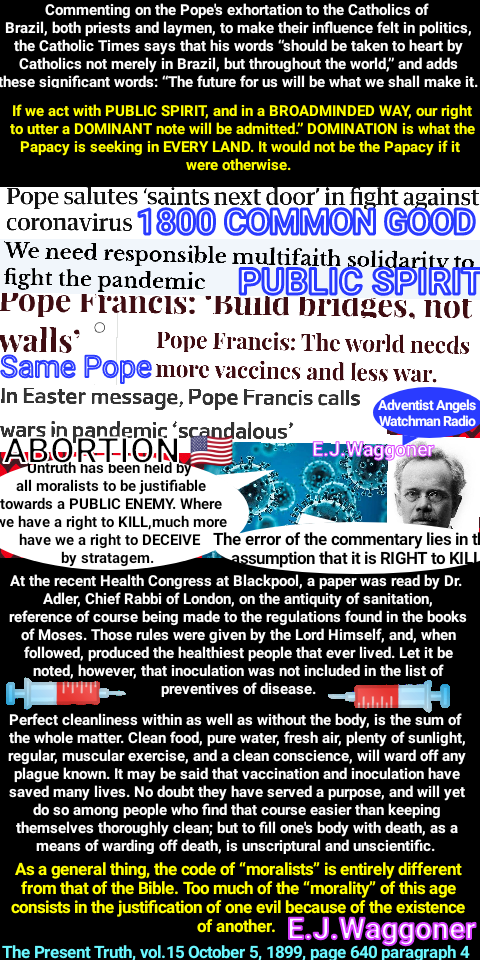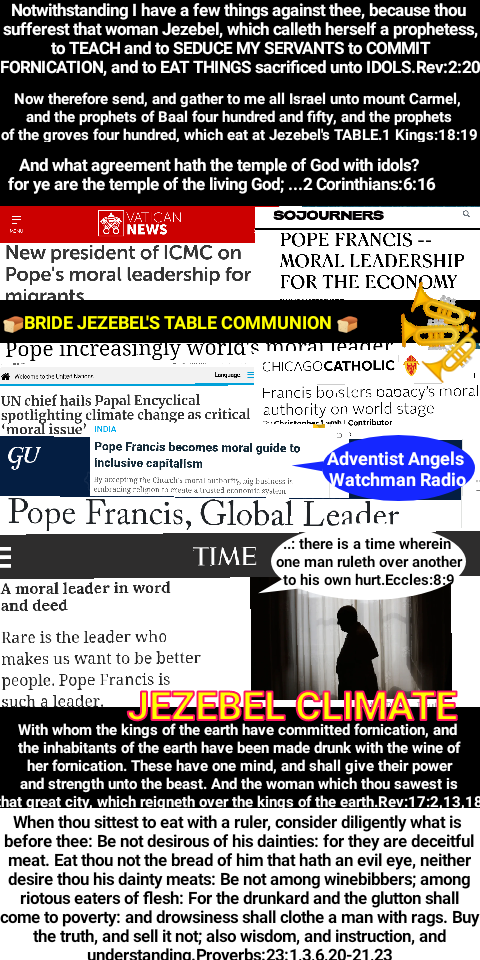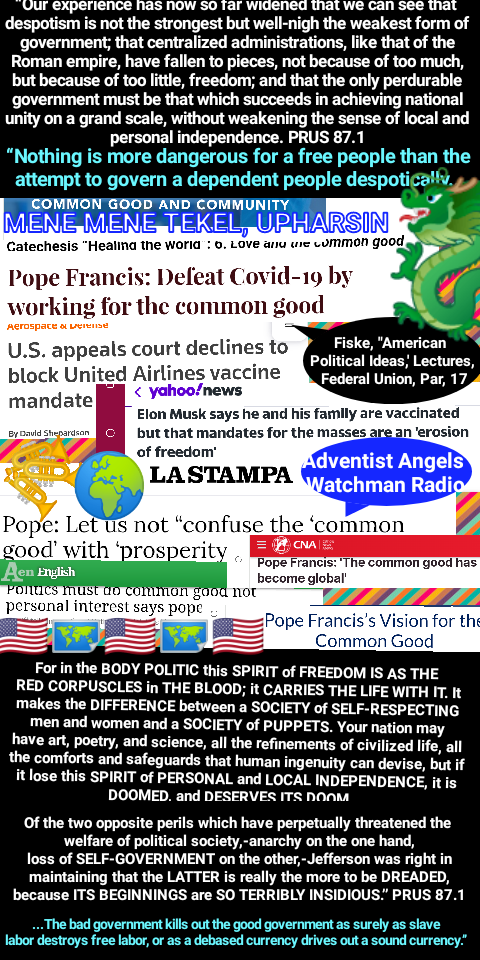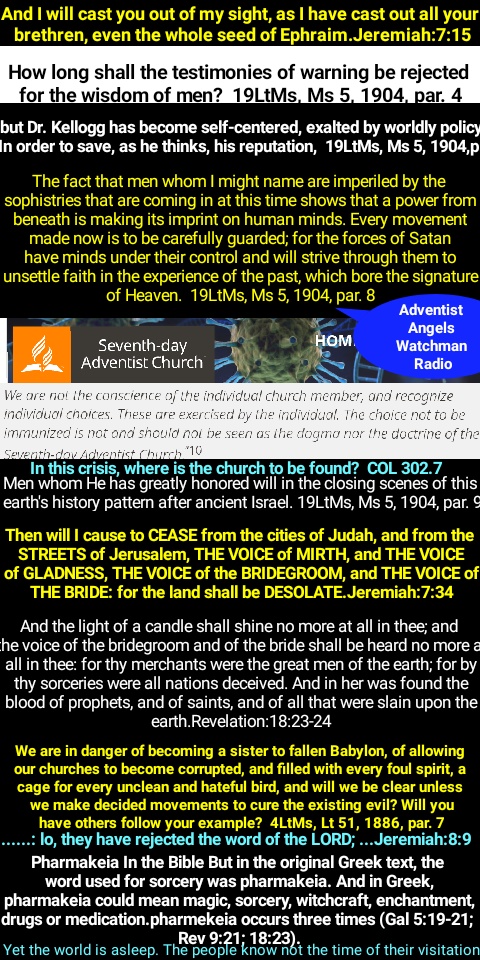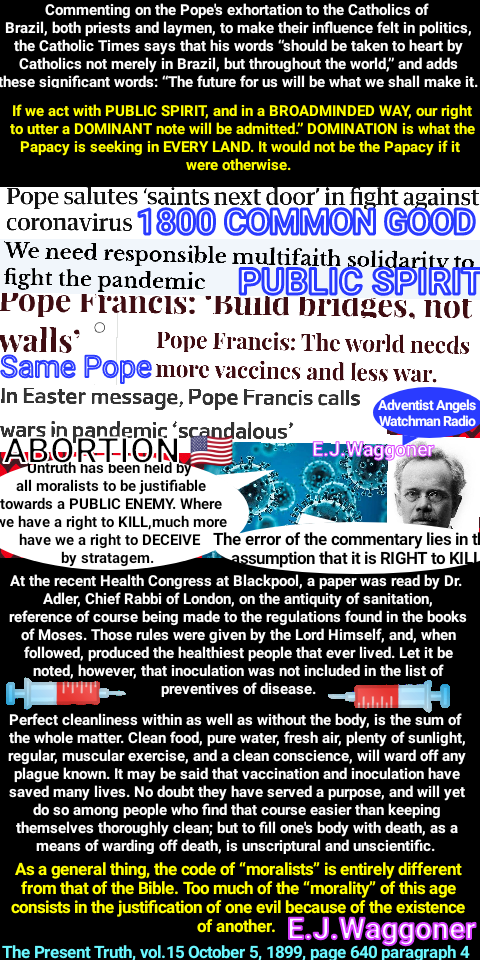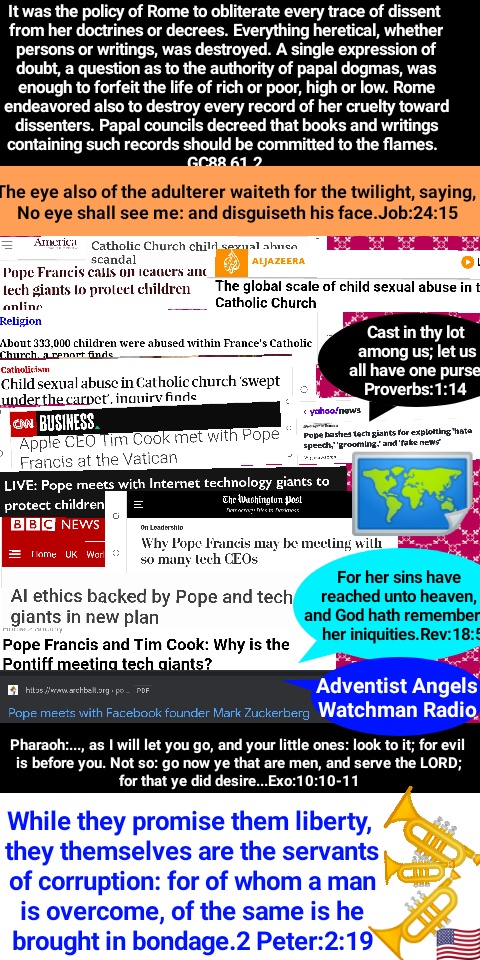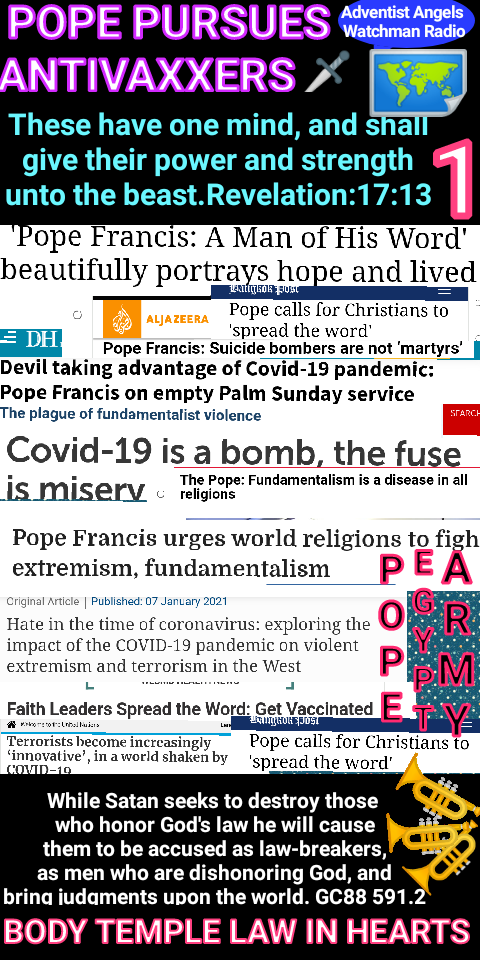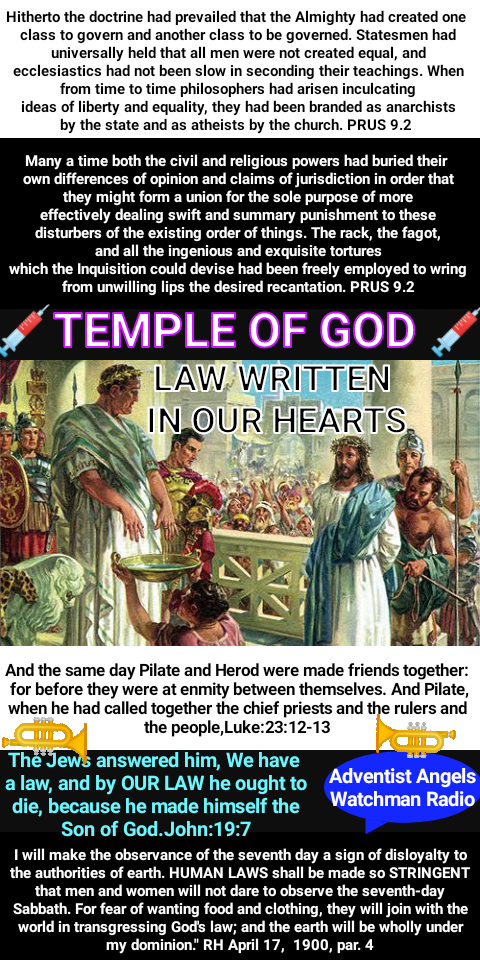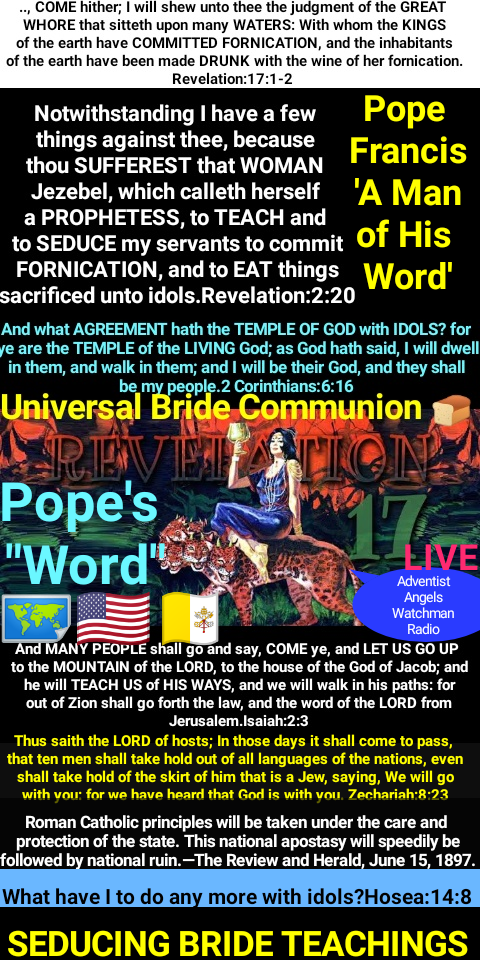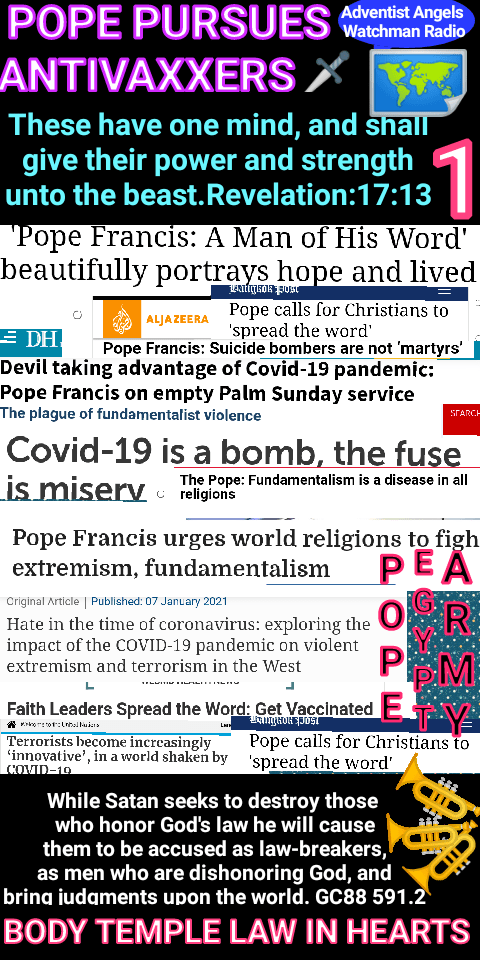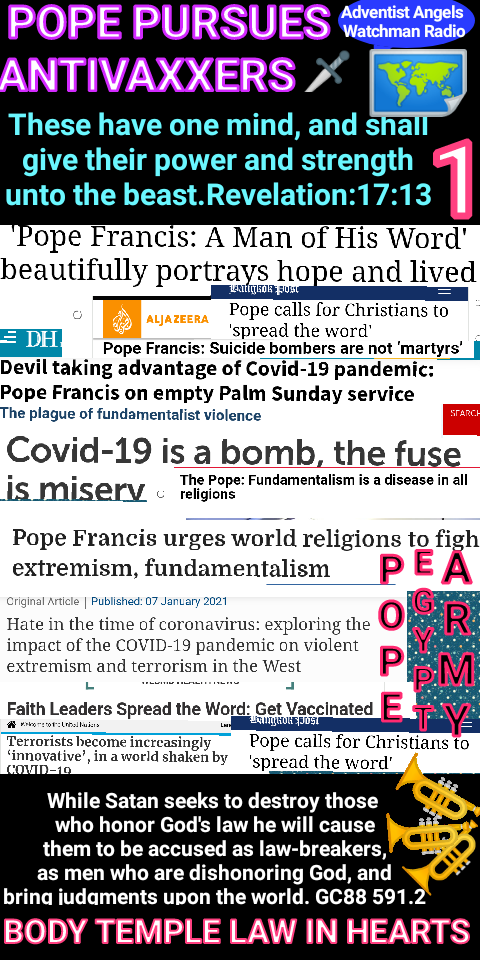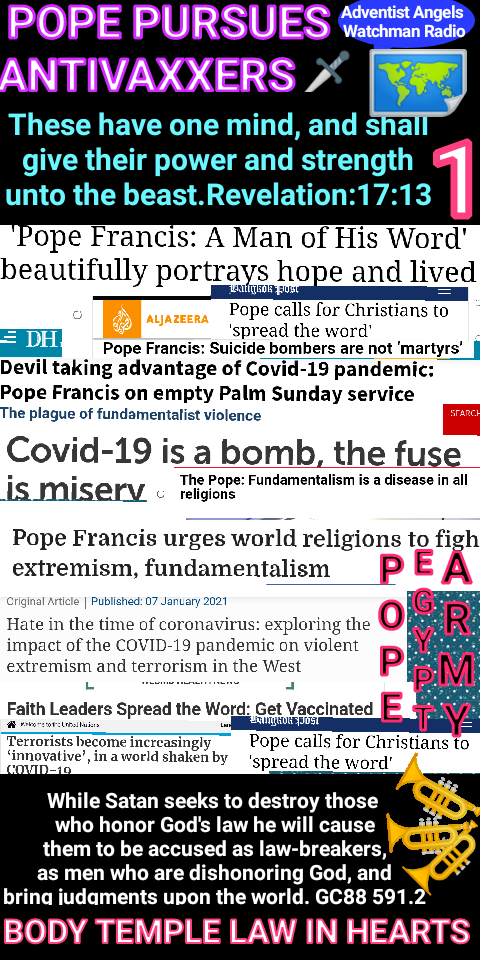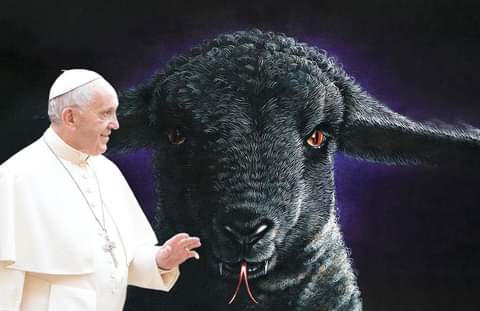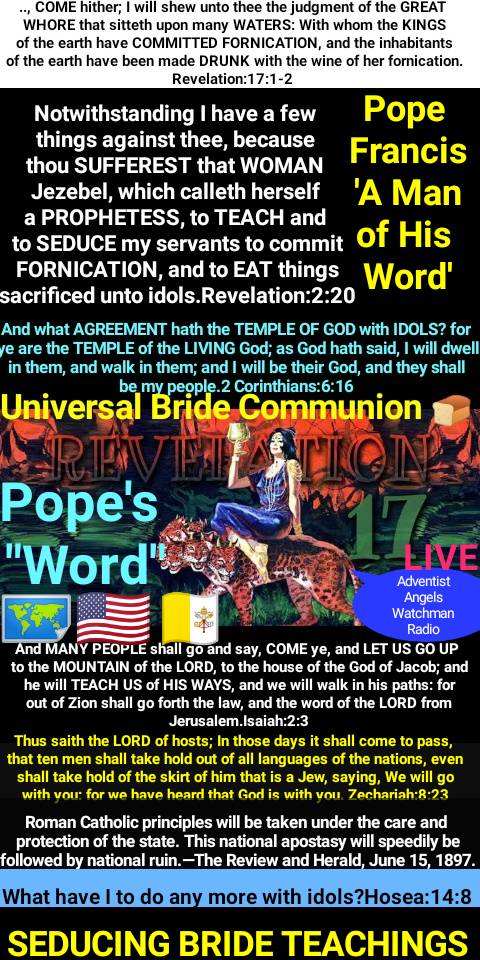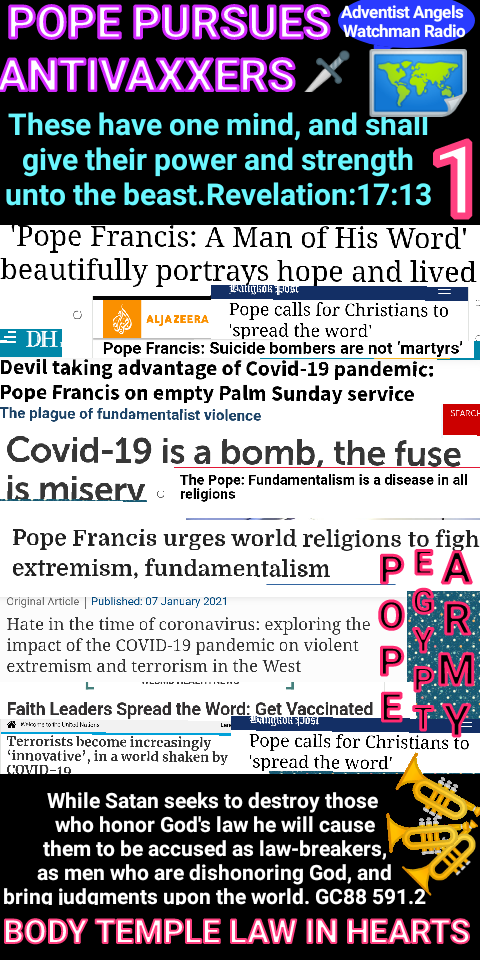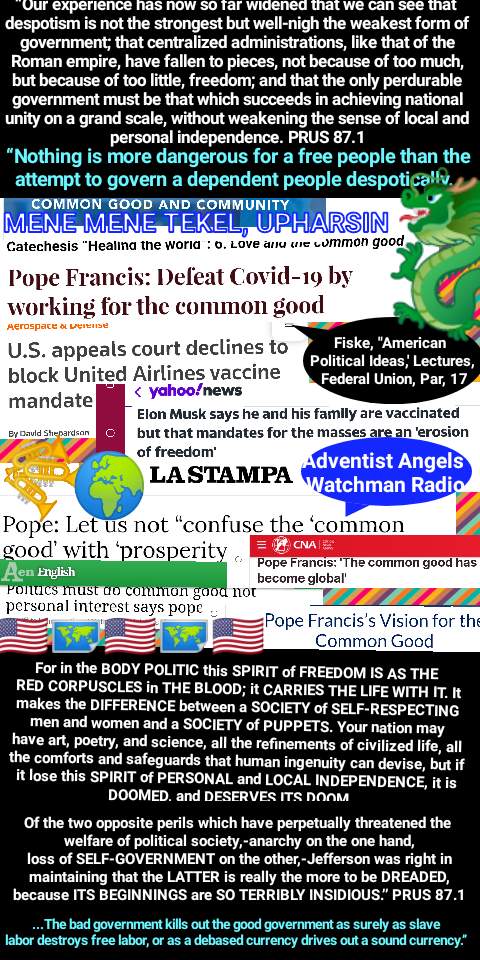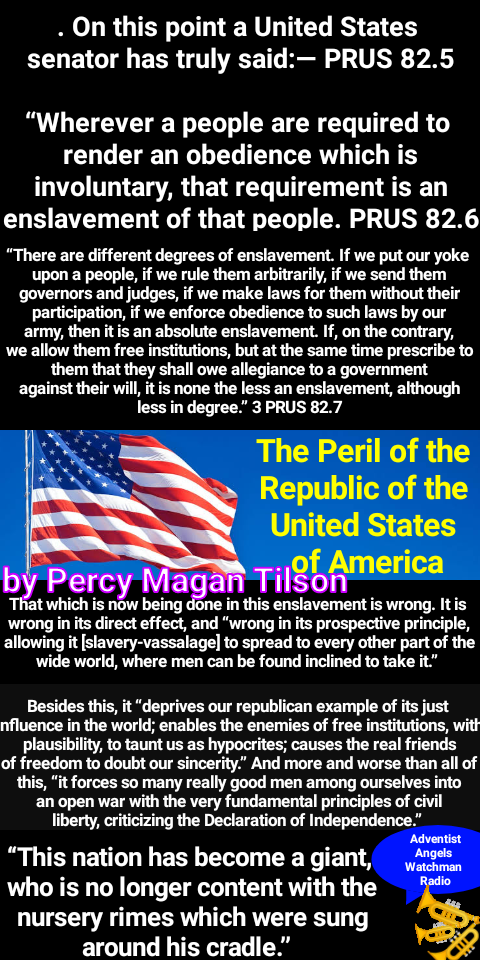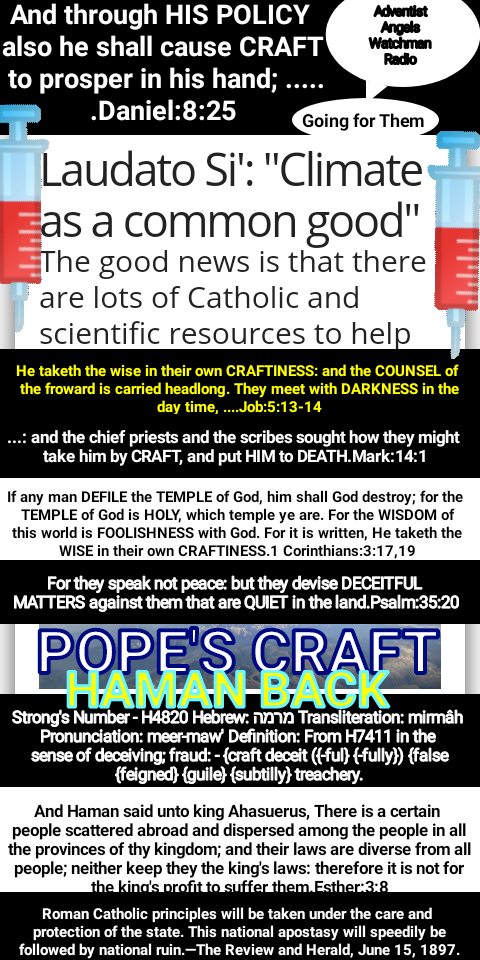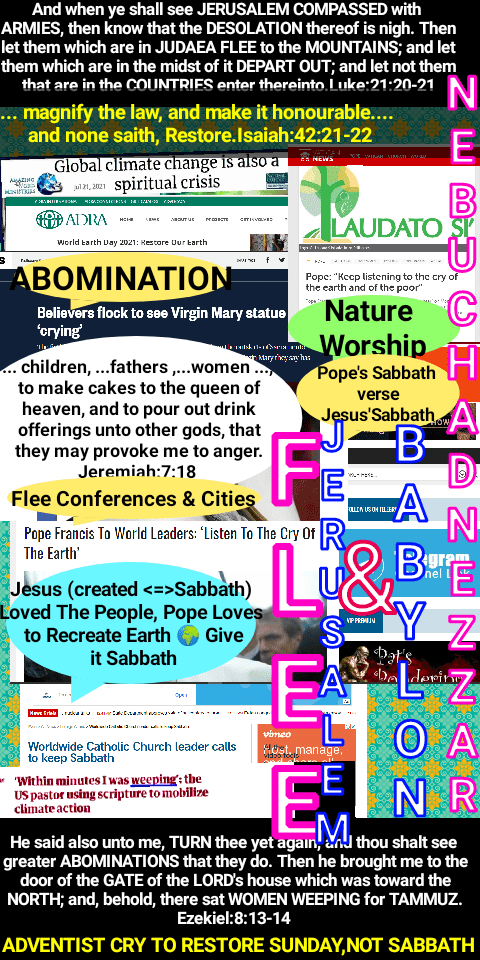

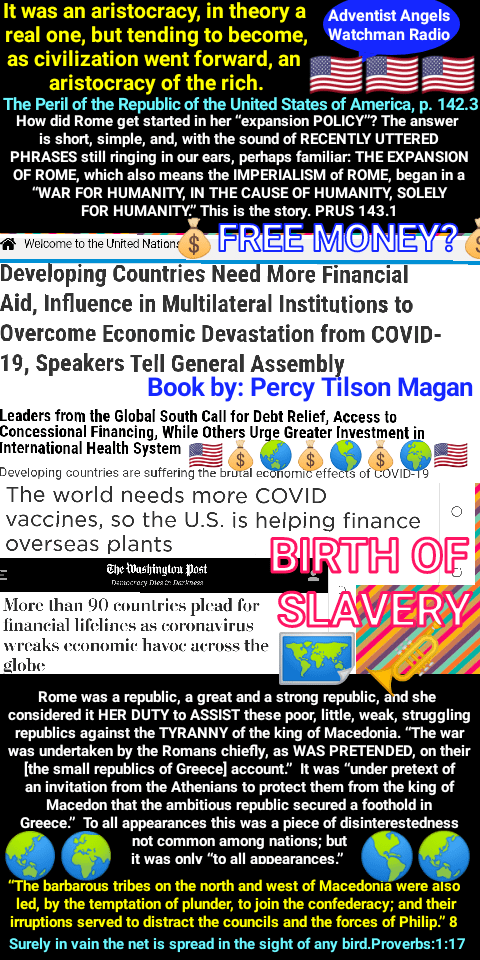
Pope Francis: Fighting a Pandemic: ANTIVAXXERS threat, Free Vaccines: “All these states were declared free and independent, except that the Romans (pretending that Antiochus, king of Syria, threatened the safety of Greece) retained, for the present, the strong places of Chalcis and Demetrias in their own hands.” 10 PRUS 145.4

“All these states were declared free and independent, except that the Romans (pretending that Antiochus, king of Syria, threatened the safety of Greece) retained, for the present, the strong places of Chalcis and Demetrias in their own hands.” 10 PRUS 145.4

Religion, once the foundation of the laws and rule of personal conduct, had subsided into opinion. The educated, in their hearts, disbelieved it. Temples were still built with increasing splendor; the established forms were scrupulously observed. Public men spoke conventionally of Providence, that they might throw on their opponents the odium of impiety; but of genuine belief that life had any serious meaning, there was none remaining beyond the circle of the silent, patient, ignorant multitude.

The whole spiritual atmosphere was saturated with cant-cant moral, cant political, cant religious; an affectation of high principle which had ceased to touch the conduct, and flowed on in an increasing volume of insincere and unreal speech. The truest thinkers were those who, like Lucretius, spoke frankly out their real convictions, declared that Providence was a dream, and that man and the world he lived in were material phenomena generated by natural forces out of cosmic atoms, and into atoms to be again dissolved. PRUS 140.3

“Tendencies now in operation may a few generations hence land modern society in similar conclusions, unless other convictions revive meanwhile and get the mastery over them; of which possibility no more need be said than this, that unless there be such a revival, in some shape or other, the forces, whatever they be, which control the forms in which human things adjust themselves, will make an end again, as they made an end before, of what are called free institutions. Popular forms of government are possible only when individual men can govern their own lives on moral principles, and when duty is of more importance than pleasure, and justice than material expediency.” 4 PRUS 142.1

Then it was that there came upon the Romans that extraordinary spirit of expansion, which led them to believe that theirs was a manifest destiny to rule the entire world; and in a few short years, from being a snug little country, locked in the arms of twin seas, Rome was transformed into an imperialism, set for the despoliation of every conquerable nation. On this point Froude has said:— PRUS 142.2

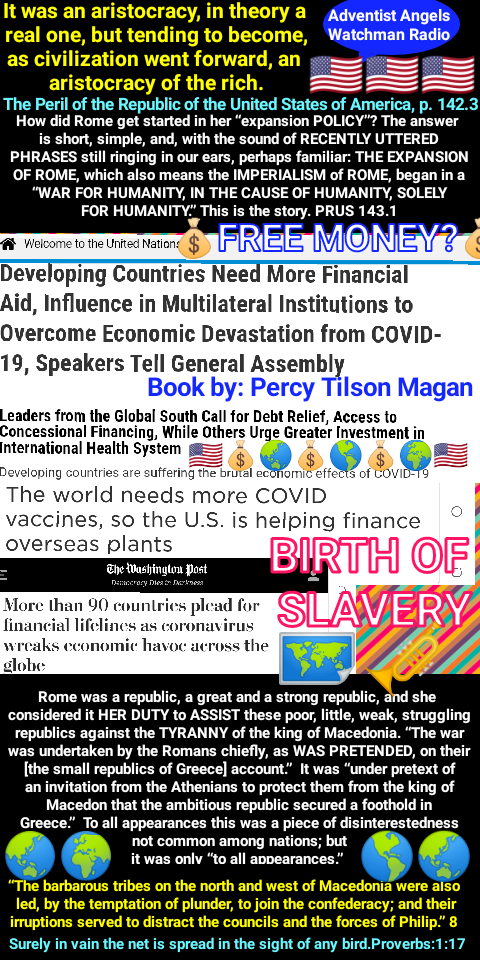
“Italy had fallen to them by natural and wholesome expansion; but from being sovereigns of Italy, they became a race of imperial conquerors. Suddenly and in comparatively a few years after the one power was gone which could resist them, they became the actual or virtual rulers of the entire circuit of the Mediterranean. The southeast of Spain, the coast of France from the Pyrenees to Nice, the north of Italy, Illyria and Greece, Sardinia, Sicily, and the Greek islands, the southern and western shores of Asia Minor, were Roman provinces, governed directly by Roman magistrates. On the African side, Mauritania (Morocco) was still free. Numidia (the modern Algeria) retained its native dynasty, but was a Roman dependency. The Carthaginian dominions, Tunis and Tripoli, had been annexed to the empire. The interior of Asia Minor up to the Euphrates, with Syria and Egypt, were under sovereigns, called allies, but like the native princes in India, subject to a Roman protectorate. Over this enormous territory, rich with the accumulated treasures of centuries, and inhabited by thriving, industrious races, the energetic Roman men of business had spread and settled themselves, gathering into their hands the trade, the financial administration, the entire commercial control of the Mediterranean basin. They had been trained in thrift and economy, in abhorrence of debt, in strictest habits of close and careful management. Their frugal education, their early lessons in the value of money, good and excellent as these lessons were, led them, as a matter of course, to turn to account their extraordinary opportunities. Governors with their staffs, permanent officials, contractors for the revenue, negotiators, bill-brokers, bankers, merchants, were scattered everywhere in thousands. Money poured in upon them in rolling streams of gold. The largest share of the spoils fell to the Senate and the senatorial families. The Senate was the permanent council of state, and was the real administrator of the empire. The Senate had the control of the treasury, conducted the public policy, appointed from its own ranks the governors of the provinces. It was patrician in sentiment, but not necessarily patrician in composition. The members of it had virtually been elected for life by the people, and were almost entirely those who had been quæstors, ædiles, prætors, or consuls; and these offices had been long open to the plebeians. It was an aristocracy, in theory a real one, but tending to become, as civilization went forward, an aristocracy of the rich. How the senatorial privileges affected the management of the provinces will be seen more and more particularly as we go on. It is enough at present to say that the nobles and great commoners of Rome rapidly found themselves in possession of revenues which their fathers could not have imagined in their dreams; and money, in the stage of progress at which Rome had arrived, was convertible into power.” 5 PRUS 142.3

This is a good description of the territory of Rome’s expansion, and what she did with it, when once it fell into her possession. The next question that calls for solution is, How did Rome get started in her “expansion policy”? The answer is short, simple, and, with the sound of recently uttered phrases still ringing in our ears, perhaps familiar: the expansion of Rome, which also means the imperialism of Rome, began in a “war for humanity, in the cause of humanity, solely for humanity.” This is the story. PRUS 143.1

When the second Punic war came to an end, with such a disastrous issue for the Carthaginians, and such a favorable outcome for the Romans, the latter determined immediately to crush the power of Philip, king of Macedon. True, peace had been concluded with him two or three years before, “yet the grounds of a new quarrel were soon discovered.” He was accused of having attacked the Athenians and some of the other friends of Rome. At this time the southern part of Greece was divided into a number of small republics, all of which paid more or less tribute to Philip of Macedon. Rome was a republic, a great and a strong republic, and she considered it her duty to assist these poor, little, weak, struggling republics against the tyranny of the king of Macedonia. “The war was undertaken by the Romans chiefly, as was pretended, on their [the small republics of Greece] account.” 6 It was “under pretext of an invitation from the Athenians to protect them from the king of Macedon that the ambitious republic secured a foothold in Greece.” 7 To all appearances this was a piece of disinterestedness not common among nations; but it was only “to all appearances.” “The barbarous tribes on the north and west of Macedonia were also led, by the temptation of plunder, to join the confederacy; and their irruptions served to distract the councils and the forces of Philip.” 8 PRUS 143.2

The parallel or analogy between that war “solely for humanity” and the one through which the United States has just passed, is quite complete. The little republics of Southern Greece stood related to Philip of Macedon much the same as Cuba, Porto Rico, and other places stood related to Spain at the time when this nation, “solely in the cause of humanity,” declared war in their behalf. And, moreover, it may not be out of the way to compare “the barbarous tribes on the north and west of Macedonia,” who were led to join the confederacy, and whose irruptions served to distract the councils and forces of Philip,-it may not be out of the way to compare-these to Aguinaldo and his “barbarous” hordes of Negritos, who, by a United States consul and a commodore of the United States navy, were led to “join the confederacy,” and whose “irruptions served to distract the councils and forces of Spain.” PRUS 144.1

At the battle of Cynocephale, in 197 b. c., Philip was signally defeated, his country was exposed to invasion, “and he was reduced to accept peace on such terms as the Romans thought proper to dictate.” PRUS 145.1

“These, as usual, tended to cripple the power of the vanquished party, and at the same time to increase the reputation of the Romans, by appearing more favorable to their allies than to themselves. PRUS 145.2

“Philip was obliged to give up every Greek city that he possessed beyond the limits of Macedonia, both in Europe and in Asia; a stipulation which deprived him of Thessaly, Achaia, Phthiotis, Perrhæbia, and Magnesia, and particularly of the three important towns of Corinth, Chalcis, and Demetrias, which he used to call the fetters of Greece.” 9 In other words, Philip of Macedon lost all his outlying dependencies; and this is just about what happened to Spain at the treaty of Paris. Both alike were stripped of by far the greater part of their territory outside of the home land. PRUS 145.3

“All these states were declared free and independent, except that the Romans (pretending that Antiochus, king of Syria, threatened the safety of Greece) retained, for the present, the strong places of Chalcis and Demetrias in their own hands.” 10 PRUS 145.4

The war had been waged by Rome at an infinite cost of blood and treasure to herself. Freely she had sacrificed the blood of her sons, and caused the tears of her daughters to be shed, in this war, “solely for humanity.” She had marshaled her armies, and mobilized her fleets, put the former in the field, and the latter in the sea, solely and only for the purpose of bringing liberty to these small and distressed dependencies, the little sister republics, who were struggling for their freedom. She asked no money nor land for all this; her cup of joy was full to the overflowing, because she had done such a great act of disinterested kindness “in the cause of humanity.” In a striking proclamation she published to the world the liberty of these people, won by her valor at arms, and freely given to them:— PRUS 145.5

“The senate and people of Rome, and Titus Quintius the general, having conquered Philip and the Macedonians, do set at liberty from all garrisons, imposts, and taxes, the Corinthians, the Locrians, the Phocians, the Phthiot-Achaians, the Messenians, the Thessalians, and the Perrhebians, declare them free! and ordain that they shall be governed by their respective customs and usages. PRUS 145.6

“Then followed the memorable scene at the Isthmian games, when it was announced to all the multitude assembled on that occasion, that the Romans bestowed entire freedom upon all those states of Greece which had been subject to the kings of Macedonia. The Greeks, unable to read the future, and having as yet had no experience of the ambition of Rome, received this act with the warmest gratitude; and seemed to acknowledge the Romans in the character they assumed, of protectors and deliverers of Greece.” 11 PRUS 146.1

Following this was a war with Antiochus, king of Syria. He was reduced to the condition of a suppliant in b. c. 190, by the event of the battle of Magnesia. Philip of Macedon had helped the Romans in their campaigns against him. This king seems “vainly to have hoped that by a faithful and a zealous observance of the treaty of peace, he might soften the remorseless ambition of the Romans.” The Ætolians fell before the Roman arms, and then the Galatians, and now the way was open for Rome to continue her ambitious designs against Perseus, king of Macedon. At the battle of Pydna his army was overthrown, and his power broken. This was in b. c. 168. “Macedonia was then divided into four districts, each of which was to be under a republican government. Half of the tribute formerly paid to the king was henceforward to be paid to the Romans, who also appropriated to themselves the produce of all the gold and silver mines of the kingdom. The inhabitants were forbidden to fell timber for ship-building; and all intermarriages and sales of land between the people of the several districts were forbid den. With these marks of real slavery, they were left, for the present, nominally free; and Macedonia was not yet reduced to the form of a Roman province.” PRUS 146.2

Then, says Arnold, and his words are pregnant with deepest instruction for the people of the United States at the present time:— PRUS 146.3

“It is curious to observe, how, after every successive conquest, the Romans altered their behavior to those allies who had aided them to gain it, and whose friendship or enmity was now become indifferent to them. Thus, after their first war with Philip, they slighted the Ætolians; after they had vanquished Antiochus, they readily listened to complaints against Philip; and now the destruction of Macedon enabled them to use the language of sovereigns rather than of allies to their oldest and most faithful friends, Eumenes, the Rhodians, and the Achaians. The senate first tampered with Attalus, the brother of Eumenes, hoping that he might be persuaded to accuse his brother, and to petition for a share of his dominions; but when they found him deaf to their temptations, they retracted some promises which they had made him, in the hope that he would listen to them. Afterward, when Eumenes himself landed in Italy on his way to Rome, with a view to removing the suspicions entertained against him, the senate, aware of his purpose, issued an order that no king should be allowed to come to Rome; and despatched one of the quæstors to announce it to him at Brundusium, and to command him to leave Italy immediately. The Rhodians had offended by declaring openly ‘that they were tired of the war with Perseus; that he, as well as the Romans, was the friend of their commonwealth; that they should wish to see the contending parties reconciled; and that they would themselves declare against those whose obstinacy should be an impediment to peace.’ This declaration, which was received at Rome most indignantly, had been privately recommended by Q. Marcius, the Roman consul, to one of the Rhodian ambassadors, who had visited him in his camp in Macedonia, during the preceding year; and Polybius reasonably conjectures that Marcius, confident of a speedy victory over Perseus, gave this advice to the Rhodians, with the treacherous purpose of furnishing the senate with a future pretense for hostility against them. However, their fault was punished by the loss of Lycia and Caria, which the senate now declared independent; and the individuals who were accused of favoring Perseus were given up to the Romans, or at the instigation of Roman officers were put to death by the Rhodian government. Nor should it be omitted that a general inquiry was instituted throughout Greece into the conduct of the principal men in the several states during the late war. Those who were accused by their countrymen of the Roman party of having favored Perseus were summoned to Rome to plead their cause as criminals; and some were even put to death. But if the mere opinions and inclinations of individuals were thus punished, the states which had actually taken part with Macedon met with a still heavier destiny. Let it be forever remembered that by the decree of the senate seventy towns of Epirus were given up to be plundered by the Roman army, after all hostilities were at an end; that falsehood and deceit were used to prevent resistance or escape; and that in one day and one hour seventy towns were sacked and destroyed, and one hundred and fifty thousand human beings sold for slaves. The instrument employed on this occasion was L. Emilius Paulus, the conqueror of Macedon, and one of those whom we are taught to regard as models of Roman virtue. There is no reason to doubt his sincere affection for his country, his indifference to money, and his respectability as a citizen, husband, son, and father. But it is useful to see what dreadful actions the best men of ancient times were led unhesitatingly to commit, from the utter absence of a just law of nations, and the fatal habit of making their country the supreme object of their duty. Nor is it possible that these evils should be prevented, unless truer notions have insensibly established themselves in the minds of men, even of those who are least grateful to the source from which they have derived them; and if modern Europe be guided by purer principles, the Christian historian can not forget from what cause this better and happier condition has arisen. PRUS 146.4

“It remains now that we speak of the conduct of the Romans toward the Achaians. The early history of the Achaian League, and the leaning of its councils toward a friendly connection with Macedon, has been already noticed. In the war between the Romans and Philip, however, the Achaians were persuaded to join with the former, a step which Polybius describes as absolutely necessary for their safety; whether it were altogether equally honorable we have hardly the means of deciding. But their new connection, whatever may be thought of its origin, was ever afterward faithfully observed, insomuch that the Romans, though sufficiently adroit in finding matter of complaint, when they were disposed to do so, and though offended by the free and independent tone which the Achaian government always maintained toward them, could yet obtain no tolerable pretext for attacking them. There was, however, a traitor among the Achaians, named Calicrates, who, jealous of the popularity of the ruling party in the councils of his country, endeavored to supplant them through the influence of Rome; and to ingratiate himself with the senate by representing his opponents as despisers of the Roman authority, which he and his friends vainly endeavored to uphold. After the Macedonian war, his intrigues were carried to a greater extent than ever. He accused a great number of the most eminent of his countrymen of having favored the cause of Perseus; and although the conduct of the Achaian government toward Rome had been perfectly blameless, and nothing was found among the papers of the king of Macedon which confirmed the charge, even against any of its individual citizens, yet, on the demand of the Romans, more than a thousand of the most eminent men in the commonwealth were arrested and sent into Italy, under pretense that they should be tried for their conduct at Rome. On their arrival in Italy, they were confined in the different cities of Tuscany, and there remained nearly seventeen years. The senate repeatedly refused the petition of the Achaian government, that they might either be released or else be brought to trial. It is added that whoever among them were at any time detected in endeavoring to escape were invariably put to death. At last, after most of them had died in captivity, the influence of Cato, the censor, was exerted in behalf of the survivors, at the request of Scipio Æmilianus, who was anxious to serve one of their number, his own familiar friend, the historian Polybius. But the manner in which Cato pleaded their cause deserves to be recorded. He represented the Achaian prisoners as unworthy of the notice of the senate of Rome. ‘We sit here all day,’ said he, ‘as if we had nothing to do, debating about the fate of a few wretched old Greeks, whether the undertakers of Rome or of Achaia are to have the burying of them.’ We have dwelt the more fully on this treatment of the Achaians, because it sets in the clearest light the character of the Roman government; and enables us to appreciate the state of the world under the Roman dominion, when such men as Polybius were subject to the worst oppression and insolence from a nation which boasted of Cato the censor as one of its greatest ornaments. PRUS 148.1

“Hitherto, however, Achaia and the rest of Greece still enjoyed a nominal independence, notwithstanding the real supremacy of the Roman power. But within little more than twenty years from the overthrow of Perseus, even these poor remains of freedom were destroyed.” 12 PRUS 149.1

Into the details of this it is not necessary to go; suffice it to say that the same course of treachery, duplicity, and base perfidy which had marked the course of Rome in other cases also marked her trail in this one. Achaia was one of the last allies of Rome, in whose behalf she had entered upon war “solely in the cause of humanity,” but with other enemies or friends, as the case might be, disposed of, it was decided that her hour for destruction was now arrived. The Achaian league was dissolved, and Greece was henceforth treated as a province, was subjected to tribute, and was governed by a Roman proconsul, or prætor. PRUS 150.1

Such are the military facts connected with the story of the “expansion” and “imperialism” of Rome. Upon them, the historian Rollin has written some “Reflections on the conduct of the Romans with regard to the Græcian states, and the kings both of Europe and Asia.” His reflections contain the wisest philosophy on these events that the writer has ever discovered. His words are full of instruction concerning that time; but they are also full of truths applicable to all times and places, and the present crisis in the United States, perhaps more than any other. He says:— PRUS 150.2

“The reader begins to discover, in the events before related, one of the principal characteristics of the Romans, which will soon determine the fates of all the states of Greece, and produce an almost general change in the universe; I mean, a spirit of sovereignty and dominion. This characteristic does not display itself at first in its full extent; it reveals itself only by degrees; and it is only by insensible progressions, which at the same time are rapid enough, that it is carried at last to its greatest height. PRUS 150.3

“It must be confessed that this people, on certain occasions, show such a moderation and disinterestedness as (judging them only from their outside) exceed everything we meet with in history, and to which it seems inconsistent to refuse praise. Was there ever a more delightful or more glorious day than that in which the Romans, after having carried on a long and dangerous war, after crossing seas, and exhausting their treasures, caused the heralds to proclaim in a general assembly that the Roman people restored all the cities to their liberty, and desired to reap no other fruit from her victory than the noble pleasure of doing good to nations, the bare remembrance of whose ancient glory sufficed to endear them to the Romans? The description of that immortal day can hardly be read without tears, and without being affected by a kind of enthusiasm of esteem and admiration. PRUS 150.4

“Had this deliverance of the Græcian states proceeded merely from a principle of generosity, void of all interested motives; had the whole tenor of the conduct of the Romans never belied such exalted sentiments,-nothing could possibly have been more august, or more capable of doing honor to a nation. But, if we penetrate ever so little beyond this glaring outside, we soon perceive that this specious moderation of the Romans was entirely founded upon a profound policy; wise indeed, and prudent, according to the ordinary rules of government, but, at the same time, very remote from that noble disinterestedness, so highly extolled on the present occasion. It may be affirmed that the Græcians had abandoned themselves to a stupid joy; fondly imagining that they were really free, because the Romans declared them so. PRUS 151.1

“Greece, in the times I am now speaking of, was divided between two powers; I mean the Græcian republics and Macedonia; and they were always engaged in war, the former to preserve the remains of their ancient liberty, and the latter to complete their subjection. The Romans, being perfectly well acquainted with this state of Greece, were sensible that they needed not to be under any apprehensions from those little republics, which were grown weak through length of years, intestine feuds, mutual jealousies, and the wars they had been forced to support against foreign powers. But Macedonia, which was possessed of well-disciplined troops, inured to all the toils of war, which had continually in view the glory of its former monarchs; which had formerly extended its conquests to the extremities of the globe; which harbored ardent, though chimerical desire of attaining universal empire; and which had a kind of natural alliance with the kings of Egypt and Syria, sprung from the same origin, and united by the common interest of monarchy,-Macedonia, I say, gave just alarms to Rome, which, from the time of the ruin of Carthage, had no obstacle left with regard to their ambitious designs, but those powerful kingdoms that shared the rest of the world between them, and especially Macedonia, as it lay nearer to Italy than the rest. PRUS 151.2

“To balance, therefore, the power of Macedon, and to dispossess Philip of the aid which he flattered himself he should receive from the Greeks, which, indeed, had they united all their forces with his, in order to oppose this common enemy, would perhaps have made him invincible with regard to the Romans; in this view, I say, this latter people declared loudly in favor of those republics, made it their glory to take them under their protection, and that with no other design in outward appearance than to defend them against their oppressors; and further to attach them by a still stronger tie, they hung out to them a specious bait (as a reward for their fidelity); I mean liberty, of which all the republics in question were inexpressibly jealous; and which the Macedonian monarchs had perpetually disputed with them. PRUS 152.1

“The bait was artfully prepared, and swallowed very greedily by the generality of the Greeks, whose views penetrated no farther. But the most judicious and most clear sighted among them discovered the danger that lay concealed beneath this charming bait; and accordingly they exhorted the people from time to time, in their public assemblies to beware of this cloud that was gathering in the west, and which, changing on a sudden into a dreadful tempest, would break like thunder over their heads, to their utter destruction. PRUS 152.2

“Nothing could be more gentle and equitable than the conduct of the Romans in the beginning. They acted with the utmost moderation toward such states and nations as addressed them for protection; they succored them against their enemies, took the utmost pains in terminating their differences, and in suppressing all commotions which arose among them, and did not demand the least recompence from their allies for all these services. By this means their authority gained strength daily, and prepared the nations for entire subjection. PRUS 152.3

“And, indeed, upon pretense of offering them their good offices, of entering into their interests, and of reconciling them, they rendered themselves the sovereign arbiters of those whom they had restored to liberty, and whom they now considered, in some measure, as their freedmen. They used to depute commissioners to them, to inquire into their complaints, to weigh and examine the reasons on both sides, and to decide their quarrels; but when the articles were of such a nature that there was no possibility of reconciling them on the spot, they invited them to send their deputies to Rome. Afterward, they used, with plenary authority, to summon those who refused to be reconciled, obliged them to plead their cause before the senate, and even to appear in person there. From arbiters and mediators being become supreme judges, they soon assumed a magisterial tone, looked upon their decrees as irrevocable decisions, were greatly offended when the most implicit obedience was not paid to them, and gave the name of rebellion to a second resistance; thus there arose, in the Roman senate, a tribunal which judged all nations and kings, from which there was no appeal. This tribunal, at the end of every war, determined the rewards and punishments due to all parties. They dispossessed the vanquished nations of part of their territories, in order to bestow them on their allies, by which they did two things from which they reaped a double advantage; for they thereby engaged in the interest of Rome such kings as were in no way formidable to them, and from whom they had something to hope; and weakened others, whose friendship the Romans could not expect, and whose arms they had reason to dread. PRUS 152.4

“We shall hear one of the chief magistrates in the republic of the Achaians inveigh strongly in a public assembly against this unjust usurpation, and ask by what title the Romans are empowered to assume so haughty an ascendent over them; whether their republic was not as free and independent as that of Rome; by what right the latter pretended to force the Achaians to account for their conduct; whether they would be pleased, should the Achaians, in their turn, officially pretend to inquire into their affairs, and whether matters ought not to be on the same footing on both sides? All these reflections were very reasonable, just, and unanswerable; and the Romans had no advantage in the question but force. PRUS 153.1

“They acted in the same manner, and their politics were the same in regard to their treatment of kings. They first won over to their interest such among them as were the weakest, and consequently the least formidable; they gave them the title of allies, whereby their persons were rendered in some measure sacred and inviolable; and it was a kind of safeguard against other kings more powerful than themselves; they increased their revenues, and enlarged their territories, to let them see what they might expect from their protection. It was this which raised the kingdom of Pergamus to so exalted a pitch of grandeur. PRUS 153.2

“In the sequel the Romans invaded, upon different pretenses, those great potentates who divided Europe and Asia, and how haughtily did they treat them, even before they had conquered! A powerful king, confined within a narrow circle by a private man of Rome, was obliged to make his answer before he quitted it; how imperious was this! But then how did they treat vanquished kings? They command them to deliver up their children, and the heirs to their crown, as hostages and pledges of their fidelity and good behavior; oblige them to lay down their arms; forbid them to declare war, or conclude any alliance, without first obtaining their leave; banish them to the other side of the mountains; and leave them, in strictness of speech, only an empty title, and a vain show of royalty, divested of all its rights and advantages. PRUS 154.1

“We are not to doubt but that Providence had decreed to the Romans the sovereignty of the world, and the Scriptures had prophesied their future grandeur; but they were strangers to those divine oracles; and besides, the bare prediction of their conquest was no justification of their conduct. Although it be difficult to affirm, and still more difficult to prove, that this people had from their first rise formed a plan, in order to conquer and subject all nations, it can not be denied but that, if we examine their whole conduct attentively, it will appear that they acted as if they had a foreknowledge of this, and that a kind of instinct determined them to conform to it in all things. PRUS 154.2

“But be this as it will, we see by the event, to what this so much boasted lenity and moderation of the Romans was confined. Enemies to the liberty of all nations, having the utmost contempt for kings and monarchy, looking upon the whole universe as their prey, they grasped, with insatiable ambition, the conquest of the whole world; they seized indiscriminately all provinces and kingdoms, and extended their empire over all nations; in a word, they prescribed no other limits to their vast projects, than those which deserts and seas made it impossible to pass.” 13 PRUS 154.3

The expansion fever which laid such firm hold upon the people of the Roman republic has come upon the people of the republic of the United States. In both cases the game of the despoliation of nations and peoples has opened with a war “solely in the cause of humanity.” In the former instance, the Romans did declare the people of the small Greek republics free and independent. The United States has not yet even done this much. The republics of Greece never became free. The “war for humanity” never gave them their liberty. They soon found, and that to their bitter disappointment, that they had only exchanged masters, and that the little finger of Rome was thicker than the loins of Philip of Macedon, and that if the king had chastised them with whips, the republic chastised them with scorpions. They soon found to their intense sorrow that in the “war for humanity” there had been a transfer made, and that they had been the subject of barter. It did not take them long to discover that they had only acquired a slavery more abject and complete than that which they had endured under their previous ruler. It was as much more complete as Rome was more powerful than Macedon. PRUS 155.1

Rome never withdrew her foot from the Greek states, and it is even now doubtful whether the United States will ever withdraw from Cuba. Recent public utterances indicate that a great change of sentiment is sweeping over the country on this point. At the meeting of the members of the Associated Press, held in Chicago, May 18, 1899, in the star speech of the evening, St. Claire McKelway, editor of the Brooklyn Eagle, said:— PRUS 155.2

“There is no newspaper which believes that we are in Porto Rico ever to get out. We are there to stay. There is none which believes that we are in Cuba to get out-soon. I think we will stay there about as long as Great Britain will stay in Egypt, and that Great Britain will stay in Egypt about as long as the Anglo-Saxon race has a habit of staying where it settles down. I am willing to differ from my brethren on this subject, but as my estimate has been only comparative, perhaps there is less room for difference than might superficially appear. The duration of our stay in the Philippines is prodigiously debated. While the debate goes on, we stay. If the debate coincides with our stay, I think it will be a protracted debate.” PRUS 155.3

Indeed, as time goes on, the prospects of this country’s withdrawing from Cuba seem to be more and more remote. A silent revolution has been taking place, a revolution more fatal to the United States than any that ever went on in Cuba could possibly have been to the Spanish throne and power. PRUS 156.1

The things which have come to pass, and which are written out in this book, both those concerning Rome and the United States, have also been written long before in the prophecies of the Book of books, on the sacred leaves of the Holy Scriptures. This is not a chimera, but a fact, a reasonable fact, and one of deepest interest to all the citizens of the United States. It is fashionable nowadays to scoff at the idea that the Bible gives any instructions concerning the affairs of nations; but nevertheless a very large portion of the Word of God is simply a history of the nations, and a record of God’s dealings with them. Nothing can be more true or evident than that God keeps an account, not only with every individual, but also with every family, every city, and every State. PRUS 156.2

When Abraham and his followers entered the land of Canaan, they were not permitted to destroy the sinful inhabitants; but, said Jehovah, addressing the father of the faithful, and referring to Israel: “In the fourth generation they shall come hither again, for the iniquity of the Amorites is not yet full.” 14 And “in the fourth generation” they did “come hither again,” and by the command of the Lord they slew and spared not; and wrote of Sihon: “Then Sihon came out against us, he and all his people, to fight at Jahaz. And the Lord our God delivered him before us; and we smote him, and his sons, and all his people. And we took all his cities at that time, and utterly destroyed the men, and the women, and the little ones, of every city, we left none to remain: only the cattle we took for a prey unto ourselves, and the spoil of the cities which we took. From Aroer, which is by the brink of the river Arnon, and from the city that is by the river, even unto Gilead, there was not one city too strong for us: the Lord our God delivered all unto us: only unto the land of the children of Ammon thou earnest not, nor unto any place of the river Jabbok, nor unto the cities in the mountains, nor unto whatsoever the Lord our God forbade us.” 15 These wars of the Israelites are often taken to prove the position that God approves of war and acts of bloodshed. But the truth is not so. When Israel was commanded to destroy the people of the land into which she entered, it was because their cup of iniquity was full, and because it would be only cruelty on the part of the Creator to permit them a longer existence. Had God permitted them to live longer, their accumulation of sin would only have grown greater, and the penalty which they would have had to receive as individual sinners would necessarily have been more severe. They were utterly destitute of the Spirit of God; it had fled away forever. And being utterly destitute of that which alone can make us holy and good, there was nothing left in them for God to ally himself to, or which he could use as a means to bring them salvation. In principle they were demons; for what are Satan and his angels but beings entirely destitute of the Spirit of God? It is in mercy, therefore, that God brings the career of wicked individuals and evil nations to a close. It is not an arbitrary act, it is the kindest thing that a merciful God can do. PRUS 156.3

When the angels visited Abraham under the oaks on the plains of Mamre, the Lord spake through them, concerning the cities of Sodom and Gomorrah:— PRUS 157.1

“And the Lord said, Shall I hide from Abraham that thing which I do; seeing that Abraham shall surely become a great and mighty nation, and all the nations of the earth shall be blessed in him? For I know him, that he will command his children and his household after him, and they shall keep the way of the Lord, to do justice and judgment: that the Lord may bring upon Abraham that which he hath spoken of him. And the Lord said, Because the cry of Sodom and Gomorrah is great, and because their sin is very grievous; I will go down now, and see whether they have done altogether according to the cry of it, which is come unto me; and if not, I will know.” 16 The angels went on their way, and Abraham remained before the Lord, and pleaded with him, first that he should spare the cities if there could be found fifty righteous persons there; and then if there could be found forty-five, forty, thirty, twenty, or even ten righteous persons within their walls. And the Lord said, “I will not destroy it for ten’s sake.” Only righteous Lot and his family were found, and to them it was said: “Escape for thy life; look not behind thee, neither stay thou in all the plains; escape to the mountain, lest thou be consumed…. Then the Lord rained upon Sodom and upon Gomorrah brimstone and fire from the Lord out of heaven; and he overthrew those cities, and all the plain, and all the inhabitants of the cities, and that which grew upon the ground.” 17 PRUS 157.2

In the case of these cities the limit of God’s forbearance had been reached, the hour of their probation had closed. It was useless to give their inhabitants a further opportunity for salvation; they had sinned away their day of grace, and were given over to wickedness. PRUS 158.1

The same God who watched over the nation of the Amorites, and destroyed them when their cup of iniquity was full; the same God who kept record of the gay pleasures and grievous sins of the people of Sodom and Gomorrah, and who consumed them in the fearful flames when they had passed the unseen line,-that same One also kept watch over the republic of Rome, and is keeping watch over the republic of the United States. In the wonderful prophecies traced with the pencil of the Holy Ghost, the history of these last two is written, and was written long before either came into existence. It was written “to the intent that the living might know that the Most High ruleth in the kingdom of men, and giveth it to whomsoever he will.” PRUS 158.2

There are many who believe that the churches and churchmen should have nothing to do with politics. None hold this view more stanchly than I do. Nevertheless, it is as true to-day as it was in centuries past and gone that prophets and priests are sent by the Lord to warn kings and nations concerning the retribution which will be visited upon them by the King of kings and Lord of lords, if they depart from the path which a divine hand has mapped out for their feet. In this sense, and in this sense only, do I believe that the voice of the ambassadors of Jesus Christ should be heard in the courts and congresses of human powers, of earthly governments. And it is because I firmly believe that if the United States persists in the course she has entered upon, her ruin and the ruin of the world can be the only result, that I have penned these lines. Prophets were sent to heathen kings, as well as to the monarchs who sat on Israel’s throne. They were sent because God loved the people, and did all that infinite love and mercy could do to save them from a general doom. If the nation as a whole heeded not, as was often the case, there were individuals who listened to the voice of the ambassadors of the Lord, and were kept from the dire troubles which God sent upon the rebellious state. My life has been devoted to the affairs of religion and spirituality. I have never been a member in any sense of any political party, and have never in my life cast a vote in city, State, or national elections. In saying this I would in no sense judge my brethren who have considered it their duty to do this; suffice it to say that it has been my conviction that as a citizen of the kingdom of heaven, and as an ambassador of Jesus Christ, I would serve humanity the best by holding entirely aloof from the political strifes which divide men into factions and parties, and devoting my strength to the sweetest of all ministries, that of reconciliation between Christ and sinners. It is only in instances like the present, when the things which are done are the things which are warned against in the Word of God, that I feel free to lift my voice and pen, trusting and praying that the spirit in which I write may rest upon and enter into those who read. With me the events which are now transpiring are not the working out of mere political theories, but of great prophetical principles. It is for this reason that I write. It is because I wish my position upon this matter of Christians in politics to be clearly understood that I have taken time and space for this digression. PRUS 158.3

In the Bible, by the pen of the prophet Daniel and of the revelator John, we have in advance of its enactment the history of Rome and the United States, the two great republics of the West. Daniel spake, and said:— PRUS 159.1

“I saw in my vision by night, and, behold, the four winds of the heaven strove upon the great sea. And four great beasts came up from the sea, diverse one from another. The first was like a lion, and had eagle’s wings: I beheld till the wings thereof were plucked, and it was lifted up from the earth, and made stand upon the feet as a man, and a man’s heart was given to it. And behold another beast, a second, like to a bear, and it raised up itself on one side, and it had three ribs in the mouth of it between the teeth of it: and they said thus unto it, Arise, devour much flesh. After this I beheld, and lo another, like a leopard, which had upon the back of it four wings of a fowl; the beast had also four heads; and dominion was given to it. After this I saw in the night visions, and behold a fourth beast, dreadful and terrible, and strong exceedingly; and it had great iron teeth: it devoured and brake in pieces, and stamped the residue with the feet of it: and it was diverse from all the beasts that were before it.” 18 PRUS 159.2

Such is a part of the vision. Daniel was grieved and troubled, and he asked one of “them that stood by,” “the truth of all this.” He was told that the great beasts are “four kings which shall arise out of the earth.” Not content with this answer he said: “I would know the truth of the fourth beast, which was diverse from all the others, exceeding dreadful, whose teeth were of iron, and his nails of brass; which devoured, brake in pieces, and stamped the residue with his feet…. Thus he said, The fourth beast shall be the fourth kingdom upon the earth, which shall be diverse from all the kingdoms, and shall devour the whole earth, and tread it down, and brake it in pieces.” 19 PRUS 160.1

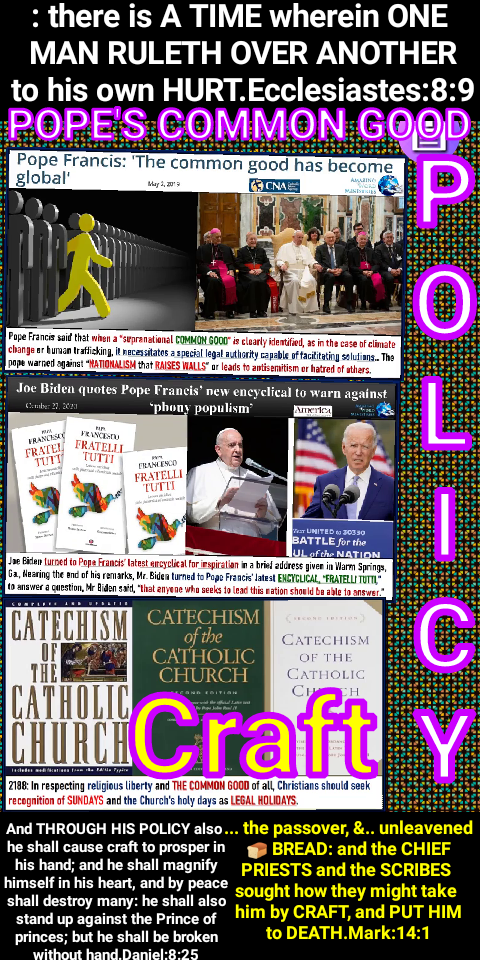
Now these four kingdoms are named outright in other places in the Bible. They were Babylon, Medo-Persia, Grecia, and Rome. Rome was the fourth, and was diverse from all before it, in that it was a republic. Now it was while it was a republic that Rome “devoured, brake in pieces, and stamped the residue with his feet.” Moreover, in Daniel 8:24, 25 it is written of this same power: “And his power shall be mighty, but not by his own power: and he shall destroy wonderfully, and shall prosper, and practise, and shall destroy the mighty and the holy people. And through his policy also he shall cause craft to prosper in his hand; and he shall magnify himself in his heart, and by peace shall destroy many: he shall also stand up against the Prince of princes; but he shall be broken without hand. And the vision of the evening and the morning which was told is true: wherefore shut thou up the vision; for it shall be for many days.” PRUS 160.2

Just what was this crafty, peaceful, destroying policy, and how his power became mighty, but not by his own power, has already been set forth clearly from the history in this chapter. By the history I have shown that Rome, being a republic, a government of the people, made high pretensions to liberty and to the love of liberty, only for the sake of liberty; that for this reason Rome pretended to love and desire liberty for other people; that the little states of Greece were struggling against monarchies, that they might themselves be free and be republics. Solely from love of liberty for the sake only of liberty, and for the sake of humanity, Rome sent her armies and navies across seas to fight the battles, and win the causes of those other peoples, only to set them free from oppressive powers, to enjoy the blessings of liberty of which Rome was the conservator in the world. And then when the battles were fought, the victories won, and the peoples delivered, those peoples were not free. They were more bound, and more hopeless than ever before, because of Rome’s greater power than that of the former oppressors. And to-day no man can intelligently read that history of the republic of Rome before any audience in the United States without that audience seeing the republic of the United States perfectly outlined up to date. PRUS 160.3

Now a point particularly to be considered is that this history of the republic of Rome was sketched in the book of Daniel three hundred and forty years before it occurred; and then that sketch was closed up and sealed, not for three hundred and forty years, not till 198 b. c. and onward; but for twenty-four hundred years, till “the time of the end.” PRUS 161.1

Why was that sketch of the Roman republic written, and then closed up and sealed until a time two thousand years after that republic had failed as a republic and become imperial?—It was because at this time, “the time of the end,” there would be another republic that would go over the same course as did that republic,-would apostatize from republicanism into imperialism. PRUS 161.2

Moreover it was a state composed of this apostasy of a republic into imperialism,-it was such a state with which the apostate church of early days, the man of sin, of the Bible, united, and this union made the papacy, “the first beast” of the Bible, as mentioned in Revelation 13. PRUS 161.3

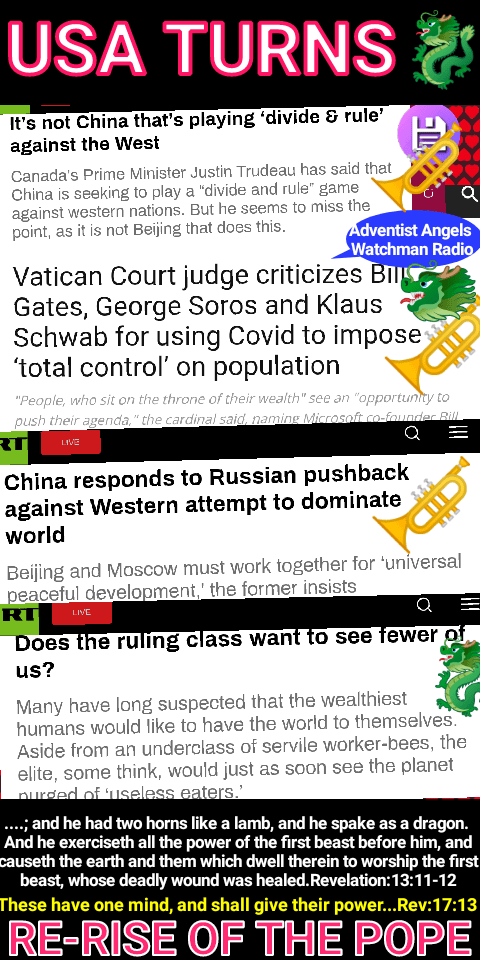
In the same thirteenth chapter of Revelation it is written: “And I beheld another beast coming up out of the earth; and he had two horns like a lamb, and he spake as a dragon.” 20 Here is depicted the rise of the United States, coming up peacefully out of the earth, instead of forming amidst long years of tumults and fightings, as was the case with all the other powers. It is represented as having two horns like a lamb. A horn in prophecy signifies power, and the two great principles which have given power to the United States and made her what she is to-day are Protestantism and Republicanism. But Protestantism and Republicanism are both in their spirit pacific; that is, they are lamblike, hence the words, “had two horns like a lamb.” It is obvious from this that should these two horns of power be plucked up, as it were, should they be abandoned, and Roman Catholic principles in things religious, and monarchical ideas in things civil, take possession of this government; then, at once, everything that is lenient and lamblike in the government would at that very moment disappear, and nothing but despotism be in their place. In other words, it is the prevalence of these two principles, Protestantism and Republicanism, which alone makes the government lamblike in its nature. PRUS 161.4

Now the nature of Protestantism is well set forth by D‘Aubigne, the historian of the Reformation. Speaking of the diet of Spires, where the famous Protest of the Princes was drawn up, and from which we get the name of Protestant, and the word Protestantism, he says:— PRUS 162.1

“The principles contained in this celebrated protest of the 19th of April, 1592, constitute the very essence of Protestantism. Now this protest opposed two abuses of man in matters of faith: the first is the intrusion of the civil magistrate, and the second the arbitrary authority of the church. Instead of these abuses, Protestantism sets the power of conscience above the magistrate, and the authority of the Word of God above the visible church.” 21 PRUS 162.2

This is the essence of Protestantism in very truth. There may be sects many and varied; but this is the underlying, fundamental, basic principle. True Protestantism opposes the “intrusion of the civil magistrate” in things pertaining to the church. PRUS 162.3

On this point George Bancroft, the great historian of the United States Constitution, has also said of the new nation:— PRUS 162.4

“Vindicating the right of individuality in religion, and in religion above all, the new nation dared to set the example of accepting in its relation to God the principle first divinely ordained of God in Judea. It left the management of temporal things to the temporal power; but the American Constitution, in harmony with the people of the several States, withheld from the federal government the power to invade the home of reason, the citadel of conscience, the sanctuary of the soul; and not from indifference, but that the infinite Spirit of eternal truth might move in its freedom and purity and power.” PRUS 163.1

And the very first amendment to the national Constitution reads:— PRUS 163.2

“Congress shall make no law respecting an establishment of religion, or prohibiting the free exercise thereof.” PRUS 163.3

Thus was the horn of power, the principle of Protestantism, established as a fundamental doctrine of the United States. PRUS 163.4

With equal truth it may be said that the “essence” of republicanism is, that “all men are created equal,” and that “governments are instituted among men deriving their just powers from the consent of the governed.” PRUS 163.5

The principles of Protestantism are the true principles of Christianity,-the Christianity of the Bible. The principles of Republicanism are also the principles of God and the Bible in things civil. PRUS 163.6

But it is said concerning the beast which symbolizes the United States in the Bible that “he had two horns like a lamb, and spake as a dragon.” Here are two things happening together, at the same time, and totally incompatible with one another,-that which is lamblike speaking as a dragon. Now a thing that is lamblike can not possibly speak as a dragon, and still retain its lamblike disposition. It therefore follows that the Scriptures have portrayed that the United States will in name retain its lamblike principles of Protestantism and Republicanism, but in nature and in practise it will deny them. This is national hypocrisy; yea, it is national apostasy. There may never in these United States exist, openly, avowedly, and in name, a union of church and state, which constitutes in itself the abandonment of Protestantism; but the thing itself will be, and even now is, here. We may never have an emperor with a crown upon his brow; but Rome was imperial, and an empire for long years, while still retaining the image and name of a republic. PRUS 163.7

Now the “first beast” was Rome, once a republic, but apostatized into an imperial monarchy, degenerated into a military despotism; united with a church once Protestant in principle, but apostatized into the papacy. The union of these two was, I say, the “first beast.” PRUS 164.1

Now when in the prophecy the image of the beast is to be made, it is said “to them that dwell on the earth, that they should make an image to the beast.” This shows that it is a government of the people where the image is made. And it is said to them that they shall make a union of church and state. This shows that this is all done in a place where there is no union of church and state. That is true of the United States at its formation, and it is not true of any other nation that was ever on earth. PRUS 164.2

These things show that the nation is first a republic, and that this nation is the one where these things are at last done. But these things can not be done in a true republic, for they are positively antagonistic to it in principle. For these things to be done in a country professing to be a republic, there must be an apostasy from the principles of a true republic. PRUS 164.3

Already there has been an apostasy from the principles of Protestantism, from the principle of a separation of church and state. The Congress of the United States, the executive, and the judiciary of the United States are already committed to the papal principles as opposed to Protestantism. This has already been done, by congressional legislation, executive action, and judicial decision. All three arms of the federal government have already interfered in behalf of a religious institution,-in behalf of Sunday and Sunday laws. Already here in the home of freedom men have been arrested and thrown into prison, and even committed to the chain-gang, in company with loathsome criminals, simply because they could not conscientiously observe the first day of the week. Into the history of this apostasy from Protestant principle I can not go. It is fully written out in other works. 22 PRUS 164.4

A true republic can never unite with papal principles; but now the Republic is apostatizing from republicanism and uniting with apostate Protestant principles, and this is in itself an “image to the beast.” PRUS 165.1

Already this nation has commenced to war against men who plead for republican principles in their island home; and according to the prophecy it is yet to go the furthest step in this awful path, and kill men for desiring Protestant principles in these United States. For it is written of the United States:— PRUS 165.2

“And he had power to give life unto the image of the beast, that the image of the beast should both speak, and cause that as many as would not worship the image of the beast should be killed.” 23 PRUS 165.3

The union of church and state in Rome hastened and actually wrought the ruin of that apostate republic. So even now will this union hasten and cause the ruin of this so far apostate republic. And the sketch of the history of the former was written in the book of the prophet Daniel then, and closed up and sealed until now, so that they that be wise may understand what to do to escape the evil and the ruin that will come, and even now hastens,-a ruin that will come to this modern great Republic as surely as came the ruin of that ancient great Republic. PRUS 165.4

This national apostasy is proceeding daily before the eyes of all the people; and as national apostasy progresses, national ruin hastens. And with this national ruin comes the ruin of the world, and of every nation in the world. PRUS 165.5

Previous

Prev result

Back to search

Next

Next result


The Peril of the Republic of the United States of America, p. 143.1 (Percy Tilson Magan)

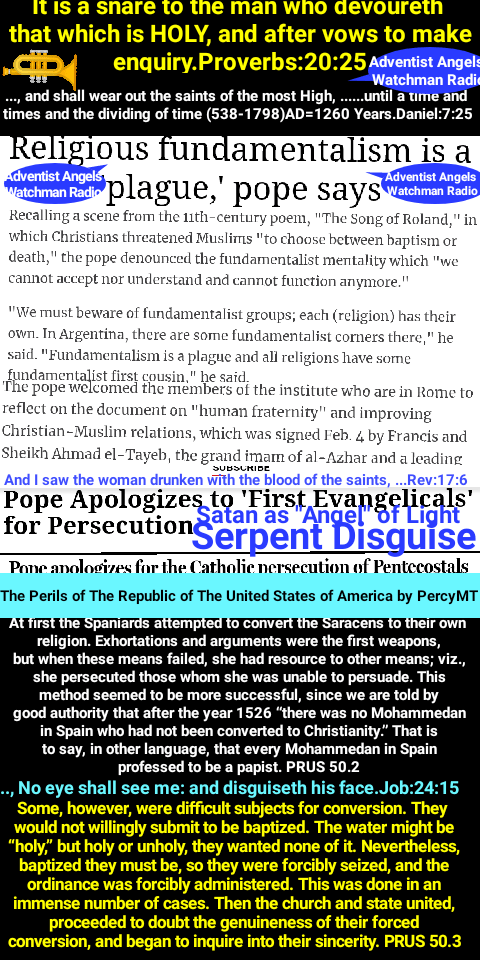
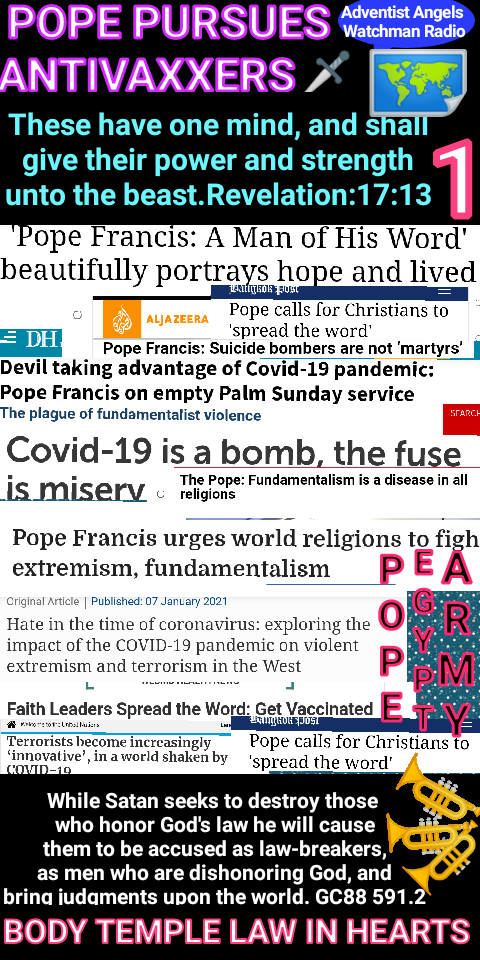
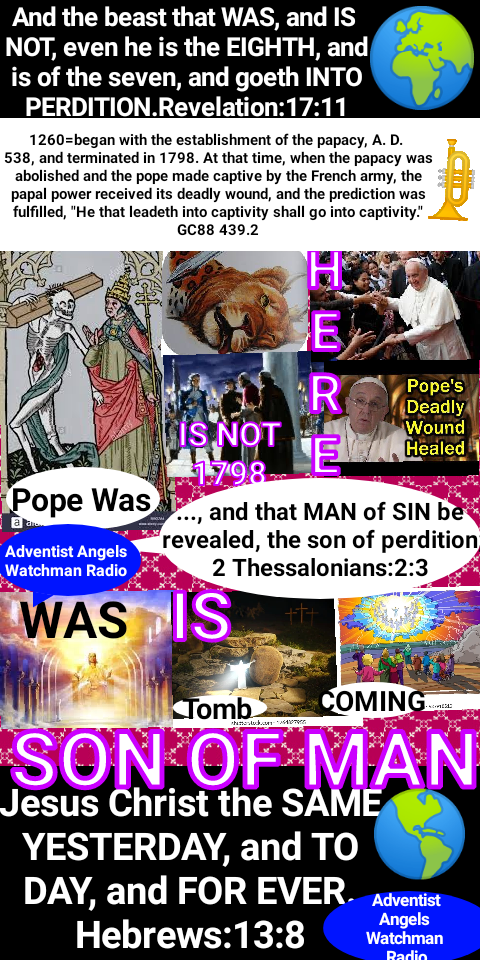
Pope Francis: Let Us Dream. “Our COVID Saviour, Body Temple, Seal The Law Among My Disciples”

Pope Francis: Let Us Dream, Our COVID Saviour, Body Temple, Seal The Law Among My Disciples

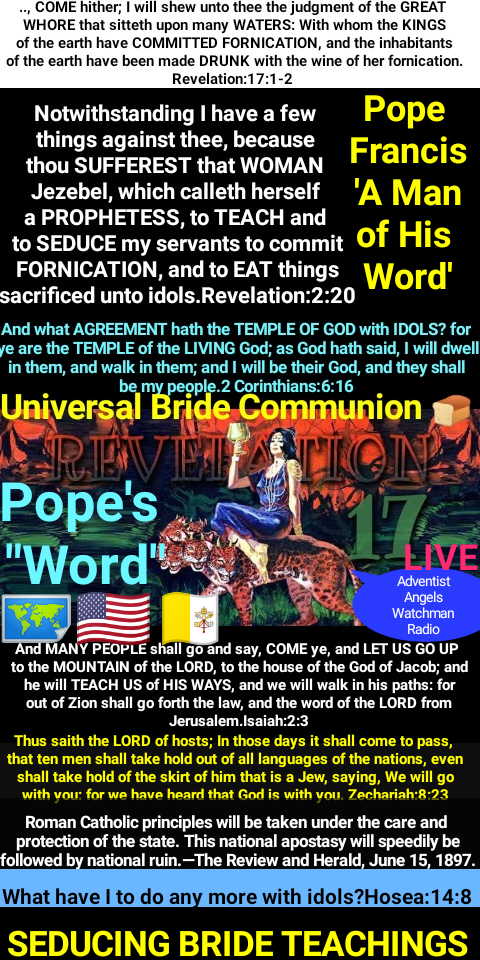
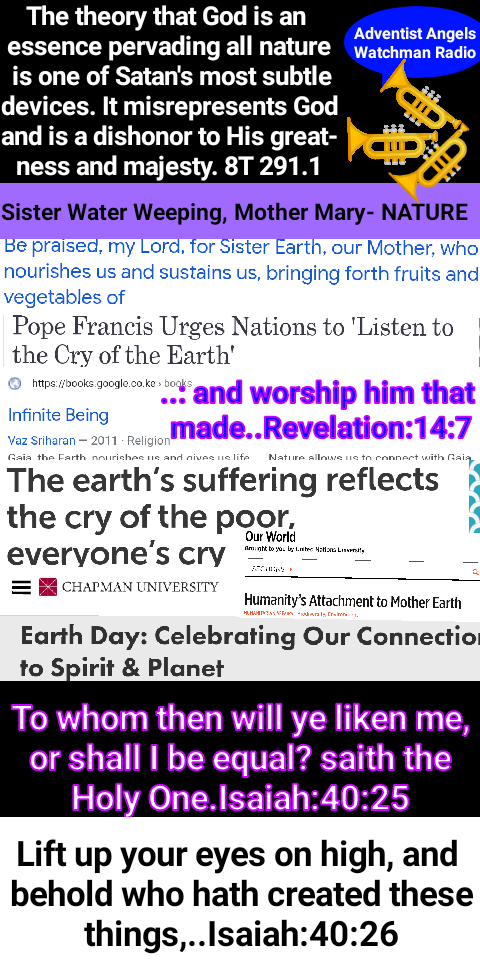
The Term “Let Us” has been used over the ages past by The King of Heavens, The Creator of Heaven and Earth when the heavenly trio said Let us Make man in our own Image and likeness Genesis 1:26… However in the building of the tower of Babel, Christ Jesus said let us go down and see what the sons of men were imagining against God .. Now the pope has arisen calling nations to “build”. What an end times Message.! Nebuchadnezzar was proud of his progress on building Great Babylon and by pride discredited God who gave Him the Kingdom. The Pope has now arisen as an Angel of Light  in the burning Climate Bush that he has heard the cry of the earth including the cry of sister water, brother stone, brother Sun, sister Moon and many of his children. This is confusion. And in Revelation 13:2-3, the papacy is receiving full control and command of the world. Yet The King of The Universe has numbered the days. Lift up your eyes. Put your Confidence in God and not men

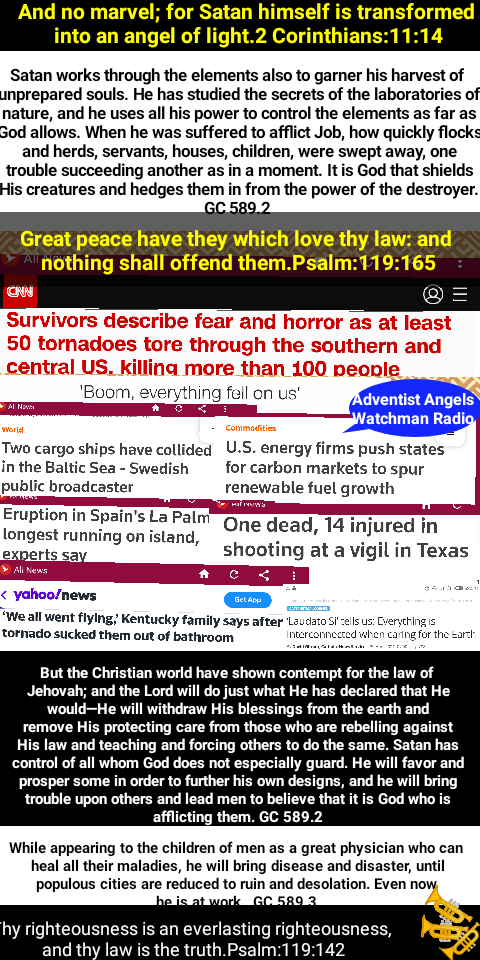
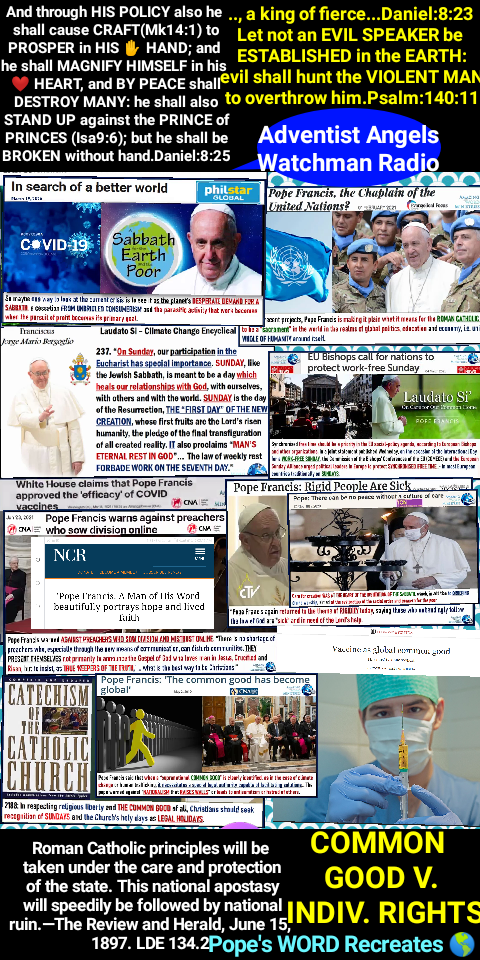
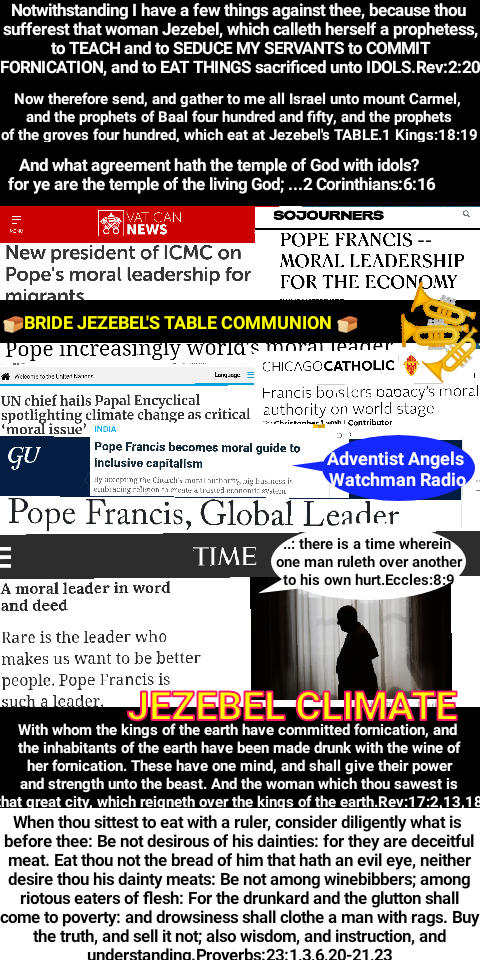
Men have introduced evil vaccines which are defiling the temple of God and thereafter the image of God for Christ has said he will dwell in us and take away the Stony hearts which don’t obey his Commandments and shall be our God and Saviour. The vaccines are not our Savior. This is deception of the world. Awake! The adversary is arising as an Angel of Light but this people know not the light. The Papacy is the Mother of Harlots and A murderer has Revelation 17:5-6 says. Darkness has covered the earth and gross darkness the people drunken with Rome policies including that of Common Good taking away Individual Unalienable Rights bestowed upon man by God. This is Satan disguising as an Angel of Light as he did to Jesus in the wilderness.

They are of those that rebel against the light; they know not the ways thereof, nor abide in the paths thereof. The murderer rising with the light killeth the poor and needy, and in the night is as a thief. The eye also of the adulterer waiteth for the twilight, saying, No eye shall see me: and disguiseth his face.
Job:24:13-15

And the light of a candle shall shine no more at all in thee; and the voice of the bridegroom and of the bride shall be heard no more at all in thee: for thy merchants were the great men of the earth; for by thy sorceries were all nations DECEIVED.
Revelation:18:23

And in all matters of wisdom and understanding, that the king enquired of them, he found them ten times better than all the magicians and astrologers that were in all his realm.
Daniel:1:20

Then the king commanded to call the magicians, and the astrologers, and the SORCERERS, and the Chaldeans, for to shew the king his DREAMS. So they came and stood before the king.
Daniel:2:2

And Jesus answered and said unto them, Take heed that NO MAN DECEIVE YOU. For many shall come in my name, saying, I AM CHRIST; and shall DECEIVE MANY. And ye shall hear of WARS and RUMOURS of WARS: see that ye be not troubled: for all these things must come to pass, but the end is not yet.
Matthew:24:4-6

1899 meeting: “Take that virus, and inject it into a mouse, and see how quickly it will die.” But yet it did not affect her in the least. The fact is, she has become so accustomed to the virus of the snake’s bite that her body is perfectly immune to it, and it apparently does her no harm whatever. Adventist Pioneer History and Vaccines https://kingosiemo.wordpress.com/2022/01/18/1899-meeting-take-that-virus-and-inject-it-into-a-mouse-and-see-how-quickly-it-will-die-but-yet-it-did-not-affect-her-in-the-least-the-fact-is-she-has-become-so-accustomed-to-t/

1899 meeting: “Take that virus, and inject it into a mouse, and see how quickly it will die.” But yet it did not affect her in the least. The fact is, she has become so accustomed to the virus of the snake’s bite that her body is perfectly immune to it, and it apparently does her no harm whatever. Adventist Pioneer History and Vaccines

  • “Take that virus, and inject it into a mouse, and see how quickly it will die.” But yet it did not affect her in the least. The fact is, she has become so accustomed to the virus of the snake’s bite that her body is perfectly immune to it, and it apparently does her no harm whatever. Adventist Pioneer History and Vaccines

General Conference Daily Bulletin, vol. 8

February 21, 1899

33rd Session. – WORCESTER, MASS., TUESDAY, – VOLUME 8. SOUTH LANCASTER, MASS. – NUMBER 5

The Daily Bulletin,

PUBLISHED BY THE GENERAL CONFERENCE OF
Seventh-day Adventists.F. S. BLANCHARD & CO., Printers, Worcester.
SUBSCRIPTION PRICE, – 50 CENTS.

CONTENTS OF THIS NUMBER

Our Pioneer Tent Preacher,41General Conference Proceedings,Eighth Meeting,41Ninth Meeting,43Bible Study – Daniel and Revelation -A. T. Jones,46Medical Missionary College,47Walla Walla College,48Report Healdsburg College,48Report Cor. Sec. I. R. L. A.,47Financial Statement I. R. L. A.,48

“Words measure power; and they measure thine. Greater art thou in thy childish years Than all the birds of a hundred spheres; They are brutes only, but thou art divine.” GCDB February 21, 1899, page 41.1

The world needs “facts” rather than “isms.” The facts of the gospel pave the path to eternal life – the “isms” of theology are like the fallen leaves which scatter over the path and hide it. GCDB February 21, 1899, page 41.2

Christ, “the Great Physician,” responded to the call of the physically sick and suffering with the same readiness that he answered the cry of the sin-sick soul. GCDB February 21, 1899, page 41.3

NINTH MEETING, MONDAY, 9:30 A. M., FEBRUARY 20

Upon the conference reassembling, Dr. J. H. Kellogg, of the Battle Creek Sanitarium, was asked to address the delegates on medical missionary work, which he did as follows:- GCDB February 21, 1899, page 44.12

The subject of medical missionary work has never occupied a great amount of time in the councils of our General Conference, and I presume it will not be proper to occupy a great amount of your time here to-day. The subject is a very large one, and I want briefly to outline the work that is being done, and needs to be done. To do this fully would occupy more time than you could well afford to devote to it here, where there are so many other subjects that need careful attention. GCDB February 21, 1899, page 44.13

The principles of health reform, or what we call our health principles, have been before this people for thirty-five years, and the more I have studied them, the more I am amazed at their magnitude, and their beauty. During the last three years especially, these principles have grown with wonderful rapidity. The length, and breadth, and depth of these, which God gave us a third of a century ago, are becoming more and more clearly defined, and more and more thoroughly established on scientific facts. GCDB February 21, 1899, page 44.14

We find that almost every new discovery in science having any bearing upon health goes to confirm these great principles, and not a single word can be found – not a single fact can be presented – by anybody that in the slightest degree weakens, or in any sense overthrows, a single one of the principles that have been practised all these years. It is a thing that ought to give us faith and hope and confidence, not only in the principles, but in the way in which the Lord brought them to us, as well as in all the other truths they accompany. If there is anything in the world that ought to strengthen one’s faith in the Lord’s work, it is just to take up these health principles, and see in what a plain, clear, simple way they were first presented, unaccompanied by scientific facts, and note how they have won their way in the world. Not only among this people, but all over the world we find these principles growing. Elder Conradi could tell you how the principles of hygiene are received in Germany and in Hungaria. Brother Holser could tell you how they are developing in Switzerland, and from Australia we have letters from Sister White, Dr. Caro, and Elder Daniells, telling how these same principles are agitating the minds of the people there. Dr. Waggoner and Professor Prescott can tell how they are growing upon the minds of the people in England; and I might spend several hours telling how the principles are developing in this country, and moving the hearts of the people. I remember that sixteen or eighteen years ago a canvasser in Ohio was introducing Good Health, and he called at a house, and introduced himself as a sanitarium missionary, and said to the lady who opened the door, “I came to talk with you about sanitarium methods.” She said, “We have not such a thing in the house, and we don’t want any.” But the time has come when the people begin to see the need of these sanitarium principles, and they want them in their houses, too. There is one thing to which I would call your attention. I do not remember whether or not I spoke about it two years ago; but it is a very fearful thing, and stares the world in the face, and they can not get away from it. There is a class of people in the world who try to make us believe that we are getting healthier; that human life is getting longer; that we are making such wonderful discoveries of how to prevent disease, and how to antagonize plagues, etc.; and that we are gradually getting the victory over these evils, and by and by, if we can not exterminate smallpox, we shall be able, at any rate, to deprive it of its power by vaccination, and in other ways. Now we have to look this matter squarely in the face. Less than a month ago I found some statistical evidence in one of our scientific journals stating that at the present time there is in the United States one idiot for every five hundred persons, and other statistics I have gathered show that there are now, in every million of people, 3,400 idiots, lunatics, and imbeciles; and that this number has increased three hundred per cent. in fifty years. Thirty years ago the proportion in England was just what it is in this country at the present time. At this rate we can look ahead, and easily tell what it will be in fifty years more. Fifty years ago there were about one thousand idiots, lunatics, and imbeciles to the million. At the present time we have 3,400 to the million. That is over three times as many. In fifty years more, increasing at the same rate, we would have ten thousand to the million, or three times 3,400. Then fifty years further on, there would be ten thousand to the million, or one per cent. of all. Fifty years more, we would have three per hundred, or three per cent. In fifty years more, there would be nine to the hundred; and in another fifty years, twenty-seven to the hundred. In another fifty years we would have eighty-one to the hundred; and in fifty years more, two hundred and forty-three to the hundred. But the world could not go so far as that, even though it be but three hundred years. Two hundred and sixty-five years would be the farthest point that could be reached, before the whole world would be made up of lunatics, imbeciles, and idiots. But society could not hold together, even to that point, judging of its condition at the present time. Let some political question come up, and it seems to seize half the population with some phase of lunacy. It is the same in many social reforms. People in the world get an idea, and it carries them away off. So we have anarchists, socialists, and various classes of people who are insane in various ways. This is likely to keep going on until we have so many imbeciles that it will be impossible for society to hold together. When we get to going down, our speed will be accelerated, as when you start a ball rolling down hill. That will go faster and faster, until it gets to the bottom, when it is dashed to pieces. 

Mrs. S. M. I. Henry: Is not that a very strong demonstration of the fact that the Lord is soon to come?

Dr. Kellogg: That is the very thing I wanted to bring to your minds. We have statistical proof of the fact that this world is soon coming to an end. The Lord is not coming to destroy the world, but to save it; he is coming to save the world from what would come to it if it went on. We are coming down to a time of absolute confusion and destruction. Men are getting more and more subject to disease all the time. There are fewer old people than formerly. The last fifty years the bottom seems to have dropped out of the constitution of the human race. The Lord made man the toughest animal on the face of the earth. Even to-day you take a man who is in good training, and there is not another beast that can compete with him. A man can travel farther in six days than a horse. A well-trained man can tire out two or three horses in the course of a week. There is no question about it. Man, however, has greatly deteriorated, but no other animal would stand the abuse that he endures, even now. How long could a horse or a cow endure such treatment as human beings give themselves? A man would not dare feed his horse what he himself eats, or his cow either. He would not even feed his dog the same. A woman eats, and feeds things to her child, that she would not give her bird; she takes better care of her cat than of herself, or her child. The world is coming to see that there is a tremendous catastrophe before the race if something is not done. The hearts of the people, the world over, are wonderfully open to receive these principles. Two things are a constant wonder to me. The first is the beauty of these principles, and the other thing is that we do not appreciate them more. How can it be? Just see what these principles can do for this people! Let me call your attention to what the world is trying to do. Just as soon as small-pox gets into a community, what do the doctors do? They say everybody has to be vaccinated. Over in India they vaccinate from arm to arm, and people get leprosy and consumption through it. In this country that method is not tolerated. You would not allow your children to be vaccinated from your neighbor’s child’s arm; but you allow them to be vaccinated from a calf, because you know the calf has a great deal better blood than your neighbor’s child has. You are afraid of your neighbor, and you have reason to be afraid of him. In India not long ago there was a case where one hundred and sixty students in a school were vaccinated from arm to arm, and sixty of those boys and girls came down with leprosy in three years. Think of that. You see vaccination is not a thing that is entirely safe; but there is some reason in it. But if you are vaccinated from a calf that has tuberculosis, then you get consumption. So you see that is not altogether safe. I believe there is something better on principle than that, and I am going to try to show you some disease with disease, and the man who is vaccinated is a little lower in vitality after he has been vaccinated than before. It is like a boy who becomes immune to the use of tobacco. At first it makes him sick, but afterward he becomes used to it, and it does not affect him; yet it is doing the boy harm all the time. It is thought by some scientists that the time will soon come when vaccination will be employed for all maladies in the earth. It has been said by Dr. Lancaster, of London, that the time will come when a young man taking a course in a medical school would, before he finished, be vaccinated for all diseases that were prevalent in the country. I do not think there would be very much left of that man after he had gone through all that. It has been proved that when a man has had small-pox, he is more subject to consumption than before.

The Chair: Has that been proved, doctor?

J. H. Kellogg: Yes, it has been proved within the last three months by statistics that have been collected that a man is not so good after he has had smallpox as he was before. That is also true of typhoid fever. Very often consumption is fastened upon the victim of typhoid fever. As I said before, this method of obtaining immunity against disease is the method of fighting disease with disease, meeting evil with evil, antidoting poison with poison. It is wonderful to see to what an extent this can be carried. In Chicago a few weeks ago a woman appeared before our medical class; and she had with her a rattlesnake, which she took out of its cage. She held him in her hand and irritated him. She beat him, and stirred him up until he became angry, and then as she bared her arm, the reptile struck it time and again, and fastened his fangs into her arm, until the flesh was all covered with the virus. Then she said, “Take that virus, and inject it into a mouse, and see how quickly it will die.” But yet it did not affect her in the least. The fact is, she has become so accustomed to the virus of the snake’s bite that her body is perfectly immune to it, and it apparently does her no harm whatever.

I remember a woman at the sanitarium, who in one day took eight hundred full doses of morphia, – enough to kill forty men. Apparently it did not hurt her, though in fact it was all the time undermining her constitution. This method of fighting disease with disease is the human way of meeting disease, just as we fight fire with fire. But God has given us a truth that has in it power to lift a man above the power of disease. He has given us principles which, if we obey and follow, will change our bodies so that we shall not have to be vaccinated; that will lift the body above the power of disease, and above the power of sin; for sin and disease go along together. Disease is the consequence of sin, and sin induces a moral disease. GCDB February 21, 1899, page 44.19

Did you ever hear of such a thing as, when there was to be a fight between pugilists like Fitzsimmons and Corbett the battle was called off because one of the men had a cold, or was down with the grip, or fever, smallpox, or anything of the kind? – Why, nobody ever heard of such a thing. The reason for it is that these men have followed the laws of health so rigorously that they are proof against any disease. When Fitzsimmons met Corbett, he was just as ready to meet smallpox or any other condition that could come to him. He was just as ready to fight germs as he was to fight Corbett, and that fact is worth considering. I met a gentleman the other day who told me that he was sick; that because he had to do a little extra work, he had broken down. I said: “That is not what broke you down; you are like a man who had a hole in his boot. As long as he went on dry land, he was all right; but as soon as he stepped his foot into water, it got wet. You have been making holes in your constitution by bad habits, and these habits have let you down; then when a little strain like this came, you broke down altogether. But it is not this little work you have just done that did the mischief; it was your tobacco-smoking and gormandizing at the dinner-table, that did the work.” Thirty years ago God gave us principles which, if they had been followed, might have made us the healthiest people in the world, – a power wherever we are, and an example to all the world. The time will come when there will be some people on this earth whom nothing can kill, not even cyclones nor earthquakes nor disease of any kind, – men whom the plagues can not kill, who can stand anything. God has given us a chance to be some of these men; and why can we not lay hold of the principles that will enable us to be this? It seems to me as if we, of all people, ought hardly to be able to contain ourselves when we have such an opportunity presented before us. GCDB February 21, 1899, page 45.1

A. F. Ballenger: Could Corbett, with all his training and careful work, be kept from these things without faith? GCDB February 21, 1899, page 45.2

Dr. Kellogg: No; because he is not absolutely obedient. I was speaking of what exists at the present time. This man is only measurably obedient; but there will come a time when these diseases will come with such power and intensity that they will strike down everybody that has not yielded to God. There is a point here. It is not faith alone that avails the man, but that which faith leads the man to do. It is not the holding of faith but the obedience that comes from faith. The man who has complete faith in God believes everything that God says; and when God tells him to do a thing, he will implicitly obey him. GCDB February 21, 1899, page 45.3

E. J. Waggoner: It is faith that saves a man, because it is faith that leads him to do that which he does. GCDB February 21, 1899, page 45.4

Dr. Kellogg: Yes; that is so. GCDB February 21, 1899, page 45.5

Mrs. S. M. I. Henry: But does not God recognize obedience as far as it goes? GCDB February 21, 1899, page 45.6

Dr. Kellogg: God is true; he can not lie; and when Corbett obeys the law of health, God will stand by that, and give him the result, but you see the time will not always be that this is so. The time will come when there will be a line drawn, and men will have been so enlightened that they will take their stand on one side or the other. Absolute obedience will be on one side, and to those who obey will belong the victory over appetite, and over the mark of the beast, and everything of that kind. But the others who have not rendered obedience fully to the Lord will have surrendered so fully to evil that they will have lost all the power to comply with any of the laws of God. Professor Bouchard, of Paris, made a statement a short time ago that a person with a perfectly healthy stomach could not get the typhoid fever, because such a stomach will digest typhoid germs just the same as it will vegetables, typhoid germs being a vegetable, just like cabbage. If a man’s stomach is strong enough to digest that kind of vegetables, he can not have typhoid fever. The same thing is true of cholera. All cholera germs are vegetables; and if you get these germs in the stomach, they will grow there on the walls of the stomach, just as mold grows on a wall; but they are vegetables, and if that stomach has the power to digest those vegetables, the man does not succumb to the disease. When Professor Koch discovered cholera germs, he brought them home with him from Egypt to Germany. A rival professor said he did not believe there was any danger in those cholera germs, – if they were cholera germs, – because he had swallowed a pint of them, and no harm resulted. Well, numberless cases of cholera occurred in Hamburg, where cholera germs had infected the drinking water. Many, however, were not attacked by the disease. Brother Conradi can bear me out in that statement. Is not that true, Elder Conradi? GCDB February 21, 1899, page 45.7

L. R. Conradi: Yes, sir, that is a fact. GCDB February 21, 1899, page 45.8

Dr. Kellogg: The reason was that some of those people had stomachs able to digest these cholera germs, and so no ill effects resulted from drinking the water full of germs. Only a small proportion of those who used the water died. Why did not all have the cholera? It is a self-evident fact that these germs were destroyed. It is only necessary for a person to have his body in such a condition that he is able to resist all these germs, to be immune; and that is the kind of opportunity that God has offered to us – to reach a state in which we may be immune from these diseases. Now you may wish me to answer this question: Do you think that by any attention a man may give to diet, he can become able to resist the seven last plagues? – No, I do not. I do not believe that a man could live so correctly on a certain diet, as to be free from danger. “Do you think a man, though he exercise so vigorously, and though his manner of living and general conduct be ever so carefully circumscribed, can come into a state where he would not succumb to these plagues?” – No; by no means. I do not think that it is possible for a man to live so healthfully that he could overcome these, unless he has faith in God. He needs that faith, that connection with God, to get the proper instruction and light; and not only that, but the power to obey God. I do not think that we have power enough to suffice, without faith in God. GCDB February 21, 1899, page 45.9

J. O. Corliss: Do you not think that the more faith a man has, the more healthfully he will live? GCDB February 21, 1899, page 45.10

Dr. Kellogg: Why, certainly. GCDB February 21, 1899, page 45.11

J. O. Corliss: I know this: the more faith I have received the more strictly I have lived health reform. GCDB February 21, 1899, page 45.12

Dr. Kellogg: Yes; that is true faith. It is not a thing that leads us to believe that God will do what we want him to do for us; but true faith will lead us to want to do the things that God wants us to do. Many people have that reversed. They think they can persuade God to do a thing that he does not want them to do: and they think that it is only necessary to have faith enough, and believe hard enough, to bring God to their terms. But it works the other way. It seems to me that real, true faith is that which leads a man to do absolutely as God wants him to do. When he gets that kind of faith, he gets into the line of God’s providence, into the divine order, so that everything goes right with him, and smoothly. He gets into the divine procession, so to speak, and everything marches along beautifully. But it is hard when we try to bring God to our terms. GCDB February 21, 1899, page 45.13

A Voice: Faith puts a man in the right channel, where the blessing is flowing. GCDB February 21, 1899, page 45.14

Dr. Kellogg: That is a channel of obedience. It is not a psychological channel, a mental channel, or a theological channel. It is not a channel simply in which a man is protected from danger, neither is it a doctrinal channel; but it is a channel of absolute obedience to God. It is true obedience, that will lead us to do exactly what God asks us to do. It seems to me that it would be profitable to discuss these principles. First, we might say that this subject divides itself naturally into two heads: (1) the principles of truth that God gave us a third of a century ago in relation to health and philanthropy; (2) our duty to our neighbor and to ourselves. These two principles came to us about the same time, – Christian philanthropy and Christian temperance. Let us consider these principles, and their relation to the other branches of what we call the truth – the third angel’s message. In the second place, let us consider, if we have time, this medical missionary work, – the methods or modes of presenting these principles before the world, and the work that is to be done in presenting these truths to the world; – also the relation of these modes and work to the evangelistic and other lines of work which this people have to do. If we could spend our time in doing this, and allow the business to come up before the legal meetings which will be held in Battle Creek, I think it would be more profitable than to consider business during this session. Why could we not profitably spend the time in that way? GCDB February 21, 1899, page 45.15
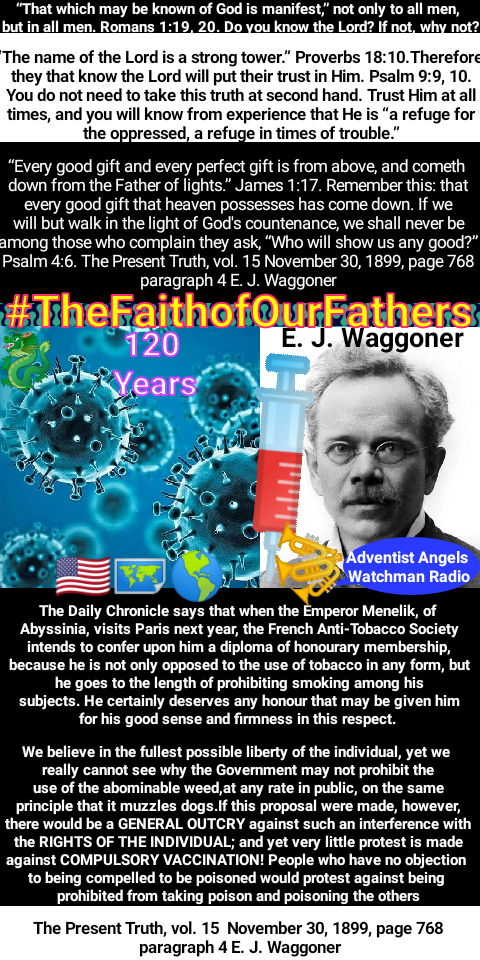
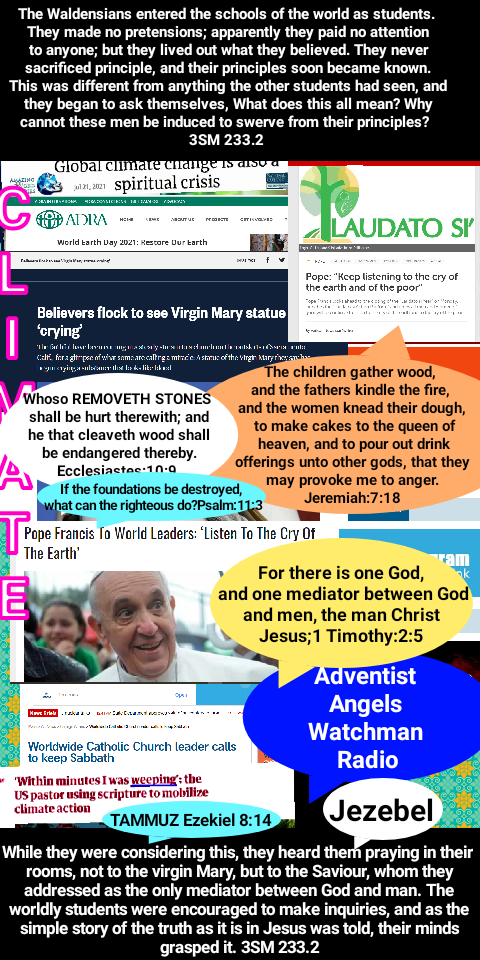
The Chair: I understand that was the design, doctor. GCDB February 21, 1899, page 45.16

Dr. Kellogg: If there is no dissent, we will consider that the best thing to do. So far as I know, the meeting is open for anybody that wants to speak, and to say what he wants to say, without any special restriction. GCDB February 21, 1899, page 45.17

The Chair: Since there are only five or six minutes before the time to adjourn, perhaps it would be well for you to occupy the rest of the time, doctor. GCDB February 21, 1899, page 45.18

Dr. Kellogg: The question has been asked, What is medical missionary work? As distinguished from purely evangelistic work, medical missionary work represents all those modes and lines of work which will reach men’s souls through attention to their physical needs. Considered by itself, apart from any other mode of Christian activity, the medical missionary work represents the complete gospel, – health, comfort, salvation, redemption for the whole man, – soul, mind, and body. Medical missionary work – not medical work, but medical missionary work – does not confine itself to the administration of medicine as a gospel measure, but employs every sort of means necessary to afford physical help and relief. Thus it includes among these organized agencies, not only hospitals and dispensaries, but sanitariums; asylums for orphans and for friendless and aged persons; rescue work for men, women, children; gospel shelters for homeless and friendless waifs; and all other means for affording physical relief, as illustrative of the various phases assumed up to this present time. I may be permitted to enumerate several institutions that have grown up, under its fostering care, in Battle Creek and Chicago. In Battle Creek there are the Battle Creek Sanitarium, the Sanitarium Hospital, the Haskell Home for Orphans, the James White Memorial Home, a rescue home for outcast women, Christian Help bands, and organized outdoor relief for the poor, cottage meetings, cottage cooking-schools, and the gospel mission. In Chicago we have the following lines of work: a small city sanitarium; the Workingmen’s Home; two gospel missions; a maternity for unfortunate girls, affording them a Christian home; a free dispensary; rescue work for men; a life-boat service; prison, jail, and saloon work; newsboys’ clubs; visiting nurses’ work; cottage and street meetings; gospel-wagon work on the street in connection with the mission industrial department in the Workingmen’s Home. In addition to these, and the natural out-growth to them, we have the training-school for medical missionary nurses, and a medical training-school for training physicians. GCDB February 21, 1899, page 45.19

Medical missionary work reaches every phase of human need. It seeks to relieve every kind of human woe. The success of medical missionary work can not be numbered by the number of converts or proselytes. If this were not true, what about the success of the great Master Medical Missionary, who went about doing good; who preached the gospel to the poor; and of whom it was said, “He healed all their sick”? At his death, only a few women hovered near the cross, and a bare handful of followers gathered in secret to mourn his loss. The immediate results of Christ’s mission of love and mercy and healing were apparently small, – a failure, – from a human standpoint; but all the centuries since have been bearing fruit to that divinely patient and infinitely wise seed-sowing. The truest measure of the success of a medical mission is its spirit. To what extent does it reflect the image of him who said, Inasmuch as ye have done it unto one of the least of these my little ones, ye have done it unto me? How far does it manifest the love and simplicity and sweetness of the Christ-life? If these questions are answered well in any work, the visible results, as regards the number of permanent adherents or converts, may be left to him who has told us, “Cast thy bread upon the waters: for thou shalt find it after many days.” The medical missionary must sow the seed without too anxious thought about the fruitage. God knows where every seed of truth has fallen. His Spirit watches over each, and waters and nurtures it, and the great day of settlement will show the results. GCDB February 21, 1899, page 45.20

At this point the conference adjourned. GCDB February 21, 1899, page 45.21

“When we turn away, from some duty or some fellow creature, saving that our hearts are too sick and sore with some great yearning of our own, we may often sever the line on which a divine message was coming to us. We shut out the man, and we shut out the angel who had sent him on to open the door.” GCDB February 21, 1899, page 45.22

General Conference Daily Bulletin, vol. 8 February 21, 1899, page 44 paragraph 17

Multitudes will exult that God is working marvelously for them, when the work is that of another spirit

Notwithstanding the widespread declension of faith and piety, there are true followers of Christ in these churches. Before the final visitation of God’s judgments upon the earth there will be among the people of the Lord such a revival of primitive godliness as has not been witnessed since apostolic times. The Spirit and power of God will be poured out upon His children. At that time many will separate themselves from those churches in which the love of this world has supplanted love for God and His word. Many, both of ministers and people, will gladly accept those great truths which God has caused to be proclaimed at this time to prepare a people for the Lord’s second coming. The enemy of souls desires to hinder this work; and before the time for such a movement shall come, he will endeavor to prevent it by introducing a counterfeit. In those churches which he can bring under his deceptive power he will make it appear that God’s special blessing is poured out; there will be manifest what is thought to be great religious interest. Multitudes will exult that God is working marvelously for them, when the work is that of another spirit. Under a religious guise, Satan will seek to extend his influence over the Christian world.
In many of the revivals which have occurred during the last half century, the same influences have been at work, to a greater or less degree, that will be manifest in the more extensive movements of the future. There is an emotional excitement, a mingling of the true with the false, that is well adapted to mislead. Yet none need be deceived. In the light of God’s word it is not difficult to determine the nature of these movements. Wherever men neglect the testimony of the Bible, turning away from those plain, soul-testing truths which require self-denial and renunciation of the world, there we may be sure that God’s blessing is not bestowed. And by the rule which Christ Himself has given, “Ye shall know them by their fruits” (Matthew 7:16), it is evident that these movements are not the work of the Spirit of God.
In the truths of His word, God has given to men a revelation of Himself; and to all who accept them they are a shield against the deceptions of Satan. It is a neglect of these truths that has opened the door to the evils which are now becoming so widespread in the religious world. The nature and the importance of the law of God have been, to a great extent, lost sight of. A wrong conception of the character, the perpetuity, and the obligation of the divine law has led to errors in relation to conversion and sanctification, and has resulted in lowering the standard of piety in the church. Here is to be found the secret of the lack of the Spirit and power of God in the revivals of our time GC 464.1 – GC 465.1

Christians were falsely accused of the most dreadful crimes and declared to be the cause of great calamities—famine, pestilence, and earthquake

The history of the early church testified to the fulfillment of the Saviour’s words. The powers of earth and hell arrayed themselves against Christ in the person of His followers. Paganism foresaw that should the gospel triumph, her temples and altars would be swept away; therefore she summoned her forces to destroy Christianity. The fires of persecution were kindled. Christians were stripped of their possessions and driven from their homes. They “endured a great fight of afflictions.” Hebrews 10:32. They “had trial of cruel mockings and scourgings, yea, moreover of bonds and imprisonment.” Hebrews 11:36. Great numbers sealed their testimony with their blood. Noble and slave, rich and poor, learned and ignorant, were alike slain without mercy.
These persecutions, beginning under Nero about the time of the martyrdom of Paul, continued with greater or less fury for centuries. Christians were falsely accused of the most dreadful crimes and declared to be the cause of great calamities—famine, pestilence, and earthquake. As they became the objects of popular hatred and suspicion, informers stood ready, for the sake of gain, to betray the innocent. They were condemned as rebels against the empire, as foes of religion, and pests to society. Great numbers were thrown to wild beasts or burned alive in the amphitheaters. Some were crucified; others were covered with the skins of wild animals and thrust into the arena to be torn by dogs. Their punishment was often made the chief entertainment at public fetes. Vast multitudes assembled to enjoy the sight and greeted their dying agonies with laughter and applause.
Wherever they sought refuge, the followers of Christ were hunted like beasts of prey. They were forced to seek concealment in desolate and solitary places. “Destitute, afflicted, tormented; (of whom the world was not worthy:) they wandered in deserts, and in mountains, and in dens and caves of the earth.” Verses 37, 38. The catacombs afforded shelter for thousands. Beneath the hills outside the city of Rome, long galleries had been tunneled through earth and rock; the dark and intricate network of passages extended for miles beyond the city walls. In these underground retreats the followers of Christ buried their dead; and here also, when suspected and proscribed, they found a home. When the Life-giver shall awaken those who have fought the good fight, many a martyr for Christ’s sake will come forth from those gloomy caverns GC 39.2 – GC 40.2

To Sit Next to Jesus Keep The Commandments

HELLO, WILL YOU SIT NEXT TO JESUS ON THE THRONE OF HEAVEN? KEEP THE COMMANDMENTS, IF JERUSALEM KNEW GOD’S VISITATION!, THEY NEVER KEPT THE COMMANDMENTS! THEY WERE WICKED

Did not Moses give you the law, and yet none of you keepeth the law? Why go ye about to kill me?
John:7:19

Also I will make him my firstborn, higher than the kings of the earth. If his children forsake my law, and walk not in my judgments; If they break my statutes, and keep not my commandments; Then will I visit their transgression with the rod, and their iniquity with stripes.
Psalm:89:27,30-32

The wicked watcheth the righteous, and seeketh to slay him.
Psalm:37:32

Salvation is far from the wicked: for they seek not thy statutes.
Psalm:119:155

Lockdown as Religion and How to Fight Against It https://www.lotuseaters.com/lockdown-as-religion-and-how-to-fight-against-it-27-05-21

Pope Assembles army to Fight ANTIVAXXERS terrorists, He Saves the Earth https://kingosiemo.wordpress.com/2022/01/10/pope-assembles-army-to-fight-antivaxxers-terrorists-he-saves-the-earth/

#adventistangelswatchmanradio
#TidingsOfTheEast
#tidingsfromtheeast
#wiseshallunderstand
#NowPlaying
#livenow

It is Twilight, Save The House of Islam, Save The Christians: Twofold Call: Religious Fundamentalism is a Plaque,C-19 Pope Says

Religious Fundamentalism is a Plaque, Pope Says

The burden of DUMAH. He calleth to me out of SEIR, Watchman, WHAT OF THE NIGHT? Watchman, WHAT OF THE NIGHT? The watchman said, The morning cometh, and ALSO THE NIGHT: if ye will ENQUIRE, ENQUIRE ye: RETURN, COME.
Isaiah:21:11-12

ADULTEROUS BRIDE IS HERE!!!!

The eye also of the adulterer waiteth for the twilight, saying, NO EYE SHALL SEE ME: and DISGUISETH HIS FACE.Job:24:15

And a vision appeared to Paul in THE NIGHT; There stood a man of Macedonia, and prayed him, saying, Come over into Macedonia, and HELP US.Acts:16:9

 Wine  of The False Bride and 450 Daughters (Churches) Makes World Drunk Moving TO AND FRO, Pope’s Communion Cup https://kingosiemo.wordpress.com/2022/01/13/%f0%9f%8d%b7-wine-%f0%9f%8d%b7-of-the-false-bride-and-daughters-churches-makes-world-drunk-moving-to-and-fro-popes-communion-cup/

But the learning of the Arabs really forced Christendom to cast aside its superstition, and to study in a rational way. The Arabian system was undoubtedly one of the chief causes of the Renaissance. And the lasting benefits which the Saracens conferred upon Europe can be clearly traced, even at the present time.

It made no difference to the Spanish Christians, however, how much the Saracens were the benefiters of mankind. They were heathen, and must be persecuted for that; and being heathen, they had no equal rights with others before even the civil law. With the Spaniards these were cardinal principles. There were no real and substantial grounds of complaint against the Saracens as competitors and neighbors. They differed from the Spaniards in religion. This was the only thing that could be said against them. They were kind, industrious, and peaceful; but all of this availed them nothing. Spain could not and would not allow the principle of freedom of conscience and of equality before the law.

At first the Spaniards attempted to convert the Saracens to their own religion. Exhortations and arguments were the first weapons, but when these means failed, she had resource to other means; viz., she persecuted those whom she was unable to persuade. This method seemed to be more successful, since we are told by good authority that after the year 1526 “there was no Mohammedan in Spain who had not been converted to Christianity.” That is to say, in other language, that every Mohammedan in Spain professed to be a papist.

Some, however, were difficult subjects for conversion. They would not willingly submit to be baptized. The water might be “holy,” but holy or unholy, they wanted none of it. Nevertheless, baptized they must be, so they were forcibly seized, and the ordinance was forcibly administered. This was done in an immense number of cases. Then the church and state united, proceeded to doubt the genuineness of their forced conversion, and began to inquire into their sincerity. They were ordered to relinquish everything that might have the most remote tendency to remind them of their former religion. They were forced, under severe penalties, to learn Spanish, and to deliver over to their persecutors all their Arabic books. They were forbidden to read Arabic, they were forbidden to write it, or even to converse in it in the sanctuary of their own homes. The ceremonies and games in which their ancestors had delighted were forbidden them. They were prohibited from wearing clothes of the same pattern as those worn by their fathers. “Their women were to go unveiled; and, as bathing was a heathenish custom, all public baths were to be destroyed, and even all baths in private houses.”

All of this was more than Saracenic flesh and blood could stand. In 1563 they rose in rebellion, and so desperately did their arms maintain the unequal contest that it was 1571 ere the insurrection was quelled. By this rising, their numbers were greatly reduced. The remnant appear to have lapsed into the quiet, every-day walks of life. But the Spaniards were not satisfied yet. The obnoxious Morisco, as these converted Mohammedans were termed, must be pursued to the grave with torture and civil disability, and even beyond that portal of darkness as far as the unrelenting hand could reach.

Whatever ills befell the arms or diplomacy of Spain were charged to the account of these unfortunates:—

“The archbishop of Valencia … assured the king that all the disasters which had befallen the monarchy had been caused by the presence of these unbelievers, whom it was now necessary to root out, even as David had done to the Philistines, and Saul to the Amalekites. He declared that the Armada, which Philip II sent against England in 1588, had been destroyed because God would not allow even that pious enterprise to succeed, while those who undertook it left heretics undisturbed at home. For the same reason the late expedition against Algiers had failed, it being evidently the will of Heaven that nothing should prosper while Spain was inhabited by apostates.”

Buckle’s History of Civilization in England, Vol. II, Chap. 1. Par. 36

#adventistangelswatchmanradio
#TidingsOfTheEast
#wiseshallunderstand
#tidingsfromtheeast
#NowPlaying

🍷 Wine 🍷 of The False Bride and 450 Daughters (Churches) Makes World Drunk Moving TO AND FRO, Pope’s Communion Cup

 Wine  of The False Bride and Daughters (Churches) Makes World Drunk Moving TO AND FRO, Pope’s Communion Cup

With whom the kings of the earth have committed fornication, and the inhabitants of the earth have been made drunk with the wine of her fornication.
Revelation:17:2

Give not thy strength unto women, nor thy ways to that which destroyeth kings. It is not for kings, O Lemuel, it is not for kings to drink wine; nor for princes strong drink: Lest they drink, and forget the law, and pervert the judgment of any of the afflicted. Open thy mouth, judge righteously, and plead the cause of the poor and needy.
Proverbs:31:3-5,9

BEEN FIGHTING WITH SATANIC POWERS, NOW LISTEN….

Why is it that men are so unwilling to trust Him who created man, and who can by a touch, a word, a look, heal all manner of disease? Who is more worthy of our confidence than the One who made so great a sacrifice for our redemption? ………..

If the professed followers of Christ would, with purity of heart, exercise as much faith in the promises of God as they repose in satanic agencies, they would realize in soul and body the life-giving power of the Holy Spirit.

God has granted to this people great light, yet we are not placed beyond the reach of temptation. Who among us are seeking help from the gods of Ekron?  5T 196.2 – 5T 196.3

Lockdown as Religion and How to Fight Against It https://www.lotuseaters.com/lockdown-as-religion-and-how-to-fight-against-it-27-05-21

Pope Assembles army to Fight ANTIVAXXERS terrorists, He Saves the Earth https://kingosiemo.wordpress.com/2022/01/10/pope-assembles-army-to-fight-antivaxxers-terrorists-he-saves-the-earth/

#adventistangelswatchmanradio
#TidingsOfTheEast
#tidingsfromtheeast
#wiseshallunderstand
#NowPlaying
#livenow

Is Pope Francis Attempting to Influence the US Supreme Court by Urging “All States” to Vaccinate their Citizens?

Is Pope Francis Attempting to Influence the US Supreme Court by Urging “All States” to Vaccinate their Citizens?

The Joe Biden administration’s vaccine mandate went into effect yesterday. Private companies with over 100 employees must require their workers to either get vaccinated, submit to weekly testing, or face heavy fines. About 80 million workers will be affected. The US Supreme Court on Friday heard challenges opposing the vaccine mandates. However, no decision has yet been made.

That didn’t stop Pope Francis from joining in on the debate. On the same day that Joe Biden’s vaccine mandate came into force, Pope Francis spoke to the 183 ambassadors from across the world who have diplomatic ties with the Vatican. During the meeting, he urged foreign leaders to vaccinate their citizens. The Pope called for an “international instrument” to force vaccines on the entire planet.

Everything Rome does is calculated. It’s no coincidence that these comments were said at a time when our country is facing one of its most crucial decisions. And, while this vaccine showdown is currently taking place in the United States, the Pope has just “urged” all nations to essentially mandate vaccinations. This Pope has gone well beyond the confines of the gospel and has become, in my opinion, a political figure attempting to influence the outcome of the United States Supreme Court. We will face worldwide tyranny like never before if the “Catholic” Supreme Court heeds his call. #sda #adventist #adventista

Click to read the full story: http://adventmessenger.org/is-pope-francis-attempting-to-influence-the-us-supreme-court-by-urging-all-states-to-vaccinate-their-citizens/

The Beast Merchandise of Souls of Men, Slavery, Sorcery and The Vaccine

I have commenced several letters to you, but have not been able to finish them before something else has come in and taken all my time.

I would be very much pleased to have the privilege of seeing you again, here in Cooranbong. I was very sorry that Elder Waggoner did not come, but I knew that he was needed in London, and therefore we could not feel as aggrieved as we otherwise would have done. I know that there is a great work to be done in London, and I would be pleased to be with you and help you in the work.


We have entered upon a time when the most earnest gospel missionary work is to be done. But I have been given light, decided light, that the so-called medical missionary work in America has absorbed means and labor that were needed in other fields, where a strong influence for the truth should be maintained. If we should all engage in the work that Dr. Kellogg has been doing for the lowest class of people, what would become of the work that is to be done in the places where the third angel’s message, the truth upon the Sabbath and the second coming of our Lord, has never been proclaimed?


The third angel’s message is to be given to our world in clear, distinct lines. Some have thought that it is best to gradually prepare the way for the presentation of the Sabbath question. The Sabbath truth is <the message> to be proclaimed with a loud voice, as represented in the fifty-eighth chapter of Isaiah.


And in the fourteenth chapter of Revelation we read, “The third angel followed them, saying with a loud voice, If any man worship the beast and his image, or receive his mark in his forehead or in his hand, the same shall drink of the wine of the wrath of God, which is poured out without mixture into the cup of his indignation; and he shall be tormented with fire and brimstone in the presence of the holy angels, and in the presence of the Lamb.” Verses 9, 10. This message embraces the two preceding messages. It is represented as being given with a loud voice, that is, with the power of the Holy Spirit. The impression made by this message will be proportionate to the earnestness with which it is proclaimed.


John beholds the loyal people of God, and he exclaims, “Here is the patience of the saints; here are they that keep the commandments of God and the faith of Jesus.” Verse 12. Babylon is represented as holding a wine cup in her hand, from which she makes all nations drink. The nations commit spiritual fornication by divorcing themselves from God and trampling on His commandments. The time in which the saints live is a trying one for those who refuse to receive the mark of the beast and his image, but through it all the saints show their patience. They continue to be steadfast in the faith, even should their firmness cost them their lives.
We know that now everything is at stake. The third angel’s message is to be <at this time> regarded as of the highest importance. It is a life and death question.


The eighteenth chapter of Revelation reveals the importance of presenting the truth in no measured terms, but with boldness and power. There must be no toning down of the truth, no muffling of the message for this time. Satan has devised a state of things whereby the proclamation of the third angel’s message shall be bound about. We must beware of his plans and methods. The third angel’s message is to be strengthened and confirmed.


John writes, “After these things I saw another angel come down from heaven, having great power; and the earth was lightened with his glory. And he cried mightily with a strong voice, saying, Babylon the great is fallen, is fallen, and is become the habitation of devils, and the hold of every foul spirit, and a cage of every unclean and hateful bird. For all nations have drunk of the wine of the wrath of her fornication, and the kings of the earth have committed fornication with her, and the merchants of the earth are waxed rich through the abundances of her delicacies. And I heard another voice from heaven, saying, Come out of her, my people, that ye be not partakers of her sins, and that ye receive not of her plagues. For her sins have reached unto heaven, and God hath remembered her iniquities.” Verses 1-5. This call is similar to the call made by the first and second angels. By the third angel the call is again repeated: “Come out of her, my people.” Verse 4.

And what agreement hath the temple of God with idols? for ye are the temple of the living God; as God hath said, I will dwell in them, and walk in them; and I will be their God, and they shall be my people. Wherefore come out from among them, and be ye separate, saith the Lord, and touch not the unclean thing; and I will receive you. And will be a Father unto you, and ye shall be my sons and daughters, saith the Lord Almighty.
2 Corinthians:6:16-18


Satan will so mingle his deceptions with truth that side issues will be created to turn the attention of the people from the great issue, the test to be brought upon the people of God in these last days.

From the light that God has given me, I know that the gospel message for this time is being turned aside for work among the lowest class of people. This work is being made the all-absorbing work for this time, but this is not in God’s order. But it is a never-ending work, and if it is carried on as it has been in the past, all the powers of God’s people will be required to counter-balance it, and the work of preparing a people to stand amid the perils of the last days will never be done.


Everyone who has heard and accepted the third angel’s message is to hold the banner of truth, unstained and uncorrupted, higher and still higher. I was shown large numbers engaged in work for the outcasts, while all through God’s moral vineyard were fields white for the harvest. Every organization among our people, as well as every individual, is responsible to God to give the last message of warning to the world with a loud voice. Strong, decided appeals are to be made in the very best way.

…, and the merchants of the earth are waxed rich through the abundance of her delicacies.Revelation:18:3, ….. and slaves, and souls of men.
Revelation:18:13,The merchants of these things, which were made rich by her, …,Revelation:18:15,….. for thy merchants were the great men of the earth; for by thy sorceries were all nations deceived.Revelation:18:23


And in no better way can the masses be reached than by camp meetings. These meetings reach all classes. Thus men and women are helped to plant their feet upon the platform of eternal truth. These meetings should be attended by laborers of varied talents and gifts. The most determined efforts should be made to arouse the people. At the close of every meeting decisions should be called for. Let all see that we are in earnest, because we have a wonderful message from heaven. Tell the people that the Lord is coming in judgment, and that neither rulers nor kings, wealth nor influence, will be able to stand against or ward off the judgments soon to fall. In many places these judgments are already falling, yet by their attitude worldlings and church members say plainly, We want none of these rebukes. We want none of your warnings. We will not hear.


“And the temple of God was opened in heaven, and there was seen in his temple the ark of his testament: and there were lightnings, and voices, and thunderings, and an earthquake, and great hail.” Revelation 11:19.
There are only two parties upon the earth—those who stand under the bloodstained banner of Jesus Christ and those who stand under the black banner of rebellion. Those who stand under Christ’s banner bear the sign of obedience spoken of in Exodus 31:12-18. Please read this Scripture carefully. In the twelfth chapter of Revelation is represented the last great conflict between the obedient and the disobedient.


“The dragon was wroth with the woman, and went to make war with the remnant of her seed, which keep the commandments of God and have the testimony of Jesus Christ.” Verse 17. “I beheld another beast coming up out of the earth, and he had two horns like a lamb, but he spake as a dragon. And he exerciseth all the power of the first beast before him, and causeth the earth and them which dwell therein to worship the first beast, whose deadly wound was healed. And he doeth great wonders, so that he maketh fire come down from heaven on the earth in the sight of men. And deceiveth them that dwell on the earth by reason of the miracles which he had power to do in the sight of the beast; saying to them that dwell on the earth, that they should make an image to the beast, which had the wound by the sword, and did live.


“And he had power to give life unto the image of the beast, that the image of the beast should both speak, and cause that as many as would not worship the image of the beast should be killed. And he causeth all both small and great, rich and poor, free and bond, to receive a mark in their right hand, or in their foreheads; and that no man might buy or sell, save he that had the mark, or the name of the beast, or the number of his name.” Revelation 13:11-17.


Satan will work miracles to deceive those who dwell upon the earth. Spiritualism will do its work by causing the dead to be personated.

Those religious bodies who refuse to hear God’s messages of warning will be under strong deception, and will unite with the civil power to persecute the saints. The Protestant churches will unite with the papal power in persecuting the commandment-keeping people of God. This union constitutes the great system of persecution which will exercise spiritual tyranny over the consciences of men.


“He had two horns like a lamb, and he spake as a dragon.” Verse 11. Though professing to be followers of the Lamb of God, men become imbued with the spirit of the dragon. They profess to be meek and humble but they speak and legislate with the spirit of Satan, showing by their actions that they are the opposite of what they profess to be. This lamb-like power unites with the dragon in making war upon those who keep the commandments of God and have the testimony of Jesus Christ. And Satan unites with Protestants and papists, acting in consort with them as the god of this world, dictating to men as if they were the subjects of his kingdom, to be handled and governed and controlled as he pleases.
If men will not agree to trample under foot the commandments of God, the spirit of the dragon is revealed. They are imprisoned, brought before councils, and fined. “He causeth all, both small and great, rich and poor, free and bond, to receive a mark in their right hand, or in their foreheads.” “He had power to give life to the image of the beast, that the image of the beast should both speak, and cause that as many as would not worship the image of the beast should be killed.” Verses 16, 15. Thus Satan usurps the prerogatives of Jehovah. The man of sin sits in the seat of God, proclaiming himself to be God, and acting above God.


There is a marked contrast between those who bear the seal of God and those who worship the beast and his image. The Lord’s faithful servants will receive the bitterest persecution from false teachers, who will not hear the Word of God, and who prepare stumbling blocks to put in the way of those who would hear. But God’s people are not to fear. Satan cannot go beyond his limit. The Lord will be the defense of His people. He regards the injury done to His servants for the truth’s sake as done to Himself. When the last decision has been made, when all have taken sides, either for Christ and the commandments or for the great apostate, God will arise in His power, and the mouths of those who have blasphemed against Him will be forever stopped. Every opposing power will receive its punishment.
“Therefore prophesy thou against them all these words, and say unto them, The Lord shall roar from on high, and utter his voice from his holy habitation; he shall give a shout, as they that tread the grapes, against all the inhabitants of the earth. A noise shall come even to the ends of the earth; for the Lord hath a controversy with the nations, he will plead with all flesh; he will give them that are wicked to the sword. … Thus saith the Lord of hosts, Behold, evil shall go forth from nation to nation, and a great whirlwind shall be raised up from the coasts of the earth. And the slain of the Lord shall be at that day from one end of the earth even unto the other end of the earth: they shall not be lamented, neither gathered, nor buried; they shall be dung upon the ground.” Jeremiah 25:30-33.


The foregoing thoughts are just a few which I have written out in a crude way. It is not necessary for me to go into further particulars. I know you will understand these things. The reason why I write thus is that others, who know not what they are about, may come to their senses. The Lord has given each man his appointed work. But the special work called medical missionary work is absorbing so much that the greater and far more essential and important work of giving the message of warning to the world has been hindered. This message is to be proclaimed at our camp meetings, and in a most earnest and decided manner.


The trumpet is to give a certain sound. And wherever the truth has been proclaimed and people have been awakened and converted to the truth, they are at once to unite in enterprises of charity. Wherever Bible truth has been presented, a work of practical godliness is to be commenced. Wherever a church is established, true missionary work is to be done for the helpless and suffering <in that place.>


Paul wrote to the Corinthian church: “Moreover, brethren, we do you to wit of the grace of God bestowed on the churches of Macedonia; how that in a great trial of affliction the abundance of their joy and their deep poverty abounded unto the riches of their liberality. For to their power I bear record, yea, and beyond their power they were willing of themselves; praying us with much entreaty that we would receive the gift, that take upon us the fellowship of the ministering to the saints. And this they did, not as we hoped, but first gave their ownselves to the Lord, and unto us by the will of God. Insomuch that we desired Titus that as he begun, so he would also finish in you the same grace also.” 2 Corinthians 8:1-6.


There had been a famine at Jerusalem, and Paul knew that many of the Christians there had been scattered abroad, and that those who remained would be likely to be deprived of human sympathy and exposed to religious enmity. Therefore he exhorted the churches to send pecuniary assistance to their brethren in Jerusalem. More than a year before, the work of collecting help for the church at Jerusalem had begun, and Paul felt that the matter should no longer be delayed, that the amount pledged should be gathered in and sent to Jerusalem. The amount raised by the churches of Macedonia had exceeded the expectations of the apostles. The people were filled with joy and gladness because they could help, and they were willing to do “beyond their power.” Verse 3.
This is the true basis of charity, according to the Word of God.

Men’s feelings may become greatly moved as they see human beings suffering as the result of their own course of action. There are those who are specially impressed to come into direct contact with this class, and the Lord gives them a commission to work in the worst places of the earth, doing what they can to redeem outcasts and bring them where they will be under the care of the churches. But the Lord has not called Seventh-day Adventists to make this work a specialty. He would not have them, in this work, engross many workers or exhaust the treasury by erecting institutions for the care of outcasts, thus hindering the work of foreign missions.

God calls for one hundred missionaries where there is now one. These are to go forth to foreign countries.


The work of the ministry is to retain its sacred, holy character. Disappointing results may be seen, as in Christ’s day in the case of Judas. And Paul mentions some who departed from the faith, giving heed to seducing spirits. Others for love of gain left the work in which the apostles took such an interest and carried forward with such rejoicing. But although errors may have to be corrected, although some of the workers cause great sorrow, yet the ministry is not to be belittled or ignored.


More aggressive work must be done. Plants must be made in the cities. Now is the time to give the third angel’s message. But this cannot be done in church buildings. Camp meetings must be held, not one mammoth camp meeting, but several camp meetings in different places. The holding of camp meetings is one of the most successful ways of working for the Lord. These meetings should continue two or three weeks, and during this time earnest work should be done for believers and unbelievers. The work done at these meetings should never be of a cheap, low grade. Men of the best spiritual gifts should attend, men who can give the messages for this time, and properly bring out the features of our faith which make us what we are—Seventh-day Adventists 15LtMs, Lt 28, 1900, par. 1 – 15LtMs, Lt 28, 1900, par. 27