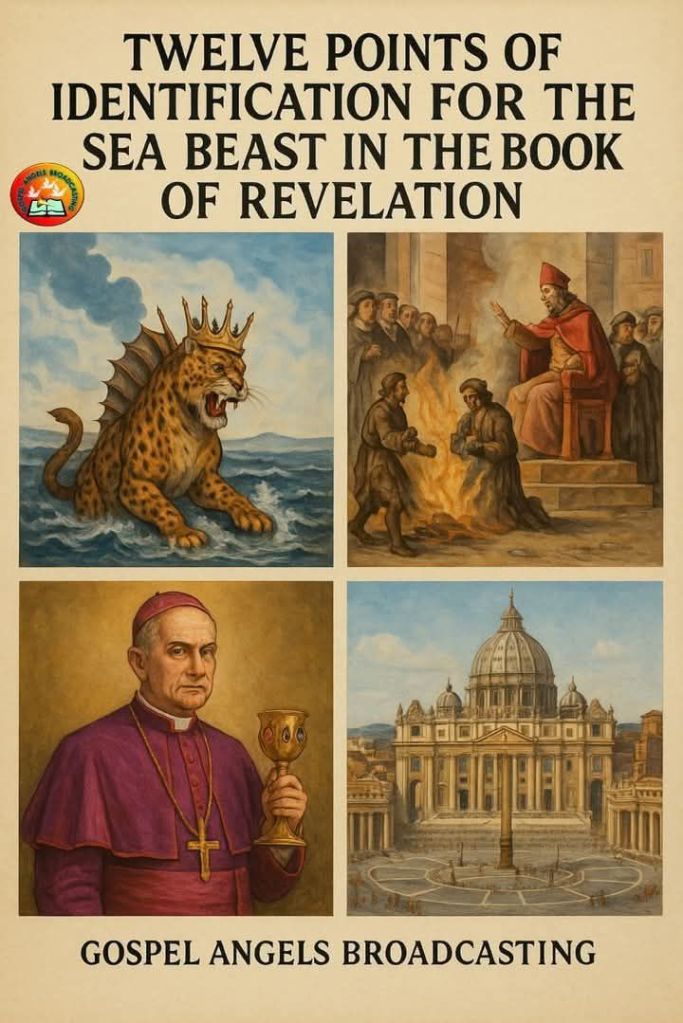
The sea beast of Revelation 13 symbolizes a religiopolitical power rising from a populated area (Rev. 17:15). Biblically and historically, this figure has been identified as the Papacy. Revelation’s imagery aligns closely with the Roman Catholic Church, particularly in its Papal system. Here are twelve key identifiers:
- RISES OUT OF THE SEA (Revelation 13:1)
“And I stood upon the sand of the sea, and saw a beast rise up out of the sea…”
In Bible prophecy, the sea represents multitudes, nations, and tongues (Revelation 17:15). This indicates that the beast power arises from a densely populated region of the world. Historically, the papacy arose in Western Europe, the heart of the former Roman Empire—exactly in such a region of nations and peoples.
Revelation 17:15 And he saith unto me, The waters which thou sawest, where the whore sitteth, are peoples, and multitudes, and nations, and tongues.
The papacy once held rule over the countries and people of Europe during the time of the Holy Roman Empire. This influence, although not yet authoritative, has widened over the entire world.
- RECEIVES POWER FROM THE DRAGON (Revelation 13:2)
“…and the dragon gave him his power, and his seat, and great authority.”
The dragon represents Satan (Revelation 12:9) but also worked through pagan Rome (Revelation 12:4-5) to attempt to destroy Christ. The papacy received its seat and authority from pagan Rome. In 330 AD, Emperor Constantine moved the capital of the empire to Byzantium (later Constantinople), leaving the bishop of Rome in a position of growing influence. In 538 AD, with the defeat of the Ostrogoths, the papacy rose to civil and religious prominence. - SPEAKS BLASPHEMY (Revelation 13:5-6)
“…and he opened his mouth in blasphemy against God…”
According to Scripture, blasphemy includes claiming to forgive sins (Mark 2:7) and claiming to be God (John 10:33). The papacy claims both through the doctrines of priestly absolution and the position of the pope as the “Vicar of Christ,” with titles implying divine authority on earth. - EXERCISES AUTHORITY FOR 42 MONTHS (Revelation 13:5)
“…power was given unto him to continue forty and two months.”
This prophetic period (42 months = 1260 days = 1260 years, using the day-for-a-year principle from Ezekiel 4:6 and Numbers 14:34) matches the time during which the papacy held supreme religious and civil authority, from 538 AD to 1798 AD. In 1798, Napoleon’s general, Berthier, captured Pope Pius VI, ending the papacy’s temporal power. - BASED IN A CITY OF SEVEN HILLS
Revelation links the beast and the harlot to “that great city” (Rev. 17:18), which sits on seven mountains (Rev. 17:9)—a well-known reference to Rome. As the seat of the Vatican, Rome is the global center of Catholic authority.
Verses: Rev. 17:9, 17:18; 18:10
The prophetic identification of the sea beast and the woman in Revelation centers heavily on a specific city. Revelation repeatedly refers to “that great city” (Rev. 17:18; 18:10), symbolizing a dominant power that reigns over kings and sits upon seven mountains—long understood as Rome, the historical seat of the Papacy.
Seven Mountains: Revelation 17:9 says, “The seven heads are seven mountains, on which the woman sitteth.” Rome is famously known as the City of Seven Hills: Aventine, Palatine, Capitoline, Quirinal, Viminal, Esquiline, and Janiculum. This geographical clue links Rome directly with the apocalyptic vision.
The Seat of Power: The Vatican is an independent city-state within Rome. It serves as the religious and political hub of the Catholic Church. The Pope, as Bishop of Rome, exercises global authority over more than a billion followers.
Historical Influence: Rome has historically functioned as the epicenter of Catholic doctrine, councils (such as the Council of Trent), and international diplomacy. Its enduring religious and political influence fulfills Revelation’s imagery of a central power reigning over kings.
Global Recognition: As the most prominent religious center for centuries, Rome’s association with the Papacy makes it the clearest match for the “great city” that dominates global affairs.
Supporting Scriptures:
Revelation 17:18 – “And the woman which thou sawest is that great city, which reigneth over the kings of the earth.”
- RELIGIOUS AND POLITICAL AUTHORITY
The beast is worshiped and exercises state power (Rev. 13:4, 8), mirroring the Papacy’s dual role as spiritual head and sovereign ruler (Vatican City). Historically, from 538 AD to 1798, it wielded both ecclesiastical and civil control.
Verses: Rev. 13:1, 4–5, 8; Dan. 7:23 - PERSECUTES THE SAINTS (Revelation 13:7)
“…and it was given unto him to make war with the saints, and to overcome them…”
Historical records confirm that millions of faithful Christians were persecuted, tortured, and killed during the Dark Ages under the authority of the Roman Church. The Inquisition, Crusades, and suppression of dissenters (such as Waldensians, Huguenots, and others) are well-documented.
Revelation 17:6 – “Drunken with the blood of the saints…”
The beast makes war with the saints and is drunken with their blood, a prophetic indicator of religious persecution, costing the lives of millions.
Historic Fulfillment: The Albigensian Crusade, the burning of people falsely condemned as heretics like John Huss and William Tyndale, and the persecution of Protestants are all historically documented.
Ellen White affirms: “The church has claimed the right to control the conscience, and has exercised this power by enforcing its dogmas through the civil arm.” (The Great Controversy, p. 564)
- INFLUENCE OVER WORLD LEADERS
The beast commits spiritual “fornication” with kings (Rev. 17:2), symbolizing its historical and ongoing political alliances—from crowning emperors to modern diplomacy with presidents and the UN.
Verses: Rev. 17:2, 17:18 - ADORNED IN SCARLET, PURPLE, AND WEALTH
The woman on the beast wears scarlet and purple (Rev. 17:4), colors of the Catholic clergy. Gold, jewels, and fine linen reflect the Church’s opulence.
Verses: Rev. 17:4; 18:16
The description of the woman sitting on the beast—clothed in scarlet and purple—has symbolic and literal application.
Literal Vestments: Cardinals wear scarlet, bishops, and high-ranking clergy wear purple, and the Pope wears white—all official colors of the Vatican hierarchy.
Symbolic Luxury: The combination of fine linen, gold, and precious stones reflects the ceremonial richness and grandeur of the Roman Church.
- IMMENSE WEALTH
Revelation 18 portrays Babylon as wealthy and powerful. The Catholic Church owns vast global assets—real estate, art, and financial institutions—consistent with this description.
Verses: Rev. 18:7, 17, 19 - Receives a Deadly Wound, Then Revives (Revelation 13:3)
“…and I saw one of his heads as it were wounded to death; and his deadly wound was healed…”
The capture of the pope in 1798 marked the “deadly wound.” However, the influence of the papacy has since revived. In 1929, the Lateran Treaty between Mussolini and the Vatican reestablished the papacy as a sovereign power, and since then, its religious and political influence has grown significantly, fulfilling the prophecy that “all the world wondered after the beast” (Revelation 13:3). - RECEIVES DEFERENCE AND UNITY FROM GLOBAL POWERS
Revelation 13:3 mentions a “deadly wound” that was healed—fulfilled when the Papacy’s temporal power was restored in 1929 (Lateran Treaty). World leaders today still seek the Pope’s counsel.
Verses: Rev. 13:3; 17:12–13
Revelation 13:3 …all the world wondered after the beast.
Revelation 17:8 The beast that thou sawest was, and is not; and shall ascend out of the bottomless pit, and go into perdition: and they that dwell on the earth shall wonder, whose names were not written in the book of life from the foundation of the world, when they behold the beast that was, and is not, and yet is.
Conclusion: The Papacy matches all seven prophetic traits of the sea beast: Rome’s centrality, dual authority, history of persecution, global political influence, symbolic vestments, and extraordinary wealth. Revelation calls God’s people to discern this system of apostasy and heed the divine appeal:
“Come out of her, my people…” (Revelation 18:4)

 Adventist Angels Watchman Radio