

legalizing Christianity in 313 A.D. “You remind me of the great Roman Emperor Constantine the Great,” Elpidophoros said, prompting cheers from the audience.
Published by
Bill Giannopoulos

Washington, D.C., March 24, 2025 — Archbishop Elpidophoros of the Greek Orthodox Archdiocese of America delivered a striking tribute to President Donald Trump during a White House celebration of Greek Independence Day, likening him to the revered Roman Emperor Constantine the Great.
The event, held in the East Room, marked the start of the Greek Revolution in 1821, which ended nearly 400 years of Ottoman rule.
Standing beside Trump, Elpidophoros praised the president’s leadership, saying, “You embody the values of our Christian faith and a love for the Gospel.” He drew a bold comparison to Constantine, who founded Constantinople—modern-day Istanbul, the archbishop’s birthplace—and is canonized in the Orthodox Church for legalizing Christianity in 313 A.D. “You remind me of the great Roman Emperor Constantine the Great,” Elpidophoros said, prompting cheers from the audience.
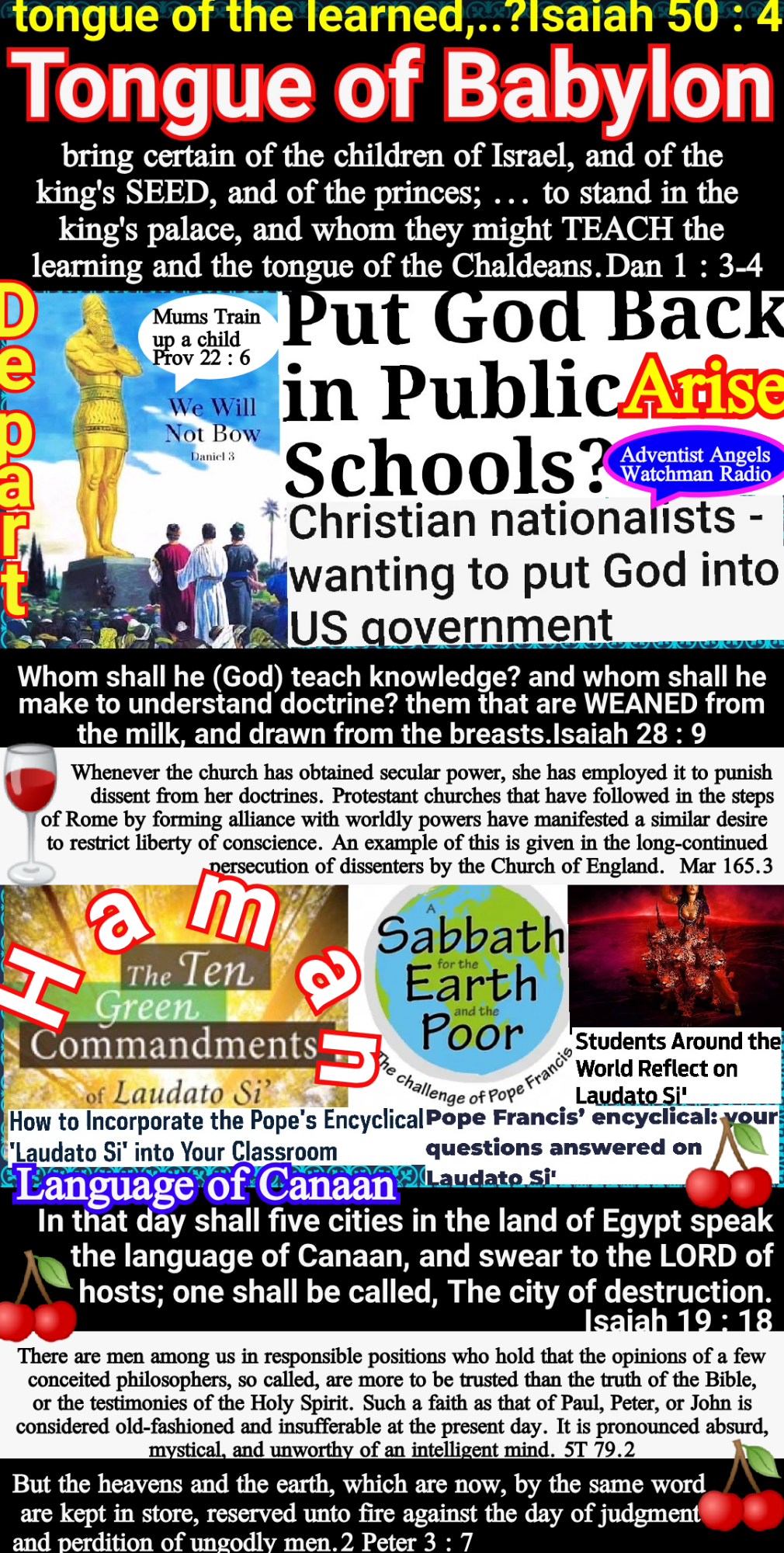
Page 53. The Sunday Law of Constantine.—The law issued by the Emperor Constantine on the seventh of March, A.D. 321, regarding a day of rest from labor, reads thus:
“All judges and city people and the craftsmen shall rest upon the venerable day of the sun. Country people, however, may freely attend to the cultivation of the fields, because it frequently happens that no other days are better adapted for planting the grain in the furrows or the vines in trenches. So that the advantage given by heavenly providence may not for the occasion of a short time perish.”—Joseph Cullen Ayer, A Source Book for Ancient Church History (New York: Charles Scribner’s sons, 1913), div. 2, per. 1, ch. 1, sec. 59, g, pp. 284, 285. GC 680.4 – GC 680.5

The archbishop presented Trump with a golden Orthodox cross, invoking Constantine’s vision before the Battle of the Milvian Bridge in 312 A.D., where a cross in the sky and Christ’s words—“In this sign, conquer!”—led to victory. “This cross is an everlasting symbol of peace and an invincible trophy,” Elpidophoros declared. “With this cross, I pray you bring peace to the world and make America invincible!” Trump accepted the gift, raising it for the crowd to see, as Elpidophoros blessed his family.
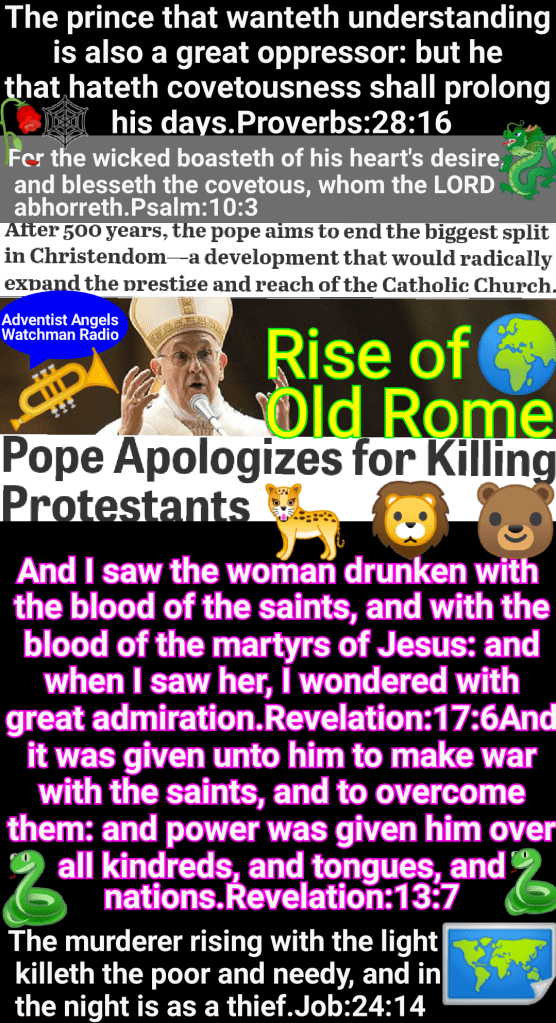
If the reader would understand the agencies to be employed in the soon-coming contest, he has but to trace the record of the means which Rome employed for the same object in ages past. If he would know how papists and Protestants united will deal with those who reject their dogmas, let him see the spirit which Rome manifested toward the Sabbath and its defenders.
Royal edicts, general councils, and church ordinances sustained by secular power were the steps by which the pagan festival attained its position of honor in the Christian world. The first public measure enforcing Sunday observance was the law enacted by Constantine. (A.D. 321; see Appendix note for page 53.) This edict required townspeople to rest on “the venerable day of the sun,” but permitted countrymen to continue their agricultural pursuits. Though virtually a heathen statute, it was enforced by the emperor after his nominal acceptance of Christianity. GC 573.2 – GC 574.1

Trump reciprocated the praise, thanking the Greek American community—particularly the “Greeks for Trump” group—for their support in his November victory. With approximately 3 million Greeks living in the United States, the community forms a significant cultural and political force, amplifying the weight of the occasion.
The exchange highlighted a surprising alignment between the president and Elpidophoros, a progressive figure whose past actions have stirred controversy within the conservative Orthodox Church. Known for marching with Black Lives Matter in 2020 and baptizing the child of a gay couple in 2022—an act that sparked global backlash—Elpidophoros has often clashed with traditionalists. He recently called critics of Greece’s gay marriage legalization “fascistic” and, at the 2022 March for Life, emphasized women’s autonomy, citing the Virgin Mary’s free choice. These stances drew criticism from several American Orthodox hierarchs.
Note 9. Page 447—The bishops of Rome began, very early, to demand obedience from all the churches. Of this the dispute between the Eastern and the Western churches respecting Easter is a striking illustration. This dispute arose in the second century. Says Mosheim: “the Christians of this century celebrated anniversary festivals in commemoration of the death and resurrection of Christ…. The day which was observed as the anniversary of Christ’s death was called the Paschal day, or Passover.” Like the Jews, Christians celebrated “a sacred feast, at which they distributed a paschal lamb in memory of the holy supper.” The Christians of Asia Minor kept this feast on the fourteenth day of the first Jewish month, when the Jews celebrated their Passover, and when Christ is said to have eaten the paschal lamb with his disciples. Three days thereafter, a festival was observed in honor of the resurrection. The Western churches, on the other hand, celebrated the resurrection of Christ on the Sunday following the Jewish Passover, and observed the paschal feast on the night preceding Sunday, thus connecting the commemoration of Christ’s death with that of his resurrection.
“Toward the conclusion of this [the second] century, Victor, Bishop of Rome, endeavored to force the Asiatic Christians, by the pretended authority of his laws and decrees, to follow the rule which was observed by the Western churches in this point. Accordingly … He wrote an imperious letter to the Asiatic prelates, commanding them to imitate the example of the Western Christians with respect to the time of celebrating the festival of Easter. The Asiatics answered this lordly requisition … With great spirit and resolution, that they would by no means depart, in this manner, from the custom handed down to them by their ancestors. Upon this the thunder of excommunication began to roar. Victor, exasperated by this resolute answer of the Asiatic bishops, broke communion with them, pronounced them unworthy of the name of his brethren, and excluded them from all fellowship with the church of Rome.” [Mosheim, Eccl. Hist., cent. 2, part 2, chap. 4., para. 9, 11.] This, says Bower, was “the first essay of papal usurpation.”
For a time, however, Victor’s efforts availed little. No regard was paid to his letters, and the Asiatics continued to follow their ancient practice. But by enlisting the support of the imperial power, which the church for so many centuries controlled to serve her purposes, Rome finally conquered. The Council of Nice, “out of complaisance to Constantine the Great, ordered the solemnity of Easter to be kept everywhere on the same day, after the custom of Rome.” [Bower’s History of the Popes, Vol. 1, pp. 18, 19.] This decree, “backed by the authority of so great an emperor,” was decisive; “none but some scattered schismatics, now and then appearing, that durst oppose the resolution of that famous synod.” [Heylyn, History of the Sabbath, part 2, chap. 2, secs. 4, 5.] GC88 685.4 – GC88 686.2
Yet, in recent months, Elpidophoros has adopted a more centrist tone, offering prayers at both national conventions last year and meeting with Trump’s new ambassador to Greece, Kimberly Guilfoyle, in December. As leader of America’s largest Orthodox community—49% of U.S. Orthodox were Greek in a 2017 Pew poll, part of the three million-strong Greek diaspora—Elpidophoros’s comparison of Trump to Constantine, a saint in Orthodoxy but not in Roman Catholicism, carries profound significance. The gesture underscores a bridge between his progressive leanings and Trump’s conservative base, uniting them in celebration of Greek heritage and faith.
President Trump welcomes Greek-American Alek Skarlatos to White House for Greek Independence Day

 Adventist Angels Watchman Radio
10 thoughts on “The Olympic Black_out Horse Again : Archbishop Elpidophoros Compares Trump to Constantine the Great at Greek Independence Day Event”