Welcome to Adventist Angels Watchman Radio official website, preparing the earth for Jesus Christ return Shortly, find us on Facebook, Twitter and You-tube. +254734228119 With Ev. King Osiemo
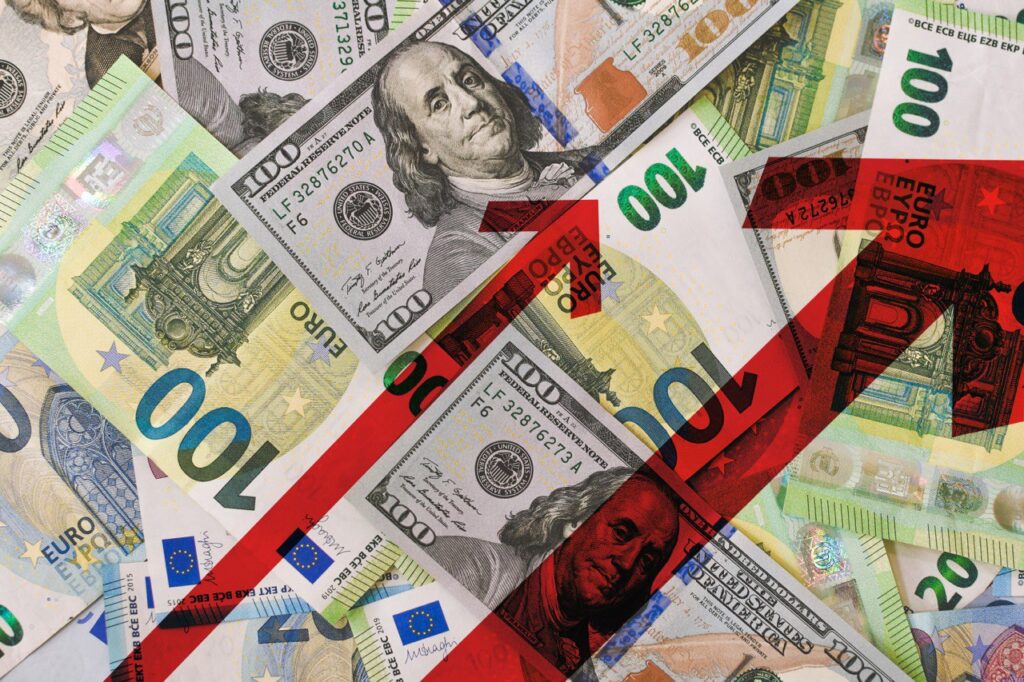
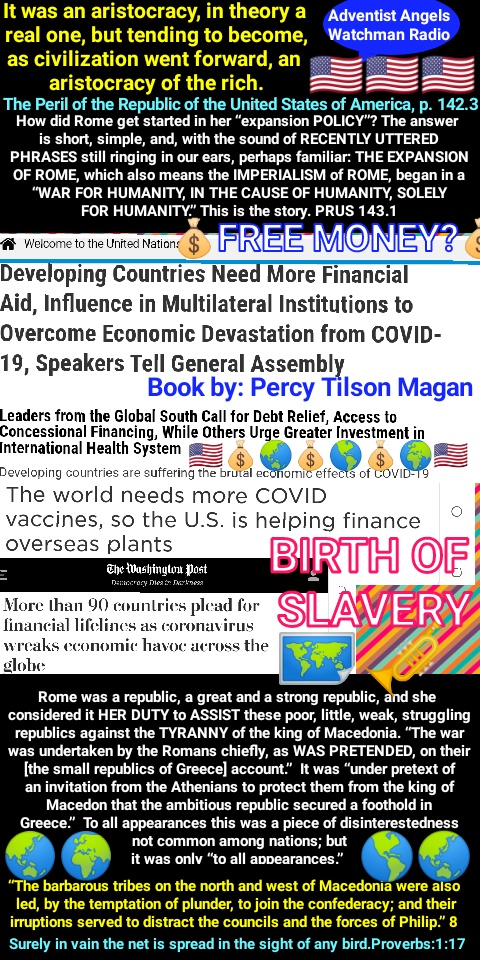
Covid-19 is still not over, Macedonian Call : Surging inflation, interest rates and living costs: Global economy calls for a middle way?
By working upon the jealousy of the kings and the ruling classes, Rome had influenced them to keep the people in bondage, well knowing that the state would thus be weakened, and purposing by this means to fasten both rulers and people in her thrall. With farsighted policy she perceived that in order to enslave men effectually, the shackles must be bound upon their souls; that the surest way to prevent them from escaping their bondage was to render them incapable of freedom. A thousandfold more terrible than the physical suffering which resulted from her policy, was the moral degradation. Deprived of the Bible, and abandoned to the teachings of bigotry and selfishness, the people were shrouded in ignorance and superstition, and sunken in vice, so that they were wholly unfitted for self-government. GC 281.1
11th August 2023
Last Updated on 11th August 2023
Romaan Basit, AARC
Markus Winkler | Unsplash
Throughout history, major world crises have often sparked economic chaos. Take the Treaty of Versailles – it marked the end of a world war, yet lit the fuse for financial turmoil. Germany, drowning in post-war debt and war reparations, plummeted into hyperinflation. Slowly but surely, public trust crumbled in the shattered economy.
The court was given up to luxury and profligacy. There was little confidence existing between the people and the rulers. Suspicion fastened upon all the measures of the government as designing and selfish. For more than half a century before the time of the Revolution the throne was occupied by Louis XV, who, even in those evil times, was distinguished as an indolent, frivolous, and sensual monarch. With a depraved and cruel aristocracy and an impoverished and ignorant lower class, the state financially embarrassed and the people exasperated, it needed no prophet’s eye to foresee a terrible impending outbreak. To the warnings of his counselors the king was accustomed to reply: “Try to make things go on as long as I am likely to live; after my death it may be as it will.” It was in vain that the necessity of reform was urged. He saw the evils, but had neither the courage nor the power to meet them. The doom awaiting France was but too truly pictured in his indolent and selfish answer, “After me, the deluge!”
By working upon the jealousy of the kings and the ruling classes, Rome had influenced them to keep the people in bondage, well knowing that the state would thus be weakened, and purposing by this means to fasten both rulers and people in her thrall.
With farsighted policy she perceived that in order to enslave men effectually, the shackles must be bound upon their souls; that the surest way to prevent them from escaping their bondage was to render them incapable of freedom. A thousandfold more terrible than the physical suffering which resulted from her policy, was the moral degradation. Deprived of the Bible, and abandoned to the teachings of bigotry and selfishness, the people were shrouded in ignorance and superstition, and sunken in vice, so that they were wholly unfitted for self-government.
But the outworking of all this was widely different from what Rome had purposed. Instead of holding the masses in a blind submission to her dogmas, her work resulted in making them infidels and revolutionists. Romanism they despised as priestcraft. They beheld the clergy as a party to their oppression. The only god they knew was the god of Rome; her teaching was their only religion. They regarded her greed and cruelty as the legitimate fruit of the Bible, and they would have none of it.
Rome had misrepresented the character of God and perverted His requirements, and now men rejected both the Bible and its Author. She had required a blind faith in her dogmas, under the pretended sanction of the Scriptures. In the reaction, Voltaire and his associates cast aside God’s word altogether and spread everywhere the poison of infidelity. Rome had ground down the people under her iron heel; and now the masses, degraded and brutalized, in their recoil from her tyranny, cast off all restraint. Enraged at the glittering cheat to which they had so long paid homage, they rejected truth and falsehood together; and mistaking license for liberty, the slaves of vice exulted in their imagined freedom. GC 280.1 – GC 281.3
The Great Controversy Between Christ and Satan by Ellen G White
The conflict between Iraq and US-led coalitions triggered similar repercussions, namely the Gulf War Recession. Soaring oil prices, with crude oil per barrel doubling in cost, once again gave rise to inflation, sending tremors through the global economy and unsettling financial markets.
Today, we witness situations similar to the above case studies. Covid-19 is still not over (with a new variant on the rise), but the recession it caused is dubbed ‘The Great Lockdown’. Meanwhile, with the Russia-Ukraine war knowing no end, we are left to bear the burden of rising fuel, food, and utility prices – the cost of living biting hard.
As we emerged from the shadows of quarantines and lockdowns, the resurgence of travel meant a greater demand for fuel. The Far East conflict, however, has constrained oil and gas supplies from Russia. The demand is greater than the supply, which is causing the trajectory of prices to creep up slowly, with inflation being a natural outcome.
Ah, the cherished champion of capitalism! What wondrous solution does this revered economic model bring forth to such a problem? Well, to tackle inflation, let’s inflate interest rates. What a fix!
The idea is that when interest rates are high, borrowing money becomes more expensive, which curbs the consumer’s purchasing power. With reduced spending, demand is set to drop, effectively taming inflation and providing a temporary and symptomatic solution. Just in the past month, the interest rate has climbed from 5% to 5.25% – the highest it’s been for 15 years.
This has a direct impact on the general public: repayments for credit cards, bank loans, car finance, etc. are set to increase. About a third of households with mortgages (as per the UK government’s English Housing Survey) will experience a spike in their monthly payments. To put it into perspective, the rise from 5% to 5.25% means those on a typical tracker mortgage would pay about £24 more a month, and those on standard variable rate (SVR) mortgages would face a £15 jump.
So, we observe interest being used as a societal deterrent with evident negative effects – precisely affirming Islam’s stance against it. This view is shared by not only Islam but also ancient philosophers like Plato, Aristotle, Seneca, Cato, and Plutarch, as well as major world religions including Judaism and Christianity.
Hence, capitalism’s flaunted solution appears less promising. While it offers fleeting relief, it often leads to recurrent economic crises, always underlying even the times of apparent remission. It is akin to applying a temporary remedy to a broken bone when a more lasting and effective solution is needed.
The Economic System of Islamwas a lecture delivered in 1945 by Hazrat Mirza Bashir-ud-Din Mahmud Ahmadra, the second Khalifa of the Ahmadiyya Muslim Community. In this, he distinctly highlighted Islam as the sole solution to the shortcomings of Capitalism and Communism. Allowing the free market to flourish under state control is what allows Islam to suggest a fine and pragmatic balance between both.
Repeatedly raising interest rates has proven ineffective in addressing the West’s growing economic challenges. It’s now crucial for the world to heed Islam’s longstanding solution. This was emphasised by Wolfgang Schaeuble during a G20 meeting, where major economies gather to shape our global future:
“Islamic finance is growing in importance for the global economy. It is therefore important that international financial institutions consider questions related to integrating Islamic finance into global finance.”
The solution to the world’s economic crises most definitely does not lie in raising interest rates. Nor does it lie in the Communist shackles of state control. Both have been tried and tested; a middle way is required and is available, yet neglected.
Welcome to Adventist Angels Watchman Radio now Live International official Page preparing the People of the world For Jesus Christ second coming. find us on Facebook YouTube, Twitter, Instagram, Palcity and Gettr
View all posts by Adventist Angels Watchman Radio








 Adventist Angels Watchman Radio
