

And he saith unto me, The waters which thou sawest, where the whore sitteth, are peoples, and multitudes, and nations, and tongues. Revelation:17:15

But the beast with lamblike horns was seen “coming up out of the earth.” Instead of overthrowing other powers to establish itself, the nation thus represented must arise in territory previously unoccupied and grow up gradually and peacefully. It could not, then, arise among the crowded and struggling nationalities of the Old World—that turbulent sea of “peoples, and multitudes, and nations, and tongues.” It must be sought in the Western Continent. GC 440.1
The Great Controversy Between Christ and Satan by Ellen G White
By Jacopo Prisco, CNN
Updated 10:33 AM EDT, Mon July 24, 2023
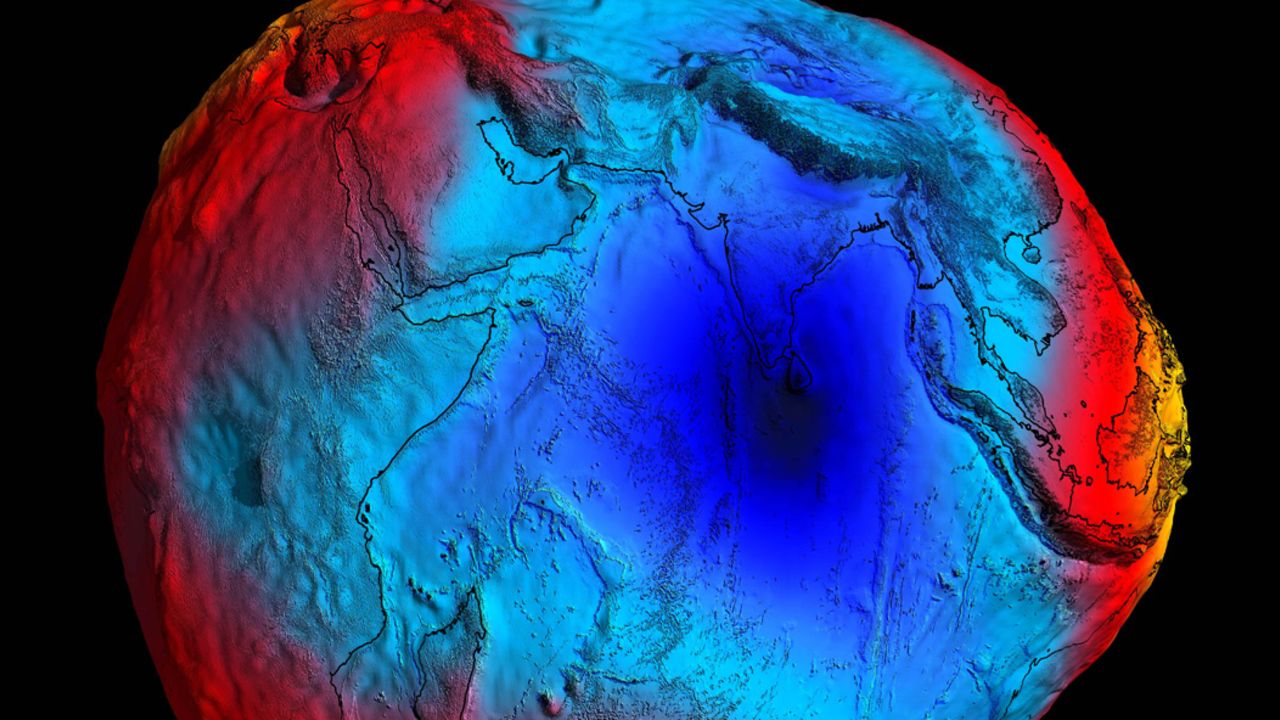
The sea level dips by over 328 feet (100 meters) in a “gravity hole” first discovered in 1948. Today, scientists hypothesize that the hole in the Indian Ocean was shaped by plumes of magma coming from deep inside the planet, according to a new study.ESA/HPF/DLR
Editor’s Note: Sign up for CNN’s Wonder Theory science newsletter. Explore the universe with news on fascinating discoveries, scientific advancements and more.CNN —
There is a “gravity hole” in the Indian Ocean — a spot where Earth’s gravitational pull is weaker, its mass is lower than normal, and the sea level dips by over 328 feet (100 meters).
It was apostasy that led the early church to seek the aid of the civil government, and this prepared the way for the development of the papacy—the beast. Said Paul: “There” shall “come a falling away, … and that man of sin be revealed.” 2 Thessalonians 2:3. So apostasy in the church will prepare the way for the image to the beast.
The Bible declares that before the coming of the Lord there will exist a state of religious declension similar to that in the first centuries. “In the last days perilous times shall come. For men shall be lovers of their own selves, covetous, boasters, proud, blasphemers, disobedient to parents, unthankful, unholy, without natural affection, trucebreakers, false accusers, incontinent, fierce, despisers of those that are good, traitors, heady, high-minded, lovers of pleasures more than lovers of God; having a form of godliness, but denying the power thereof.” 2 Timothy 3:1-5. “Now the Spirit speaketh expressly, that in the latter times some shall depart from the faith, giving heed to seducing spirits, and doctrines of devils.” 1 Timothy 4:1. Satan will work “with all power and signs and lying wonders, and with all deceivableness of unrighteousness.” And all that “received not the love of the truth, that they might be saved,” will be left to accept “strong delusion, that they should believe a lie.” 2 Thessalonians 2:9-11. When this state of ungodliness shall be reached, the same results will follow as in the first centuries.
The wide diversity of belief in the Protestant churches is regarded by many as decisive proof that no effort to secure a forced uniformity can ever be made. But there has been for years, in churches of the Protestant faith, a strong and growing sentiment in favor of a union based upon common points of doctrine. To secure such a union, the discussion of subjects upon which all were not agreed—however important they might be from a Bible standpoint—must necessarily be waived. GC 443.4 – GC 444.2
This anomaly has puzzled geologists for a long time, but now researchers from the Indian Institute of Science in Bengaluru, India, have found what they believe is a credible explanation for its formation: plumes of magma coming from deep inside the planet, much like those that lead to the creation of volcanoes.
To whom they all gave heed, from the least to the greatest, saying, This man is the great power of God. And to him they had regard, because that of long time he had bewitched them with sorceries. But when they believed Philip preaching the things concerning the kingdom of God, and the name of Jesus Christ, they were baptized, both men and women.
Acts:8:10-12


To come to this hypothesis, the team used supercomputers to simulate how the area could have formed, going as far back as 140 million years. The findings, detailed in a study published recently in the journal Geophysical Research Letters, center around an ancient ocean that no longer exists.
A disappearing ocean
Humans are used to thinking about Earth as a perfect sphere, but that’s far from the truth.
“The Earth is basically a lumpy potato,” said study coauthor Attreyee Ghosh, a geophysicist and associate professor at the Centre for Earth Sciences of the Indian Institute of Science. “So technically it’s not a sphere, but what we call an ellipsoid, because as the planet rotates the middle part bulges outward.”
null
Ad Feedback
Our planet is not homogeneous in its density and its properties, with some areas being more dense than others — that affects Earth’s surface and its gravity, Ghosh added. “If you pour water on the surface of the Earth, the level that the water takes is called a geoid — and that is controlled by these density differences in the material inside the planet, because they attract the surface in very different ways depending on how much mass there is underneath,” she said.
The “gravity hole” in the Indian Ocean — officially called the Indian Ocean geoid low — is the lowest point in that geoid and its biggest gravitational anomaly, forming a circular depression that starts just off India’s southern tip and covers about 1.2 million square miles (3 million square kilometers). The anomaly was discovered by Dutch geophysicist Felix Andries Vening Meinesz in 1948, during a gravity survey from a ship, and has remained a mystery.
null
Ad Feedback
Hidden molten rock layer found beneath Earth’s tectonic plates
“It is by far the biggest low in the geoid, and it hasn’t been explained properly,” Ghosh said.
We have some information and some confidence about what the Earth looked like back then
To find a potential answer, Ghosh and her colleagues used computer models to set the clock back 140 million years in order to see the big picture, geologically. “We have some information and some confidence about what the Earth looked like back then,” she said. “The continents and the oceans were in very different places, and the density structure was also very different.”




From that starting point, the team ran 19 simulations up to the present day, recreating the shifting of tectonic plates and the behavior of magma, or molten rock, inside the mantle — the thick layer of Earth’s interior that lies between the core and the crust. In six of the scenarios, a geoid low similar to the one in the Indian Ocean formed.
Fear, and the pit, and the snare, are upon thee, O inhabitant of the earth. And it shall come to pass, that he who fleeth from the noise of the fear shall fall into the pit; and he that cometh up out of the midst of the pit shall be taken in the snare: for the windows from on high are open, and the foundations of the earth do shake. The earth is utterly broken down, the earth is clean dissolved, the earth is moved exceedingly. Isaiah:24:17-19
The distinguishing factor in all six of these models was the presence of plumes of magma around the geoid low, which along with mantle structure in the vicinity are believed to be responsible for the formation of the “gravity hole,” Ghosh explained. The simulations were run with different parameters of density for the magma, and in those in which the plumes were not present, the low did not form.
The plumes themselves originated from the disappearance of an ancient ocean as India’s landmass drifted and eventually collided with Asia tens of millions of years ago, Ghosh said.
For enquire, I pray thee, of the former age, and prepare thyself to the search of their fathers: (For we are but of yesterday, and know nothing, because our days upon earth are a shadow:)Job:8:8-9
“India was in a very different place 140 million years ago, and there was an ocean between the Indian plate and Asia. India started moving north and as it did, the ocean disappeared and the gap with Asia closed,” she explained. As the oceanic plate went down inside the mantle, it could have spurred the formation of the plumes, bringing low-density material closer to Earth’s surface.
Video Ad Feedback
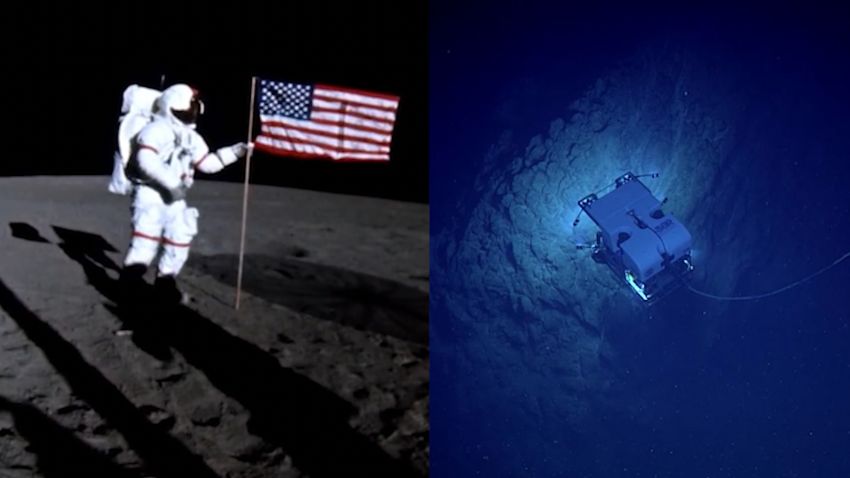
More humans have visited the moon than the bottom of the ocean
01:31 – Source: CNN
The future of the geoid low
The geoid low formed around 20 million years ago, according to the team’s calculation. It’s hard to say whether it will ever disappear or shift away.
“That all depends on how these mass anomalies in the Earth move around,” Ghosh said. “It could be that it persists for a very long time. But it could also be that the plate movements will act in such a way to make it disappear — a few hundreds of millions of years in the future.”
‘Underground climate change’ is deforming the ground beneath buildings, study finds
Huw Davies, a professor in the School of Earth and Environmental Sciences at Cardiff University in the UK, said the research is “certainly interesting, and describes interesting hypotheses, which should encourage further work on this topic.” Davies was not involved with the study.
Dr. Alessandro Forte, a professor of geology at the University of Florida in Gainesville who was also not involved with the study, believes there is good reason to carry out computer simulations to determine the origin of the Indian Ocean geoid low, and that this study is an improvement over earlier ones. Past research only simulated the descent of cold material across the mantle, rather than including hot rising mantle plumes as well.
However, Forte said he found a couple flaws in the study’s execution.
“The most outstanding problem with the modeling strategy adopted by the authors is that it completely fails to reproduce the powerful mantle dynamic plume that erupted 65 million years ago under the present-day location of Réunion Island,” he said. “The eruption of lava flows that covered half of the Indian subcontinent at this time — producing the celebrated Deccan Traps, one of the largest volcanic features on Earth — have long been attributed to a powerful mantle plume that is completely absent from the model simulation.”
Another issue, Forte added, is the difference between the geoid, or surface shape, predicted by the computer simulation and the actual one: “These differences are especially noticeable in the Pacific Ocean, Africa and Eurasia. The authors mention that there is a moderate correlation, around 80%, between the predicted and observed geoids, but they don’t provide a more precise measure of how well they match numerically (in the study). This mismatch suggests that there may be some deficiencies in the computer simulation.”

Humans pump so much groundwater that Earth’s axis has shifted, study finds
Ghosh said that not every possible factor can be accounted for in the simulations.
“That’s because we do not know with absolute precision what the Earth looked like in the past. The farther back in time you go, the less confidence there is in the models. We cannot take into account each and every possible scenario and we also have to accept the fact that there may be some discrepancies on how the plates moved over time,” she said. “But we believe the overall reason for this low is quite clear.”

 Adventist Angels Watchman Radio
One thought on “A Falling Away First: There is a ‘gravity hole’ in the Indian Ocean, and scientists now think they know why”